








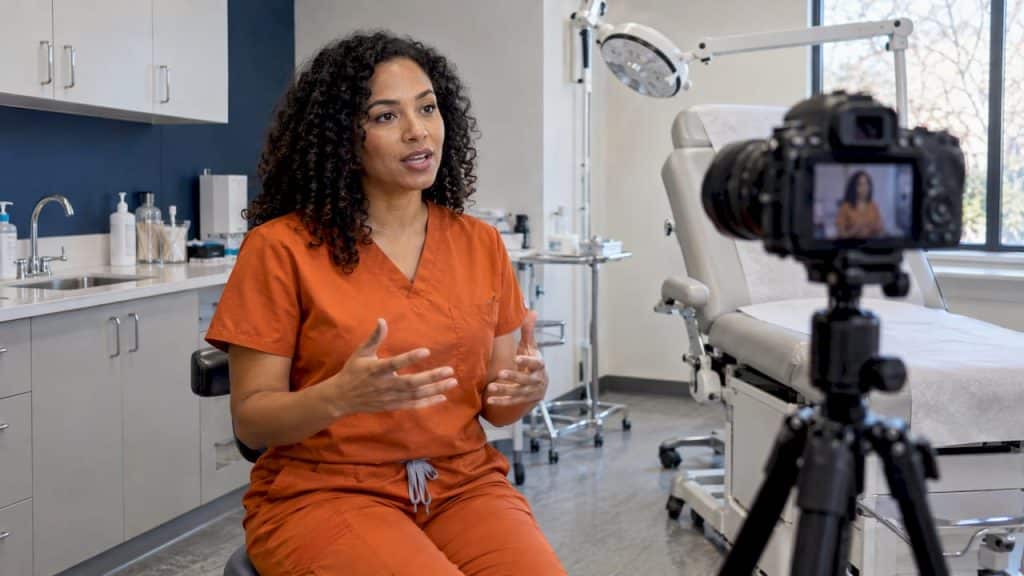
You can run YouTube ads for a medical practice, and most local clinic services are allowed. The catch is that Google treats health as a sensitive category. That affects which services you can promote, what your video can show, how you target viewers and what your website tracking is allowed to collect. Get those four things right before you spend a dollar, and the campaign setup itself is the easy part.
This guide walks through the policy limits, the creative rules, targeting, the HIPAA checks and the setup steps, in the order we work through them with clinic owners.
TL;DR
- Most clinic services can be advertised on YouTube, but prescription-drug services, addiction services, telemedicine and experimental treatments carry restrictions or outright bans.
- Health is a sensitive category: you cannot use Customer Match, remarketing lists, lookalike segments or audience expansion for it, and viewers under 18 are excluded from personalized ads.
- Video that shows blood, exposed organs or fear-inducing close-ups can be disapproved. Calm, educational creative is the safer path.
- Review every tracking tool on your site before launch. A cookie banner does not authorize sharing protected health information with an ad vendor.
- Pick one objective, set a realistic budget, and judge results by booked appointments, not views alone.
Table of Contents
- Where YouTube fits in a clinic’s marketing
- What Google’s healthcare policy allows
- Creative rules for medical video
- Targeting: what you can and cannot use
- Privacy and HIPAA checks before you publish
- Setting up the campaign step by step
- Measuring results and adjusting
- Our perspective on YouTube for clinics
- Work with AdJet on your clinic’s campaigns
- FAQ
- Sources
Where YouTube fits in a clinic’s marketing
People search Google when they already know what they need: “urgent care near me” or “Botox consultation.” YouTube works earlier. A viewer watching a video about knee pain or skincare is not yet looking for a provider, but a short, credible video from a local practice can put you on their list.
Many clinics come to us after a search campaign has plateaued or after lead quality dropped. YouTube rarely replaces search in those cases. It adds a layer: awareness and trust-building above the bottom-of-funnel clicks. If you are deciding where the next dollar goes, our comparison of SEO and PPC for online visibility explains how the channels differ in speed and cost.
One point on expectations: video builds familiarity, and familiarity converts slowly. Plan for several weeks of testing before you judge the channel, and expect to refine creative and targeting along the way. We do not promise results from any ad channel, and you should be cautious of anyone who does.
What Google’s healthcare policy allows
YouTube ads follow Google Ads policy. For the United States, Google’s healthcare and medicines policy expects ads and landing pages to follow applicable laws and industry standards. Some healthcare content is prohibited. Other categories can advertise only in permitted locations, after you apply and are approved.
Here is how the main categories break down for a U.S. practice:
| Service or product | What Google’s policy says |
|---|---|
| General clinic services (primary care, imaging, physical therapy, dermatology) | Generally allowed when ads and landing pages follow the policy and applicable law |
| Prescription-drug services, pharmaceutical manufacturers | Restricted, with approval requirements and location limits |
| Addiction services | Restricted, with certification and location requirements |
| Online pharmacies | Allowed only with qualifying LegitScript or NABP accreditation plus Google certification |
| Telemedicine providers | Allowed when accredited through LegitScript’s healthcare merchant program and certified by Google |
| Prescription opioid promotion | Prohibited |
| Speculative or experimental treatments | Prohibited in most cases |
The table summarizes Google’s U.S. healthcare policy. Read the current version before you plan a campaign, because the lists change.
Stem cells, gene therapy and regenerative medicine
This is where regenerative and longevity clinics get caught. Google’s policy on speculative and experimental treatments lists stem-cell therapy, cellular therapy, gene therapy and similar regenerative medicine among prohibited promotions. It makes an exception for FDA-licensed or FDA-approved treatments and for purely educational or informational content. If your practice offers these services, do not assume an ad will pass. Build the campaign around the services that clearly qualify and keep the rest educational.
Sexual health and wellness
Google allows certain lubricants and prescription drugs for erectile dysfunction or female sexual interest and arousal disorder on YouTube only in limited cases. The sexual health policy requires non-sexual positioning, no suggestive themes, age targeting of 18 or older, compliance with the healthcare location restrictions and compliance with local law.
Telehealth and pain clinics
Telemedicine needs the certification path described above. We cover the process in our guide to telehealth ad compliance and BAAs. Pain management practices face their own constraints around prescription terms, which we outline in our pain clinic advertising policy guide.
Drug claims and fair balance
If your ad mentions a prescription product, federal advertising rules apply on top of Google’s. The FDA says advertisements can be false, lacking in fair balance or otherwise misleading under 21 CFR 202.1(e)(6), 21 USC 321(n) and 21 USC 352. Most clinics are not drug manufacturers, but if your script discusses specific medications, have your compliance lead or attorney review it.
Creative rules for medical video
Google’s YouTube and Discover Feed ad requirements prohibit ads that focus on specific body parts or health conditions when the imagery is disturbing. That includes blood, bodily fluids, exposed organs, gory procedures, visible pus or infections, and close-ups meant to evoke negative emotion. The same policy allows non-disturbing advertising for health conditions, hair loss, skin care and weight loss.
In practice, the standard is about how you show a service, not whether you can. A few habits keep medical video approvable:
- Show people, not pathology. A physician speaking to the camera, a clean treatment room or a patient consultation passes more easily than a surgical close-up.
- Skip fear tactics. A script that opens with a scary symptom invites disapproval and tends to attract the wrong audience anyway.
- Avoid before-and-after shock imagery. If your specialty relies on results photos, test conservative versions and check the policy again before scaling.
- Match the video to the landing page. The destination must follow the same healthcare policies as the ad.
- Make one clear request. Book a consultation, call the office, or schedule an appointment. One call to action per ad.
A practical format for most practices is 15 to 45 seconds: a provider introduces themselves, names the problem in plain language, explains how the practice helps and tells viewers what to do next. Record a few variations with different openings and let performance data show which one works.
The landing page matters as much as the video. A viewer who clicks and finds a slow, generic page will leave. Our notes on landing pages in healthcare marketing and designing high-converting landing pages cover what to put on the page.
Targeting: what you can and cannot use
Targeting is where most medical advertisers are surprised. Google’s personalized advertising policy for health classifies physical and mental conditions, chronic-care treatments, intimate-body-part health, invasive procedures (including cosmetic surgery or injections) and disabilities as sensitive health interests.
For promotion tied to those interests, the policy says you generally can use predefined Google audiences, in-market and affinity segments, permitted demographics, life events and location targeting. You cannot use advertiser-curated audiences: Customer Match, advertiser data segments, audience expansion or lookalike segments. Users under 18 are not eligible for personalized advertising. Creative or landing pages for sensitive custom segments have additional serving limits.
Medical Economics reports the same practical outcome: remarketing, similar segments and audience expansion are unavailable for sensitive-health advertising, while contextual, demographic, location and predefined audience options remain, within Google’s limits.
What this means for a med spa, pain clinic or therapy practice:
- Lead with location. Radius and ZIP-level targeting around your service area is the most dependable lever.
- Use predefined audiences. In-market and affinity segments that fit your service give you reach without patient data.
- Do not upload patient lists. Even if it were technically possible, it is the wrong move for privacy reasons covered below.
- Do not plan around remarketing. If your funnel depends on following website visitors with video, redesign it. We explain cookieless options in how to set up remarketing without PHI risk and audit the problem in our healthcare remarketing restrictions guide.
One question that comes up often: can you target by age? Demographic targeting is generally available, but remember the under-18 exclusion for personalized health ads, and the 18-plus requirement for sexual health categories.
Privacy and HIPAA checks before you publish
The ad itself is only half the compliance picture. The other half is what happens when someone clicks.
HHS Office for Civil Rights and the FTC jointly warned hospital systems and telehealth providers about online tracking technologies. Covered entities must protect data under HIPAA. Organizations outside HIPAA may still face exposure under the FTC Act and the Health Breach Notification Rule. The warning also stresses that risk exists even when a third-party tool was embedded by your website vendor.
The HHS guidance on online tracking technologies adds specifics:
- HIPAA applies when tracking tools used by covered entities or business associates collect or disclose protected health information (PHI).
- Impermissible disclosures to tracking vendors for marketing generally require HIPAA-compliant authorization.
- A privacy policy notice or cookie banner alone does not authorize disclosing PHI to a tracking vendor.
- Where the vendor is a business associate, you need a signed business associate agreement and an applicable Privacy Rule permission, and disclosures must be limited to the minimum necessary.
A pre-launch checklist we use:
- List every pixel, tag and script on the pages the ad will send people to.
- Check whether any of them load on appointment, patient portal or condition-specific pages.
- Confirm which vendors, if any, have signed a business associate agreement with you.
- Remove or restrict tags that send page URLs, form fields or event names revealing a condition or service request.
- Document what you decided and why.
The same logic applies to other ad platforms, as we explain in our Meta Pixel and HIPAA guide. For a broader view, see whether HIPAA-compliant marketing is possible with Google Ads. This is not legal advice. Your privacy officer or healthcare attorney should sign off on tracking decisions.
Setting up the campaign step by step
Google’s video campaign guide lays out the basic flow. Here it is, with the choices a medical practice should make at each step.
- Choose an objective. The objective determines which campaign types are available. For a clinic, that is typically leads or awareness of a local service.
- Set budget and bidding. Start with a daily budget you can sustain for several weeks. Too small, and you will not gather enough data to learn anything.
- Pick locations and audiences. Use your service area and the permitted predefined audiences from the previous section.
- Organize ad groups. Separate them by service, such as one for injectables and one for skin tightening, so each group has its own message and landing page.
- Add your video ads. You can use an uploaded YouTube video, a template from the Asset Library or the editor. Google says you can create up to 50 ads while building a campaign. Write a relevant headline and a clear call to action.
- Submit and wait. Ads are typically approved within a day, and Google notes they may take a few days to start showing.
Upload your video to YouTube first, and make sure the title, description and thumbnail also follow the healthcare policy. Disapprovals often trace back to the landing page rather than the video, so test the destination too. If you have had approvals stall in the past, our Google Ads compliance checklist for clinics and healthcare Google Ads audit can help you find the cause.
Measuring results and adjusting
Google’s guidance ties measurement to the objective and bidding goal you chose. If your budget is fully spent, consider raising it. If it is not, adjust targeting, bidding and ads to improve performance.
For a medical practice, we suggest a layered view:
- Early signals (first two weeks): view rate, click-through rate and cost per click. These tell you whether the creative holds attention.
- Mid signals: landing page conversion rate, form submissions and calls. These tell you whether the page and offer match the video.
- Business outcomes: booked consultations, show rates and revenue per patient. These tell you whether the channel pays.
Watch out for vanity numbers. A video can collect many views and produce no appointments if it reaches the wrong audience. Compare your page performance against realistic ranges using our clinic conversion rate benchmarks, and use the digital marketing profit calculators to estimate what a booked patient is worth against your ad spend.
Change one variable at a time. If you alter the video, audience and landing page in the same week, you will not know which change mattered. And because tracking must stay privacy-safe, set up conversion measurement with the same care you gave the pre-launch review, preferably with server-side or consent-aware methods.
Our perspective on YouTube for clinics
We see the same pattern across medical and aesthetic clients. A practice wants video because it feels modern, launches without checking policy, and then loses weeks to disapprovals or, worse, to a tracking setup that exposes patient information.
Our view is that compliance is not a hurdle placed in front of growth. It is the structure that lets growth last. When the policy, tracking and landing page work are done first, the campaign has room to be tested, improved and scaled without being shut down.
We also think YouTube works best as part of a system. Search captures people ready to book. Video builds recognition before they search. A fast, clear landing page turns both into appointments. Each piece needs the others, and each needs to be measured against booked patients, not impressions.
As a Google Partner agency with HIPAA-conscious processes, we build and manage these campaigns for clinics, and we are direct about timelines: expect a testing period, expect adjustments, and expect your budget to be judged on actual patient inquiries.
Felix
Work with AdJet on your clinic’s campaigns
If you want help with the Google side of this, our Google Ads management service covers campaign structure, policy compliance and reporting for medical practices. If the landing page is the weak link, our landing page plans start with a Starter Plan at $299 per month, and we can walk you through which option fits your service mix.
FAQ
Can a medical practice run YouTube ads?
Yes. Most general clinic services can be advertised, as long as the ads and landing pages follow Google’s healthcare and medicines policy and applicable U.S. law. Certain categories, such as prescription-drug services, addiction services and telemedicine, need approval or certification, and some treatments are prohibited.
Can I target past patients or website visitors with YouTube ads?
Not for sensitive health promotion. Google’s policy says advertiser-curated audiences such as Customer Match, advertiser data segments, lookalikes and audience expansion are unavailable. Use location, permitted demographics and predefined Google audiences instead.
How long does YouTube ad approval take?
Google says ads are typically approved within a day, and they may take a few days to start showing. Healthcare ads can take longer if a policy review or certification is involved, so build extra time into your launch plan.
Can I show procedures or results in my video?
Yes, if the imagery is not disturbing. Google’s YouTube requirements prohibit ads with blood, exposed organs, gory procedures or fear-inducing close-ups, but non-graphic ads for skin care, hair loss, weight loss and health conditions can be allowed.
Does a cookie banner make my tracking HIPAA compliant?
No. HHS states that a privacy policy notice or cookie banner alone does not authorize disclosing PHI to a tracking vendor. You need the right agreements and permissions, and you should limit disclosures to the minimum necessary.
Sources
- Create a Video campaign – YouTube Help
- Healthcare and medicines – Advertising Policies Help
- Speculative and experimental medical treatment policy
- Sexual health and wellness – Display & Video 360 Help
- Health in personalized advertising – Advertising Policies Help
- YouTube and Discover Feed ad requirements
- FDA: Laws & Regulations about Advertising & Promotional Labeling
- HHS OCR and FTC warning on online tracking technologies
- HHS: Use of Online Tracking Technologies by HIPAA Covered Entities
- Medical Economics: How to advertise your practice without leaking patient information