









There is no single U.S. rulebook for cannabis advertising. Each state that licenses cannabis writes its own rules on who may see an ad, what it must say and where it can run. On top of that, the big ad platforms apply their own bans, and general consumer-protection and communications laws still apply to your marketing. If you run a dispensary or a cannabis clinic, the safe way to work is to build your marketing around the strictest rule in your state and treat every channel as its own compliance question.
This guide covers the rules that most often trip up licensed operators: audience-age thresholds, license and warning statements, website age gates, health claims, pre-approval, and the platform policies that decide where you can actually buy visibility. Rules change often, so use the official links below to confirm the current text for your state before you publish.
TL;DR
- Cannabis advertising is regulated state by state. Thresholds for the share of an audience that must be 21 or older range from about 70% to 85% in the states we reviewed.
- Most states require your license information, truthful and substantiated claims, and no health claims that mislead. Some require fixed warnings or advance review by the regulator.
- Your website is advertising. Some states, such as Maryland, now spell out exactly how an age screen must work.
- Meta and Google do not accept ads for marijuana or THC products, so organic search, your own website and compliant owned channels carry most of the load.
- Endorsements, texts and calls fall under general consumer-protection and telecom rules, not only cannabis rules.
Table of Contents
- Why there is no one national standard
- Audience-age thresholds: the number that shapes your media plan
- What your ads must say: license information and warnings
- Your website is advertising too
- What you can say about products and health effects
- Pre-approval and recordkeeping
- Beyond the cannabis rules: endorsements, texts and calls
- Can you advertise cannabis on Facebook, Instagram or Google?
- A pre-publish checklist
- Our perspective
- Where AdJet fits
- FAQ
- Sources
Why there is no one national standard
Cannabis is regulated by each state that licenses it. A dispensary in Arizona, a clinic in Maryland and a brand in California each answer to a different agency with different wording. That is why a single “USA” checklist cannot be accurate on its own. What does repeat across states is a small set of ideas:
- Keep ads away from people under 21.
- Identify the licensee.
- Do not mislead, especially about health effects.
- Do not encourage overconsumption.
- Keep the regulator able to see what you ran.
Treat those five ideas as the frame, then read your own state’s text for the numbers. Our broader overview of the legal restrictions on cannabis advertising covers the same ground at a higher level.
Audience-age thresholds: the number that shapes your media plan
The most practical rule for a marketer is the audience-composition threshold. Many states do not ban an ad channel outright. They allow it only when reliable, current data shows that a set share of the audience is 21 or older. If you cannot produce that data, you cannot run the placement.
The thresholds differ, and they are not small differences when you buy media:
| State | Threshold for covered ads | Source |
|---|---|---|
| California | At least 71.6% of the audience reasonably expected to be 21+ | Cal. Bus. & Prof. Code §26151 |
| Arizona | At least 73.6% expected to be 21+ for electronic, social media and website advertising | A.R.S. §36-2859 |
| Maryland | At least 85% reasonably expected to be 21+, backed by recent audience data | Maryland Cannabis Administration advertising guidance, 2026 |
| New Mexico | At least 70% for print and digital placements | New Mexico administrative amendment, 2022 |
| New York | At least the share of state residents age 21+ in the latest Census Bureau estimates, for covered placements; in-retailer-only ads are excepted | OCM Part 129 guidance |
A few things to take from this table.
The data requirement matters as much as the percentage. Maryland, for example, asks for recent, readily available audience data. A media buy you cannot document is a risk even if the audience probably skews adult.
Thresholds are moving. Maryland’s guidance is dated August 24, 2026. If you last read your state’s rules a few years ago, read them again.
New York’s figure is a moving target. Because it is tied to Census estimates for residents 21 and older, the number is not fixed in the rule. Check the OCM guidance for how it is calculated.
A worked example
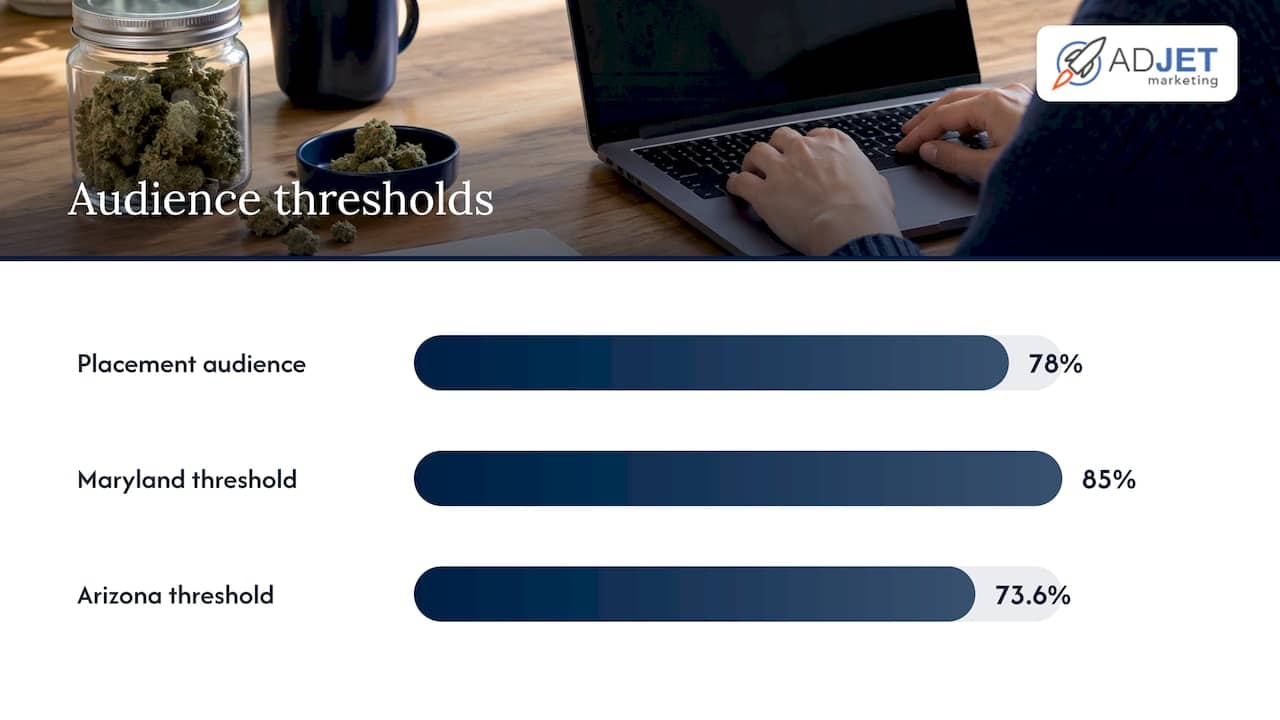
Say you operate in Maryland and want to buy a digital placement on a local news site. The publisher reports that 78% of its readers are 21 or older. Under the 85% threshold in the state’s guidance, that placement does not qualify as a covered ad, however good the site is. A placement with documented audience data above 85% does. In Arizona, the same 78% would clear the 73.6% bar. The same ad plan can be compliant in one state and not in another.
What your ads must say: license information and warnings
Most states want the public to know who is advertising. California requires licensee identity and license number in advertising, including internet ads, and requires ads to be truthful and appropriately substantiated (Cal. Bus. & Prof. Code §26151).
New York goes further. Its Office of Cannabis Management guidance requires the licensee name and number, a fixed age-and-safety warning and a rotating warning in covered advertising (OCM Part 129 guidance). Arizona’s statute is titled to include a warning requirement as well, so check A.R.S. §36-2859 for the current wording.
A practical habit: build the required license line and warning into your ad templates and website footer once, then check them each time your state updates its guidance. Missing a required line on one banner is the kind of error that gets repeated across a hundred placements.
Your website is advertising too
Many operators focus on paid media and forget that regulators treat a website as advertising. Two states show how specific the expectations have become.
Maryland. The statute requires a cannabis-related website to use an age-gate, age-screen or age-verification mechanism before a visitor can view content and before any personal information is collected (Maryland §36-903). The August 2026 guidance adds detail: the screen must be neutral and require a date of birth. A yes/no prompt, a persistent-cookie bypass, or inferring age without a date of birth is not sufficient (Maryland Cannabis Administration guidance).
Ohio. The Division of Cannabis Control’s guidance, effective October 5, 2026, requires a website or web presence to make visitors affirm they are 18 or older if they are a medical cannabis patient and 21 or older otherwise, and to prominently display the DCC seal (Ohio DCC Advertising Guidance).
These two rules point to a design decision that affects SEO. An age gate that blocks content before anything loads can also block what search engines see if it is built poorly. The gate has to satisfy the regulator and still let your pages be crawled and indexed correctly. We cover the search side in our guide to SEO basics for cannabis websites.
What you can say about products and health effects
The common rule is simple to state and easy to break: do not make untrue or misleading statements, and be able to back up what you say. California requires truthful, appropriately substantiated advertising and prohibits health-related statements that are untrue or misleading about the effects of cannabis consumption (Cal. Bus. & Prof. Code §26151).
Ohio’s guidance lists several other categories regulators do not want to see: false or misleading ads, obscene or indecent material, promotions that encourage overconsumption, and contests or raffles awarding anything of value unless the stated conditions are met (Ohio DCC Advertising Guidance).
For a clinic or dispensary, this translates into a few working rules:
- Describe products by what they are: type, potency as labeled, format, availability.
- Keep educational content factual and tied to a source you can name.
- Do not promise outcomes for a condition. A claim about relief, sleep or anxiety needs substantiation, and in many states it is safer to leave it out of ads entirely.
- Run promotions through a legal check before launch, especially giveaways, referral rewards and loyalty offers.
Pre-approval and recordkeeping
Some regulators review ads before you use them. Ohio’s DCC guidance says licensees must submit ads for Division review before creating, using or disseminating them. The Division then has 21 business days to approve, deny or ask for remediation (Ohio DCC Advertising Guidance).
That timeline affects planning. If you want a campaign live for a seasonal sale, the submission has to go in weeks ahead, not days. Even in states without pre-approval, keep a dated archive of every ad, the audience data you relied on and the version of the rule you checked against. If a regulator asks, you can show your work.
Beyond the cannabis rules: endorsements, texts and calls
Cannabis-specific rules are only part of the picture. The National Cannabis Industry Association’s advertising committee advises treating endorsements, calls and texts as compliance issues in their own right, because general consumer-protection and communications laws apply too (NCIA committee guidance, 2024). Two points stand out:
- Endorsements. People who recommend or review your products should disclose any relationship with you, and a business may be held liable for third-party statements about its products.
- Calls and texts. The Telephone Consumer Protection Act and Do Not Call requirements apply to covered cannabis-business calls and texts, including campaigns run through hired telemarketers.
So a text-message promotion or an influencer partnership is not safe just because the creative follows your state’s ad rules. Consent for texts, disclosure for endorsements and control over what partners say about you all need their own process. For clinics that also collect patient information, our guide on patient email marketing explains what is allowed in a related channel.
Can you advertise cannabis on Facebook, Instagram or Google?
Short answer: not in the usual way. Platform policy is separate from state law, and a fully legal ad under your state’s rules can still be rejected.
Meta (Facebook and Instagram). Meta’s policy says advertisers cannot run ads that promote or offer the sale of THC products or cannabis products containing related psychoactive components, ingestible or not (Meta Transparency Center). Organic posting is a separate question that depends on Meta’s rules on content that promotes sale or use, so keep posts informational and avoid anything that reads as a sales offer.
Google Ads. Google’s recreational drugs policy does not allow ads for substances that alter mental state for recreation, and it lists marijuana among its examples (Google Ads policy). The page notes a limited pilot for cannabis-related content in Canada, not the U.S. Policies shift, so read the current page before you plan around it. Our notes on Google Ads cannabis policy and the Google Ads compliance checklist for clinics go deeper on how this plays out for healthcare-adjacent businesses.
The result is that most compliant cannabis visibility comes from channels you control or earn: your website, local search, content and email where consent exists. That is why a cannabis clinic’s marketing mix usually leans on organic search and on conversion-focused landing pages. We outline that mix in digital marketing strategies for cannabis clinics.
A pre-publish checklist
Before any ad, page or message goes out, run through these questions:
- Which state’s rules apply? Use the rules of every state where the ad can be seen and where you hold a license.
- Does the placement meet the audience threshold? Do you have recent, reliable data that you can save?
- Is the license information in place? Name and number where your state requires them, plus any fixed or rotating warning.
- Is every claim truthful and substantiated? Remove health promises you cannot support.
- Does the website have a compliant age screen? In Maryland that means date of birth, not a yes/no button.
- Is there a promotion, giveaway or contest? Check the conditions in your state’s guidance.
- Is there an endorsement, text or call? Confirm disclosure and consent.
- Does the platform allow it? A legal ad can still be rejected by Meta or Google.
- Is pre-approval required? If so, allow for the review window.
- Is it archived? Keep the final ad, date, audience data and rule reference.
Our perspective
Many operators come to us after an ad account was shut down or a page was flagged, and almost always the problem was one assumption: that a rule from one state or one platform applied everywhere. It does not.
Our approach is to start from the strictest requirement you face and design the website, the landing pages and the content around it. That means an age screen built so it satisfies the regulator without hiding your pages from search, claims that stay factual, and a measurement setup that does not collect more personal information than it needs.
Because the biggest paid channels are closed to cannabis products, we focus on the work that compounds: technical SEO, local visibility, clear service pages and landing pages that turn visitors into actual customers or patients. Expect this to take months rather than weeks, and expect budgets to depend on your market and how many locations you serve. We do not promise rankings or revenue. We build a compliant foundation and report on what the data shows.
Felix
Where AdJet fits
If you want help turning these rules into a working site and search presence, we are a Google Partner agency that builds and manages WordPress websites, landing pages and SEO for clinics and other local businesses, with HIPAA-compliant processes. Our landing page plans include a Starter Plan at $299 per month and a Premium Plan at $1,500 per month, and our SEO service is scoped to your market. If you are comparing providers, our guide on what to ask cannabis SEO companies about compliance lists the questions worth putting to any agency.
FAQ
Is cannabis advertising legal in the United States?
It is legal where your state allows it and only within that state’s rules. Licensed businesses can advertise, but typically must keep ads away from under-21 audiences, show license information and avoid misleading claims. Each state sets its own details, so check your regulator’s current guidance.
What percentage of an audience must be 21 or older?
It depends on the state. California uses 71.6%, Arizona 73.6%, New Mexico 70% and Maryland 85%, while New York ties its figure to Census estimates of residents age 21 and older. You generally need recent, reliable audience data to show you meet it.
Can I post cannabis content on Facebook or Instagram?
Paid ads that promote or sell THC or psychoactive cannabis products are not allowed under Meta’s policy. Keep any organic posts informational and compliant with your state rules, and read Meta’s current policy page before you plan content.
Does my website need an age gate?
In several states, yes. Maryland requires an age screen before content access or personal data collection, and the guidance calls for a date of birth. Ohio requires visitors to affirm their age and the DCC seal to be shown. Check your own state’s text.
Do text messages and influencer posts fall under advertising rules?
Yes, and under more than cannabis rules. Telephone Consumer Protection Act and Do Not Call requirements apply to covered calls and texts, and endorsers should disclose their relationship with you. Treat both as separate compliance steps.
Sources
- California Business and Professions Code, Division 10, Chapter 15
- Arizona Revised Statutes §36-2859
- Maryland Cannabis Administration advertising guidance, August 2026
- Maryland Alcoholic Beverages and Cannabis §36-903
- New York OCM Part 129 marketing and advertising guidance
- New Mexico administrative amendment, 2022
- Ohio DCC Advertising Guidance
- NCIA committee guidance on cannabis marketing regulations, 2024
- Meta Transparency Center: Drugs and Pharmaceuticals
- Google Ads Help: Recreational drugs policy