









A clinic ranks in Google Maps when Google judges it the most relevant, the closest and the best known option for what the patient typed. You control relevance and prominence. You do not control distance, and you cannot pay for a better position. That is why the clinics that hold the top three spots are rarely the ones that spent the most. They are the ones whose profile, reviews and website all say the same clear thing about what they treat and where.
We work with medspas, pain management clinics, therapists and other private practices, and the pattern is consistent. Owners come to us after poor lead quality or a profile that never made it into the map pack, and the fix is usually in the fundamentals, done carefully and kept up. This guide covers those fundamentals in the order that matters, and where our team fits into the work.
TL;DR
- Google ranks local results on relevance, distance and prominence, and there is no way to pay for a better local ranking.
- Relevance comes from a verified, complete profile with the right categories. Prominence comes from reviews, ratings and links from other websites.
- Distance is fixed by your address, so a real, eligible location and consistent details matter more than any trick.
- Your website supports the profile: one clear page per service and location, and a booking page that matches what the profile promises.
- Expect weeks to months, not days. Compliance matters at every step, especially in review replies and tracking.
Table of Contents
- How Google decides which clinics show up
- Check eligibility before you optimize anything
- Build the profile Google can match to searches
- Reviews: the prominence signal you earn one patient at a time
- What your website must do to support the map listing
- Map pack, organic results and ads: how they differ
- Realistic timelines and what to measure
- Common mistakes we see
- Our perspective
- Where AdJet fits
- FAQ
- Sources
How Google decides which clinics show up
Google’s own help page says local results are mainly based on three things: relevance, distance and prominence. Each one is worth understanding separately, because each is fixed by a different kind of work.
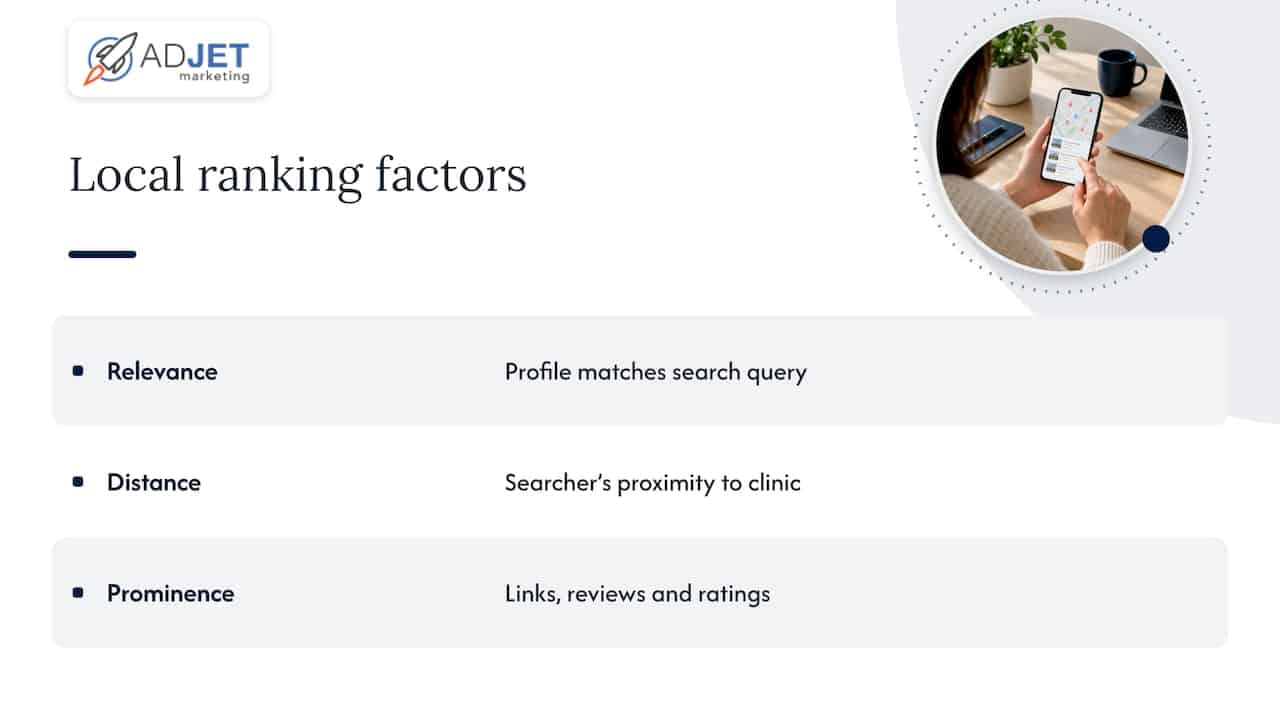
Relevance is how well your Business Profile matches what someone searched. A patient typing “pain management” or “botox” is asking Google to match a service. Complete and detailed information makes a profile more likely to show up.
Distance is how far you are from the person searching, or from the location Google believes they are in. A clinic two miles from the patient can outrank a better-reviewed clinic ten miles away. You cannot change this other than by having an accurate address.
Prominence is how well known the business is. Google says this is based in part on how many websites link to you and how many reviews and ratings you have. A clinic with a long record of recent patient reviews and mentions across the web looks more established than a new listing.
One more point from Google’s page: there is no way to request or pay for a better local ranking. Anyone who sells you a guaranteed map pack position is selling something Google says does not exist. Google Ads can put you above the map, but that is a separate paid placement, covered below.
Google also explains where profile data comes from: crawled web content, licensed data, user contributions and its own interactions with the place. In practice, that means your profile is not only what you typed into it. Patients can add photos and reviews, and web pages that mention your address and phone number feed the same record. Inconsistent details across the web create a messy record.
An older Google statement, the 2010 Lat Long post on local search ranking, named the same three factors and noted that claimed listings get no special ranking treatment over unclaimed ones. Claiming is the entry ticket, not the advantage. The advantage comes from what you build on top of it.
Check eligibility before you optimize anything
Many ranking problems are eligibility problems. Google’s policies state that a business must make in-person contact with customers during stated hours to qualify for a profile. Content such as reviews, photos, videos and posts must also represent the location accurately. Violations can lead to restricted display or loss of account access.
Google’s representation guidelines add practical rules that matter to clinics:
- Use a precise, real-world address. P.O. boxes and virtual offices are ineligible.
- Put a suite number in Address Line 2, not in the street line.
- Co-working and shared offices qualify only with clear signage, customers received on site and staff present during business hours. Therapists who rent a room by the hour should read this carefully before creating a profile.
- Use one profile per business. Google allows separate profiles in some cases for individual practitioners or departments, so a multi-doctor practice should check those rules before creating extras.
A profile that breaks these rules can be suspended, and a suspension costs far more than a few weeks of slower growth. If you are unsure whether your arrangement qualifies, settle that first.
Build the profile Google can match to searches
Once eligibility is clear, the profile is your highest-leverage asset. Google’s guidance is to verify the business and keep your full address, hours (including special and holiday hours), category and attributes current. It also asks you to respond to reviews and add photos and videos.
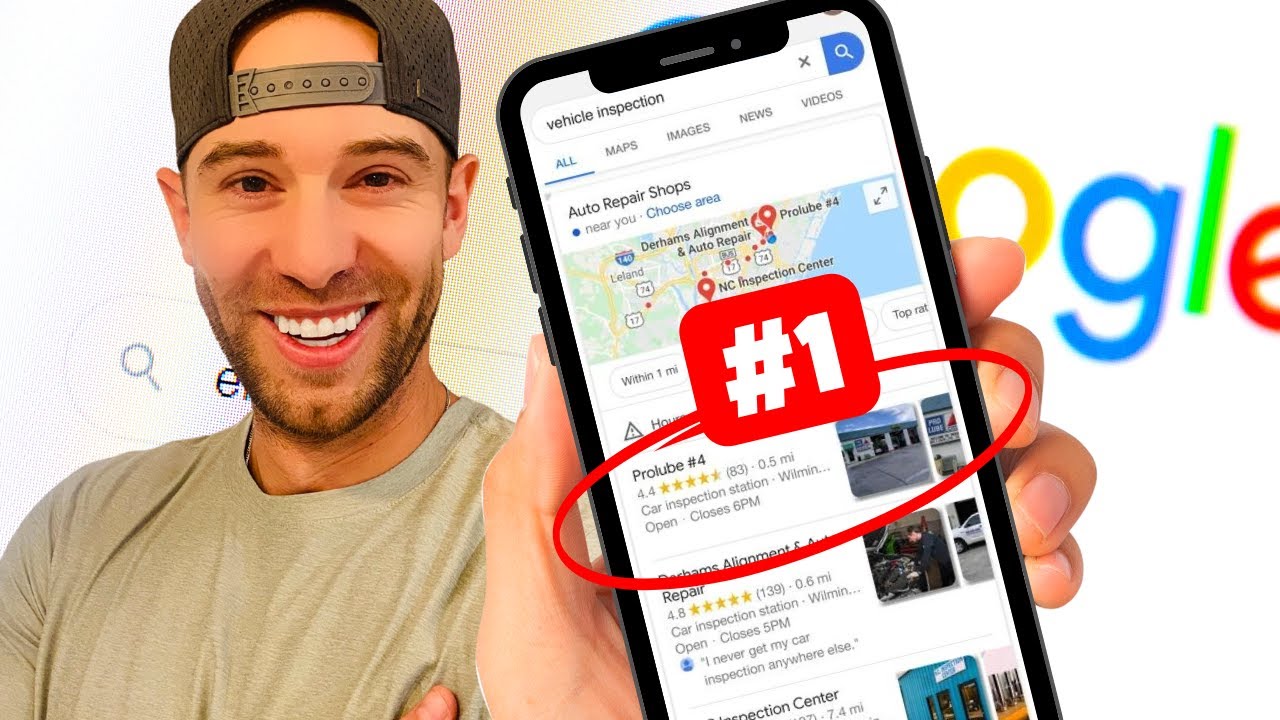
Categories: fewer and more specific
Google’s instruction is to use the fewest categories needed to describe the core business, choosing specific ones that represent the main business rather than keywords. The common mistake is stacking categories for every service in the hope of ranking for each. A plastic surgery practice that adds a dozen loosely related categories dilutes its signal. Choose the primary category that describes what most patients come for, then add secondary categories only where they truly describe the practice.
Name, address and phone: identical everywhere
Write your name, address and phone number exactly the same way on the profile, your website, and your other listings. Because Google compiles data from several sources, small differences (Suite versus Ste, an old phone number on a directory) can weaken the match. Audit the main directories and the footer of your own site first.
Hours, attributes and service areas
Keep regular and special hours accurate, including holidays. If you visit patients or serve a wider area, Google lets you define service areas by city, zip code or other places. Set them to where you genuinely work, not to every town within driving distance.
Photos, services and the booking link
Photos of the real entrance, waiting room, treatment rooms and team help a patient trust an unfamiliar clinic. Patients compare clinics on more than distance, and a complete profile gives them what they need, much as a checklist for finding the right dental clinic walks a patient through what to look for.
If you add an appointment link, Google’s business links policy requires the profile to be verified first. For multi-location practices, the link must lead to a dedicated landing page for that specific location, not a general homepage or another location’s page, and the patient must be able to complete the booking there. Social media pages, messaging apps, app stores and link shorteners are not accepted targets.
For regulated practices there is an extra layer: what you collect through booking forms and tracking tools can involve protected health information. Our guide to a HIPAA-safe medical Google Business Profile covers setup, reviews and booking with that in mind, and our walkthrough of the ideal clinic profile setup for the map pack goes through the profile field by field.
Reviews: the prominence signal you earn one patient at a time
Google states that more reviews and positive ratings can help local ranking, and that replying shows you value feedback. Positive reviews and helpful replies help a business stand out. For a clinic, reviews do double duty: they feed ranking and they decide whether the patient who finds you actually calls.
Asking for reviews in a way that holds up
- Ask at the moment of satisfaction: at checkout, or in a follow-up message after the visit.
- Send the direct review link, so the patient does not have to search for your profile.
- Ask every patient, not only the happy ones. A steady flow of recent reviews reads as more credible than a burst.
- Never offer payment or gifts in exchange for a review, and do not post reviews on a patient’s behalf. Google’s policies require content to accurately represent the location, and violations can restrict your profile.
Steady beats big. Five new reviews a month for a year do more for a clinic than fifty in a week followed by silence.
Replying without exposing patient information
This is where healthcare differs from a restaurant. A public reply that confirms someone was your patient, or mentions their treatment, can disclose protected health information. A safe reply thanks the reviewer, speaks in general terms and invites them to contact the office directly. Write a short internal policy, give front-desk staff approved reply templates, and have a person with compliance responsibility review anything that touches a complaint. Mental health practices, where even the fact of being a client is sensitive, should be especially strict.
What your website must do to support the map listing
Google compiles profile data in part from crawled web content, and prominence draws on links from other websites. Your site is therefore part of your map ranking, not a separate project.
- One page per service, and per location if you have several. A page that clearly explains one treatment, who it is for, the provider, and the neighborhood you serve gives Google something specific to match. A single “Services” page listing everything gives it very little.
- Visible name, address and phone number in text, matching the profile exactly.
- A location page the profile can link to. The booking link rule above means each location needs its own page where a patient can book.
- Fast, mobile-friendly pages. Most patients searching nearby are on a phone, and a slow page loses them after the click regardless of rank.
- Local links. Hospital affiliations, professional associations, local press and community organizations that link to you add to prominence. Earn them through real relationships, not link schemes.
Our local SEO guide for healthcare clinics explains how these pieces fit together, and the medical clinic SEO guide goes deeper on content. If the booking step is where visitors drop off, the online booking conversion guide is the place to start.
Map pack, organic results and ads: how they differ
Patients see three kinds of results, and they are won in different ways.
| Placement | How you get it | Speed | Cost model |
|---|---|---|---|
| Map pack (local pack) | Relevance, distance and prominence on your Business Profile | Weeks to months | Time and ongoing effort |
| Organic results | Website content, technical health, links | Months | Time and ongoing effort |
| Google Ads | Bid, ad quality and landing page | Days to start | Pay per click |
Paid and organic work together. Ads can generate appointments while the profile and site build strength, and the data from ad campaigns shows which services and keywords convert best. If you want to see how ads connect to your profile, our page on Google My Business ads explains how they work. Remember that running ads does not improve your map ranking, since Google says rankings cannot be bought.
Realistic timelines and what to measure
No one can promise a position, and the owner who says otherwise is guessing. What you can set are sensible expectations:
- First few weeks: fix eligibility, categories, consistency and missing profile information. These changes are fast to make but Google needs time to reflect them.
- Next few months: a steady review flow, new service and location pages, and the first local links. Movement is gradual and uneven.
- Ongoing: competitors in dense markets such as a large city’s med spa scene keep adding reviews and content, so the work does not end.
Track three things that tie to patients rather than vanity numbers: calls from the profile, booking-link clicks and completed appointment requests. Rankings differ by searcher location, so a single check from your office desk misleads. Look at how many new patients came from the profile each month and what each one cost you to acquire.
Common mistakes we see
- A virtual office or P.O. box used as the address, which Google does not accept.
- Categories chosen as keywords instead of descriptions of the business.
- Several duplicate profiles for one practice after a move or rebrand.
- A booking link that points to the homepage instead of a page where the patient can book.
- Review replies that confirm a patient relationship or a diagnosis.
- Sporadic review requests, then months of nothing.
- Treating the profile as a one-time setup rather than something reviewed monthly.
Our perspective
We approach map ranking as a trust problem more than a trick problem. Google says plainly that ranking rests on relevance, distance and prominence, and that it cannot be bought. That tells you where the work is: an accurate profile, a website that backs it up, and a steady record of real patient feedback.
Many clinics come to us after poor lead quality. The profile gets views, but the calls are for services the practice does not offer, or the patients who do call never book. Usually the categories are too broad, the website pages are too thin, or the booking path is confusing. Fixing those usually does more than adding more of anything.
For healthcare, we also build around privacy from the start. Review replies, forms and tracking all touch patient information, and our processes are built to be HIPAA-compliant. Growth and compliance do not have to compete.
We also like to be direct about timing. Map ranking is not a switch, and we set expectations around timelines and budgets before work begins, with reporting you can read and check.
Felix
Where AdJet fits
If you would rather not manage profile upkeep, review workflows, location pages and tracking alongside patient care, this is the work we do. AdJet Marketing is a Google Partner agency that handles search engine optimization for medical clinics, aesthetic practices and other local businesses, and Google Ads management for practices that want appointments while organic visibility builds. We also build and manage WordPress websites and landing pages for the pages your profile links to. Pricing for SEO and Google Ads is not published, so the first step is a conversation about your locations, services and goals.
FAQ
Can I pay Google to rank higher in Google Maps?
No. Google states there is no way to request or pay for a better local ranking. You can run Google Ads for paid placement, but that is separate from the local map results, which depend on relevance, distance and prominence.
How many reviews does a clinic need to rank?
There is no published number. Google says more reviews and positive ratings can help your local ranking, so the goal is a steady flow of recent, genuine reviews rather than a target count. What matters is how you compare with the other clinics showing for the same search in your area.
Does adding “near me” to my website help?
No. Google’s ranking factors are relevance, distance and prominence, and distance is measured from the searcher, not from a phrase on your page. Spend that effort on clear service pages, an accurate address and a complete profile.
Can a therapist working from a shared office have a profile?
Only if the office meets Google’s rules: clear signage, customers received on site and staff present during business hours. A virtual office or P.O. box is not eligible. Check Google’s representation guidelines for your exact setup before creating the profile.
How long does it take to see movement?
Profile fixes can be reflected within weeks, while reviews, content and local links build over months. Results vary by specialty and by how competitive your city is, so judge progress by calls and booked appointments from the profile rather than by one ranking check.
Sources
- Tips to improve your local ranking on Google, Google Business Profile Help
- Understand how Google sources and uses info in Business Profiles
- How Local Search Ranking Works, Google Lat Long blog (2010)
- Overview of Google Business Profile policies
- Guidelines for representing your business on Google
- Edit your Business Profile, Google Business Profile Help
- Business links policies and guidelines, Google Business Profile Help