








Many aesthetic clinic owners assume Google Ads are either off-limits or too legally risky to touch. That assumption costs them patients every single day. The truth is, with the right certification, strategy, and compliance framework, Google Ads are one of the most powerful patient acquisition tools available to aesthetics practices. This guide covers everything you need to know: how Google Ads work for aesthetic clinics, what the policies require, how AI tools can amplify your results, and how to avoid the pitfalls that trip up most practices. By the end, you will have a clear roadmap to grow your clinic with confidence.
Table of Contents
- Why Google Ads matter for aesthetics clinics
- How Google healthcare ad policies shape your strategy
- Maximizing results: AI tools and best practices for Google Ads
- Common pitfalls and proven strategies for sustained growth
- A different angle: Why compliance-first growth wins in healthcare aesthetics
- Take your aesthetics growth further with Google Ads specialists
- Frequently asked questions
Key Takeaways
| Point | Details |
|---|---|
| Certified campaigns matter | Proper certification allows safe, effective ad campaigns in the medical aesthetics sector. |
| Compliance builds trust | Following Google’s and legal rules protects your clinic’s reputation and patient data. |
| AI tools boost efficiency | Leveraging tools like Performance Max can make campaigns more effective—within policy boundaries. |
| Avoid common pitfalls | Careful ad copy and ongoing monitoring help you dodge rejections and wasted spend. |
Why Google Ads matter for aesthetics clinics
When someone searches “lip filler near me” or “best Botox clinic in [city],” they are not browsing casually. They are ready to book. That is the core advantage Google Ads offer: direct access to high-intent patients at the exact moment they are looking for your services. No other channel matches that precision.
Traditional marketing channels like print ads, radio, or even organic social media reach broad audiences who may or may not want your services. Google Ads put your clinic in front of people who are actively searching for what you offer. The difference in conversion potential is significant.
Demand for non-surgical aesthetic treatments has grown sharply in recent years. Treatments like Botox, dermal fillers, laser skin resurfacing, and body contouring are searched millions of times each month across the United States. Clinics that run well-structured Google Ads campaigns capture this demand directly. Those that do not are effectively handing patients to competitors.
Here is what Google Ads allow aesthetics clinics to do that traditional channels cannot:
- Target by location: Show ads only to people within a specific radius of your clinic
- Target by device: Reach patients on mobile when they are searching on the go
- Target by search intent: Bid on specific treatment keywords with high commercial intent
- Control spend in real time: Pause, scale, or adjust budgets based on performance data
- Track actual bookings: Connect ad clicks directly to appointment conversions
The ability to compare performance across channels is also valuable. Understanding Google vs social media ads helps you allocate budget where it produces the best return for your specific practice.
“Google has strict healthcare ad policies that affect the aesthetics industry. Understanding and following these policies is not optional — it is the foundation of any compliant and effective campaign.”
For med spas and aesthetic clinics evaluating where to invest, reviewing Google Ads ROI for medspas provides a concrete comparison of what each platform actually delivers in terms of patient leads and cost per acquisition.
How Google healthcare ad policies shape your strategy
Now that you see Google Ads’ potential, it is crucial to navigate the regulatory landscape safely and effectively. Google does not treat aesthetics advertising the same as general retail. Healthcare and medical advertising falls under a specific policy framework, and violations can result in ad disapprovals, account suspensions, or permanent bans.

Certification is required for prescription-related treatments like Botox and restricted terminology must be avoided. If your clinic advertises injectables, you must complete Google’s healthcare advertiser certification before your ads will run. This process verifies that your practice meets the legal and ethical standards Google requires.
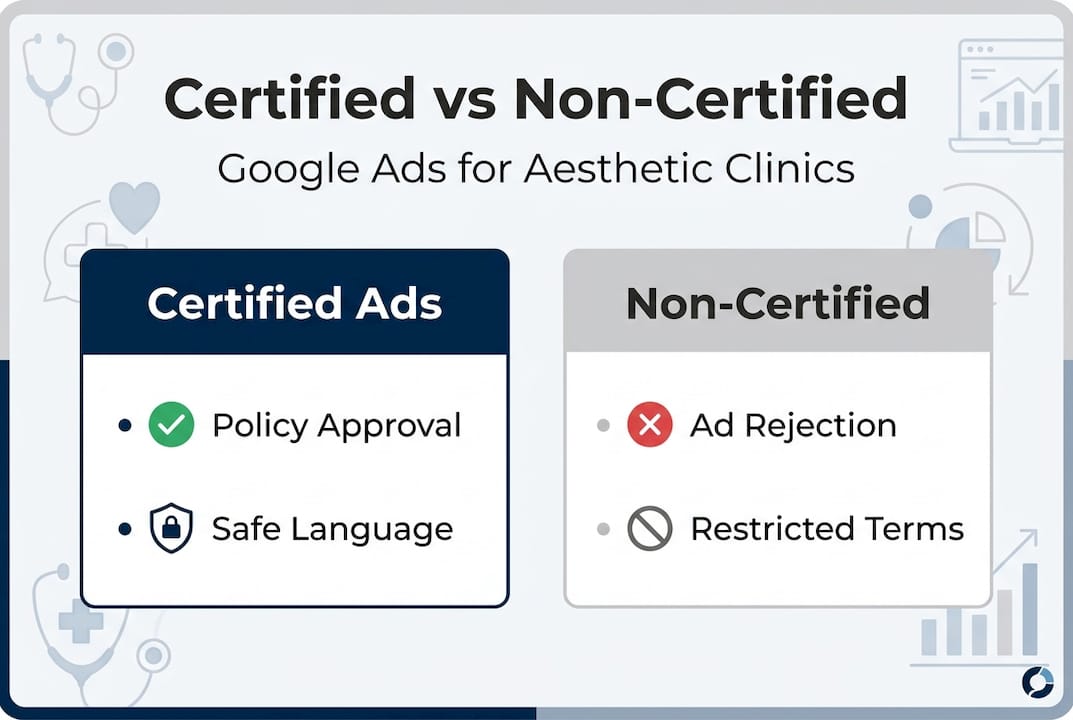
Here is a clear comparison of certified versus non-certified advertising in the aesthetics space:
| Factor | Certified ads | Non-certified ads |
|---|---|---|
| Prescription treatment ads | Allowed with approval | Rejected or removed |
| Reach and placement | Full network access | Severely limited |
| Risk of account suspension | Low when compliant | High |
| Patient trust signals | Stronger | Weaker |
| Compliance with local law | Required and verified | Unverified, higher risk |
Beyond certification, local law compliance matters enormously. What is permitted in one state may be restricted in another. For example, advertising specific drug names, before-and-after imagery, or promotional pricing on medical treatments varies by jurisdiction. Ignoring these differences is one of the fastest ways to get your ads pulled.
Terms and phrases to avoid in your ad copy include unapproved drug names, exaggerated outcome claims, and language that implies guaranteed results. Even well-intentioned copy can trigger a policy violation if it crosses these lines.
If you are managing HIPAA-compliant Google Ads for a medical aesthetics practice, the intersection of HIPAA and Google’s ad policies adds another layer of complexity. Tracking patient behavior through ad pixels must be handled carefully to avoid exposing protected health information (PHI).
Pro Tip: Working with a certified Google Partner agency that specializes in healthcare advertising removes much of this compliance burden. They know which terms trigger rejections, how to structure campaigns within policy limits, and how to appeal disapprovals effectively.
Maximizing results: AI tools and best practices for Google Ads
With compliance in check, it is time to optimize your campaigns with the smartest tools available. Google’s AI-powered advertising products have changed how clinics can manage and scale their ad spend. But they come with important caveats for healthcare advertisers.
AI tools like Performance Max boost ad efficiency, but healthcare ads may appear below AI Overviews, which limits visibility in some search placements. This means you cannot rely entirely on automation. Human oversight remains essential.
Here is how Performance Max compares to standard Google Search campaigns for aesthetics clinics:
| Feature | Performance Max | Standard search ads |
|---|---|---|
| AI optimization | Fully automated | Manual or smart bidding |
| Placement control | Limited | High |
| Creative flexibility | Multi-format assets | Text-focused |
| Healthcare compliance control | Requires close monitoring | Easier to manage |
| Best for | Brand awareness + leads | Direct patient acquisition |
For most aesthetic clinics, a hybrid approach works best: use Performance Max for broader reach and brand visibility, while maintaining standard search campaigns for high-intent treatment keywords.
Here are the steps to set up an effective aesthetics Google Ads campaign:
- Complete healthcare certification before creating any prescription treatment ads
- Define your target geography using radius targeting around your clinic location
- Build tightly themed ad groups around specific treatments (e.g., one group for lip fillers, one for laser treatments)
- Write compliant ad copy that avoids restricted terms and focuses on benefits and consultation offers
- Set up conversion tracking to measure phone calls, form submissions, and appointment bookings
- Enable call extensions so mobile users can call directly from the search results page
- Review search term reports weekly to identify irrelevant queries and add negative keywords
Understanding how telehealth keywords affect lead quality is also worth evaluating, particularly if your clinic offers virtual consultations alongside in-person treatments.
Pro Tip: If your cost per lead suddenly spikes without a change in budget, check whether a policy update has restricted your keyword set or shifted your ad placements. Healthcare ad policies update regularly, and what worked last quarter may be flagged today.
Common pitfalls and proven strategies for sustained growth
After exploring powerful optimization tools, it is vital to recognize pitfalls and methods that can make or break long-term ad success. The aesthetics category has a higher rate of ad rejection than most industries. Knowing why helps you avoid the most common traps.
Ad content must avoid restricted terms and comply closely with policy and law. The most frequent reasons aesthetics ads get rejected include:
- Using brand names of prescription injectables without proper certification
- Making outcome guarantees or before-and-after claims that violate policy
- Advertising procedures that require a medical license without proper verification
- Using landing pages that do not match the ad content or lack required disclosures
- Targeting audiences in ways that violate healthcare privacy standards
Structuring your campaigns for new patient growth means thinking beyond the ad itself. Your landing page is where conversions happen or fail. A compliant, fast-loading landing page with a clear call to action, patient trust signals, and a simple booking form will outperform a generic homepage every time.
Proven strategies that work specifically for aesthetic clinics include:
- Hyper-local targeting: Focus on zip codes or neighborhoods with higher disposable income and aesthetic service demand
- Consultation-focused offers: Promote free or low-cost consultations rather than treatment prices to reduce policy risk and increase lead volume
- Trust signals in ad copy: Include credentials, years of experience, or patient satisfaction indicators where policy allows
- Dedicated landing pages per treatment: One page for Botox, one for fillers, one for laser treatments, each with specific messaging
- Negative keyword management: Block irrelevant searches like “DIY filler” or “cheap Botox kit” to protect your budget
For a broader view of med spa marketing strategies that complement your Google Ads efforts, combining paid search with SEO and reputation management creates a more resilient patient acquisition system.
Pro Tip: Review your disapproved ads immediately. Google provides specific rejection reasons, and many disapprovals can be resolved with minor copy edits. Letting disapproved ads sit without action wastes budget and delays results. Reviewing results from Google Ads in healthcare across similar clinic types also helps set realistic benchmarks for cost per lead.
A different angle: Why compliance-first growth wins in healthcare aesthetics
Most clinics approach compliance as a constraint. We see it differently. Compliance is actually a competitive advantage.
When your ads consistently pass Google’s review process, your campaigns run without interruption. When your landing pages meet legal standards, patients trust your practice before they even call. When your tracking setup respects HIPAA guidelines, you protect both your patients and your business from serious financial and reputational risk.
Clinics that cut corners on compliance often see short-term gains followed by account suspensions, wasted ad spend, and damaged credibility. The practices that build sustainable patient pipelines are the ones that treat policy adherence as a core part of their marketing strategy, not an afterthought.
Patients researching aesthetic treatments are making decisions about their appearance and health. They are paying close attention to how clinics present themselves online. A compliant, professional ad campaign signals that your practice operates with integrity. That signal builds trust before a single consultation happens.
Exploring real-world compliance solutions shows that compliant marketing and strong growth are not in conflict. They reinforce each other.
Take your aesthetics growth further with Google Ads specialists
Running compliant, high-performing Google Ads for an aesthetics clinic requires expertise that goes beyond general digital marketing knowledge. Healthcare advertising policy, certification requirements, HIPAA-compliant tracking, and treatment-specific campaign structure all demand specialized experience.
At AdJet Marketing, we are a certified Google Partner agency that works exclusively with medical clinics, aesthetic practices, and healthcare providers. We handle certification, campaign setup, compliance monitoring, and ongoing optimization so your clinic can focus on patient care. Whether you want to audit an existing campaign or launch a new one, we build strategies around your specific growth goals. Review how Google Ads ROI for medspas compares to other channels, then connect with our team to discuss what a compliant, results-driven campaign looks like for your practice.
Frequently asked questions
Do I need special certification to run Google Ads for Botox or fillers?
Yes, Google requires clinics to complete healthcare certification for prescription treatments like Botox and fillers before those ads will be approved and served.
Why do some Google Ads get rejected in the aesthetics category?
Ads are often rejected because they use restricted terms or violate Google’s health policies or local laws, including unapproved substance names or outcome guarantees.
Can AI tools like Performance Max replace manual management for healthcare ads?
Performance Max boosts efficiency but healthcare ads may appear below AI Overviews, meaning compliance monitoring and manual oversight remain essential for consistent results.
What is the main advantage of Google Ads for aesthetics clinics?
The main advantage is instant access to high-intent patients who are actively searching for specific aesthetic treatments in your geographic area, making conversions far more likely than with broad-reach channels.
Recommended
- Google Ads Vs Meta Ads For Medspas: Which Brings Better ROI – AdJet Digital Marketing & Google Partner Agency | SEO Development Google Ads Social
- Social Media Vs. Google — Which Brings Better Patients? – AdJet Digital Marketing & Google Partner Agency | SEO Development Google Ads Social
- Is HIPAA-Compliant Marketing Possible With Google Ads? → Yes—Here’s How To Do It Right – AdJet Digital Marketing & Google Partner Agency | SEO Development Google Ads Social
- Should We Run Brand Campaigns For Our Clinic Name? Why It Pays – AdJet Digital Marketing & Google Partner Agency | SEO Development Google Ads Social