








Run procedure-specific search campaigns with server-side conversion tracking and compliant landing pages. That single sentence captures the minimum viable program for plastic surgery Google Ads. Before you spend a dollar, three priorities must be in order:
Compliance checklist (do these first):
- Pause or remove any client-side tracking pixels on procedure inquiry forms
- Open Google’s Healthcare and Medicines certification for your account
- Confirm your landing pages carry required disclaimers and no outcome guarantees
Campaign structure checklist:
- Create one dedicated landing page per procedure (rhinoplasty, breast augmentation, liposuction, etc.)
- Build separate campaigns for each high-margin procedure, not one catch-all campaign
Tracking checklist:
- Schedule server-side tracking implementation before launching any smart-bidding strategy
- Map only booked consults (not raw form fills) as your primary conversion action in Google Ads
These steps are not optional polish. They are the foundation. Everything else in this guide builds on them.
Key Takeaways
Compliant, profitable plastic surgery Google Ads require server-side PHI filtering, one campaign per procedure, and booked-consult conversion data feeding your bidding strategy.
| Point | Details |
|---|---|
| Compliance comes first | Pause client-side pixels on forms and open Google Healthcare certification before launching any campaign. |
| One campaign per procedure | Separate campaigns for each high-margin procedure improve Quality Scores and give you precise budget control by procedure margin. |
| Track booked consults, not form fills | Feed CRM booking statuses back to Google via offline conversion import; raw form fills produce unreliable bidding signals. |
| Expect stable performance by month 2–3 | Visible leads typically arrive within 7–14 days; consistent, predictable results follow after negatives mature and conversion data builds. |
| Adjetmarketing handles the full setup | As a Google Partner, Adjetmarketing builds server-side tracking, procedure landing pages, and compliant campaign architecture for aesthetic practices. |
Table of Contents
- How do plastic surgery Google Ads actually capture patient intent?
- What does a practical plastic surgery campaign structure look like?
- Which keywords and targeting settings reduce wasted spend?
- What ad copy and landing page rules keep you within Google policy?
- How do you track conversions without transmitting PHI?
- What budgets, bids, and timelines should you plan for?
- How do you measure performance and keep campaigns healthy?
- What should you realistically expect in the first 90 days?
- What we see in real clinic accounts
- How Adjetmarketing helps plastic surgery practices run compliant, profitable campaigns
- Sources
How do plastic surgery Google Ads actually capture patient intent?
Search is where the highest-intent patients show up. When someone types “rhinoplasty surgeon near me” or “tummy tuck cost Dallas,” they have already moved past the research phase. They are comparing providers and looking for a reason to call. That is the moment a well-structured plastic surgery PPC campaign intercepts them.
Google Ads surfaces your practice at the top of those results through a combination of bid, Quality Score, and ad relevance. Ad rank determines whether you appear above organic results, and for high-ticket procedures, that top position matters. Patients searching for cosmetic surgery online rarely scroll past the first two or three results.
High-intent queries (convert well, prioritize budget here):
- “Breast augmentation surgeon [city]”
- “Rhinoplasty cost [state]”
- “Mommy makeover near me”
- “Tummy tuck financing options”
Research-phase queries (lower intent, use cautiously):
- “Rhinoplasty recovery time”
- “Is liposuction permanent”
- “Breast implant types comparison”
Research-phase queries can build awareness, but they rarely convert to booked consults at a rate that justifies the same CPC as procedure-plus-location terms. Reserve most of your budget for the high-intent bucket.
Call extensions, location extensions, and structured snippets all influence click behavior on medical queries. A call extension showing your clinic’s phone number directly in the ad can drive calls without a landing page visit, which is valuable for patients who prefer to speak with someone before booking. Structured snippets listing procedures (“Rhinoplasty · Breast Augmentation · Body Contouring”) help patients confirm relevance before clicking, which improves your click-through rate and lowers wasted spend.
Display and YouTube campaigns serve a different purpose. Use them for awareness and, carefully, for remarketing after you have PHI-safe tracking in place. A patient who visited your rhinoplasty page but did not book is a reasonable remarketing candidate, provided your tracking setup does not transmit any protected health information back to Google. Effective ads for plastic surgery start with search and layer in other formats only once the foundation is solid.
Performance Max can complement search campaigns, but it performs best when fed high-quality conversion data via offline conversion imports. Do not start with Performance Max as your only campaign type.
What does a practical plastic surgery campaign structure look like?
Separate campaigns for each major procedure is the architecture that works. One campaign for rhinoplasty, one for breast augmentation, one for body contouring, and a separate consultation-focused campaign for patients who are still deciding on a procedure. This separation gives you budget control by procedure margin, cleaner Quality Scores, and far less policy scrutiny than a single mixed campaign.
Naming convention example:
| Campaign name | Purpose | Budget priority |
|---|---|---|
| Search_Rhinoplasty_NYC | Procedure-specific, high intent | High (high-margin procedure) |
| Search_BreastAug_NYC | Procedure-specific, high intent | High |
| Search_Consult_NYC | Consultation-focused, mixed procedures | Medium |
| Search_Financing_NYC | Financing-intent keywords, all procedures | Medium |
Within each procedure campaign, build 3–5 ad groups bucketed by intent:
- Near-me / local: “rhinoplasty surgeon Manhattan,” “nose job near me”
- Surgeon-search: “best rhinoplasty surgeon NYC,” “board-certified nose surgeon”
- Cost / financing: “rhinoplasty cost New York,” “nose job payment plan”
- Comparison: “rhinoplasty vs non-surgical nose job”
Single-procedure campaign setup checklist:
- Define your keyword list (20–40 terms per ad group, tightly themed)
- Write 3 responsive search ads per ad group with credential-based headlines
- Add call, location, and structured-snippet extensions
- Map each ad group to its dedicated landing page (not the homepage)
- Build a negative keyword list before launch (see Section 4)
- Set a manual CPC bid initially; switch to Target CPA only after 30+ booked-consult conversions
If you operate multiple clinic locations, consider separate Google Ads accounts per location under a Manager (MCC) account. Shared negative keyword lists at the MCC level save time and keep irrelevant traffic out of every account simultaneously.
Which keywords and targeting settings reduce wasted spend?
Procedure-plus-location keywords and financing-intent keywords are your two highest-priority buckets. “Breast augmentation surgeon Chicago” and “rhinoplasty financing no credit check” both signal a patient who is close to a decision. Financing keywords often carry lower CPC competition than straight procedure terms, and they attract patients who are motivated but need a payment path, which is a segment many clinics underserve.
Geo-targeting guidance:
- Use radius targeting around your clinic rather than broad city or state targeting
- Exclude zip codes that contain competing hospitals or unrelated medical facilities where possible
- For multi-location practices, create location-specific campaigns rather than one national campaign with location bid adjustments
Audience targeting:
- Avoid any audience segment tied to sensitive health conditions; Google restricts this for healthcare advertisers
- Use “website visitors” remarketing audiences only after server-side PHI-safe tracking is confirmed
- In-market audiences for “cosmetic procedures” can supplement search campaigns but should not replace keyword targeting
Starter negative keyword list:
- free, DIY, at home, natural, non-surgical (when running surgical procedure campaigns)
- jobs, careers, training, school, course, certification
- pictures, photos (without “before after” context)
- insurance, covered by insurance, Medicare, Medicaid
- cheap, cheapest (unless you are specifically targeting budget-conscious patients)
- recovery stories, complications, risks (research-phase terms that rarely convert)
Pair them with a landing page that includes a financing calculator or a clear monthly-payment estimate. That single page can become one of your best-performing assets.*
What ad copy and landing page rules keep you within Google policy?
Google classifies plastic surgery under its restricted Healthcare and Medicines category. That classification means additional pre-approval requirements, tighter content rules, and a higher baseline rejection rate than standard advertising categories. Educational, credential-based creative is the safest and most effective approach.
Ad copy dos:
- Lead with board certification, years of experience, or a named credential (“Board-Certified Plastic Surgeon”)
- Include a local signal in at least one headline (“Serving Dallas–Fort Worth”)
- Use a clear next step in the description (“Schedule your private consultation today”)
- Reference financing availability if you offer it (“Flexible financing available”)
Ad copy don’ts:
- No outcome guarantees (“Look 10 years younger guaranteed”)
- No before/after imagery in ad creative (this applies to image extensions and display ads)
- No testimonial-style claims in ad text (“Patients love their results”)
- No language implying a health condition is being treated (“Fix your broken nose”)
Industry analyses confirm that cosmetic surgery campaigns face higher rejection rates, and that outcome-claim language is one of the most common triggers. Write headlines around credentials, location, and the consultation step, not around results.
Responsive search ad headline templates:
- “Board-Certified Plastic Surgeon [City]”
- “Rhinoplasty Consultations Available”
- “Natural-Looking Results, Expert Care”
- “Financing Options for [Procedure]”
- “Schedule Your Private Consult Today”
Landing page checklist:
- Headline matches the ad exactly (if the ad says “Rhinoplasty in Dallas,” the page says “Rhinoplasty in Dallas”)
- Remove or minimize site navigation to keep focus on the conversion action
- Include surgeon credentials, board certification, and professional affiliations above the fold
- Before/after gallery is permitted on the page (with documented patient consent and required disclaimers), but not in ad creative
- Show transparent pricing ranges or financing information
- Booking form collects only name, phone, and preferred contact time — no diagnosis or medical history fields
- Include a disclaimer: “Results may vary. Consult with a board-certified surgeon to discuss your individual goals.”
- Add a privacy policy link visible near the form
A systematic review of plastic surgery social media found that only a small share of plastic surgery posts link to board-certified surgeons, which means your credentials are a genuine differentiator in ad copy and on landing pages. Patients notice, and Google’s policy reviewers do too.
How do you track conversions without transmitting PHI?
Remove standard client-side pixels from procedure inquiry forms before you do anything else. The standard Google Ads tag, when placed on a form confirmation page, can capture URL parameters that include patient-identifiable information. Google Ads is not a HIPAA-covered entity, and your ad account requires special handling to avoid transmitting protected health information (PHI) to Google’s servers.

The compliant architecture works like this:
Server-side conversion flow:
- Patient submits inquiry form on your landing page
- Form data is captured by your CRM (never sent to Google directly)
- A PHI-filtering layer strips all identifiable fields (name, email, phone, IP address, any health-related data)
- The filtered event (a conversion signal with no patient identifiers) is mapped to a compliant conversion schema
- That clean event is sent to Google via the Google Ads API or server-side Google Tag Manager
Technical checklist:
- Disable enhanced conversions in your Google Ads account until your server-side setup is verified
- Remove the gtag.js pixel from all procedure inquiry forms and confirmation pages
- Implement server-side Google Tag Manager (sGTM) with a PHI-stripping rule set
- Map offline conversions: when a consult is booked in your CRM, send that status back to Google as an offline conversion import
- Test with mock PHI data and review server logs to confirm no identifiers appear in outbound payloads
Compliance verification table:
| Test | What to check | Who is responsible |
|---|---|---|
| Payload inspection | No name, email, phone, or IP in conversion events | IT / developer |
| URL parameter audit | No PHI in landing page URLs or query strings | Marketing + IT |
| Form logging review | CRM captures data; Google receives only the event signal | IT + legal |
| Enhanced conversions status | Confirmed disabled in Google Ads UI | Marketing manager |
For consent management, tools like OneTrust or Cookiebot help clinics implement cookie consent flows that align with both Google’s consent mode requirements and broader privacy standards. A comparison of OneTrust vs. Cookiebot for healthcare marketers can help you choose the right platform for your clinic’s technical environment.
Pro Tip: Feed only booked consults and confirmed-booking statuses to Google’s smart-bidding algorithm. Optimizing on raw form fills inflates your apparent conversion count but trains the algorithm on low-quality signals. Booked consult data produces far more reliable Target CPA performance over time.
For a deeper walkthrough of HIPAA-compliant Google Ads tracking, the implementation steps and common pitfalls are covered in detail.
What budgets, bids, and timelines should you plan for?
This gives the algorithm time to learn without burning through your full budget during a period when negatives are still maturing and landing pages may need adjustment.
Budget guidance by clinic size and market:
These ranges reflect U.S. market CPCs for plastic surgery terms, which are among the highest in healthcare advertising. ASPS procedure volume data can help you benchmark expected patient demand by procedure type and season, which informs how to allocate budget across campaigns.
Bidding strategy timeline:
- Days 1–30: Manual CPC bidding. You control every bid, which protects budget while you gather data and refine negatives.
- Days 30–60: If you have 15+ booked-consult conversions, test Target CPA on your highest-volume procedure campaign.
- Days 60–90: Expand Target CPA to additional campaigns. Begin evaluating Performance Max as a supplement to search, not a replacement.
Seasonal and financing budget notes:
- January and September tend to see higher search volume for body-contouring procedures (post-holiday and back-to-school cycles)
- Allocate 15–20% of total budget to financing-intent campaigns year-round; increase that share in Q1 when patients are using tax refunds to fund elective procedures
How do you measure performance and keep campaigns healthy?
Your primary KPIs, in order of importance: cost per booked consult, conversion rate from click to booked consult, cost per booked procedure, and margin-adjusted ROAS. Raw form fills and phone calls matter, but only as leading indicators. The number that tells you whether the program is working is cost per booked consult.
Weekly hygiene checklist:
- Review the search terms report and add irrelevant queries to your negative keyword list
- Check budget pacing (are campaigns hitting daily limits before the end of the day?)
- Verify conversion data is flowing correctly (a sudden drop in conversions usually means a tracking issue, not a performance issue)
- Review Quality Scores for your top keywords; a score below 5 signals a landing page or ad relevance problem
Testing cadence:
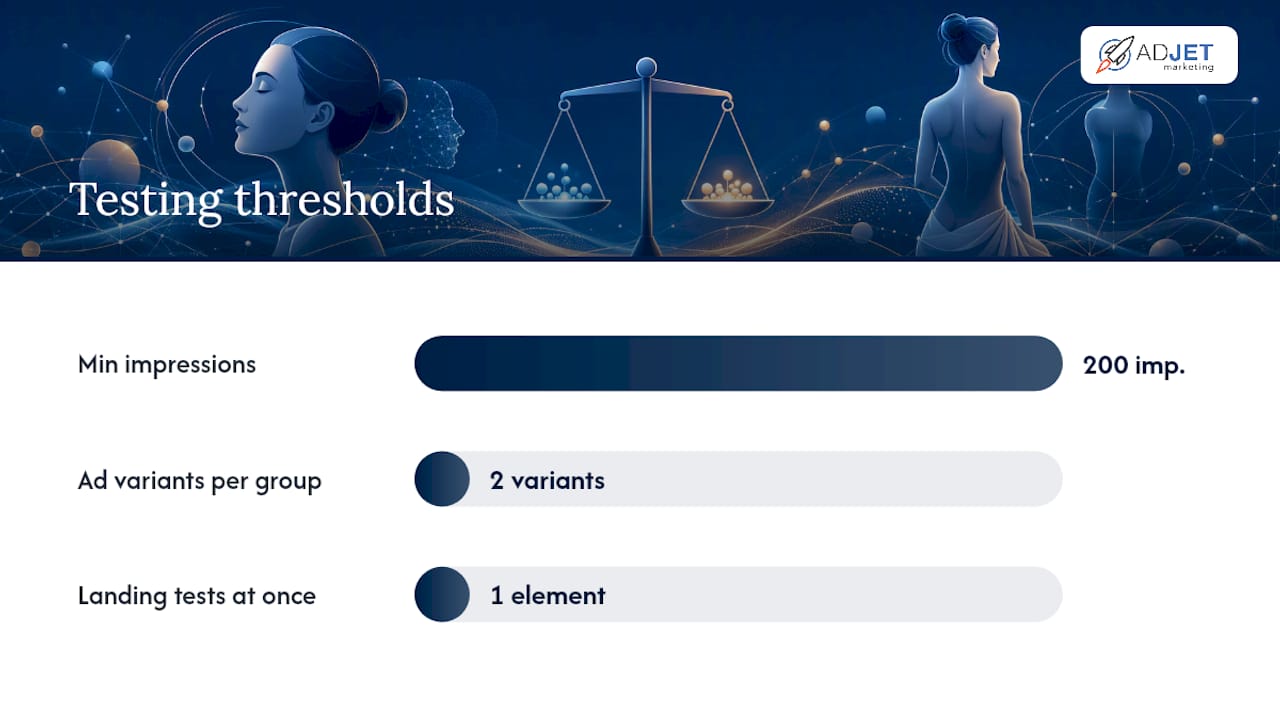
- Ad copy A/B: Run two responsive search ad variants per ad group; let each accumulate at least 200 impressions before drawing conclusions
- Landing page variants: Test one element at a time (headline, form placement, CTA button text); use Google Ads experiments or a third-party tool
- Bidding experiments: Use Google’s campaign experiments feature to test Target CPA against manual CPC on a 50/50 traffic split
- Offline conversion lift: Compare booked-consult rates in periods before and after implementing server-side tracking to confirm data quality improvement
Diagnosing common signals:
- High CPC with low conversion rate: usually a landing page problem, not a bidding problem
- Good CTR but no conversions: the ad is relevant but the landing page is not delivering on the promise
- Low impression share: budget is too low for the target geography, or Quality Score needs work
- Conversion tracking shows zero events: almost always a pixel or server-side configuration issue
For clinics pairing paid campaigns with organic growth, healthcare SEO strategies can reduce your long-term cost per patient acquisition by building organic visibility alongside paid.
What should you realistically expect in the first 90 days?
Visible leads typically appear within 7–14 days of launch if your tracking and landing pages are correctly configured. Stable, predictable performance usually arrives by month 2 or 3, assuming you are actively managing negatives and the conversion feed is clean.
Week-by-week launch timeline:
- Week 1: Campaign goes live, initial QA on tracking, first search terms review, confirm conversions are recording
- Week 2: Add 20–40 negative keywords from search terms report, check landing page load speed and mobile experience
- Week 3–4: First landing page adjustments based on bounce rate and time-on-page data; review ad copy performance
- Month 2: Negatives are maturing, conversion data is building; consider first bidding strategy test
- Month 3: Evaluate Performance Max addition, scale budgets on campaigns with confirmed positive ROAS
Common early problems and fixes:
- Policy rejection: Usually triggered by outcome claims or before/after imagery in ad creative. Revise headlines to credential-based language and resubmit.
- High CPC with no conversions: Check landing page message-match and form functionality. A broken form is a common culprit.
- Low search volume: Your keyword list may be too narrow or your geo radius too small. Expand cautiously.
When to hire an agency:
Consider bringing in external help when your monthly ad spend exceeds $5,000, when PHI compliance complexity is beyond your internal IT capacity, or when you have been running campaigns for 60 days without a clear booked-consult conversion feed. The technical requirements for server-side tracking and offline conversion imports are real, and getting them wrong carries both financial and regulatory risk. Digital marketing for plastic surgeons at that scale benefits from a team that has built these systems before.
What we see in real clinic accounts
Many clinics come to us after months of running Google Ads to their homepage. The campaigns are generating clicks, the phone rings occasionally, and the cost per lead looks acceptable on paper. Then we look at the actual booking rate and the picture changes. Homepage traffic converts at a fraction of the rate of procedure-specific landing pages because the patient has to do the work of finding the relevant information. One of the first things we do is build dedicated landing pages for each procedure and redirect the campaigns. The improvement in booked consults is usually visible within the first billing cycle.
The second pattern we see constantly is PHI in the conversion payload. A clinic has the Google Ads tag firing on the form confirmation page, and the URL contains the patient’s name or email as a query parameter. Nobody set it up maliciously; it is just how the form builder works by default. The fix is server-side tracking with a PHI-stripping layer, but the risk was real until it was addressed.
Our practical recommendations from working with aesthetic practices: enforce landing page parity before scaling budget, measure booked consults not form fills, and implement server-side conversions before you turn on Performance Max. Performance Max needs clean, high-quality conversion data to perform well. Feeding it raw form fills trains it on noise.
One more thing worth saying plainly: document patient consent for any before/after imagery you use on landing pages. Google updated its cosmetic surgery policy to tighten before/after and outcome-claim restrictions, and your consent documentation is your first line of defense if an ad is flagged. Keep signed consent forms on file and make sure your disclaimer language is visible near any imagery.
How Adjetmarketing helps plastic surgery practices run compliant, profitable campaigns
Adjetmarketing is a Google Partner agency that builds and manages Google Ads programs specifically for medical clinics and aesthetic practices. For plastic surgery clients, that means procedure-specific campaign architecture, server-side PHI-safe conversion tracking, and dedicated landing pages designed to convert clicks into booked consults.
We handle the technical setup that most clinics cannot do internally: disabling enhanced conversions, implementing server-side GTM with PHI-stripping rules, and feeding booked-consult data back to Google for smart-bidding accuracy. We also manage the ongoing compliance layer, reviewing ad copy against Google’s healthcare policy before submission to reduce rejection rates.
If you want to know where your current setup stands, the right starting point is a technical audit. We review your tracking configuration, campaign structure, landing pages, and conversion data quality, then give you a clear picture of what is working and what carries compliance or performance risk. To schedule that audit, visit our Google Ads service page.
Sources
The recommendations in this guide draw on the following sources, selected for policy authority, clinical relevance, and practical applicability to U.S. plastic surgery advertising:
- Social media in plastic surgery: a systematic review
- Google Ads policy: restricted healthcare and medicines (archived)
- Google Ads for Plastic Surgeons: Restricted Category Campaign Architecture — Curve Compliance
This article is general information, not a substitute for advice from a qualified doctor. Consult a qualified healthcare professional about your own circumstances before acting on anything here.