









Start with procedure-specific pages and Google Business Profile optimization, set up your measurement baseline in Google Search Console, and you should see map-pack movement within 60–90 days and attributable consults within 4–7 months. That’s the short version. Everything below is the detailed playbook.
Here’s what to do this week:
- Audit your current procedure pages. Identify which procedures have dedicated pages and which are buried in a generic “services” list.
- Claim and fully complete your Google Business Profile. Add services, appointment links, photos, and a primary category of “Plastic Surgeon.”
- Install Google Search Console if it isn’t already connected, and submit your sitemap.
- Pull a Core Web Vitals report from PageSpeed Insights to identify any technical issues blocking rankings.
- Identify your three highest-revenue procedures and prioritize those pages for content upgrades first.
The American Society of Plastic Surgeons (ASPS) publishes advertising guidance that governs how you present before/after content and promotional claims. Get familiar with it before you publish anything new.
Key Takeaways
Plastic surgery SEO requires procedure-page-first architecture, verified E-E-A-T signals, and HIPAA-safe tracking to drive attributable consults from organic search.
| Point | Details |
|---|---|
| Start with procedure pages | Build one dedicated, long-form page per high-volume procedure before any other content work. |
| GBP drives early wins | Active Google Business Profile optimization typically produces map-pack movement within 60–90 days. |
| Timelines are realistic | Meaningful consult attribution from organic search is typically measurable by months 5–7 of a focused campaign. |
| Compliance is non-negotiable | HIPAA-safe tracking, FTC-compliant claims, and ASPS gallery consent must be in place before publishing new content. |
| Adjetmarketing offers an audit-first approach | Adjetmarketing’s medical SEO engagements start with a full technical and GBP audit to identify gaps before any retainer begins. |
Table of Contents
- Why plastic surgery SEO demands a different approach than general local SEO
- The 8-point prioritized SEO playbook for plastic surgery practices
- How to structure procedure pages that rank and convert
- Technical SEO and site experience: must-fix items that block rankings
- Google Business Profile and local SEO playbook for map-pack visibility
- How to build authority and backlinks for a medical practice
- Converting visits into consults: landing pages, intake flows, and tracking
- KPIs, realistic timelines, and sample budgets for plastic surgery SEO
- Common mistakes, compliance pitfalls, and red flags when hiring agencies
- What an E-E-A-T-driven workflow looks like in practice
- What I’ve seen working with plastic surgery clinics
- Adjetmarketing helps plastic surgery practices build SEO that drives real consults
- Sources
Why plastic surgery SEO demands a different approach than general local SEO
Plastic surgery is classified as a YMYL (Your Money or Your Life) topic by Google. That classification has real consequences for how your content is evaluated, how your site ranks, and what happens when you cut corners.
Google’s algorithm history shows a consistent pattern: every major core update since 2018 has tightened the standards for medical content. Sites without documented author expertise, clinical citations, and verifiable credentials have lost rankings, sometimes dramatically, after updates like Medic (2018) and the 2023–2024 Helpful Content rollouts. This isn’t a trend that reverses.
E-E-A-T for plastic surgery means more than adding a doctor’s name to a page. It means documented editorial workflows: a named surgeon reviews and approves procedure content, author bylines carry credentials and board certifications, and every factual claim links to a clinical source or professional body. Google’s quality raters use these signals to assess whether a site deserves to rank for health queries.
What this means practically:
- Content authorship: Every procedure page needs a named, credentialed author or reviewer. A generic “medical team” byline won’t satisfy quality raters.
- Compliance hygiene: HIPAA applies to your intake forms, tracking pixels, and any patient data that touches your CRM. FTC rules govern before/after claims and testimonials. ASPS advertising guidance covers gallery consent and promotional restrictions.
- Link standards: A bulk directory package that works fine for a plumber is a liability for a plastic surgery site. YMYL sites are held to a higher standard for link quality.
- Editorial workflows: You need a documented process for who reviews content, when, and how updates are approved. This protects you during algorithm updates and demonstrates E-E-A-T to Google’s systems.
General SEO agencies often skip these steps because their standard process doesn’t include clinical review or compliance checks. That’s where specialist processes, including structured author bylines, medical schema, and HIPAA-safe tracking, make the difference between rankings that hold and rankings that evaporate after the next core update. For a deeper look at how these workflows apply to clinics, medical SEO for clinics covers the E-E-A-T and content workflow requirements in detail.
The 8-point prioritized SEO playbook for plastic surgery practices
Use this as your project scope and briefing document. Each item is ordered by impact and dependency.
-
Procedure pages (own this first). Build or upgrade one dedicated page per high-volume procedure. This is the highest-ROI activity. Owner: agency or in-house marketer with clinical review from surgeon.
-
Google Business Profile and local signals. Complete your GBP, add services, appointment links, and photos. Respond to every review. Owner: clinic staff or agency. Quick win: 60–90 days.
-
Technical SEO and Core Web Vitals. Fix crawlability, HTTPS, mobile rendering, and page speed before scaling content. Owner: agency or developer. Gating issue.
-
Conversion optimization (CRO). Short consult forms, visible phone numbers with call tracking, and mobile-first UX. Owner: agency or web developer.
-
Authority and backlinks. Earn links from medical publications, local health reporters, ASPS directories, and referral partners. Owner: agency. Long-game activity.
-
Content calendar and FAQ clusters. Blog posts, FAQ schema, and topical clusters around each procedure. Owner: agency with clinical review. Builds over 6–12 months.
-
Reviews and reputation. Implement a consent-safe review request process and monitor velocity. Owner: clinic staff with agency guidance.
-
Measurement and reporting. Set up GA4, Search Console, and call tracking before anything else goes live. Owner: agency or in-house marketer.
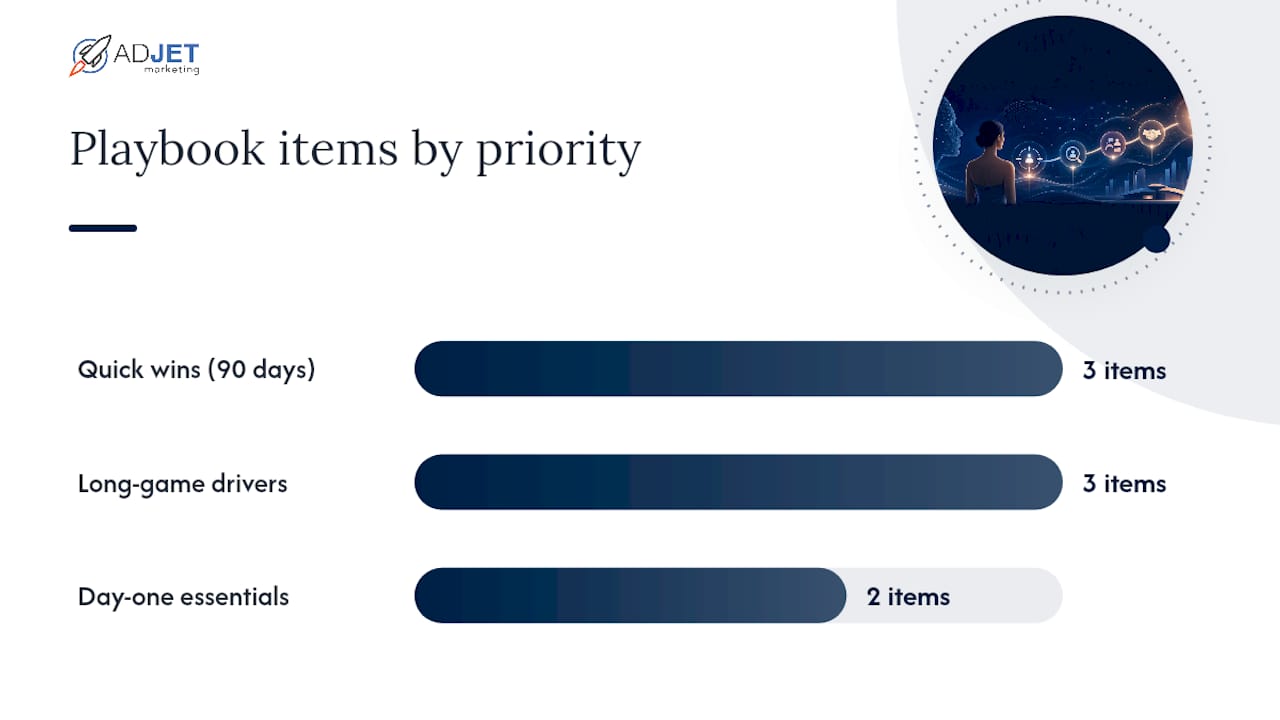
Quick wins (items 2, 3, and 7) can show movement within 90 days. Items 1, 5, and 6 are the long-game drivers of organic consult volume. Items 4 and 8 should be in place from day one, not added later.
Pro Tip: Use Semrush or Ahrefs to size the keyword opportunity for each procedure before you decide which pages to build first. A procedure with 500 monthly searches and low competition often outperforms a high-volume term that’s dominated by major hospital systems.
For a broader view of how SEO fits alongside paid ads and website design for plastic surgery practices, plastic surgery marketing covers the full channel mix.
How to structure procedure pages that rank and convert
Every high-value procedure needs its own dedicated, long-form page. A single “services” page listing rhinoplasty, breast augmentation, and liposuction in three sentences will not rank for any of them. The one-page-per-procedure approach is the standard for practices that want to win local procedure searches.
The content template that works
Each procedure page should follow this structure, in order:
- Headline that includes the procedure name and a location modifier (e.g., “Rhinoplasty in Dallas, TX”).
- Patient question lead — open with the question your patient is actually asking, not a clinical definition.
- Procedure overview in plain language, 150–200 words.
- Ideal candidate section — who is a good fit and who isn’t. This builds trust and pre-qualifies leads.
- Step-by-step process — what happens from consultation through surgery.
- Recovery timeline with realistic milestones.
- Expected outcomes — honest, not promotional.
- Cost range or financing note — patients search for this. Avoiding it doesn’t help you; it sends them to a competitor who answers the question.
- FAQ section using schema-friendly Q&A blocks (FAQ schema markup).
- Surgeon bio link with credentials, board certifications, and a photo.
- Before/after gallery with photo dates, patient consent statement, and structured markup.
- Strong CTA — a visible consult booking button or form, above the fold on mobile.
Internal linking pattern
Each procedure page should link to three canonical supporting pages: the cost/financing page, the recovery guide, and the surgeon bio. It should also link to two or three related blog posts (e.g., “What to expect after rhinoplasty” or “Rhinoplasty vs. septoplasty: what’s the difference”). This internal linking pattern distributes authority and signals topical depth to Google.
Before/after galleries are one of the strongest trust signals on a procedure page — and one of the highest compliance risks. The ASPS advertising policy sets clear standards for how member practices should present gallery content, including consent requirements and restrictions on misleading imagery. Every photo needs a date, a written consent statement, and a disclaimer that results vary. Structured markup (ImageObject schema) helps search engines index gallery content correctly.
Pro Tip: Add FAQ schema markup to every Q&A block on your procedure pages. Featured snippet and AI Overview placements for procedure queries are heavily driven by structured Q&A content. SERP feature optimization for these blocks can generate visibility beyond your organic ranking position.
Technical SEO and site experience: must-fix items that block rankings
Fix crawlability, mobile UX, Core Web Vitals, and schema first. These are gating issues. A beautifully written procedure page that loads in 6 seconds on mobile, has duplicate canonical tags, or lacks structured data will underperform regardless of content quality.
Run these tools immediately:
- PageSpeed Insights — pull field data for Core Web Vitals (LCP, CLS, INP) for your top procedure pages and your homepage.
- Google Search Console — check the Coverage report for crawl errors, the Core Web Vitals report for failing URLs, and the Mobile Usability report.
- Mobile UX check — load your site on a real Android and iOS device, not just a desktop browser’s responsive mode.
Priority fix checklist
- HTTPS: Every page must be served over HTTPS. Mixed content warnings suppress rankings.
- Canonicalization: Confirm that each procedure page has a single canonical URL. Duplicate content from URL parameters or trailing slashes is common on WordPress sites.
- Mobile rendering: Procedure pages, forms, and CTAs must be fully functional on mobile. Most patients searching for cosmetic procedures are on their phones.
- Core Web Vitals: Target LCP under 2.5 seconds, CLS under 0.1, and INP under 200ms. Gallery-heavy pages are the most common offenders.
- Image optimization: Compress before/after photos using WebP format. Lazy-load images below the fold. Add descriptive alt text that includes the procedure name.
- Structured data: Implement Physician schema for surgeon profiles, MedicalProcedure or MedicalCondition schema for procedure pages, and Review schema where applicable.
- Sitemap and robots.txt: Submit an updated XML sitemap to Search Console. Confirm that robots.txt isn’t accidentally blocking procedure pages or gallery directories.
- Site architecture: Procedure pages should be reachable in two clicks from the homepage. Deep-click journeys (four or more levels) reduce crawl frequency and dilute internal link authority.
Avoid creating thin templated location pages unless you have a staffed address at that location. A page that says “We serve patients in [City]” with no unique content is a liability, not an asset.
Google Business Profile and local SEO playbook for map-pack visibility
Your Google Business Profile is the primary local asset for plastic surgery practices. Treat it like a conversion-focused mini-site that mirrors your procedure-level CTAs, not a directory listing you set up once and forget.
GBP setup checklist
- NAP consistency: Name, address, and phone number must match exactly across your website, GBP, and all citations.
- Primary category: “Plastic Surgeon” (not “Medical Clinic” or “Cosmetic Surgeon” — use the most specific applicable category).
- Service attributes: Add individual services mapped to your procedure pages (rhinoplasty, breast augmentation, liposuction, etc.).
- Appointment links: Connect your booking system or consult request form directly from GBP.
- Photos and video: Upload high-quality exterior, interior, and team photos. Add a short practice overview video. Update photos quarterly.
- Staff profiles: Add surgeon profiles with credentials.
- Q&A management: Seed your own Q&A section with common patient questions and answers. Monitor and respond to user-submitted questions.
GBP review velocity matters more than total review count. A practice with 40 reviews posted over the last six months will typically outperform one with 200 reviews, most of which are two years old. Patients and Google’s local algorithm both weight recency. Build a steady, consent-safe cadence of review requests rather than a one-time campaign.
Review strategy
Request reviews through a post-consultation email or SMS sequence. Keep the ask simple and direct. Never offer incentives for reviews — that violates Google’s policies and the FTC’s endorsement guidelines. When you receive a negative review, respond professionally within 48 hours. A thoughtful response to a negative review often reassures prospective patients more than a perfect score.
KPIs to track for local visibility
- Map-pack impressions (GBP Insights)
- GBP calls and direction requests
- Profile views (search vs. maps)
- Review velocity (new reviews per month)
- Conversion rate from GBP to website clicks
For location pages, only create one if you can point to a staffed address or a documented service area. Thin location pages with no unique content are a common source of wasted effort in multi-location rollouts.
How to build authority and backlinks for a medical practice
Quality beats quantity. A single link from a regional health publication or a university medical center carries more weight than 50 links from generic directories. For YMYL sites, bulk link packages and low-quality guest posts are high-risk, not just low-value.
Tactics that work for plastic surgery practices
- Clinician-byline articles: Pitch procedure explainers or patient education pieces to local health publications, regional magazines, and hospital newsletters. The surgeon’s byline earns both the link and the E-E-A-T signal.
- Local hospital and clinic partnerships: If your surgeons have admitting privileges or referral relationships, request a listing or mention on the partner organization’s website.
- Medical society citations: Listings on plasticsurgery.org and board certification directories (American Board of Plastic Surgery) are high-authority citations that also build patient trust.
- Local news and health reporters: Offer your surgeon as a source for stories on cosmetic trends, patient safety, or procedure innovations. Earned media links are among the highest-quality links available.
- Patient story features: With documented written consent, a patient’s story published on a local news site or health blog generates a natural, high-trust link.
- University and academic partnerships: If your practice is affiliated with a teaching hospital or residency program, pursue a link from the institution’s faculty or partner page.
Avoid any agency or vendor that offers a “link package” for medical sites. Bulk directories, private blog networks, and low-quality guest posts are counterproductive for YMYL sites. Google’s spam systems are specifically tuned to detect unnatural link patterns in health content. A penalty on a plastic surgery site can take 6–12 months to recover from, and the reputational damage with patients is harder to quantify.
Use Ahrefs to audit your current backlink profile before starting outreach. Filter by domain rating and topical relevance. Prioritize acquiring links from domains that already rank for health or medical queries in your market.
Converting visits into consults: landing pages, intake flows, and tracking
Conversion depends on the page experience and a simple, clinic-aligned intake flow. Expanding content volume before fixing conversion is a common mistake. A procedure page that drives 500 visits per month but converts at 0.5% produces fewer consults than one that drives 200 visits at 3%.
Landing page checklist
- Short consult forms: Ask for name, phone, email, desired procedure, and preferred contact time. Every additional field reduces completion rates.
- Visible phone number with call tracking: Use dynamic number insertion (DNI) so calls from organic search are attributed separately from paid traffic.
- Trust signals above the fold: Surgeon credentials, board certifications, and a before/after photo (with consent) should appear before the patient scrolls.
- Mobile-first UX: The form and CTA button must be thumb-accessible on a 375px screen. Test it on a real device.
- Friction reduction: Remove navigation menus from dedicated consult landing pages. Every link that isn’t the CTA is an exit opportunity.
The intake form is where most practices lose attribution data. If your form doesn’t capture the referring source, the search term, and the desired procedure, you can’t close the loop between your SEO investment and your consult volume. That gap makes it nearly impossible to justify budget increases or identify which procedure pages are driving revenue.
Tracking essentials
- Google Analytics 4: Configure conversion events for form submissions, phone click-to-calls, and appointment confirmations.
- Google Search Console: Connect to GA4 for query-level data. Monitor which procedure keywords are driving clicks and impressions.
- Call tracking with DNI: Tools like CallRail allow you to assign unique numbers to organic, paid, and direct traffic sources.
- UTM conventions: Standardize UTM parameters across all campaigns so GA4 attribution is consistent.
- CRM integration: Pass form submission data, including the search term and referral source, into your CRM so front-desk staff can qualify leads by channel.
For A/B testing, start with headline variants and CTA placement before testing page structure. Micro-conversion goals to measure include video plays on procedure overview videos, gallery interactions, and FAQ section engagement.
KPIs, realistic timelines, and sample budgets for plastic surgery SEO
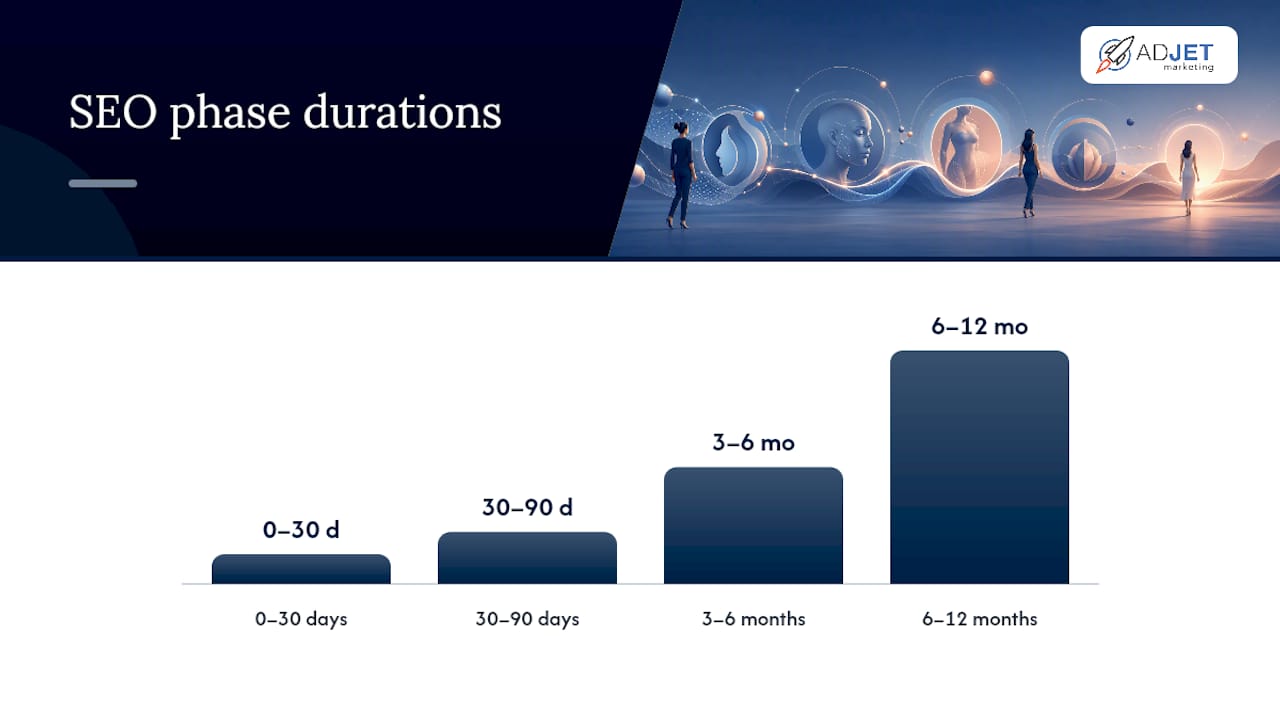
Expect map-pack movement in 60–90 days with active GBP work. Procedure keyword traction typically takes 6–12 months, depending on market competitiveness. Meaningful patient acquisition is often trackable by months 5–7 after a focused campaign begins.
KPIs to track
- Consultations attributed to organic search (primary KPI)
- Procedure-page conversion rate (form submissions + calls / organic sessions)
- GBP views, calls, and direction requests
- Organic visibility for target procedure keywords (tracked in Search Console and Semrush)
- New review velocity (reviews per month)
- Core Web Vitals scores for top procedure pages
Sample budget tiers
Healthcare SEO typically costs more than general SEO because of the compliance requirements, clinical review workflows, and content depth required for YMYL topics. An audit-first approach is recommended before committing to a retainer.
These ranges align with tiered retainer structures reported for medical practices by practice size and market competitiveness.
Timeline vs. expected outcomes
| Timeframe | Expected Outcomes | Primary Activities |
|---|---|---|
| 0–30 days | Baseline established, technical issues identified | Audit, GBP setup, Search Console, GA4 |
| 30–90 days | Map-pack movement, improved Core Web Vitals | GBP optimization, technical fixes, first procedure pages |
| 3–6 months | Procedure keyword rankings emerging, GBP calls increasing | Content production, link outreach, CRO |
| 6–12 months | Attributable consults from organic, review velocity building | Full content calendar, authority links, reporting refinement |
To benchmark SEO value against paid search, use Semrush to pull CPC data for your target procedure keywords. In the Physicians & Surgeons category, CPCs for terms like “rhinoplasty [city]” or “breast augmentation [city]” often run $15–$40 per click. Organic rankings that generate the same click volume represent significant cost savings over time, though paid ads remain the faster path to immediate consults while SEO builds. For a direct comparison of the two channels, SEO vs. PPC breaks down when each makes sense for a medical practice.
For aesthetics-specific benchmarks and ROI data, SEO benefits for aesthetics practices provides additional context on what to expect by practice type.
Common mistakes, compliance pitfalls, and red flags when hiring agencies
The most common SEO mistakes plastic surgery practices make
- Thin or templated procedure pages: A page with 200 words and a stock photo will not rank. It also signals low E-E-A-T to Google’s quality systems.
- Bulk link packages: Any vendor offering 50 directory links for $200/month is selling you a liability, not an asset.
- Missing written patient consent for before/after photos: Publishing gallery content without documented consent exposes you to HIPAA liability and violates ASPS advertising standards.
- No author attribution on procedure content: Unattributed medical content fails E-E-A-T checks. Every procedure page needs a named, credentialed reviewer.
- HIPAA-unsafe tracking: Standard Google Analytics configurations can capture PHI (protected health information) if intake forms aren’t properly isolated. Use server-side tagging or a HIPAA-compliant analytics configuration.
- Ignoring negative reviews: A pattern of unanswered negative reviews damages both local rankings and patient trust.
Compliance reminders
- HIPAA: Review your intake forms, tracking pixels, and CRM integrations with a HIPAA compliance consultant before launching any new tracking setup.
- FTC rules: Before/after claims and testimonials must reflect typical results. “Results may vary” disclaimers are required. Paid endorsements must be disclosed.
- ASPS guidance: Member practices should follow ASPS advertising policy for gallery content, promotional claims, and patient testimonials.
The most dangerous agency red flag isn’t a bad pitch — it’s vague reporting. If a vendor can’t tell you which procedure keywords moved, how many GBP calls came from organic, or what the consult attribution looks like by channel, they’re not running a real program. Vague monthly reports with “traffic increased 12%” and no consult data are a signal that measurement wasn’t set up correctly from the start.
Additional red flags in agency proposals
- Promises of “top rankings in 30 days” or guaranteed positions
- No mention of content authorship or clinical review workflows
- Monthly fees under $1,000 that claim to include content, links, and technical work
- No audit phase before the retainer begins
- Inability to explain their link acquisition process
If your site has been harmed by past vendor tactics, start with a full technical and backlink audit using Ahrefs and Search Console. Disavow toxic links through Google’s Disavow Tool, rebuild procedure pages with proper E-E-A-T signals, and document your editorial workflow before publishing new content. Recovery takes time, but a clean foundation is faster to build on than a compromised one.
For a broader list of marketing mistakes that apply across healthcare practices, healthcare marketing mistakes to avoid covers the most common errors we see in clinic audits.
What an E-E-A-T-driven workflow looks like in practice
The process isn’t complicated, but it requires discipline. Here’s how a structured agency-client engagement typically flows for a plastic surgery practice:
Phase 1: Audit (weeks 1–2). Technical audit via Search Console and PageSpeed Insights, GBP health check, backlink profile review in Ahrefs, and a content gap analysis against target procedure keywords.
Phase 2: Procedure pages and GBP (weeks 3–8). Build or upgrade the top three to five procedure pages using the content template above. Complete GBP setup. Implement Physician and FAQ schema. Submit updated sitemap.
Phase 3: Technical fixes (weeks 3–6, parallel). Resolve Core Web Vitals failures, canonicalization issues, and mobile rendering problems. Optimize gallery images.
Phase 4: Content and clinical review (ongoing from week 6). Launch a content calendar with two to four pieces per month. Each piece goes through a documented clinical review step: the surgeon reviews for accuracy, the marketer reviews for SEO, and the final version carries the surgeon’s byline.
Phase 5: Authority outreach (month 3 onward). Begin clinician-byline pitches to local health publications, pursue ASPS and board certification directory listings, and identify referral partner link opportunities.
Phase 6: Measurement and iteration (ongoing). Monthly reporting on consult attribution, GBP calls, procedure keyword rankings, and Core Web Vitals. Quarterly CRO review of top procedure pages.
The practices that see the clearest results from this process are the ones that treat the surgeon’s involvement as a feature, not a bottleneck. When the surgeon’s name, credentials, and voice are woven into the content, the E-E-A-T signal is genuine — and patients respond to it. A page that reads like it was written by a real physician who performs this procedure every week converts differently than one that reads like a generic health article.
Example outcomes from a structured engagement
| Metric | Baseline (Month 1) | Month 6 | Month 12 |
|---|---|---|---|
| GBP calls (organic) | Untracked | Tracked, increasing | Measurable, attributed |
| Procedure page rankings | Page 3–5 | Page 2–3 | Page 1–2 for target terms |
| Consult attribution (organic) | Not measured | Partial attribution | Full attribution via GA4 + call tracking |
| Review velocity | Sporadic | 4–6 new reviews/month | 6–10 new reviews/month |
These are representative outcomes based on a structured engagement with active clinical review and consistent content production. Individual results depend on market competitiveness, starting domain authority, and the practice’s ability to participate in the review and approval process.
Compliance was handled throughout: patient consent was documented before any before/after content was published, physician attribution appeared on every procedure page, and the editorial workflow was documented in a shared project brief that both the agency and the practice signed off on.
What I’ve seen working with plastic surgery clinics
Most clinics that come to us for SEO have already tried something. They ran Google Ads for six months and got clicks but not consults. Or they hired a general SEO agency that built links and wrote blog posts, but the procedure pages never moved. The common thread is that the foundational work, the procedure pages, the GBP, the tracking, was either skipped or done poorly.
The audit-first approach matters because it tells you exactly where the gap is before you spend a dollar on content or links. Sometimes the issue is purely technical: a site that loads in 7 seconds on mobile or has 40 pages blocked in robots.txt. Sometimes it’s a content problem: five procedures sharing one page with 300 words each. Knowing which problem you’re solving changes the entire project plan.
On the paid ads vs. SEO question: if you need consults in the next 60 days, start with Google Ads while SEO builds. The two channels aren’t in competition. Paid search gives you immediate data on which procedure terms convert; SEO turns that knowledge into durable organic rankings that don’t stop when the budget does.
Adjetmarketing helps plastic surgery practices build SEO that drives real consults
Adjetmarketing is a Google Partner agency that works specifically with medical clinics and aesthetic practices. For plastic surgery practices, the core services are procedure-page SEO, Google Business Profile management, high-converting WordPress website design, GA4 and call tracking setup, and conversion rate optimization. Every engagement starts with an audit so you know exactly what’s blocking your rankings and consults before any retainer begins.
If you’re ready to see where your practice stands, request a medical marketing review or explore Adjetmarketing’s SEO services to get a clear picture of what a focused plastic surgery SEO program would look like for your practice.
Sources
Use these directly to run audits, check compliance, and validate recommendations:
When using any external data or clinical citations in your procedure content, preserve your physician-review workflow. Every factual claim that comes from an external source should be reviewed and approved by the named surgeon before publication. That review step is part of your E-E-A-T documentation, not just a quality check.
This article is general information, not a substitute for advice from a qualified doctor. Consult a qualified healthcare professional about your own circumstances before acting on anything here.