









Most real estate agents assume that dominating online lead generation requires a massive budget and a team of marketing specialists. That assumption is costing you clients. The truth is, a practical methodology for Google Ads lead generation focuses on tracking conversions like calls and forms, then using that data to refine bids and concentrate spend on the keywords that actually generate appointments. Smart strategy beats big spending every time. In this guide, you will learn exactly why Google Ads is a powerful equalizer for real estate agents, how to measure what matters, and which mistakes drain budgets without producing results.
Table of Contents
- How Google Ads transforms real estate lead generation
- Comparing Google Ads to other real estate lead sources
- What makes Google Ads profitable: measurement and ongoing optimization
- Common pitfalls and missed opportunities with Google Ads
- The uncomfortable truth: success with Google Ads is about what happens after the click
- Take your real estate ads to the next level
- Frequently asked questions
Key Takeaways
| Point | Details |
|---|---|
| Target high-intent buyers | Google Ads lets you reach people actively searching for real estate, increasing the quality of your leads. |
| Track and optimize every step | Success depends on tracking calls and forms, and refining your campaigns based on real appointments. |
| ROI beats volume | Focus on closed deals and commissions instead of simply generating more leads. |
| Act fast on every lead | Prompt follow-up is crucial to avoiding ‘lead decay’ and maximizing your ad investment. |
| Consistent improvement wins | Continually analyzing and adjusting your Google Ads delivers better results than a ‘set-and-forget’ approach. |
How Google Ads transforms real estate lead generation
To understand why Google Ads stands out, let’s look closely at how it changes the real estate lead game.
Most marketing channels reach people who might eventually want to buy or sell a home. Google Ads is different. It reaches people who are actively searching right now. When someone types “homes for sale in Austin under $400k” into Google, they are not casually browsing. They have intent. That distinction is the foundation of everything that makes Google Ads powerful for real estate.
Here is what makes Google Ads uniquely effective for agents:
- Intent-based targeting: You appear in front of buyers and sellers at the exact moment they are searching for a solution, not just scrolling through social media.
- Geographic precision: You can target specific zip codes, cities, or neighborhoods, so your ad budget focuses entirely on the markets where you actually close deals.
- Flexible budget control: You set daily caps, adjust bids in real time, and pause campaigns whenever needed. No long-term contracts or locked-in fees.
- Conversion tracking: Google Ads lets you track every phone call, every form submission, and every action a visitor takes on your landing page, making your ROI visible and measurable.
- Ad scheduling: You can show ads only during business hours, or during the times when your leads are most likely to call, which reduces wasted impressions.
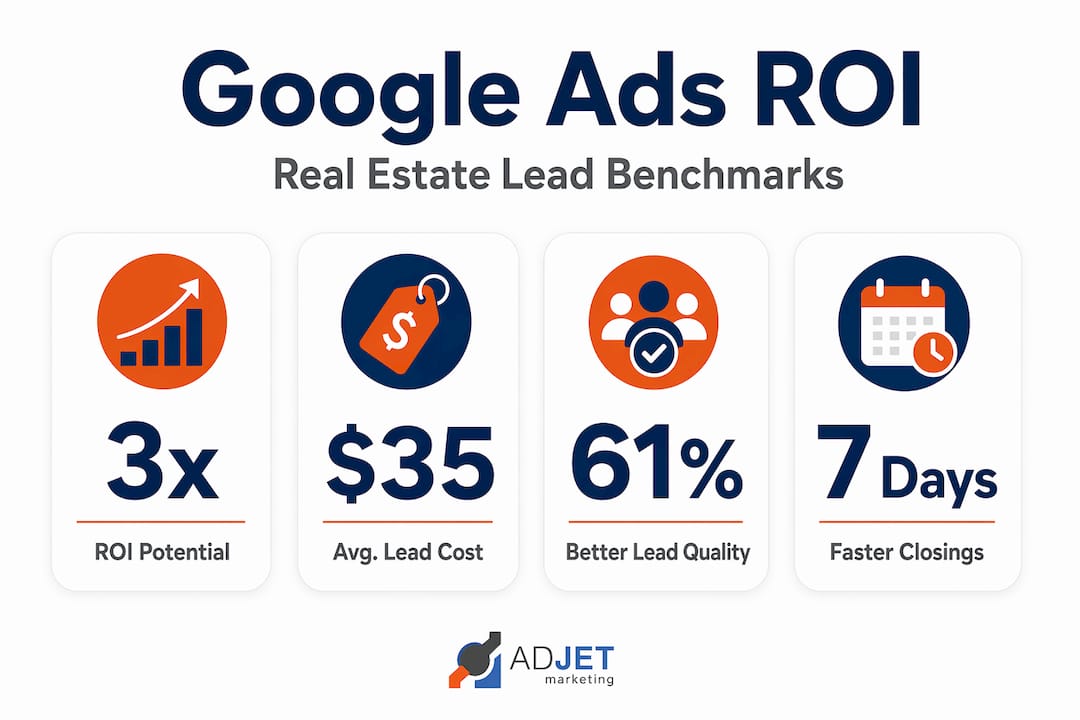
Real estate lead cost and ROAS expectations are market-specific and funnel-dependent. Published benchmarks show that cost per lead can vary widely between markets, which is why you should measure profitability by closed deals and commission earned rather than just counting how many leads came in. A $50 lead that closes a $500,000 transaction is worth far more than 20 free leads that never answer the phone.
Understanding analytics in marketing helps you connect ad spend directly to revenue outcomes, not just traffic numbers. When you combine that analytical mindset with optimizing Google Ads campaign structure, you start making decisions based on actual business results.
Pro Tip: Stop measuring your Google Ads success by leads generated. Start measuring by closed deals and commissions earned. A single closed transaction can justify an entire month of ad spend, so track the full journey from click to contract.
Comparing Google Ads to other real estate lead sources
Now that you see Google Ads’ strength in generating quality leads, let’s compare it directly to other popular options.

Real estate agents typically rely on a mix of sources for online leads. Each has strengths and trade-offs. Understanding those differences helps you allocate your marketing budget with confidence rather than guessing.
Common real estate lead sources explained:
- Real estate portals (listing platforms): These are subscription-based platforms where you pay for leads in a specific zip code. They offer high lead volume but also high competition, since multiple agents often receive the same lead simultaneously.
- Facebook and Meta ads: These reach a broad audience using demographic and interest targeting. They work well for brand awareness and generating buyer leads at scale, but the intent level is generally lower than search-based ads.
- Google Ads (search campaigns): These capture leads who are actively searching for real estate services. The intent is higher, the competition is direct, and results are fully trackable.
Here is a direct comparison of the three most common sources:
| Factor | Real estate portals | Facebook/Meta ads | Google Ads |
|---|---|---|---|
| Lead intent | Low to medium | Low | High |
| Cost per lead | High | Medium | Medium to high |
| Lead exclusivity | Shared | Exclusive | Exclusive |
| Speed to convert | Slow | Slow to medium | Fast |
| Budget control | Limited | High | High |
| ROI transparency | Low | Medium | High |
| Management effort | Low | Medium | High |
The data tells a clear story. Real estate lead cost and ROAS expectations show that Google Ads can deliver higher ROI compared to portal leads, but that result depends entirely on how well you execute and follow up. Google Ads gives you the raw material. Your systems and speed determine the outcome.
“Google Ads can have higher ROI vs portals, but results are still contingent on execution. The agent who responds in five minutes will outperform the one who waits five hours, every time.”
Many agents fall into predictable traps when comparing lead sources. Here are the most common mistakes to avoid:
- Comparing lead volume instead of lead quality and intent
- Ignoring how quickly leads are contacted after they come in
- Choosing a source based on low cost per lead rather than low cost per closed deal
- Abandoning Google Ads too early before campaigns have enough data to optimize
- Underestimating the lead generation insights that come from search intent data
When you apply proven ad strategies to your Google Ads campaigns, the gap between Google Ads and portals widens further in your favor. The key is structured campaign management, not just turning on ads and hoping.
What makes Google Ads profitable: measurement and ongoing optimization
Having compared sources, let’s get practical about making Google Ads deliver real results, not just leads.
Profitability in Google Ads comes from a disciplined approach to measurement. You need to know which metrics matter at each stage of the funnel and how they connect to actual revenue. Here is a clear breakdown of the KPIs you should track:
| Metric | What it measures | Why it matters |
|---|---|---|
| Impressions | How often your ad appeared | Signals reach and keyword volume |
| Click-through rate (CTR) | Percentage who clicked your ad | Measures ad relevance and appeal |
| Calls generated | Phone calls from your ads | Direct lead signal |
| Form submissions | Online inquiries from landing pages | Lead volume indicator |
| Appointments booked | Calls/forms that became showings | True conversion metric |
| Deals closed | Transactions sourced from ads | Revenue attribution |
| Cost per deal | Ad spend divided by closed deals | Real profitability measure |
Tracking all seven of these data points gives you a complete picture of where your funnel leaks and where it performs. Most agents only track the first two or three. That is exactly why most agents feel like Google Ads does not work for them.
Here is a step-by-step process for ongoing optimization:
- Set up conversion tracking from day one. Track both phone calls and form fills through Google Ads. Without this, you are flying blind. A practical methodology for Google Ads lead generation is built on using this conversion data to refine bids and identify which keywords generate actual appointments.
- Add negative keywords weekly. Negative keywords prevent your ads from showing on irrelevant searches. Terms like “rental listings,” “free MLS search,” or “real estate license course” burn budget without producing buyers or sellers. Review your search term reports every week.
- Adjust bids based on what converts. If a specific keyword drives calls that turn into appointments, increase its bid. If another keyword drives clicks but zero calls, reduce it or pause it.
- Optimize your landing page, not just your ads. Traffic quality means nothing if the page visitors land on does not convert. Use clear calls-to-action, fast load times, and lead capture forms above the fold.
- Track lead benchmarks by city to calibrate your expectations by market. What is normal in one city may be underperformance in another.
- Review website KPIs and tools monthly to identify which pages convert visitors into leads and which drive them away.
Pro Tip: Lead decay is real and it is expensive. When a high-intent lead submits a form and does not hear back within five minutes, their interest drops sharply. Every hour you wait after that makes contact less likely. Build an automated response system that reaches out immediately, even when you are with another client.
Common pitfalls and missed opportunities with Google Ads
Making Google Ads work means sidestepping some all-too-common blunders. Here is what to watch out for and how to capitalize on what others miss.
The biggest single reason Google Ads underperforms for real estate agents is not the platform, the targeting, or even the budget. It is what happens after someone clicks.
“If an agent’s follow-up process is slow or untracked, Google Ads can underperform because lead decay and poor lead-to-conversation rates negate the benefit of buying high-intent traffic.”
That quote deserves to be on your wall. You can have a perfectly structured campaign with ideal keywords and a reasonable budget, and still see a poor return if leads are not contacted immediately and consistently.
Here are the critical mistakes agents make, and how to avoid each one:
- Ignoring call and form tracking. If you cannot see which ads generated a call, you cannot make smart decisions about where to spend more or less. Set up Google Ads call tracking and form tracking on day one.
- Setting and forgetting campaigns. Google Ads campaigns require active management. Keyword performance shifts, competitors change their bids, and search behavior evolves. Review your campaigns at least weekly.
- Measuring success by lead volume, not appointments. A hundred leads that never answer the phone are worthless. Ten leads that book showings are everything. Shift your focus to lead-to-appointment rate.
- Skipping negative keywords. Broad match keywords without a robust negative keyword list will bleed your budget on irrelevant searches fast.
- Sending traffic to your homepage. Your homepage is built for many audiences. A dedicated landing page focused on one specific offer, like a free home valuation or a buyer consultation, converts far better.
- Underestimating the role of effective CTAs on your landing pages. A weak call-to-action kills conversion rates even when your ad and targeting are strong.
Here is a quick checklist to protect your ad spend and improve results:
- [ ] Track every call and form submission
- [ ] Follow up with new leads within five minutes
- [ ] Analyze conversion data weekly
- [ ] Refine your keyword list regularly, adding negatives
- [ ] Test one landing page element at a time
- [ ] Review compliant Google Ads tips to ensure your tracking setup stays within platform guidelines
- [ ] Consider working with a Google partner agency for ongoing oversight and optimization
The uncomfortable truth: success with Google Ads is about what happens after the click
Most guides about Google Ads for real estate focus on keywords, bidding strategies, and ad copy. Those things matter. But they are only half of the equation.
We have seen agents with small budgets and modest campaigns outperform competitors who spend five times as much, simply because their follow-up systems were faster and more consistent. The agent who calls a lead within three minutes is not just slightly better. They are dramatically more likely to book that appointment. The research consistently shows that speed-to-response is the single most impactful variable in converting online leads to consultations.
Here is the contrarian view we want you to sit with: the platform does the first 50% of the work. You do the other 50%. No agency, no algorithm, and no budget increase can substitute for a disciplined system of follow-up. Automated text messages, immediate email responses, and persistent call attempts over the first 48 hours are what separate agents who thrive with Google Ads from those who call it a waste of money.
An agent’s follow-up process being slow or untracked directly causes Google Ads underperformance, because lead decay and poor lead-to-conversation rates cancel out the advantage of high-intent traffic. You can buy the best leads in the market and lose them all by waiting too long to follow up.
Our hard-won lesson: the agents who review their lead-to-appointment rate monthly and adjust their follow-up scripts based on real outcomes consistently improve over time. The agents who only review their cost per click and lead count stay stuck in frustration. Make lead-to-appointment rate your north star metric.
Apply proven follow-up strategies to your post-click process and you will see the ROI on your ad spend improve, often dramatically, without changing a single thing in the campaign itself.
Take your real estate ads to the next level
Ready to put this strategy into practice and outperform your market? Managing Google Ads effectively takes consistent attention, technical know-how, and a clear system for tracking what actually matters. If you are spending money on ads without full visibility into calls, appointments, and closed deals, you are leaving significant revenue on the table.
At AdJet Marketing, we build and manage Google Ads campaigns specifically designed to generate high-quality leads with full conversion tracking built in from the start. We handle ongoing optimization, keyword management, landing page performance, and reporting so you always know exactly what your spend is producing. Not sure whether paid ads or organic search is the right starting point? Our SEO vs PPC guide lays out exactly when each strategy makes sense. Reach out today and let us show you what a properly managed campaign can do for your pipeline.
Frequently asked questions
How much should real estate agents budget for Google Ads?
Budgets vary significantly by market and competition level, but the most important measure is your cost per closed deal, not how many leads you generate per dollar. Start with a budget you can sustain for at least 60 to 90 days to collect enough data for meaningful optimization.
Do Google Ads work better than Zillow or portal leads?
Google Ads can deliver higher ROI compared to portal leads when you have strong tracking and a fast follow-up system in place. The key difference is lead exclusivity and intent level, both of which favor Google Ads.
What is “lead decay” in Google Ads for real estate?
Lead decay is the rapid loss of conversion potential that occurs when a new lead is not contacted quickly. Research shows that lead decay and slow follow-up can erase all the advantages of high-intent Google Ads traffic, making speed of response one of your most important performance variables.
Which Google Ads keywords work best for real estate?
Hyper-local, intent-based keyword phrases like “homes for sale in [neighborhood]” or “list my home in [city]” consistently outperform generic terms because they attract buyers and sellers who are ready to act, not just researching casually.
How do you track if Google Ads are generating appointments?
Set up call tracking and form submission tracking directly in your Google Ads account, then tie those conversion events to actual showings or listing appointments in your CRM. Tracking conversions through calls and forms and using that data to refine your bids is the foundation of a profitable, continuously improving campaign.
Recommended
- What’s The ROI Of Google Ads For Realtors? | Why It’s Worth Every Penny – AdJet Digital Marketing & Google Partner Agency | SEO Development Google Ads Social
- How To Get High-quality Real Estate Leads Online
- Real Estate Agent SEO – AdJet Digital Marketing & Google Partner Agency | SEO Development Google Ads Social
- How Can I Advertise My Real Estate Business Online? | Digital Tactics That Convert – AdJet Digital Marketing & Google Partner Agency | SEO Development Google Ads Social