








When a homeowner needs a plumber or an HVAC technician at 9 PM, they search Google and call the first credible result they see. Local SEO for home services is the system that puts your business in that top spot, not a competitor down the street. Yet most home service providers either skip local SEO entirely or treat it as a one-time setup task. This guide walks you through a structured 90-day plan, grounded in current data, that covers everything from your Google Business Profile to review management to website optimization so you attract more ready-to-hire customers nearby.
Table of Contents
- Key takeaways
- What you need before starting local SEO
- Your 90-day local SEO execution plan
- Common local SEO mistakes in home service marketing
- Measuring success and planning next steps
- My honest take on local SEO for home services
- Ready to accelerate your local visibility?
- FAQ
Key takeaways
| Point | Details |
|---|---|
| Google Business Profile is foundational | Optimizing your GBP with accurate categories, photos, and services directly affects how Google ranks you locally. |
| Review velocity matters most | Consistently earning and responding to new reviews builds the trust signals Google uses to rank local businesses. |
| NAP consistency across directories | Mismatched business name, address, or phone data across listings slows ranking gains even when other factors are strong. |
| AI is changing local discovery | 45% of consumers now use AI tools for local recommendations, making accurate data and strong reviews more critical than ever. |
| Metrics confirm what is working | Tracking calls, direction requests, and organic clicks from GBP shows you where to invest more and where to adjust. |
What you need before starting local SEO
Before you spend a single hour optimizing, get your foundation in place. Missing these basics means every effort you make afterward will underperform.
Your Google Business Profile (GBP) is non-negotiable. Claim and verify it if you have not already. Fill in your business name, address, phone number, website, service area, hours, and primary and secondary categories. This is where local ranking factors come into play: relevance, distance, and prominence. You can influence relevance and prominence directly. Distance is determined by where the searcher is located relative to your GBP address, so accuracy here matters far more than most business owners realize.
Tools you will need:
- Google Search Console and Google Analytics 4 (both free, both required)
- A spreadsheet or citation management tool to track your business listings across directories
- A review monitoring tool or at minimum a system to receive email alerts when new reviews come in
- A structured data testing tool to validate your LocalBusiness schema
Consistent NAP data is the backbone of every listing strategy. NAP stands for Name, Address, Phone. Every time these details appear differently across Yelp, Angi, HomeAdvisor, or local chamber directories, you introduce confusion for Google. Citation inconsistencies slow ranking improvements even when your review strategy is otherwise solid.
Pro Tip: Before anything else, Google your own business name and check the top five listing results. Note every variation in how your name or phone number appears. That list becomes your first citation cleanup task.
Finally, establish a review generation system from day one. You do not need software to start. A simple text message or email template asking satisfied customers for a Google review, sent within 24 hours of job completion, is enough to begin building velocity.
Your 90-day local SEO execution plan
This plan is built around phases. Each phase compounds on the last. Rushing through them without completing each step properly is the most common mistake we see.
Phase 1 (Days 1 to 14): Optimize your Google Business Profile
- Select the most specific primary category available (e.g., “Plumber” instead of “Contractor”).
- Add all relevant secondary categories your services qualify for.
- Write a description that includes your city, key services, and what makes you different. Keep it factual.
- Upload at least 15 high-quality photos: team in uniform, vehicles with branding, completed jobs, your storefront or office.
- Add every service you offer with individual descriptions and approximate pricing where possible.
- Set your service area to the specific cities and ZIP codes you actually serve. Avoid setting an unrealistically large radius.
Phase 2 (Days 15 to 30): Clean up your local citations
Audit every directory listing you can find. Fix NAP inconsistencies on Google, Yelp, Bing Places, Apple Maps, Angi, HomeAdvisor, and niche directories specific to your trade. A 90-day structured approach to cleaning listings, optimizing GBP, and building reviews consistently outperforms random SEO activity.
Phase 3 (Days 31 to 60): Optimize your website for local intent
Your website needs to do three things: confirm you serve the customer’s area, clearly present your services, and make it easy to contact you. Build or update these pages:
- Homepage: Include your city and primary service in the H1 heading. Add your phone number prominently above the fold.
- Service pages: One page per core service. Each page should target a specific keyword like “water heater repair in [City].”
- Location pages: If you serve multiple cities, create a dedicated page per city with unique content. Avoid duplicating the same page with just the city name swapped out. Multi-location providers who manage separate GBP listings and location-specific pages consistently outperform those who rely on a single listing.
Phase 4 (Days 45 to 75): Build a review acquisition process
Reviews are not just social proof. 97% of consumers read reviews for local businesses before making a decision. Volume, rating, and recency all affect both consumer confidence and ranking. Build a system:
- After every completed job, send a follow-up message with a direct link to your Google review page.
- Train your technicians to ask verbally when customers express satisfaction.
- Respond to every review within 48 hours. 80% of consumers are more likely to use a business that responds to each review.
Phase 5 (Days 60 to 90): Add LocalBusiness schema to your website
Schema markup tells Google specific facts about your business in a format it can read directly. Your LocalBusiness schema must match your GBP exactly: same business name, address, phone, and hours. Opening hours metadata is frequently misconfigured, and errors here can prevent your listing from showing an “Open now” label in search results.

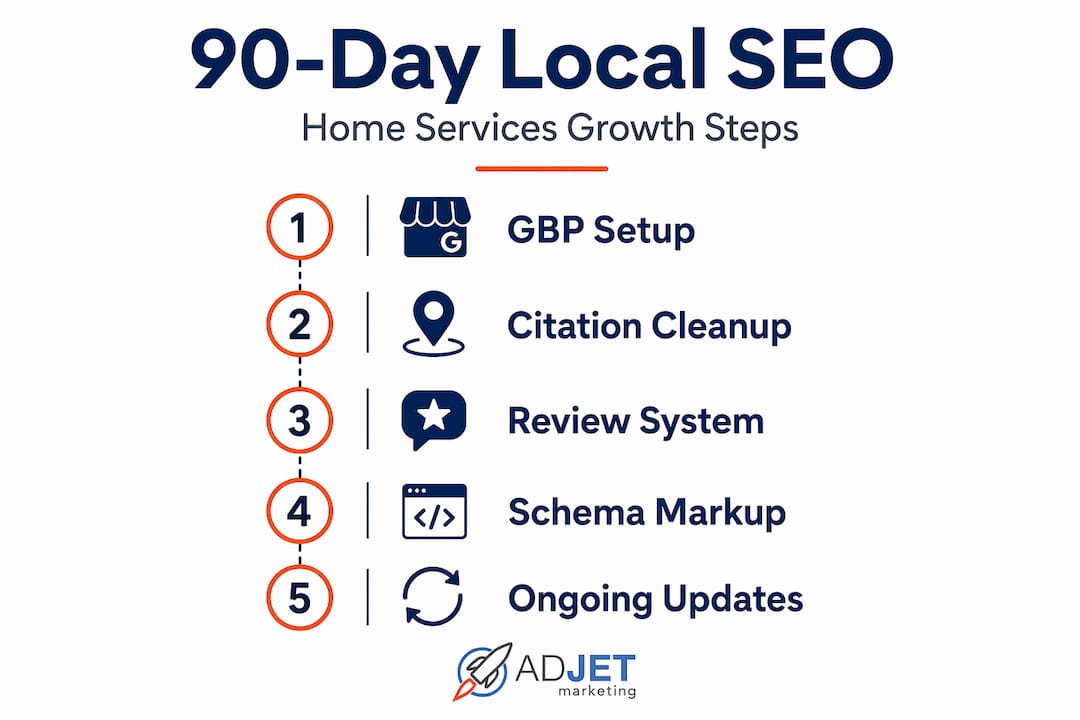
| Phase | Timeline | Primary Focus |
|---|---|---|
| GBP optimization | Days 1 to 14 | Categories, photos, services, description |
| Citation cleanup | Days 15 to 30 | NAP consistency across all directories |
| Website optimization | Days 31 to 60 | Service pages, location pages, conversion elements |
| Review system | Days 45 to 75 | Acquisition process, response protocol |
| Schema markup | Days 60 to 90 | LocalBusiness schema, validation, GBP alignment |
Pro Tip: Post an update, offer, or completed project photo to your GBP at least once every two weeks. Active GBP accounts with regular posts send freshness signals that contribute to local prominence.
Common local SEO mistakes in home service marketing
Even business owners who invest real time into local SEO frequently undermine their results with a handful of recurring errors. Here is what to watch for.
- Ignoring review responses. Delayed or absent responses signal low engagement to both Google and potential customers. With 81% of consumers expecting a reply within a week, falling behind on responses directly costs you jobs.
- Inconsistent NAP data. If your business is listed as “ABC Plumbing LLC” in one place and “ABC Plumbing” in another, Google weighs those as potentially different entities. Consistency across every platform is not optional.
- Faking your location. Using a UPS Store address or listing a city you do not actually operate from risks Google suspending your GBP entirely. Distance from the searcher to your actual business location is fixed. You cannot game it safely.
- Neglecting conversion elements. Getting traffic to your website without a clear call-to-action, visible phone number, or easy booking form means you are paying for visibility with no return. Local traffic from high-intent searches converts when the page makes it easy.
- Ignoring AI-driven discovery. 45% of consumers now use AI tools for local business recommendations, up from just 6% the prior year. Most AI recommendations pull from your reviews and public data. A poor reputation or outdated information across platforms will cost you referrals you never even see.
- Going dark on your GBP. No new photos, no posts, no updated hours. Google interprets inactivity as low relevance. Staying active takes less than 30 minutes per week and makes a measurable difference in prominence scores.
Pro Tip: Set a recurring calendar reminder every Monday morning to check for new reviews and post one GBP update. Consistency matters more than volume here.
Measuring success and planning next steps
You cannot improve what you do not measure. Tracking the right signals shows you what is working and where to focus your next 90 days.
Primary metrics to track from GBP Insights:
- Phone calls directly from your GBP listing
- Direction requests (strong signal that someone intends to visit or confirm you are real)
- Website clicks from GBP
- Number of searches that triggered your listing (search queries report)
Website and search metrics:
- Organic traffic to service and location pages via Google Analytics 4
- Keyword ranking positions in your primary service cities using a geo-grid tracking tool
- Conversion rate on key landing pages (calls, form fills, chat initiations)
Review metrics to monitor monthly:
- Total review count across Google and other platforms
- Average star rating trend over time
- Your average response time to new reviews
| Metric | Tool | Review Frequency |
|---|---|---|
| GBP calls and clicks | GBP Insights | Weekly |
| Keyword ranking by location | Geo-grid rank tracker | Monthly |
| Organic traffic by page | Google Analytics 4 | Monthly |
| Review velocity and rating | GBP / Yelp dashboards | Weekly |
| Schema validity | Schema Validator tool | Quarterly |
Once you see consistent growth in calls and direction requests, the next step is expanding. Add service-area pages for adjacent cities where you are getting search impressions but lower click-through rates. Build more citations in trade-specific directories. Increase your review cadence by automating follow-up messages after each job.
Expect the first meaningful ranking shifts around weeks six to ten. Local SEO is not instant, but the compounding effect of consistent monthly activity builds a position that paid ads cannot replicate. Review velocity and responsiveness generate the highest short-term return on investment among local prominence signals.
My honest take on local SEO for home services
I have worked with home service businesses at various stages of their online presence, and the pattern I see consistently is this: the businesses winning locally are not doing anything exotic. They answer their reviews within a day. They keep their GBP updated. They have clean, fast service pages with a phone number at the top.
What trips people up is the assumption that local SEO is a one-time project. You set it up, it runs. That is not how it works. The competitive edge in local SEO comes from monthly maintenance of activity signals. It is the contractor who posted a photo of a finished bathroom remodel last Tuesday, not the one who optimized their profile two years ago and forgot about it.
The AI shift also deserves more attention than most people give it. When someone asks an AI assistant to find a local plumber and that AI pulls recommendations, it is drawing on your public review data, your business description, and your listing accuracy. AI-driven local recommendations are now a meaningful channel, and most home service providers are not thinking about it at all.
My advice: commit to a 90-day cycle, not a 90-day sprint. Run the plan, review your metrics, then run it again with adjustments. The businesses that treat local SEO as an ongoing operational practice are the ones that hold the top spot for years.
— Felix
Ready to accelerate your local visibility?
Local SEO for home services requires ongoing attention across your GBP, website, citations, and reviews. Keeping all of those moving parts aligned while running your actual business is genuinely difficult. At Adjetmarketing, we work directly with home service providers to build and manage the exact systems described in this guide. That includes GBP optimization, citation management, review response strategy, and location-specific website content. If you want a clearer picture of what your current SEO gaps are costing you, our local SEO strategy guide is a strong starting point. We also cover the broader principles behind effective search visibility for service businesses in detail. When you are ready to move from reading to results, our team is here to help build something that lasts.
FAQ
What is the most important factor in local SEO for home services?
Your Google Business Profile, combined with consistent review acquisition, has the greatest direct impact on local rankings. Google ranks local businesses based on relevance, distance, and prominence, and reviews are the strongest signal you can actively control.
How long does local SEO take to show results?
Most home service businesses begin seeing measurable ranking shifts between weeks six and ten of consistent optimization. Full results from a structured local SEO plan typically take three to six months to materialize.
How many reviews do I need to rank well locally?
There is no fixed number, but recency and volume both matter. A business with 40 recent reviews will typically outrank one with 200 older reviews and no recent activity, since review recency is a ranking signal Google weighs actively.
Does my website matter if my GBP is fully optimized?
Yes, significantly. Your GBP drives initial visibility, but your website handles conversion. Weak service pages with no clear call to action mean high-intent visitors leave without contacting you, which also signals low engagement back to Google.
How does AI affect my local SEO strategy?
AI tools now influence local discovery for nearly half of consumers, according to BrightLocal’s AI trust research. Accurate business data, strong review profiles, and consistent listings across platforms all feed into the sources AI systems use to make local recommendations.
Recommended
- Local SEO Tips To Dominate The MedSpa Market – AdJet Digital Marketing & Google Partner Agency | SEO Development Google Ads Social
- Case Studies – AdJet Digital Marketing & Google Partner Agency | SEO Development Google Ads Social
- What To Expect In Your First 90 Days With A Cannabis SEO Agency – AdJet Digital Marketing & Google Partner Agency | SEO Development Google Ads Social
- How To Dominate Local Search With Service Area Pages – AdJet Digital Marketing & Google Partner Agency | SEO Development Google Ads Social