









Working with a counseling marketing agency is not as simple as handing your brand to someone who knows Google Ads. Mental health marketing operates in a different reality than most service industries. There are HIPAA rules that govern how you use patient data, ethical guidelines that shape what you can say, and an audience that responds to trust, not tactics. This guide explains exactly what a specialized agency does, how to evaluate one, and what growth strategies for counseling actually work when compliance and credibility both need to stay intact.
Table of Contents
- Key takeaways
- What makes a counseling marketing agency different
- HIPAA compliance in counseling marketing
- Digital marketing strategies for counseling practices
- How to choose the right counseling marketing agency
- Measuring success with your marketing partner
- My take on finding the right agency partner
- How Adjetmarketing supports counseling practices
- FAQ
Key takeaways
| Point | Details |
|---|---|
| Specialization matters | Generic agencies often lack the compliance knowledge mental health practices need to market safely. |
| HIPAA governs marketing | Using PHI in marketing communications requires patient authorization unless a specific exception applies. |
| SEO before paid ads | Building local SEO and directory listings first creates a stable foundation before scaling paid campaigns. |
| Vet your agency deeply | Ask about tracking architecture and PHI safeguards, not just claimed HIPAA awareness. |
| Measure the right metrics | Focus on booked appointments and cost-per-lead, not just clicks or impressions. |
What makes a counseling marketing agency different
Most general marketing agencies are built around e-commerce, retail, or B2B lead generation. When they take on a counseling practice as a client, they often apply the same playbook. That is where things go wrong.
A counseling marketing agency, or any agency genuinely specializing in therapy marketing services, understands that you are marketing to people at vulnerable moments. The language, the imagery, and the offer all need to reflect that reality. You are not selling a product. You are communicating that help is available, and trust is the foundation of that message.
Here is what distinguishes a specialized agency from a generalist:
- Compliance architecture. They design campaigns and tracking setups with HIPAA in mind from the start, not as an afterthought.
- Sector-specific SEO. Mental health SEO requires understanding local search intent, condition-specific queries, and how to structure content that ranks without making clinical claims.
- Ethical ad copy. They know what you cannot say in a Google ad for a therapy practice and write copy that converts without crossing ethical or regulatory lines.
- Niche audience understanding. They know that someone searching for “therapist near me” is in a different mindset than someone researching “CBT for social anxiety,” and they build campaigns that reflect those differences.
Generic agencies miss these distinctions consistently. Many clinics come to us after poor lead quality or, worse, after receiving a compliance inquiry triggered by improper tracking on their existing campaigns.
Pro Tip: Ask any prospective agency to walk you through how they set up conversion tracking for a mental health client. Their answer will tell you immediately whether they understand the compliance stakes involved.
HIPAA compliance in counseling marketing
This is the area where even well-intentioned practices and agencies get into trouble. HIPAA draws a clear line between treatment communications and marketing communications, and that line has direct consequences for how you promote your practice.

Marketing communications using PHI require individual patient authorization unless a specific exception applies. Treatment communications, such as reminders about a follow-up appointment, do not require that same authorization. Misclassifying these categories can lead to investigations, significant penalties, and brand damage that is difficult to recover from.
The digital marketing context makes this even more complicated. Standard Google Ads conversion tracking can capture health-related identifiers as part of the URL or form data. Google Ads tracking can transmit PHI inadvertently, which is why HIPAA-conscious campaigns route conversion data through compliant intermediaries that sanitize and filter identifiers before they reach any advertising platform.
A legitimate mental health advertising agency will:
- Use server-side tracking or HIPAA-compliant intermediary tools to prevent PHI from entering ad platforms
- Establish Business Associate Agreements (BAAs) with relevant vendors
- Avoid retargeting based on condition-specific page visits without appropriate consent frameworks
- Build cookieless remarketing tactics that protect patient privacy while still allowing re-engagement
“Effective HIPAA-compliant marketing requires close collaboration between marketers, legal teams, and compliance professionals. The goal is not to stop marketing. It is to market in a way that protects both the patient and the practice.”
Compliance is not a reason to avoid digital marketing. It is a reason to choose your agency carefully. Understanding how PHI is protected in marketing workflows before you sign any contract is worth your time.
Digital marketing strategies for counseling practices
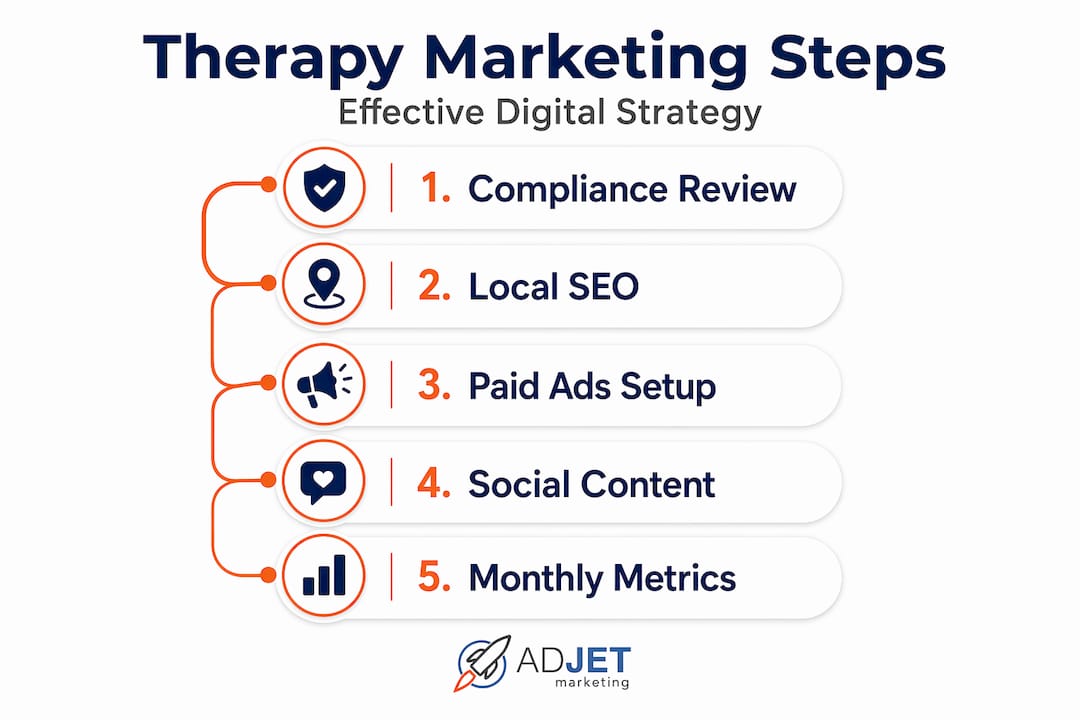
Once you understand the compliance foundation, the actual marketing strategies are practical and learnable. Effective counselor digital marketing typically combines organic and paid tactics, with organic work building credibility and paid campaigns accelerating client acquisition.
Local SEO and directory listings
Local directories and niche listings are foundational for counseling practices because most clients search within a defined geographic area. Getting listed on platforms like Psychology Today, Headway, and Google Business Profile costs little and builds significant discovery traffic. Specialized mental health SEO goes further by optimizing your website for condition-specific and location-based search terms, such as “anxiety therapist in [your city]” or “EMDR counselor near [neighborhood].”
Google Ads for therapists
Paid search works well for counseling practices when campaigns are built correctly. The data is clear: starting with a $500 to $2,000 monthly budget and targeting long-tail keywords generates significantly better returns than broad terms. A phrase like “couples therapist for infidelity issues” converts far better than “therapist near me” because the intent is specific and the person is ready to act.
Many providers lose money on paid ads not because Google Ads does not work, but because campaign setup errors send budget to irrelevant searches. Expert management typically recovers its own cost through reduced wasted spend within the first 60 to 90 days.
| Tactic | Best for | Timeline to results |
|---|---|---|
| Local SEO | Long-term organic growth | 3 to 6 months |
| Google Ads | Immediate client acquisition | 2 to 6 weeks |
| Content marketing | Building trust and authority | 4 to 8 months |
| Social media for therapists | Brand awareness and referrals | Ongoing |
| Directory listings | Low-cost local visibility | Immediate to 4 weeks |
Content and social media
Content marketing and social media for therapists are often underused. A consistent blog addressing common questions about anxiety, depression, or relationship issues builds both SEO authority and patient trust before someone ever calls your office. Social media works best for mental health practices when it focuses on psychoeducation rather than promotion. Explaining what to expect in a first therapy session or sharing coping tools performs far better than ads about “booking now.”
Pro Tip: Long-tail, specialty-specific keywords paired with conversion-optimized landing pages consistently outperform broad keyword targeting. Do not let an agency run ads to your homepage.
How to choose the right counseling marketing agency
This is where most clinics rush the decision, and it costs them. Here is a structured approach to evaluating potential agency partners.
-
Ask about their mental health client experience. Request specific examples, not vague claims. Which types of counseling practices have they worked with? What results did they generate, and over what timeline?
-
Probe their compliance knowledge directly. Ask how they handle conversion tracking for healthcare clients. If they cannot explain their tracking architecture and PHI safeguards in plain terms, that is a serious red flag.
-
Evaluate their service range. A practice in early growth needs different support than one trying to scale from 3 to 10 therapists. Confirm the agency offers SEO, paid ads, website design, and content, or at minimum the specific services you need right now.
-
Request a sample report. Their reporting structure tells you what they actually pay attention to. Agencies that report only on traffic and clicks are not focused on your real goal: booked appointments.
-
Ask about their onboarding process. A credible agency conducts a strategy audit before proposing anything. If they are ready to launch campaigns before understanding your ideal client, specialty, or geographic market, that is not expertise. That is a template being resold.
-
Watch for these red flags. Guarantees of specific ranking positions, one-size-fits-all packages, no mention of compliance, and pressure to sign long contracts with no performance clauses. All of these signal misalignment.
Measuring success with your marketing partner
Once campaigns are live, the real work of a good agency relationship begins. Knowing which metrics to track keeps you and your agency accountable.
The most meaningful KPIs for how to market a counseling practice effectively include:
- Cost per booked appointment. Not cost per click, not cost per lead. The actual cost to fill a slot.
- Appointment show rate. Marketing quality directly affects whether leads show up. Poor targeting brings in people who never commit.
- Organic search position for target keywords. Track 5 to 10 terms that reflect your specialty and location.
- Website conversion rate. What percentage of visitors request an appointment or contact you?
- Return on ad spend (ROAS). For paid campaigns, this tells you the revenue generated per dollar spent.
Starting Google Ads at small daily budgets of $10 to $15 per day gives you testing data without burning budget before the campaigns are optimized. Expect 30 to 60 days before you can draw meaningful conclusions from paid traffic. Organic SEO typically takes 3 to 6 months to show measurable movement. Setting those expectations early, with your agency, prevents unnecessary panic and premature pivots.
A quality agency reviews performance data with you monthly, explains what the numbers mean in plain terms, and connects every metric back to practice growth.
My take on finding the right agency partner
I have worked with enough mental health practices to recognize a consistent pattern. Many providers come to us after a frustrating experience with a general marketing agency that promised results but never understood the audience. The campaigns ran. The budget spent. The calls that came in were not the right fit, or worse, the tracking setup created a compliance exposure nobody caught until it was late.
What I have learned is that the single most predictive factor in a successful counseling marketing partnership is whether the agency asks about your clinical specialty before your budget. An agency that understands the difference between marketing for a trauma-focused practice versus a general adult therapy practice will build completely different campaigns. The messaging, the keywords, the landing page copy, and even the ad extensions differ in ways that matter.
I have also seen practices assume that their existing website is fine and that ads alone will fix their pipeline. Usually the site is the problem. A therapist website that loads slowly, lists credentials without communicating outcomes, and buries the contact form converts poorly regardless of how much paid traffic you send it.
The compliance dimension surprises most new clients. Not because they are cavalier about privacy, but because they genuinely did not know that standard ad platforms could receive protected health information through URL parameters or form submissions. When we walk them through what HIPAA-compliant tracking actually looks like compared to their current setup, the reaction is usually concern followed by relief. It is solvable. You just need an agency that knows it is a problem.
My practical advice: start the conversation by asking what the agency would change about your current website before touching your ad budget. Their answer will tell you whether you are talking to someone who understands practice growth or someone who sells campaign volume.
— Felix
How Adjetmarketing supports counseling practices
At Adjetmarketing, we work with mental health therapists and counseling clinics who are ready to grow their caseload without compromising compliance or clinical integrity. Our team understands why marketing matters in healthcare and applies that understanding to every campaign we build. We handle SEO tailored specifically for mental health providers, Google Ads structured with HIPAA-safe tracking, and website design focused on converting the right visitors into scheduled appointments.
We are a Google Partner agency, which means our paid media campaigns are built to a verified standard. We have developed compliant workflows for tracking, remarketing, and lead capture that protect your practice while generating real results. If you want to see a step-by-step approach to what this looks like in practice, our Google Ads guide for therapists walks through exactly how we structure compliant, high-converting campaigns. We also help practices avoid the most common healthcare marketing mistakes that quietly drain budgets and stall growth. Reach out to Adjetmarketing when you are ready to build a marketing strategy that actually fits the way you practice.
FAQ
What does a counseling marketing agency actually do?
A counseling marketing agency provides SEO, paid advertising, content strategy, and website services tailored specifically for therapy and mental health practices, with an emphasis on HIPAA compliance and ethical client communication.
Is it safe to run Google Ads for a therapy practice?
Yes, with the right setup. HIPAA-safe Google Ads campaigns use server-side tracking and compliant intermediaries to prevent protected health information from entering ad platforms.
How much should a counseling practice spend on Google Ads?
Most practices start at $500 to $2,000 per month, targeting long-tail keywords for better conversion rates and lower cost per booked appointment.
How long does therapy marketing take to show results?
Paid ads typically produce measurable results within 2 to 6 weeks, while local SEO and content marketing take 3 to 6 months to generate consistent organic traffic.
What should I ask a mental health advertising agency before hiring?
Ask specifically how they handle conversion tracking for healthcare clients, whether they sign a BAA with vendors, and request examples of campaigns they have run for similar mental health practices.