









Your real estate website is not a digital brochure. That framing costs agents and agencies more leads than almost any other misconception in the industry. Effective real estate website design guides visitors through a deliberate journey: from browsing properties to trusting your brand, comparing your expertise against others, and ultimately reaching out. This article covers the architecture, IDX integration choices, mobile experience, and local content strategies that separate high-converting real estate websites from ones that just look good on a laptop.
Table of Contents
- Key takeaways
- Real estate website design: building a conversion-first architecture
- IDX and MLS integration: SEO, compliance, and the right choice
- Mobile-first design for real estate sites
- Neighborhood pages and agent branding that earn trust
- My perspective on why most real estate sites underperform
- How Adjetmarketing helps real estate professionals convert more traffic
- FAQ
Key takeaways
| Point | Details |
|---|---|
| Follow a staged conversion flow | Structure your site around four phases: Browse, Trust, Compare, and Convert to align content with visitor intent. |
| Choose IDX integration wisely | API-based IDX creates indexable pages and improves SEO; iframe IDX does not, hurting your organic rankings. |
| Design mobile-first, always | Over 64% of real estate traffic is mobile, so thumb-friendly navigation and short forms are non-negotiable. |
| Neighborhood pages drive leads | These pages convert at 4 to 7%, far outperforming homepages and property detail pages. |
| Agent branding is a conversion lever | Rich bio pages with video, testimonials, and booking tools can capture 3 to 5% of visitors as leads. |
Real estate website design: building a conversion-first architecture
Most real estate websites make the same structural mistake. They put the IDX search front and center, treat listings as the destination, and wonder why visitors browse dozens of properties but never submit a form. The actual problem is architectural. Your site is sending people to a search tool before they trust you enough to hand over their contact information.
Structuring pages around visitor intent leads to three to five times higher lead capture compared to IDX-first designs. The framework that consistently produces results is a four-stage buyer journey.
- Browse. Visitors arrive and explore properties, neighborhoods, and market content. Your homepage and neighborhood pages carry this load.
- Trust. The visitor starts asking, “Who is this agent, and why should I work with them?” Agent bio pages, testimonials, and video introductions handle this stage.
- Compare. The visitor evaluates your expertise against other options. Market reports, neighborhood data, and client reviews matter here.
- Convert. The visitor is ready to act. Contact forms, call buttons, and scheduling widgets need to be frictionless at this stage.
The content architecture that supports this flow looks like: homepage leads to agent profile pages and neighborhood pages, which lead to listing detail pages, which connect back to contact paths. IDX is a feature within this structure. It is not the spine of the site.
When IDX search dominates the homepage, conversion rates improve significantly only after repositioning IDX as a supporting feature and giving agent and neighborhood pages priority real estate in the navigation and layout.

Pro Tip: Place your most compelling neighborhood page link and a simple three-field contact form above the fold on the homepage. Do not lead with a full IDX search bar. Let visitors self-identify their area interest before sending them into listings.
IDX and MLS integration: SEO, compliance, and the right choice
IDX integration is where many real estate web development projects go sideways. There are two main approaches, and the difference in SEO outcome is dramatic.
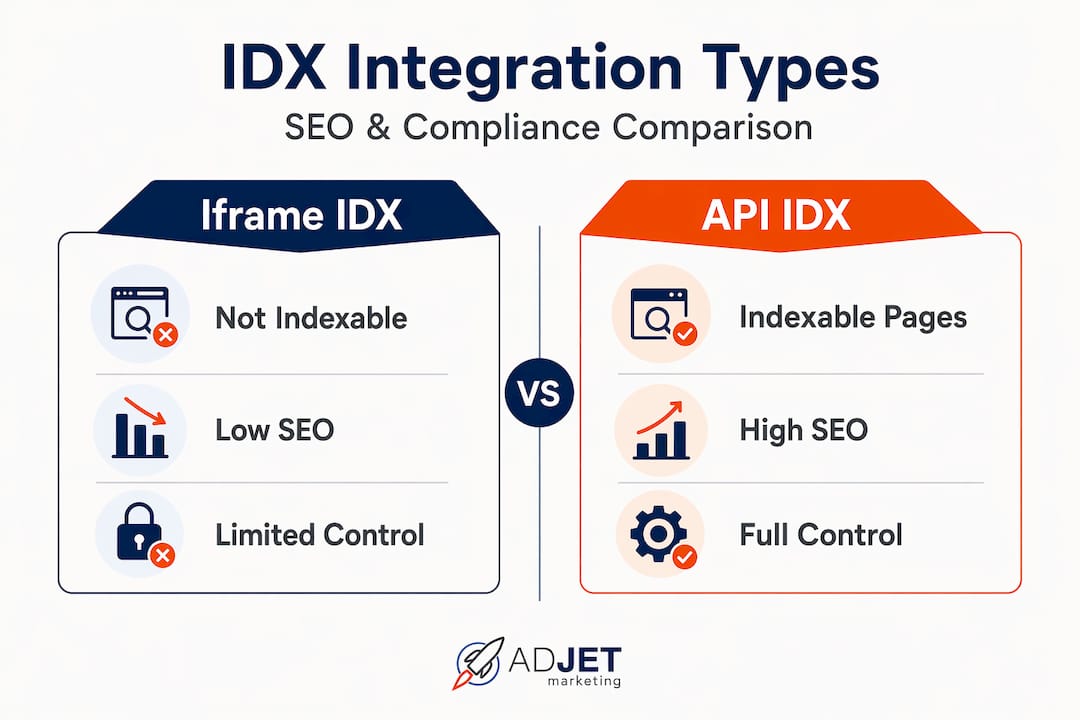
| Integration type | Indexable by Google? | SEO impact | Compliance control |
|---|---|---|---|
| Iframe IDX | No | Negative. Pages treated as empty frames. | Limited. Provided by IDX vendor. |
| Import/API IDX | Yes | Positive. Each listing becomes a native page. | Full. You control disclaimers and attribution. |
Import/API-style IDX creates indexable pages under your domain. Each listing gets a unique URL and meta tags. Google crawls and ranks these pages, which means your MLS listings contribute directly to your organic traffic. Iframe IDX, by contrast, pulls listing data into a frame that Google treats as empty. You get the listings displayed, but none of the SEO benefit.
The compliance side is equally important, and agents often underestimate it. MLS compliance requires proper broker attribution, disclaimers on every page displaying MLS data, and timely data updates. Missing any of these requirements puts your MLS membership at risk and can result in your data feed being terminated.
The best practice before launching your site is to stage IDX content for MLS approval before going live. This means getting your disclaimers, attribution formats, and display rules reviewed before the site is public. Reworking a live site to meet compliance requirements is expensive and disruptive.
Here is what a legally sound, SEO-friendly IDX setup requires on every relevant page:
- Broker name and license number displayed clearly
- MLS logo or attribution statement as required by your local MLS
- Data freshness timestamp or last-updated notice
- A disclaimer stating that listing information is not guaranteed accurate
IDX and SEO must be treated together as a single decision. The IDX vendor you choose and the integration method you use will determine whether your listing pages help or hurt your search rankings.
The recommended approach for most agents is a hybrid: use custom-built featured listing pages for your own listings, and supplement with an import-style IDX feed for area inventory. This gives you full editorial control over your most important properties while still offering visitors broad search capability.
Pro Tip: Ask any IDX vendor directly: “Do your listing pages create indexable URLs under my domain?” If the answer is no or unclear, keep looking. Your site’s long-term SEO depends on that answer.
Mobile-first design for real estate sites
Mobile devices account for 64% of real estate website traffic in 2026, but mobile conversion rates consistently lag desktop. The gap is not a mobile user problem. It is a design problem. Most real estate sites are built for desktop and then squeezed down to fit a phone screen, which creates a frustrating experience that sends visitors straight to a competitor.
Responsive real estate websites that are built mobile-first from the ground up behave differently. They prioritize the actions mobile visitors actually take: tapping to call, swiping through photos, and quickly submitting a short inquiry form. They do not force users to navigate a complex desktop menu or fill out a seven-field form on a four-inch screen.
The specific design decisions that move the needle on mobile include:
- Thumb-friendly navigation. Menu items, buttons, and tap targets sized for fingers, not mouse cursors. Minimum 44 by 44 pixels per touch target.
- Swipe-optimized image galleries. Property photo carousels that respond to touch gestures without lag or misfire.
- Click-to-call above the fold. Mobile visitors often browse listings while physically in a neighborhood or at an open house. A visible phone button at the top of every page captures those high-intent contacts.
- Short lead capture forms. Forms with 3 to 4 fields convert around 28% better than longer forms. Ask for name, phone, and area of interest. Qualify further after the call.
- Fast load times. Property photos are large files. Compress images, use lazy loading, and host on a CDN to keep mobile load times under three seconds.
Traditional desktop layouts rely on hover states, multi-column grids, and sidebars. None of those translate to mobile. When you design for mobile first and then scale up to desktop, the result is a site that works well for everyone instead of one that works well for a shrinking minority.
Pro Tip: Test your site on a real phone, not just a browser’s responsive design mode. Use your thumb, not your index finger. If you cannot complete a contact form with one hand in under 30 seconds, your mobile UX needs work.
Neighborhood pages and agent branding that earn trust
If you are thinking about how to design a real estate website that consistently generates quality leads, neighborhood pages are the single highest-leverage investment you can make. Neighborhood pages convert at 4 to 7%, compared to property detail pages which convert at 0.5 to 1.5% and homepages which convert at 1 to 2%. The reason is intent. Visitors on a neighborhood page are not idly browsing. They have identified a specific area and are actively gathering information to make a decision.
Neighborhood landing pages are the highest-leverage SEO and conversion assets when they combine unique editorial content, current market statistics, and multiple calls to action. A neighborhood page that only repeats generic information available on every other real estate site will not rank and will not convert.
A high-performing neighborhood page includes:
- Original editorial content. Your genuine perspective on what makes the neighborhood worth considering. Not copied from Wikipedia or another listing site.
- Current market data. Median sale price, days on market, price trends, and inventory levels updated at least quarterly.
- School and amenity information. Linked to real sources, not just listed without context.
- Local photography. Images you have taken or licensed, not stock photos of generic suburban streets.
- Soft and hard calls to action. A soft CTA might be “Download our neighborhood market report.” A hard CTA is “Schedule a showing.”
Agent branding deserves equal attention. Agent bio pages with authentic narratives, photos, reviews, intro videos, and booking widgets convert at 3 to 5%, yet most agents use a generic template that captures almost none of that potential. The specific elements that raise bio page conversions include named and addressed testimonials (not anonymous five-star reviews), a short video introduction of 60 to 90 seconds, and an embedded calendar booking tool.
Adding reviews schema markup to your agent bio page allows Google to display star ratings in search results, which increases click-through rates before a visitor ever reaches your site.
Pro Tip: Treat your neighborhood pages like published articles, not database entries. Google rewards unique, authoritative local content. So do buyers who are choosing between agents.
My perspective on why most real estate sites underperform
I have seen a pattern repeat itself more times than I can count. An agent or a small agency invests in a website that looks polished, launches it with a full IDX search on the homepage, and then wonders why the phone is not ringing. The site is technically functional. The problem is that no one designed it with a buyer’s decision process in mind.
The most common mistakes I see are: leading with IDX before establishing any trust with the visitor, using long qualification forms when the visitor is not remotely ready to commit, and building a desktop site that is then declared “mobile responsive” without ever being tested on an actual phone.
What actually works is less intuitive than it sounds. Put the agent’s story, local expertise, and neighborhood pages at the center of the site. Let IDX serve visitors who are already engaged, not strangers who just arrived. IDX should not be the front door but a tool used after visitors have already identified with your brand.
I also think agents underestimate how much continuous iteration matters. A site that converts well in month one will not necessarily convert well in month six as market conditions and visitor behavior shift. The best real estate websites are treated as living tools, not finished products. Data on which neighborhood pages drive the most form submissions, which bio page elements reduce bounce rate, and which CTAs generate calls should inform ongoing design decisions.
The agents who grow consistently through their websites are not the ones with the biggest IDX catalogs. They are the ones who understand their buyer’s journey and design every page to move that buyer forward.
— Felix
How Adjetmarketing helps real estate professionals convert more traffic
At Adjetmarketing, we work with real estate agents and agencies who are tired of websites that look good but do not generate leads. Our approach to professional web design services combines conversion-focused architecture, mobile-first development, and local SEO strategy into a single, measurable system.
We do not hand you a template and wish you luck. We build the staged buyer journey into your site structure, set up IDX integration with full MLS compliance in mind, and create neighborhood pages that rank and convert. Our search engine optimization services extend that work into ongoing organic visibility, so your site keeps generating leads long after launch.
If you are ready to build a real estate website that works as hard as you do, we are ready to help you design it. Reach out to Adjetmarketing to talk through your current site and where the opportunities are.
FAQ
What is the most important element of real estate website design?
The most important element is a staged conversion architecture that guides visitors through browsing, building trust, comparing options, and converting. Sites built around this flow consistently outperform IDX-first designs.
What is the difference between iframe IDX and API IDX?
Iframe IDX displays listings in a non-indexable frame that Google cannot crawl, which limits SEO value. API or import-based IDX creates native, indexable listing pages under your domain that improve organic rankings.
How many fields should a real estate lead form have?
Lead capture forms with 3 to 4 fields convert approximately 28% better than longer forms. Ask for the minimum information needed to follow up, then qualify the lead further during the initial conversation.
Why do neighborhood pages convert better than listing pages?
Neighborhood pages attract visitors with specific location intent who are actively evaluating where to buy. They convert at 4 to 7% compared to 0.5 to 1.5% for property detail pages, because the visitor is further along in the decision process.
How do I make my real estate website mobile-friendly?
Design mobile-first by prioritizing thumb-sized tap targets, swipe-optimized photo galleries, click-to-call buttons above the fold, and short contact forms. Test on a real device, not just a desktop browser’s responsive preview.
Recommended
- Real Estate SEO: Strategies For Agents To Boost Leads
- What Landing Pages Do Top Realtors Use? | Convert More Clicks Into Clients – AdJet Digital Marketing & Google Partner Agency | SEO Development Google Ads Social
- What Are The Best Lead Magnets For Realtors? | Freebies That Actually Work – AdJet Digital Marketing & Google Partner Agency | SEO Development Google Ads Social
- What Website Features Do Top Agents Use? | The Real Estate Site Checklist – AdJet Digital Marketing & Google Partner Agency | SEO Development Google Ads Social