









Most healthcare landing pages convert fewer than 7% of visitors, yet top-performing clinics regularly hit conversion rates of 6.5-16% with the right page structure. If your clinic is running Google Ads or Facebook campaigns and sending that paid traffic to your homepage, you are almost certainly leaving booked appointments on the table. This guide breaks down what a landing page actually is, how it differs from the rest of your website, and exactly what you need to build pages that turn curious visitors into confirmed patients.
Table of Contents
- What is a landing page? Key differences and purpose
- Why landing pages work for clinics: Data and benchmarks
- Anatomy of high-converting healthcare landing pages
- Critical landing page best practices for medical clinics
- The uncomfortable truth about healthcare landing pages
- Start driving more patients with expert clinic landing pages
- Frequently asked questions
Key Takeaways
| Point | Details |
|---|---|
| Landing pages are single-purpose | A true landing page has one goal—like booking patient visits—and no distracting links. |
| Clinic results beat homepages | Healthcare clinics using focused landing pages see 6-16% more new patient actions. |
| Trust drives conversions | Displaying credentials and real reviews first builds confidence and boosts bookings. |
| Testing outperforms guessing | Clinics that A/B test CTAs and messaging enjoy 35% higher win rates. |
| Speed matters | Pages that load in under 2 seconds convert nearly 50% better than slower ones. |
What is a landing page? Key differences and purpose
A landing page is one of the most misunderstood tools in healthcare marketing. Many clinic owners assume their website homepage does the same job. It does not.
A landing page is a standalone web page designed for a single, specific goal, such as booking an appointment or capturing a lead, and it is entirely distinct from a homepage that serves multiple purposes. Your homepage introduces your clinic, lists all your services, links to your blog, and invites visitors to explore. A landing page does exactly one thing: it asks the visitor to take one specific action and removes every distraction that could pull them away from it.

Think about the difference in intent. When someone clicks a Google Ad for “knee pain specialist in Dallas,” they already know what they want. If they land on your homepage, they have to navigate through menus, find the right service, and figure out where to book. Every extra click costs you a patient. A dedicated landing page meets them exactly where they are, answers their specific question, and offers one clear next step.
Here is how a landing page and a homepage compare directly:
| Feature | Landing page | Homepage |
|---|---|---|
| Purpose | Single conversion goal | General information hub |
| Navigation | Removed or minimal | Full site navigation |
| Content focus | One service or offer | All services and brand info |
| Call-to-action | One clear CTA | Multiple links and options |
| Best used for | Paid ads, email campaigns | Organic brand discovery |
| Conversion rate potential | 6-16% | 1-3% |
The most common and costly mistake clinics make is routing all paid ad traffic to their homepage. You spend money to get the click, and then a confusing homepage structure loses the patient before they ever book.
“Sending paid ad traffic to a homepage is the single fastest way to waste your marketing budget. Patients who click an ad have a specific need. A dedicated landing page meets that need directly and converts at 3-5x the rate of a general homepage.”
Common landing page types for medical clinics include:
- Appointment booking pages for specific services like Botox, physical therapy, or pain management
- Lead capture pages offering a free consultation, symptom checker, or downloadable guide
- Campaign-specific pages tied to seasonal promotions or new service launches
- Specialty pages created for each treatment or condition you target with ads
Building high-converting landing pages requires knowing this foundation first. Understanding digital marketing for clinics starts with getting this structure right.
Why landing pages work for clinics: Data and benchmarks
Now that you know what a landing page is, the data makes a compelling case for why every clinic running paid traffic needs one.
Healthcare landing page conversion rates average 3.1-6.8%, with top performers regularly hitting between 6.5% and 16%. The general industry median sits around 6.6%, while the cost per lead in B2B healthcare reaches $377. Those numbers matter because they set your benchmark. If your current pages convert below 3%, you have significant room to grow.
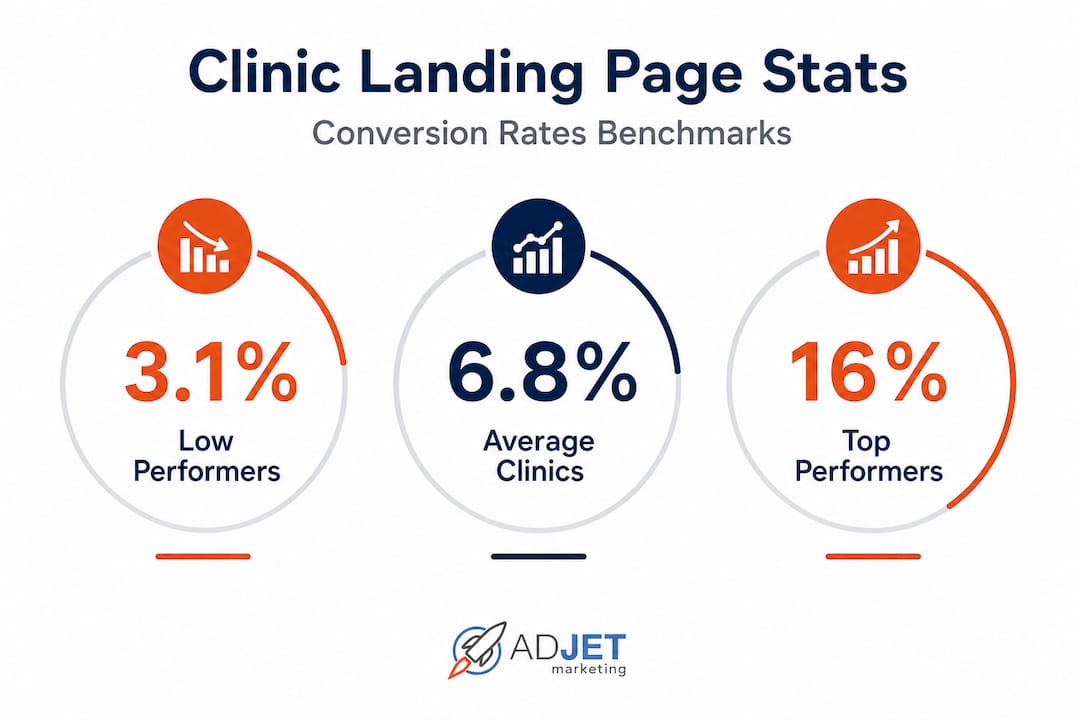
It is important to understand the gap within healthcare itself. Some sources report rates as low as 3.1% for clinics that rely on general or compliance-heavy pages, while highly targeted SaaS products achieve 21.5%. The difference is not just industry, it is intent alignment and trust. Healthcare patients carry much higher hesitation than someone downloading software. They need to trust your credentials, read reviews, and feel reassured before they book. Dedicated pages that address this hesitation directly are what separate the 3% clinics from the 16% clinics.
Key benchmark data for healthcare landing pages:
| Metric | Low performers | Average clinics | Top performers |
|---|---|---|---|
| Conversion rate | Below 3.1% | 3.1-6.8% | 6.5-16% |
| Cost per lead (healthcare) | $400+ | $377 | Under $200 |
| Page load time | 4+ seconds | 2-3 seconds | Under 2 seconds |
| Trust signals above fold | None | 1-2 | 3+ |
The clinics that consistently perform in the top tier share three characteristics. They use dedicated pages for every service and campaign rather than one generic page. They reduce friction by removing navigation and offering a single clear call-to-action. And they invest in trust signals like credentials, certifications, and patient reviews, which we will cover in detail in the next section.
Pro Tip: If you are currently running SEO strategies for clinics alongside paid ads, make sure each campaign has its own unique landing page. Organic and paid traffic have different intent levels, and separate pages let you tailor the message and track results accurately.
The ROI case is straightforward. Switching from a homepage to a dedicated landing page for a single Google Ads campaign can double or triple your conversion rate without increasing your ad spend. That means the same monthly budget produces two to three times as many booked appointments. For a clinic spending $2,000 per month on ads, that difference translates directly into revenue growth.
Anatomy of high-converting healthcare landing pages
Understanding the data is one thing. Building a page that performs at the top of those benchmarks requires getting the structure exactly right.
Landing pages outperform full websites for single-offer testing in service businesses like clinics. But they must handle the healthcare industry’s high trust barriers using specific proof elements, and they should never include multiple CTAs or site navigation that distracts the visitor.
Here are the essential components of a high-converting clinic landing page, in order of priority:
-
A clear, single call-to-action. Every element on your page should point toward one action, whether that is “Book Your Free Consultation” or “Call Now to Schedule.” Multiple CTAs create decision paralysis and reduce conversions. Pick one and repeat it two or three times throughout the page.
-
Trust signals above the fold. Above-the-fold trust means the first thing a patient sees before they scroll should include your credentials, board certifications, years of experience, and at least one patient review. Healthcare patients make trust decisions in seconds. If your qualifications are not immediately visible, many visitors will leave without reading further.
-
Benefit-oriented headlines and emotional subheadlines. Your main headline should speak to the patient’s desired outcome, not your service name. Instead of “Physical Therapy Services,” try “Reduce Your Pain and Get Back to Life Faster.” The subheadline reinforces the emotional benefit with a specific reassurance like “Over 500 patients treated with measurable results.”
-
Remove navigation and distractions completely. This is non-negotiable. Navigation menus give visitors an easy exit from your conversion path. Strip them from all landing pages. The only links on the page should be your CTA button and any legally required links such as your privacy policy.
-
Dedicated pages for each service and campaign. Running ads for Botox, knee injections, and therapy at the same time? Each service needs its own landing page. Pages dedicated to testing individual services achieve 50% higher optimization win rates. The message, imagery, and social proof should all match the specific service being advertised.
-
A professional, relevant hero image or video. Visual content should show real results, your actual clinic, or your medical team. Stock photos of generic doctors perform measurably worse than authentic imagery. Patients want to see where they are going before they commit.
For a practical example of how to structure these elements, reviewing a good landing page for therapy shows the exact layout and copy approach that works for sensitive healthcare services. These principles apply across digital marketing essentials for any clinic specialty.
Pro Tip: Place your booking form or CTA button in the top half of the page before the patient has to scroll. Research consistently shows that forms placed above the fold on mobile devices outperform below-fold forms by a significant margin.
Critical landing page best practices for medical clinics
With the anatomy in place, these actionable best practices will help your clinic’s landing page perform at the top of industry benchmarks.
The most important habit you can build is regular testing. A/B testing CTAs produces a 35% win rate on average, meaning one version of your button text, color, or placement will outperform the other about one in three tests. That is a significant improvement opportunity if you run tests consistently. Start with your headline and CTA button. These two elements have the highest impact on whether a visitor converts.
Here is a practical list of best practices every clinic should implement:
- Test your CTA text. “Book Your Appointment” vs. “Get Your Free Consultation” can produce very different results depending on your specialty and audience. Test one variable at a time.
- Add video testimonials. Video and testimonials boost conversions by 24-34% in healthcare. A 60-second patient story explaining their experience builds more trust than any headline you could write.
- Keep load time under 2 seconds. Page speed is a direct conversion factor. A page that loads in under 2 seconds converts 47% better than a slow-loading one. Compress images, minimize scripts, and use a fast hosting environment.
- Align your ad copy to your landing page headline. If your Google Ad says “Knee Pain Relief Without Surgery,” your landing page headline should echo that exact message. This message match reduces bounce rates and signals to the visitor that they are in the right place.
- Use a short form. Ask for only the information you need at this stage: name, phone number, and preferred appointment time. Every additional field reduces form completion rates.
- Display a phone number prominently. Many healthcare patients, particularly older demographics, prefer to call. Make your phone number clickable and visible at the top of the page.
Reaching 6-10% conversion rates requires stripping all distractions, aligning your ad messaging to your page, and layering social proof throughout. Pages that underperform almost always share the same flaws: too many options, generic copy, and no visible trust signals.
Pro Tip: Review your clinic growth strategies alongside your landing page performance monthly. Ad campaigns and landing pages need to evolve together. A strong ad driving traffic to a weak page will always underperform.
The uncomfortable truth about healthcare landing pages
Here is what most marketing guides will not tell you directly: the biggest obstacle for clinic landing pages is not design, it is mindset.
We work with clinic owners who have invested in professional-looking pages and still see low conversion rates. The common thread is almost never a design flaw. It is overcomplicated messaging driven by compliance anxiety, and a deep reluctance to test anything that feels “risky.”
Healthcare providers are understandably cautious. HIPAA compliance shapes how you communicate, what data you collect, and how you use patient information in marketing. But that caution can become paralysis. We see clinics with landing pages so loaded with legal disclaimers and careful language that the actual patient benefit gets buried. Compliance and clarity are not opposites. You can be fully compliant and still write a direct, compelling headline that tells a patient exactly how you will help them.
The second issue is the “set it and forget it” approach. Clinics spend months getting a landing page approved internally and then treat it as a permanent fixture. A/B testing CTAs with a 35% win rate means one in three tests will improve your performance. If you never test, you never improve. A landing page is not a finished product. It is a living experiment that should be tested, reviewed, and updated at least quarterly.
The third mindset trap is measuring the wrong thing. Clinic owners often evaluate landing pages by traffic volume, not conversion rate. High traffic to a page converting at 2% is a money-losing scenario. A page with half the traffic converting at 10% drives more actual appointments. Shift your focus to conversion rate, cost per lead, and booked appointments. Those are the numbers that reflect real growth.
What we have learned from working with clinics across multiple specialties is this: the dental landing page case study model applies broadly. Trust-first design, single-action focus, and ongoing testing consistently outperform complicated pages regardless of specialty. The clinics that grow fastest are not the ones with the fanciest pages. They are the ones that commit to testing and improving.
Start driving more patients with expert clinic landing pages
Understanding why marketing matters for healthcare is the first step. Turning that knowledge into a landing page that consistently books patients is where the real work begins. At AdJet Marketing, we build and manage high-converting pages specifically for medical clinics, med spas, pain management practices, and specialty providers. Our team handles the strategy, design, copywriting, and testing so your pages perform at the top of industry benchmarks. If your current pages are underdelivering, we can show you exactly where they are losing patients and what to fix. Reach out to our team today and get a free landing page performance review for your clinic.
Frequently asked questions
What’s the ideal conversion rate for a clinic’s landing page?
Aim for 6-10% as a realistic target. Healthcare rates typically range from 3.1-6.8%, with the best-performing clinic pages reaching up to 16% through strong trust signals and focused design.
Should my Google or Facebook Ads link to a landing page or my homepage?
Always send paid ad traffic to a dedicated landing page, never your homepage. Dedicated pages consistently outperform homepages for PPC traffic because they match the visitor’s specific intent and remove distracting navigation.
What is the number one trust signal for healthcare landing pages?
Credentials and patient reviews displayed above the fold are the most powerful trust drivers. Above-the-fold trust signals like board certifications and verified reviews overcome the high hesitation unique to healthcare decision-making.
How can I quickly improve my clinic landing page’s conversion rate?
Start by A/B testing your CTA button text and adding a short video testimonial. Testing CTAs achieves a 35% win rate on average, and video testimonials increase conversions by 24-34%. Remove all navigation links and cut any form fields you do not immediately need.
Recommended
- What’s A Good Landing Page For Therapy Services? → A Copy & Layout You Can Steal – AdJet Digital Marketing & Google Partner Agency | SEO Development Google Ads Social
- How To Create A High-Converting Landing Page For Your Dental Clinic – AdJet Digital Marketing & Google Partner Agency | SEO Development Google Ads Social
- What Landing Pages Do Top Realtors Use? | Convert More Clicks Into Clients – AdJet Digital Marketing & Google Partner Agency | SEO Development Google Ads Social
- Landing Page Design – AdJet Digital Marketing & Google Partner Agency | SEO Development Google Ads Social