









Search engine algorithms are multi-stage systems that crawl, index, rank, and serve web pages to match user queries with the most relevant results. They are not a single formula. Google alone uses layered models including Googlebot, RankBrain, BERT, and MUM, each handling a different part of the process. Understanding this pipeline is the foundation of every effective SEO strategy, and it matters more now that generative AI features have changed how results are displayed and evaluated.
How does the crawling and indexing stage work?
Search engines operate through a pipeline of crawling, indexing, ranking, and serving. Each stage is distinct, and a failure at any one of them stops your content from appearing in results.
Crawling is the discovery phase. Googlebot, Google’s web crawler, follows links across the web to find new and updated pages. It does not browse the live web in real time. Instead, it works from a queue of URLs and visits them on a schedule based on crawl budget and site authority.

One technical detail that surprises many site owners: Googlebot fetches only the first 2MB of bytes per URL. Any content beyond that limit is not rendered or indexed. For large pages with heavy scripts loaded early in the HTML, this means your most important content may be invisible to Google entirely.
After crawling, Google’s Web Rendering Service processes the page. The WRS executes JavaScript and CSS to understand the final text and structure as a browser would render it. Only then does indexing happen. Indexing stores processed information, including page text, headings, tags, images, and video metadata, in Google’s index databases for retrieval.
Common crawl blockers include:
- Robots.txt disallows that prevent Googlebot from accessing key pages
- Noindex tags applied by mistake during development and never removed
- Slow server response times that exhaust crawl budget before key pages are reached
- JavaScript-heavy pages where critical content only loads after rendering, which delays indexing
Pro Tip: Place your primary topic statement, main heading, and structured data as early as possible in the HTML. This keeps them within the first 2MB Googlebot fetches and increases the chance they are indexed correctly.
What factors influence how search engines rank pages?
Ranking is the stage where algorithms weigh dozens of signals to order pages by relevance and quality for a specific query. Ranking factors fall into three broad categories: on-page SEO, off-page authority, and technical performance.
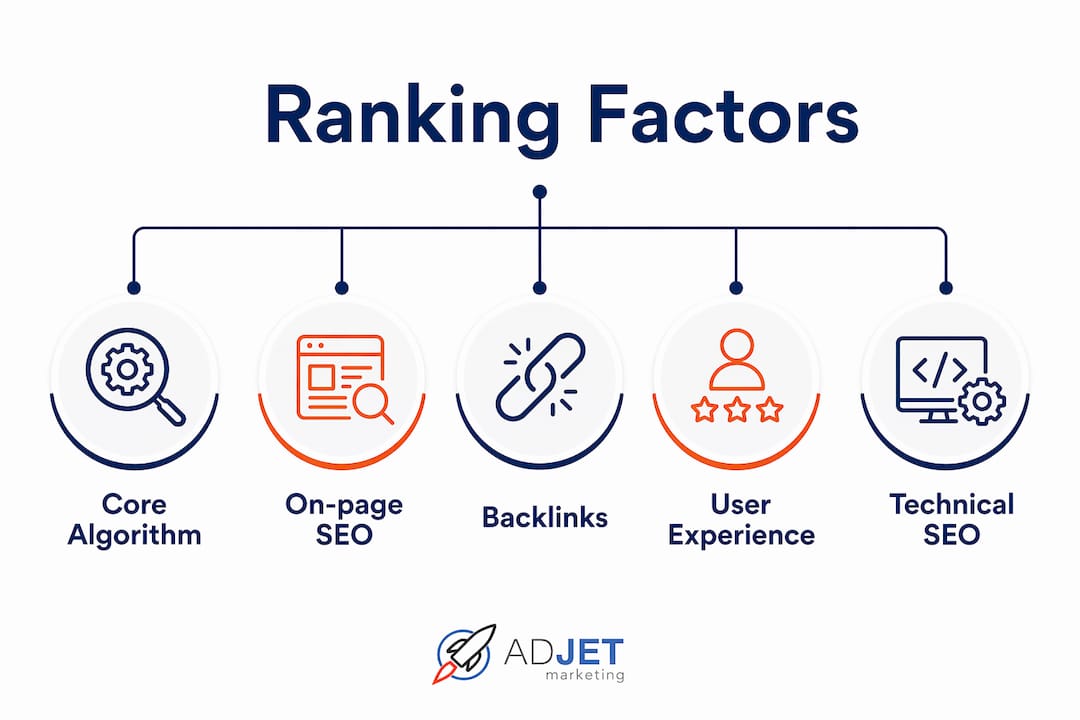
| Ranking factor category | What it includes | Why it matters |
|---|---|---|
| On-page SEO | Content quality, keyword use, headings, structured data | Signals relevance to the query |
| Off-page authority | Backlinks, brand mentions, PageRank signals | Signals trust and credibility |
| Technical SEO | Site speed, mobile-friendliness, HTTPS, Core Web Vitals | Signals a reliable user experience |
The PageRank algorithm assigns importance scores based on the quality and quantity of incoming links. A link from a high-authority site passes more ranking value than ten links from low-quality pages. This is why building authoritative backlinks still matters, even with all the AI changes in 2026.
Modern ranking systems go well beyond keyword matching. RankBrain interprets unfamiliar queries by mapping them to related concepts. BERT understands the context of words within a sentence, not just the words themselves. MUM handles complex, multi-step queries across languages and formats. Google also applies quality controls through systems like Helpful Content and SpamBrain, which filter out thin, AI-generated, or manipulative content before it ranks.
Understanding search intent is the practical output of all this. Informational queries, transactional queries, and commercial research queries each trigger different ranking priorities. A page optimized for the wrong intent type will not rank well, regardless of its technical quality.
Pro Tip: Before writing any page, identify whether the query is informational, transactional, or commercial. Match your content format and call to action to that intent type. Google’s ranking systems reward alignment between content and intent more than keyword density.
How do search engine algorithms integrate AI and machine learning?
Search algorithms are not a single formula but a collection of layered AI models working together. Each model handles a specific part of understanding or evaluating content. Treating them as one lever is the most common misconception in SEO, and it leads to wasted effort.
RankBrain was Google’s first major machine learning ranking component. It interprets queries it has never seen before by finding patterns in past search behavior. BERT followed, adding deep language understanding at the sentence level. MUM extended this further, processing text, images, and video across multiple languages simultaneously.
Generative AI features, including Google’s AI Overviews, add another layer. These features synthesize answers from multiple sources and display them above traditional organic results. Google’s 2026 guidance recommends focusing on valuable, unique, non-commodity content to perform well in both traditional rankings and AI-generated summaries. Generic content that restates what every other page says gets filtered out at this stage.
The practical implications for your SEO strategy include:
- Write for entities, not just keywords. AI models evaluate topics, brands, people, and places as entities with relationships. Content that clearly establishes what a page is about, and who or what it references, performs better in semantic search.
- Answer specific questions directly. BERT rewards content that answers the precise question in the query, not content that circles around it.
- Use structured data. Schema markup helps AI models understand your content’s context, which improves eligibility for rich results and AI Overviews.
- Avoid thin content. Helpful Content systems actively suppress pages that exist primarily to rank rather than to inform or assist the reader.
The role of AI in modern SEO continues to grow. Aligning your content with how these models evaluate relevance is now as important as traditional on-page optimization.
What practical steps can you take to optimize for today’s algorithms?
Effective optimization targets each stage of the algorithm pipeline separately. A site with great content but crawl errors will not rank. A site that ranks but fails on intent alignment will not convert.
-
Audit your crawl health first. Use Google Search Console to identify crawl errors, blocked URLs, and pages excluded from the index. Fix these before working on content. A stage-gated diagnostic approach works through discovery, fetch availability, indexing inclusion, and ranking outcomes in sequence.
-
Place key content early in the HTML. Your main heading, primary topic statement, and structured data should appear within the first portion of the page’s HTML. This protects them from the 2MB fetch limit and signals relevance immediately to Googlebot.
-
Build technical SEO fundamentals. Site speed, mobile-friendliness, and HTTPS are baseline requirements. Core Web Vitals scores directly affect ranking eligibility for many queries. Google’s 2026 SEO best practices confirm these remain non-negotiable.
-
Earn authoritative backlinks. Off-page authority still flows through link structure. Focus on earning links from relevant, high-authority domains in your industry. One strong editorial link outperforms dozens of low-quality directory links.
-
Optimize for generative AI features. Write content that directly answers specific questions. Use clear headings, concise paragraphs, and structured data. Pages that answer questions clearly are more likely to be cited in AI Overviews.
-
Match content to search intent. Every page should serve one clear intent type. For healthcare and service businesses, this often means separating informational blog content from transactional service pages. Mixing intent on a single page dilutes its ranking signal.
Pro Tip: If a page is not ranking despite good content, diagnose the pipeline stage first. Check whether the page is indexed at all before adjusting content. Many healthcare SEO failures trace back to indexing issues, not content quality.
Key takeaways
Search engine algorithms function as a four-stage pipeline, and optimizing each stage separately produces better results than treating the algorithm as a single system to beat.
| Point | Details |
|---|---|
| Algorithms are multi-stage systems | Crawling, indexing, ranking, and serving each require separate optimization attention. |
| The 2MB crawl limit is real | Place key content, headings, and structured data early in HTML to stay within Googlebot’s fetch limit. |
| Ranking uses multiple AI models | RankBrain, BERT, and MUM each evaluate different aspects of relevance and query context. |
| Intent alignment drives rankings | Matching content type and format to informational, transactional, or commercial intent outperforms keyword density. |
| AI Overviews change the visibility equation | Unique, specific, well-structured content is more likely to appear in generative AI summaries above organic results. |
What I’ve learned from diagnosing algorithm problems at the source
Most SEO conversations I have with clinic owners and marketers start in the wrong place. They want to know which keywords to target or how many backlinks to build. Those are ranking-stage questions. But when I pull up their Search Console data, the problem is almost always earlier in the pipeline.
Pages blocked by robots.txt. Service pages excluded from the index because a developer left a noindex tag on after a site migration. Critical content buried 300 kilobytes into a JavaScript-heavy page, well past what Googlebot actually fetches. These are not content strategy failures. They are pipeline failures, and no amount of keyword research fixes them.
The stage-gated diagnostic model changed how I approach technical SEO audits. You work through discovery, fetch availability, indexing, and ranking in that order. If a page is not discovered, nothing else matters. If it is discovered but not indexed, ranking tactics are irrelevant. This sounds obvious, but most SEO checklists skip straight to on-page optimization without confirming the page is even in the index.
The AI shift in 2026 adds a layer on top of this. Generative AI features reward content that is specific, direct, and genuinely useful. Generic service descriptions that could apply to any clinic in any city do not get cited in AI Overviews. The practices that win in AI search are the same ones that have always worked in organic search: answer the question clearly, establish authority, and give the reader something they cannot find on every other page. The algorithm has changed. The underlying principle has not.
— Felix
How Adjetmarketing approaches SEO for service businesses
Adjetmarketing works with medical clinics, aesthetic practices, and service businesses that need more than generic SEO advice. Our approach starts with a pipeline audit, confirming that pages are crawled, indexed, and ranking before adjusting content or ad spend. We apply the same stage-gated diagnostic model described in this article to every client engagement.
If you want to understand exactly where your site stands in the algorithm pipeline and what is holding back your visibility, our SEO services page outlines how we build and manage campaigns for healthcare and service businesses. You can also review common healthcare marketing mistakes that affect rankings before you even start optimizing.
FAQ
What are search engine algorithms?
Search engine algorithms are multi-stage systems that crawl, index, rank, and serve web pages to match user queries with relevant results. Google’s algorithm includes multiple AI models such as RankBrain, BERT, and MUM working together.
How does Googlebot crawl a website?
Googlebot follows links to discover URLs and fetches up to 2MB of content per page. Content beyond that byte limit is not rendered or indexed, which makes page structure and content placement critical for SEO.
What are the main factors affecting search rankings?
Ranking factors fall into three categories: on-page SEO, off-page authority including backlinks, and technical performance including site speed and Core Web Vitals. Search intent alignment is the most direct signal of content relevance.
How do AI models like BERT and RankBrain affect SEO?
BERT interprets the context of words within a sentence to understand query meaning. RankBrain maps unfamiliar queries to related concepts using machine learning. Both reward content that directly answers specific questions over content that targets keywords without addressing intent.
How do I optimize for Google’s AI Overviews?
Write content that answers specific questions directly, use clear headings and structured data, and avoid generic descriptions that duplicate what other pages already say. Unique, specific, and well-structured content is most likely to be cited in AI-generated summaries.
Recommended
- SEO Terminology For Real Estate Agents: 2026 Guide
- SEO Best Practices 2026: What Marketers Must Know
- Website Optimization Guide For Marketing Pros In 2026
- The Ultimate Guide To Dental SEO: Outranking Your Competitors – AdJet Digital Marketing & Google Partner Agency | SEO Development Google Ads Social