









Digital marketing for aesthetics is defined as the use of online channels, including search engines, paid ads, social media, and email, to attract, engage, and convert prospective patients into booked appointments. Aesthetic clinics operate in a high-consideration market where patients research extensively before committing to a procedure. That research happens across Google, YouTube, Instagram, TikTok, and review platforms, often over weeks or months. Clinics that lack a consistent, measurable online presence lose patients to competitors who show up at every stage of that research process. The importance of digital marketing in this field is not theoretical. It is the primary driver of new patient acquisition and long-term practice growth.
Why digital marketing for aesthetics drives patient engagement
Patient engagement in aesthetics does not follow a straight line. Patients use Google, Maps, YouTube, Reddit, AI, and reviews dynamically rather than moving through a predictable funnel. A prospective patient might discover your clinic through a TikTok video, read your Google reviews, watch a before-and-after reel on Instagram, and then search your name directly before booking. Each of those touchpoints is an opportunity to build trust or lose it.

Digital channels generate engagement and conversion tracking data across web, email, and social media, enabling marketers to adjust strategy in near real time. That feedback loop is what separates digital marketing from traditional advertising. You do not wait until the end of a campaign to learn what worked.
Content formats that consistently perform well with aesthetics audiences include:
- Before-and-after photo posts on Instagram and Facebook, which build visual proof of results
- Short-form video on TikTok and Instagram Reels explaining procedures, recovery, and pricing
- FAQ blog posts and service pages that address patient hesitations before they become objections
- Google Business Profile updates with current photos, service descriptions, and responses to reviews
Pro Tip: Respond to every Google review within 48 hours. Review recency and response rate are factors in local search ranking, and a thoughtful reply to a negative review often converts skeptical readers into inquiries.
Unified branding and coordinated messaging across AI, video, reviews, and websites increases patient conversion rates. Patients exposed to consistent messaging across channels are more likely to complete a booking than those who encounter fragmented or inconsistent information.
What are the key digital channels for aesthetics marketing?
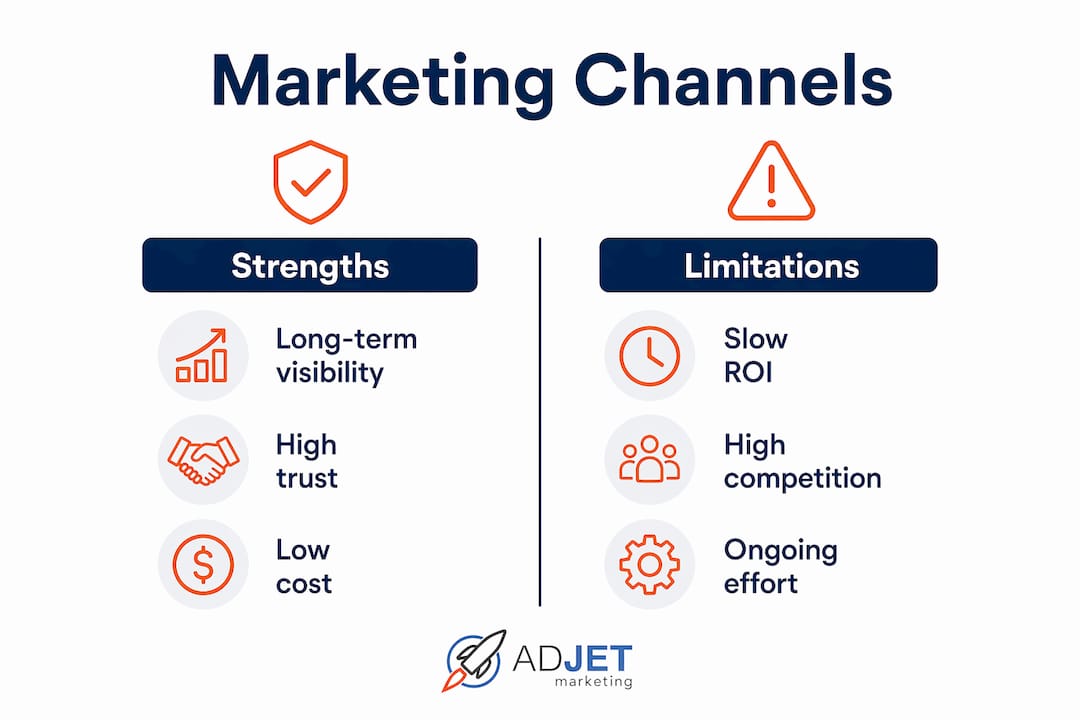
Choosing the right mix of channels is one of the most consequential decisions you make as a clinic owner or marketing professional. Each channel serves a different stage of the patient journey and carries different cost structures, timelines, and ROI profiles.
| Channel | Strengths | Limitations | ROI Timeline |
|---|---|---|---|
| SEO | Long-term visibility, high trust, low cost per lead at scale | Slow to build (6–12 months) | Long-term |
| Google Ads | Immediate visibility, precise intent targeting | Ongoing spend required | Short-term |
| Instagram / TikTok | Visual appeal, brand awareness, emotional connection | Lower direct conversion rate | Medium-term |
| Email marketing | Low cost, high retention, repeat visit driver | Requires existing list | Medium-term |
| Google Business Profile | Local search dominance, review credibility | Limited content control | Short to medium |
Aesthetic clinics perform well on visual social platforms due to the natural alignment between the visual nature of aesthetic results and the format strengths of Instagram and TikTok. These platforms are not just brand awareness tools. They are where patients form emotional connections with providers before ever visiting a website.
Search engine optimization builds discoverability over time and generates patient inquiries at a lower cost per lead than paid ads once the investment matures. Paid search, particularly Google Ads, fills the gap while SEO builds. The two channels work best together, not as alternatives.
- Email marketing is underused in aesthetics. A well-segmented list of past patients is one of the highest-ROI assets a clinic can own. Seasonal promotions, treatment reminders, and educational content keep your practice top of mind between visits.
- Google Business Profile optimization, including photo uploads, service descriptions, and HIPAA-compliant review requests, directly influences how often your clinic appears in local map results.
Pro Tip: When running Google Ads for aesthetic procedures, send traffic to a dedicated landing page for each treatment, not your homepage. A page built specifically for, say, Botox or laser resurfacing converts at a significantly higher rate because it matches the patient’s exact search intent.
For a deeper comparison of paid search versus organic strategies, the SEO vs. PPC breakdown from Adjetmarketing covers the tradeoffs in detail for medical clinics.
Why does measurement and attribution matter in aesthetics marketing?
Most clinics track clicks and form fills. That is not enough. Marketing conversions must be interpreted based on completed appointments and revenue rather than click events to reflect true business impact. A campaign that generates 200 form fills but only 12 completed appointments is performing very differently from one that generates 80 form fills and 60 completed appointments.
Traditional last-click attribution models cause significant undervaluation of early-stage content and awareness campaigns. A patient who found you through a TikTok video six weeks ago, read your blog twice, and then clicked a Google Ad before booking will show up in last-click reporting as a paid search conversion. The TikTok and blog content get zero credit, which leads to budget decisions that cut the channels doing the most work.
Healthcare marketing adds another layer of complexity. HIPAA restricts what data you can collect and how you can use it. Pixel-based retargeting that works freely in other industries requires careful implementation in healthcare to avoid transmitting protected health information (PHI). Privacy-compliant tracking methods, such as server-side tagging and consent-based analytics, protect your clinic while still giving you the data you need.
A practical measurement framework for aesthetics clinics should track:
- Marketing metrics: impressions, clicks, cost per lead, and lead volume by channel
- Operations metrics: show rate, appointment completion rate, and no-show rate
- Finance metrics: revenue per patient, cost per acquired patient, and lifetime patient value
Every marketing dollar spent generates data on source ads, traffic, and conversions, enabling continuous campaign improvement. The clinics that grow fastest are the ones that use that data to make decisions, not just to report results.
How to build a cohesive aesthetic brand across digital channels
A consistent brand presence is not about using the same logo everywhere. It is about delivering the same message, tone, and visual identity at every point where a patient encounters your practice online.
- Align your website, social profiles, and Google Business Profile with the same service descriptions, pricing language, and visual style. Inconsistencies create doubt. Patients notice when your Instagram shows one set of services and your website lists another.
- Create service-specific content that addresses the questions patients actually ask. Pages covering procedure details, recovery expectations, pricing ranges, and candidacy criteria reduce friction and pre-qualify leads before they call.
- Use video to build emotional connection. A 60-second provider introduction video on your homepage increases time on site and builds the personal trust that aesthetic patients require before committing to a procedure.
- Manage reviews with a HIPAA-compliant process. Timing review requests at non-PHI-triggering moments and using general feedback language improves local SEO without creating privacy risk. Ask for feedback after a general visit check-in, not in a message that references a specific treatment.
- Build a fast follow-up system for new leads. Speed to contact is one of the strongest predictors of lead conversion in healthcare. A lead that does not receive a response within two hours is significantly more likely to book with a competitor.
A targeted Google Business Profile optimization can significantly increase patient inquiries from local search. For aesthetic clinics that serve a defined geographic area, local SEO is often the highest-leverage investment available.
For clinics building or rebuilding their web presence, a well-designed medical spa website is the foundation that every other channel depends on. Traffic from any source converts at a fraction of its potential if the website does not build trust and guide visitors toward booking.
Key takeaways
Digital marketing for aesthetics clinics works because it combines measurable patient engagement, multi-channel presence, and attribution-aligned ROI into a single growth system.
| Point | Details |
|---|---|
| Multi-channel presence is required | Patients research across Google, YouTube, Instagram, and reviews before booking. |
| Attribution must connect to revenue | Track completed appointments and patient value, not just clicks and form fills. |
| Channel mix drives different outcomes | SEO builds long-term leads; Google Ads delivers immediate volume; social builds trust. |
| HIPAA compliance shapes your tracking | Privacy-compliant analytics protect your clinic while preserving data quality. |
| Brand consistency increases conversion | Unified messaging across all platforms reduces patient drop-off and builds trust. |
What I’ve learned running digital marketing for aesthetic clinics
Many clinics come to Adjetmarketing after spending months on a single channel, usually Instagram or Google Ads, without seeing the patient growth they expected. The problem is rarely the channel itself. It is the absence of a system connecting that channel to everything else.
The clinics I see grow consistently share one habit: they treat digital marketing as a measurement practice, not a content practice. They care less about how many posts they published and more about which channels are producing completed appointments at an acceptable cost. That shift in mindset changes everything about how you allocate budget and time.
One thing I tell every clinic owner is to resist the pressure to be everywhere at once. Start with two channels you can execute well, measure them properly, and expand from there. A well-managed Google Ads account and a strong Google Business Profile will outperform a scattered presence across six platforms every time.
The attribution challenge in healthcare is real and worth taking seriously. I have seen clinics cut their SEO budget because it did not show up in last-click reports, only to watch their lead volume drop three months later when the organic rankings they had built began to decay. Understanding how your channels interact is not optional. It is the difference between growing and spinning your wheels.
— Felix
How Adjetmarketing helps aesthetic clinics grow with digital marketing
Adjetmarketing works with aesthetic clinics, med spas, and plastic surgery practices to build digital marketing strategies that connect every channel to real patient outcomes. We handle SEO, Google Ads, social media, and website design with a focus on HIPAA-compliant tracking and attribution that reflects actual appointments and revenue, not just clicks. Our team builds the measurement infrastructure that lets you see which campaigns are producing patients and which are not. If you are ready to move from guesswork to a data-backed growth system, contact Adjetmarketing to discuss a strategy built around your clinic’s specific patient acquisition goals. You can also explore our digital marketing guide for healthcare clinics to see how the full system fits together.
FAQ
Why do aesthetics clinics need digital marketing?
Aesthetic patients research providers extensively online before booking, using Google, social media, reviews, and video. Clinics without a strong digital presence lose those patients to competitors who appear at every stage of that research process.
What digital marketing channels work best for aesthetics?
Google Ads and SEO drive the highest-intent patient traffic, while Instagram and TikTok build brand trust and emotional connection. Email marketing is the most cost-effective channel for retaining existing patients and driving repeat visits.
How should aesthetics clinics measure digital marketing ROI?
Track conversions at the appointment completion level, not just form fills or clicks. Align your marketing metrics with operations data, such as show rates and revenue per patient, to get an accurate picture of campaign performance.
What is HIPAA-compliant marketing for aesthetic clinics?
HIPAA-compliant marketing avoids collecting or transmitting protected health information through ad pixels or tracking tools. It includes using server-side tagging, consent-based analytics, and general language in review requests that does not reference specific treatments.
How long does it take to see results from aesthetics digital marketing?
Google Ads can generate patient inquiries within days of launch. SEO typically requires 6–12 months to produce significant organic traffic. A combined strategy delivers short-term volume from paid ads while building long-term organic visibility in parallel.