









Data-driven marketing in healthcare is defined as the practice of using patient behavior data, campaign analytics, and clinical outcome metrics to guide every marketing decision, from budget allocation to channel selection. Healthcare organizations that adopt this approach stop guessing which channels produce patients and start measuring it directly. The benefits of data in healthcare marketing are concrete: better targeting, lower cost per acquisition, and campaigns that can be tied to real appointments. This article explains why data-driven marketing for healthcare is no longer optional, and how to build the infrastructure that makes it work.
How does data-driven marketing improve patient acquisition in healthcare?
Healthcare systems with mature analytics achieve 23% higher patient acquisition rates compared to organizations still relying on traditional marketing methods. That gap exists because data-driven teams know which search terms, ad placements, and content pieces actually convert prospects into booked appointments.

Healthcare marketing is not like selling software. Patient acquisition journeys span 6–12 months, and lead costs run up to 5x higher than the cross-industry average. Those numbers mean a poorly targeted campaign does not just underperform. It burns through budget at a rate that most clinics cannot sustain.
Data analytics in healthcare marketing solves this by enabling three specific capabilities:
- Patient segmentation: Grouping prospects by condition, geography, insurance type, or prior engagement so you reach the right person with the right message.
- Intent tracking: Identifying which patients are actively researching treatments versus browsing casually, so you allocate spend toward high-intent prospects.
- Lead scoring: Ranking inbound leads by their likelihood to book, so your front desk team prioritizes the calls most likely to convert.
Pro Tip: Focus your first segmentation effort on your highest-value patient cohorts, such as elective procedure candidates or patients with recurring treatment needs. These groups justify the data investment fastest and produce the clearest ROI signal.
What infrastructure and data integration challenges exist in healthcare marketing?
The biggest reason healthcare marketers fail at analytics is not their dashboard. Infrastructure failure is the principal cause of poor analytics performance. Without a unified data warehouse that connects your ad platforms, CRM, website, and call tracking, every report you produce is incomplete.
Building that infrastructure in healthcare is harder than in other industries. Here is why, and what each challenge actually requires:
- Unified data warehouse setup. You need a single environment where Google Ads, Meta, your CRM, and your website analytics feed into the same reporting layer. Without this, you are comparing numbers from different systems that define conversions differently.
- Campaign taxonomy governance. Every campaign, ad group, and UTM parameter must follow a consistent naming convention. Without governance, your data becomes unreadable at scale and attribution breaks down.
- EHR to marketing data integration. Connecting electronic health records to marketing platforms requires complex schema mapping and consent alignment. This goes far beyond a simple API connection. Clinical data fields do not map cleanly to marketing attributes, and every data point transferred must carry a consent flag.
- HIPAA compliance at every integration point. Any system that touches patient data must handle protected health information (PHI) correctly. This means access controls, audit logs, and data minimization at each connection.
- Consent management. Patients must explicitly consent to how their data is used for marketing purposes. Your consent framework must be documented and enforceable across all platforms.
Analytics add value by simplifying complexity and enabling budget reallocation toward what works. But that value only materializes when the underlying infrastructure is sound.
How does data-driven marketing enable HIPAA-compliant measurement and ROI tracking?
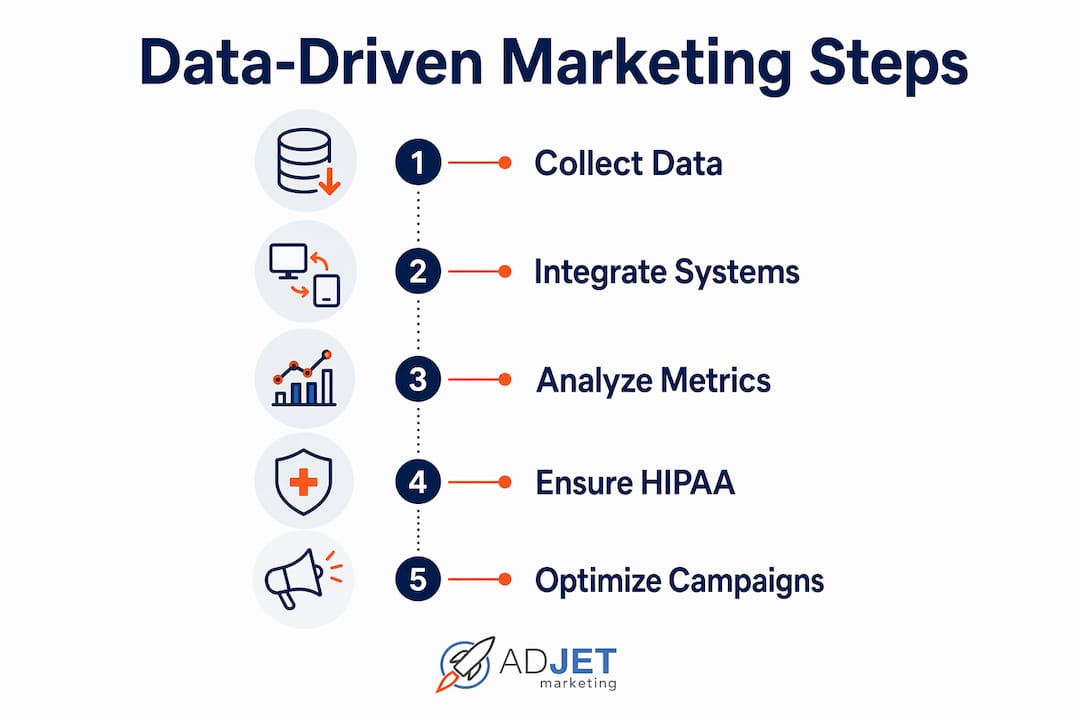
Only 1% of healthcare marketers connect more than 50% of their spend directly to patient conversions. The primary barriers are compliance gaps and fragmented data systems. That statistic reveals how much ROI most healthcare organizations are leaving unmeasured.
HIPAA-compliant measurement requires a different technical approach than standard web analytics. The key practices are:
- Server-side tracking. Standard web analytics risk HIPAA violations by capturing PHI in URLs or form fields. Server-side tracking strips PHI before the data is processed, keeping your analytics clean and compliant.
- Aggregated data reporting. Instead of tracking individual patient journeys, you measure cohort-level patterns. This protects patient privacy while still giving you statistically valid campaign performance data.
- Closed-loop attribution. This ties a specific ad click or search query to a booked appointment or completed procedure. It requires connecting your ad platforms to your CRM or scheduling system without exposing individual patient records.
- Proxy metrics for clinical outcomes. When you cannot directly measure clinical results for marketing purposes, you use proxy metrics such as appointment show rates, consultation completion rates, and treatment acceptance rates.
Health systems spending $120,000–$180,000 annually on unified infrastructure achieve 3:1 to 8:1 ROI. That return comes from faster campaign optimization, reduced wasted spend, and the ability to shift budget toward channels that demonstrably produce patients.
What practical steps can healthcare marketers take to implement data-driven strategies?
A phased approach works better than trying to build everything at once. Most clinics that come to Adjetmarketing after poor lead quality have the same problem: they invested in ads before they had the measurement infrastructure to know what was working.
Pro Tip: Start with call tracking and CRM integration before touching anything else. These two integrations unlock 65% of attribution value at roughly 15–20% of total integration cost. They are the highest-leverage starting point.
The phased roadmap looks like this:
- Data audit (weeks 1–4). Catalog every data source you currently have: ad platforms, website analytics, CRM, phone system, and scheduling software. Identify gaps and conflicts.
- Priority integrations (weeks 5–12). Connect call tracking and CRM first. Then add website analytics with server-side tracking configured for HIPAA compliance.
- Governance setup (weeks 8–16). Establish campaign naming conventions, consent management protocols, and data access controls before you scale any campaigns.
- Measurement shift (months 4–6). Move from vanity metrics like impressions and clicks to outcome metrics like cost per booked appointment and patient lifetime value.
- Routine analytics close (ongoing). Run a weekly or biweekly analytics review to catch budget waste early and reallocate toward top-performing channels.
On the channel side, paid ads and SEO serve different roles when guided by data. Paid search through Google Ads produces faster results, typically within 30–90 days, but requires continuous budget. SEO builds compounding visibility over 6–12 months and reduces cost per acquisition over time. Data analytics tells you which channel is producing patients at what cost, so you can allocate budget rationally rather than by gut feel. You can see current healthcare advertising approaches that are producing results in 2026 to benchmark your channel mix.
Tracking patient intent and reducing friction builds the emotional trust that high-consideration health decisions require. That trust is not built by spending more. It is built by showing up with the right message at the right moment, which only data makes possible.
Key Takeaways
Data-driven marketing for healthcare works because it replaces assumption-based spending with measurable, patient-centered decisions grounded in real attribution data.
| Point | Details |
|---|---|
| Analytics drive acquisition | Mature analytics users achieve 23% higher patient acquisition than traditional marketing peers. |
| Infrastructure is the real barrier | Unified data warehouses and governance, not better dashboards, determine analytics success. |
| HIPAA compliance is non-negotiable | Server-side tracking and aggregated reporting protect PHI while enabling accurate ROI measurement. |
| Start with call tracking and CRM | These two integrations unlock 65% of attribution value at the lowest implementation cost. |
| Phased implementation reduces risk | A structured rollout from data audit to routine analytics close produces faster, more reliable results. |
Why I think most healthcare marketers are solving the wrong problem
The clinics I work with most often arrive frustrated. They have spent money on Google Ads or SEO, they have a dashboard with numbers in it, and they still cannot tell you which campaign produced their last 10 patients. The instinct is to blame the tool. The actual problem is almost always the infrastructure underneath it.
Healthcare marketers tend to invest in reporting before they invest in data integrity. That is backwards. A beautiful dashboard built on fragmented, uncleaned data gives you confident-looking numbers that are wrong. I have seen clinics pause campaigns that were actually working because their attribution was broken and the data made the campaign look like a failure.
The other mistake I see constantly is treating compliance as a reason not to measure. HIPAA does not prohibit analytics. It prohibits careless handling of PHI. Server-side tracking, consent management, and aggregated reporting let you measure everything that matters without touching protected data. Compliance and performance are not in conflict. They require different technical choices, but both are achievable.
The most effective healthcare marketers I know treat their data infrastructure the way a clinic treats its equipment. They invest in it before they need it, they maintain it consistently, and they do not expect it to run itself. Effective marketing for healthcare providers starts with that foundation, not with the ad creative.
— Felix
How Adjetmarketing helps healthcare marketers build data-driven systems
Adjetmarketing works directly with medical clinics, med spas, pain management practices, and private healthcare providers to build the measurement infrastructure that makes marketing accountable. We connect Google Ads, call tracking, CRM, and website analytics into a unified reporting system that ties spend to booked appointments, not just clicks. If you are not sure why healthcare marketing matters to your bottom line, that page is a good starting point. For clinics ready to move past guesswork and into measurable patient acquisition, our team builds the systems, runs the campaigns, and reports on what actually works.
FAQ
What is data-driven marketing in healthcare?
Data-driven marketing in healthcare is the use of patient behavior data, campaign analytics, and attribution systems to guide marketing decisions. It replaces assumption-based spending with measurable, outcome-linked strategies.
How does data analytics improve patient acquisition?
Healthcare systems with mature analytics capabilities achieve 23% higher patient acquisition rates than those using traditional methods. Analytics enable precise patient segmentation, intent tracking, and lead scoring that reduce wasted spend.
Is data-driven marketing HIPAA compliant?
Yes, when implemented correctly. Server-side tracking strips PHI before processing, and aggregated reporting measures campaign performance without exposing individual patient records.
Why do so few healthcare marketers measure ROI accurately?
Only 1% of healthcare marketers connect more than 50% of their spend to patient conversions. The main barriers are fragmented data systems and compliance gaps, not a lack of available tools.
Where should a healthcare marketer start with data-driven strategies?
Start with call tracking and CRM integration. These two steps unlock the majority of attribution value at the lowest implementation cost and give you an immediate, measurable view of which campaigns are producing patients.