









Data-driven medical marketing is defined as the practice of using patient behavior signals, campaign performance metrics, and clinical data to guide every marketing decision a healthcare clinic makes. The role of data in medical marketing has moved from a nice-to-have capability to the foundation of patient acquisition. Health systems with mature analytics achieved 23% higher patient acquisition rates than those relying on non-data-driven approaches. That gap is not a rounding error. It represents hundreds of booked appointments per year for a mid-size clinic.
What is the role of data in medical marketing?
Data gives healthcare marketers the ability to replace assumptions with evidence. Without it, you are allocating budget based on gut feeling, which is exactly how clinics end up overspending on channels that produce no appointments. The industry term for this practice is health marketing analytics, and it covers everything from tracking which Google Ads keywords drive actual bookings to modeling which patient segments are most likely to churn.
The core function of data in this context is closing the loop between a marketing dollar spent and a patient who walks through the door. Only 1% of healthcare marketers can connect more than half of their marketing spend to confirmed patient conversions. That figure reveals how large the measurement gap still is across the industry, and it explains why so many clinic owners feel their marketing budget disappears without clear results.

Data also shapes how you communicate with prospective patients. When you know that a patient searched for “pain management near me” before calling your clinic, you can tailor your follow-up messaging to match that specific concern. That level of personalization is only possible with structured data collection and analysis. The digital marketing guide for healthcare clinics from Adjetmarketing covers how to build this kind of measurement foundation from the ground up.
What types of data do healthcare marketers use?
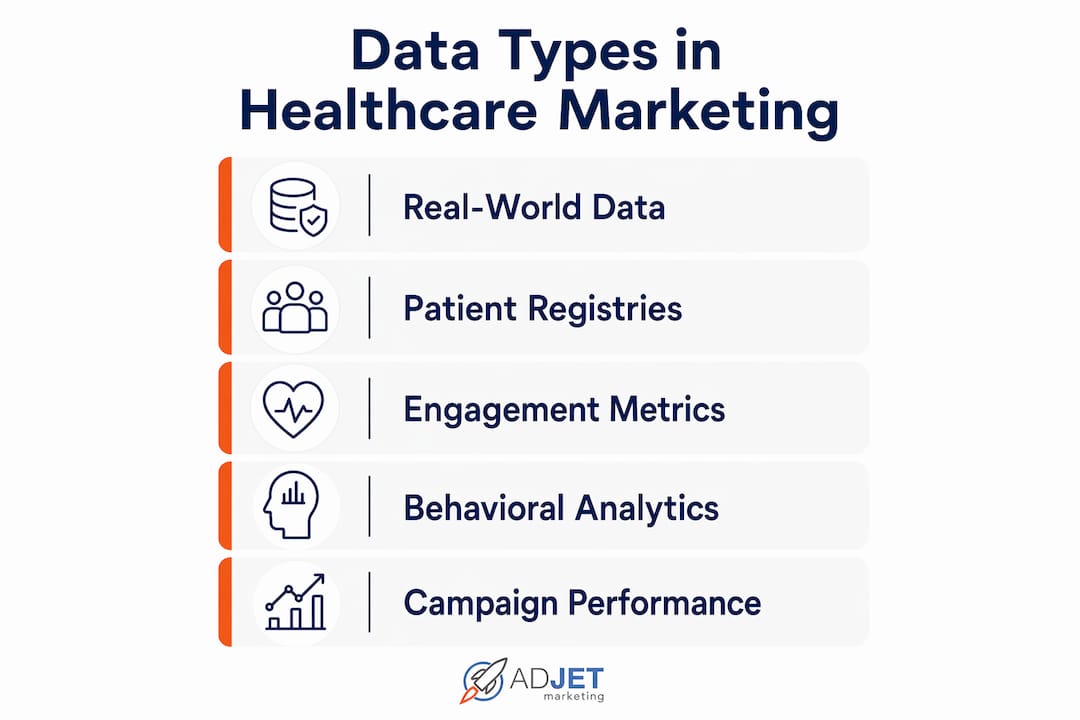
Healthcare marketers draw from three distinct data categories, and each one serves a different purpose in campaign planning and patient engagement.
First-party patient data is the most reliable source available to your clinic today. Patient portals generate constant engagement signals, including login frequency, appointment scheduling behavior, and form completions. Call center records and electronic medical records (EMRs) add offline conversion data that most digital analytics tools miss entirely.
Real-World Data (RWD) expands your view beyond your own clinic walls. This category includes:
- Electronic health records (EHRs) from health system networks
- Insurance claims data showing treatment patterns across populations
- Patient registry data for specific condition groups
- Wearable device outputs tracking health behaviors over time
RWD from EHRs and patient registries improves targeting precision and allows marketers to monitor campaign effectiveness in real time. For a pain clinic, this means you can identify geographic clusters of patients with chronic pain diagnoses and direct your Google Ads spend toward those zip codes.
Engagement and behavioral metrics round out the picture. These include website session data, click-through rates on email campaigns, time-on-page for condition-specific landing pages, and call tracking data tied to specific ad campaigns. When you combine all three data categories, you get a full picture of the patient acquisition funnel from first search to attended appointment. Understanding why analytics drives better ROI is the first step toward building that integrated system.
How does privacy compliance affect data use in healthcare marketing?
HIPAA compliance is not optional in healthcare marketing. It is the legal and ethical baseline that governs how you collect, store, and use any data connected to patient identity or health status. Protected Health Information (PHI) includes names, dates of service, diagnosis codes, and even IP addresses when combined with health-related search behavior.
The compliance challenge is more technical than most clinic owners realize. Standard web analytics tools often violate HIPAA by inadvertently capturing PHI through URL strings, form field data, and session recordings. A basic Google Analytics setup on a patient intake page can transmit condition-specific information to third-party servers without any intentional action on your part.
HIPAA-compliant de-identification and tokenization are the two primary technologies that allow you to link offline health data to online digital identifiers without exposing PHI. De-identification removes or masks all 18 HIPAA-defined patient identifiers. Tokenization replaces sensitive data fields with non-sensitive placeholders that can be matched across systems without revealing the underlying information. These tools make it possible to run attribution models that connect a Google Ad click to an actual appointment without ever exposing a patient’s identity.
Pro Tip: Before deploying any web analytics or ad tracking on pages where patients enter personal or health information, review your Business Associate Agreements (BAAs) with every vendor in your data pipeline. A missing BAA is a HIPAA violation waiting to happen. You can find a detailed breakdown of PHI protection workflows that Adjetmarketing uses with healthcare clients.
What analytical methods are transforming healthcare marketing?
Advanced analytics in medical promotion goes well beyond counting clicks and impressions. The methods below represent the current standard for clinics that want to connect marketing spend to real patient outcomes.
| Method | What it measures | Best use case |
|---|---|---|
| Marketing Mix Modeling (MMM) | Contribution of each channel to patient volume over time | Allocating budget across SEO, paid ads, and offline channels |
| Predictive patient modeling | Likelihood of acquisition or churn based on behavioral signals | Identifying high-value prospects and at-risk patients |
| Multi-touch attribution | Credit assigned to each touchpoint in the patient journey | Understanding which combination of channels drives bookings |
| Last-click attribution | Full credit to the final touchpoint before conversion | Simple reporting; not recommended as a standalone model |
Marketing mix modeling uses Bayesian causal metrics to reveal how each media channel contributes to patient volume over time, independent of last-click bias. This matters because a patient who books an appointment after seeing a Google Ad likely also saw your clinic’s blog post, read a Google review, and visited your website twice before converting. Last-click attribution gives all the credit to the ad and none to the other touchpoints.
Predictive models for patient churn analyze signals like missed appointments, declines in patient portal logins, and gaps in preventive care visits. These signals appear weeks before a patient disengages entirely, giving your marketing team time to re-engage them with targeted outreach. Healthcare marketers using privacy-first infrastructure can run multi-touch attribution across the full funnel by integrating CRM data, EHR records, and call center logs into a single measurement framework.
The shift toward transparent, “white-box” analytics models is also significant. Rather than relying on black-box algorithms that produce recommendations without explanation, white-box frameworks show exactly which variables drive each prediction. That transparency is critical when you need to justify a budget reallocation to a clinic administrator or board.
How do you implement data-driven marketing in a healthcare clinic?
Building a data-driven marketing program in a healthcare setting requires coordination across your marketing, IT, and compliance teams. The following steps reflect what actually works in practice, not just in theory.
-
Audit your current tracking setup. Identify every pixel, tag, and analytics script running on your website. Flag any that touch pages where patients enter personal or health information. Replace non-compliant tools with HIPAA-safe alternatives before running any paid campaigns.
-
Build a first-party data collection system. Set up call tracking numbers tied to specific campaigns, integrate your CRM with your patient management system, and configure your patient portal to capture engagement signals. First-party data from portals and call centers is the most reliable source for closing the loop to attended appointments.
-
Implement server-side tracking. Server-side tracking processes data on your own server before sending it to ad platforms, keeping PHI out of third-party systems. This is the technical foundation of a compliant, measurable marketing program.
-
Define conversion events that matter. Stop measuring success by clicks or impressions alone. Define conversions as booked appointments, completed intake forms, or confirmed phone consultations. Every campaign should optimize toward one of these outcomes.
-
Run a monthly attribution review. Compare channel performance using multi-touch attribution data, not last-click reports. Adjust budget allocations based on which channels contribute most to confirmed patient conversions across the full funnel.
Pro Tip: Many clinics come to Adjetmarketing after spending months optimizing for click-through rates while their actual appointment volume stays flat. The fix is almost always the same: connect your ad platform data to your scheduling system and measure what actually happens after the click.
The why data-driven marketing matters resource from Adjetmarketing walks through the specific infrastructure decisions that separate clinics with measurable ROI from those still guessing.
Key Takeaways
Data-driven medical marketing produces measurably higher patient acquisition rates only when clinics combine compliant data infrastructure, advanced attribution models, and first-party data systems into a unified measurement program.
| Point | Details |
|---|---|
| Analytics maturity drives acquisition | Health systems with mature analytics achieved 23% higher patient acquisition rates than non-data-driven peers. |
| Measurement gaps are widespread | Only 1% of healthcare marketers can connect more than half of their spend to confirmed patient conversions. |
| HIPAA compliance is technical | Server-side tracking and tokenization are required to collect marketing data without exposing PHI. |
| First-party data is most reliable | Patient portal signals and call center records provide the clearest path from ad spend to booked appointments. |
| Attribution models must go beyond last-click | Marketing mix modeling and multi-touch attribution reveal the true contribution of each channel to patient volume. |
What I have learned from watching clinics get this wrong
The most common mistake I see is clinics treating data as a reporting tool rather than a decision-making tool. They pull a monthly report, see that Google Ads generated 200 clicks, and call it a success. Nobody asks how many of those clicks became appointments, and nobody checks whether the patients who did book were the right fit for the clinic’s services.
The second mistake is underestimating the compliance dimension. I have seen well-intentioned marketing teams install session recording software on patient intake pages without realizing they were capturing PHI. The legal exposure is real, and the reputational damage from a HIPAA breach far outweighs any short-term marketing gain.
What actually works is treating your marketing program like a laboratory. You form a hypothesis, run a campaign, measure the outcome against a real conversion event, and adjust. That requires clean data, compliant infrastructure, and the patience to wait for statistically meaningful results. Small clinics often want to see ROI in 30 days. The honest answer is that meaningful attribution data usually takes 60–90 days to accumulate, especially when you are building first-party data systems from scratch.
The clinics that get this right share one trait: they invest in the measurement infrastructure before they scale their ad spend. They know what a patient acquisition costs, which channels drive the most bookings, and which patient segments have the highest lifetime value. That knowledge compounds over time and creates a durable competitive advantage.
— Felix
How Adjetmarketing helps healthcare clinics use data effectively
Adjetmarketing works with medical clinics, med spas, pain management practices, and plastic surgeons to build marketing programs grounded in real patient data. As a Google Partner agency, we structure Google Ads campaigns around confirmed appointment conversions, not vanity metrics. We implement server-side tracking, configure HIPAA-compliant analytics pipelines, and connect ad performance data to your scheduling system so you can see exactly which campaigns fill your calendar.
If you are ready to move from guesswork to a measurable patient acquisition system, our digital marketing strategy development service is built for exactly this situation. We assess your current data infrastructure, identify compliance gaps, and build a campaign architecture that produces results you can verify.
FAQ
What is the role of data in medical marketing?
Data in medical marketing is the practice of using patient behavior signals, campaign metrics, and clinical records to guide budget allocation, targeting, and messaging decisions. It replaces assumption-based marketing with measurable, patient-focused strategies.
How does HIPAA affect healthcare marketing data collection?
HIPAA requires that any data collection touching patient identity or health information use compliant tools, signed Business Associate Agreements, and techniques like de-identification or tokenization to prevent PHI exposure in ad platforms.
What is marketing mix modeling in healthcare?
Marketing mix modeling (MMM) is an analytical method that uses statistical techniques to measure how each marketing channel contributes to patient volume over time, independent of last-click bias. It is particularly useful for clinics running both digital and offline campaigns.
Why do most healthcare marketers struggle with attribution?
Only 1% of healthcare marketers can connect more than half of their spend to confirmed patient conversions, primarily because standard analytics tools capture incomplete data and lack integration with scheduling or EMR systems.
What data sources are most reliable for healthcare marketing?
First-party data from patient portals, call centers, and CRM systems is the most reliable source for healthcare marketing insights. It provides direct signals from real patients and can be linked to appointment outcomes without relying on third-party data providers.