









Your website is losing money right now. Not dramatically, not all at once, but steadily, through slow load times, confusing layouts, and pages that never quite convince visitors to act. This website optimization guide covers what actually moves the needle: performance, SEO, and conversion improvements grounded in 2026 data. Whether you manage a medical clinic, a growing service business, or an e-commerce operation, you will find a clear, practical framework here for turning a decent site into one that generates real results.
Table of Contents
- Key takeaways
- Starting with the right foundation
- Core website optimization tactics that work
- Mistakes that undermine your results
- Measuring what actually improved
- My take on what actually moves the needle
- How Adjetmarketing can help
- FAQ
Key takeaways
| Point | Details |
|---|---|
| Audit before you act | Run a full technical and UX baseline audit before touching a single element of your site. |
| Speed has a direct cost | A 1-second delay reduces conversions by 7%, making performance a revenue issue, not just a tech one. |
| Combine data with qualitative insight | Analytics tells you what is happening; session recordings and user feedback tell you why. |
| CRO requires statistical discipline | A/B tests need at least two weeks and enough traffic to reach 95% confidence before drawing conclusions. |
| Optimization is a cycle, not a project | Sustained testing and monitoring outperform any one-time redesign or quick fix. |
Starting with the right foundation
Before you touch a single element on your site, you need to know where you actually stand. Jumping into optimization without baseline data is how teams waste months on the wrong problems.
Start by setting up or auditing these tools:
- Google Analytics 4 for traffic, behavior flows, and conversion funnels
- Google Search Console for crawl errors, indexing issues, and search performance
- A heatmap tool (such as Hotjar or Microsoft Clarity) for click patterns and scroll depth
- Session recording software to watch real users interact with your pages
- PageSpeed Insights and Lighthouse for initial performance benchmarking
Once your tracking is in place, define clear KPIs before you start changing anything. Are you trying to reduce bounce rate? Increase form submissions? Improve organic rankings for specific terms? Each goal requires a different optimization focus, and without defined targets, you have no way to measure success.
| Goal | Primary metric | Tool to track it |
|---|---|---|
| Faster page speed | Core Web Vitals (LCP, CLS, INP) | PageSpeed Insights, CrUX |
| More organic traffic | Impressions, clicks, rankings | Google Search Console |
| Higher conversion rate | Form submissions, calls, bookings | GA4, heatmaps |
| Lower bounce rate | Bounce rate, session duration | GA4, session recordings |
From there, perform a structured website audit checklist covering technical SEO, page speed, mobile responsiveness, content quality, and conversion pathways. This audit becomes your optimization roadmap. Mobile traffic exceeds 60% of total web visits, which means any audit that does not prioritize the mobile experience is already incomplete.

Pro Tip: Run your most important pages through both lab tools (Lighthouse) and real-user data (CrUX in PageSpeed Insights). Lab scores help with diagnosis; field data reflects what your actual visitors experience.
Core website optimization tactics that work
This is where preparation becomes execution. The website optimization process breaks naturally into three areas: performance, SEO, and conversion rate optimization. Each supports the others, and neglecting one limits the return on everything else.
Performance optimization
- Compress and convert images. Images account for 50 to 70% of total page weight. Switching to WebP or AVIF formats alongside proper compression is the highest return optimization most sites can make today.
- Fix JavaScript loading. JavaScript is the most expensive resource on most pages due to parsing and execution costs. A 200 KB JavaScript bundle costs far more in processing time than a 200 KB image. Audit your JS, eliminate unused code, and defer what is not needed on initial load.
- Defer third-party scripts. Analytics tags, ad pixels, and chat widgets often block rendering. Deferring non-critical scripts significantly improves page interactivity and load times. Load them after your primary content has rendered.
- Inline critical CSS, async the rest. Inlining the CSS needed for above-the-fold content while loading the rest asynchronously reduces render-blocking and directly improves Core Web Vitals.
- Self-host and preload fonts. Using "font-display: swap` alongside self-hosted fonts with preload hints reduces layout shifts and improves perceived loading speed. Relying on third-party font CDNs adds a DNS lookup on every visit.
- Use a CDN and review your hosting. A content delivery network reduces physical distance between your server and your users. For clinics and local service businesses, this matters less than for national brands, but a slow host still kills performance regardless of where your users are located.
Pro Tip: Every 100ms of latency can cost 1% in revenue. That figure comes from e-commerce data, but it applies to any site where speed affects whether someone stays or leaves.
SEO optimization strategies
Strong technical structure remains the foundation of organic visibility. Google’s 2026 guidelines emphasize clear site architecture, unique and substantive content, and demonstrable author credentials, particularly as generative AI changes how search results are surfaced.
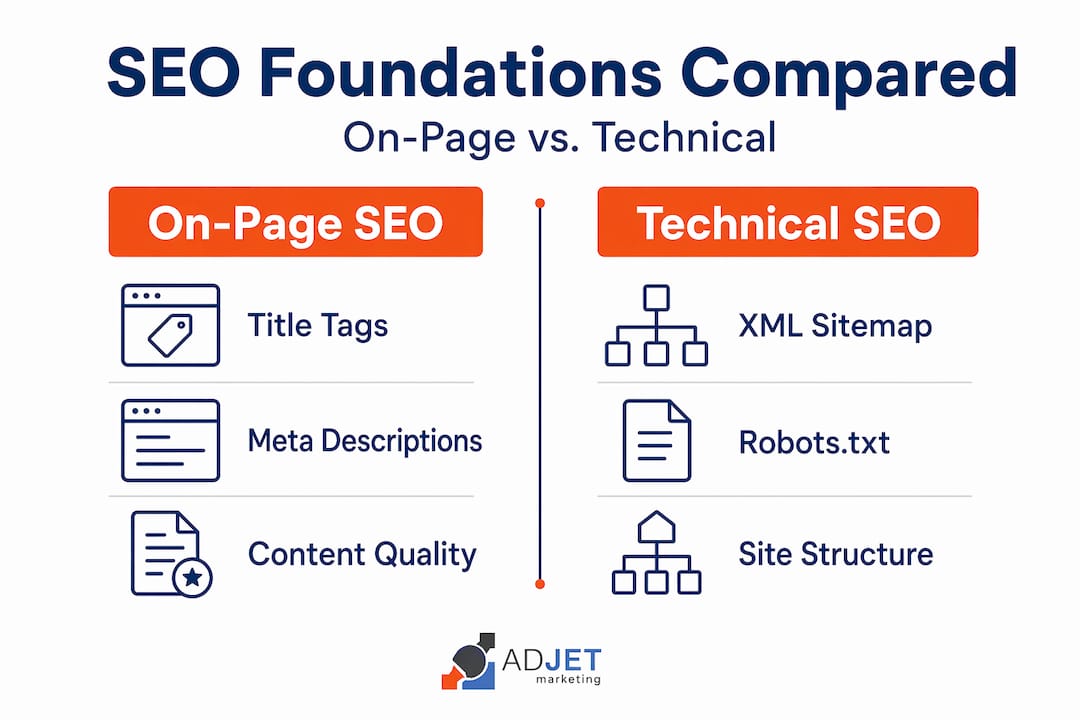
Here is a quick comparison of on-page vs. technical SEO focus areas:
| On-page optimization | Technical SEO |
|---|---|
| Title tags and meta descriptions | XML sitemap and robots.txt |
| Header structure (H1, H2, H3) | Crawlability and indexing |
| Keyword placement and content depth | Canonical tags and duplicate content |
| Internal linking and anchor text | Schema markup and structured data |
| Image alt text | Core Web Vitals and page speed |
For healthcare practices and clinics, the on-page optimization guide should also account for E-E-A-T signals (experience, expertise, authoritativeness, and trustworthiness). Adding author bios, credentials, and references to clinical staff on service pages meaningfully strengthens how Google evaluates your content. You can see how this applies specifically in a healthcare SEO context where trust signals carry extra weight.
Conversion rate optimization
Successful CRO is a scientific process. It is not about moving a button or changing a color on a hunch. It combines quantitative data (where users drop off, what they click) with qualitative feedback (why they leave without converting) to form testable hypotheses.
Start by identifying your highest-traffic, lowest-converting pages. These are your biggest opportunities. Then look at friction points: form length, confusing calls to action, slow load times on key landing pages, or lack of social proof near decision points.
For clinical websites, a well-structured high-converting landing page typically includes a clear headline, a specific offer, trust signals (reviews, credentials), a short form, and a visible phone number above the fold. Each element addresses a specific concern a potential patient might have before booking.
A/B tests require a minimum of two weeks and enough traffic to reach statistical confidence before you act on results. Ending tests early because a variant looks promising is one of the most common and costly mistakes in CRO.
Mistakes that undermine your results
Even with the right tools and intentions, certain patterns consistently derail optimization efforts. Knowing what to watch for saves significant time and budget.
- Lazy loading your hero image. Lazy loading the LCP element hurts your largest contentful paint score directly. Hero images should always load eagerly, not deferred.
- Ignoring mobile experience. Reviewing your site only on desktop while the majority of your traffic comes from phones means you are optimizing for the wrong audience.
- Testing without enough data. Running A/B tests on pages that receive fewer than a few hundred visits per week produces unreliable results. Low-traffic tests mislead more than they inform.
- Adding too many plugins or scripts. Each tracking pixel, chat widget, and third-party integration adds weight and request overhead. Audit your scripts quarterly and remove anything that is not actively earning its place.
- Treating optimization as a one-time project. A site optimized today degrades as content, traffic patterns, and technology shift. Continuous monitoring is not optional.
“The psychology behind conversion rate optimization is about understanding visitor needs and removing barriers, not applying quick visual tricks.”
CRO Guide 2026, PxlPeak
Pro Tip: After any major site update, recheck your Core Web Vitals in PageSpeed Insights within 28 days. Google updates field data on a rolling 28-day window, so changes show up faster than most people expect.
Measuring what actually improved
Tracking improvements closes the loop on your website optimization process. Without measurement, you cannot distinguish a real win from a coincidence.
| Metric | What it measures | Best tool |
|---|---|---|
| Largest Contentful Paint (LCP) | Perceived load speed of main content | PageSpeed Insights, CrUX |
| Interaction to Next Paint (INP) | Page responsiveness to user input | Chrome UX Report |
| Cumulative Layout Shift (CLS) | Visual stability during load | Lighthouse, PageSpeed Insights |
| Conversion rate | Percentage of visitors who complete a goal | GA4, A/B testing platform |
| Organic click-through rate | SEO performance on search results | Google Search Console |
Real-user Core Web Vitals from the Chrome User Experience Report (CrUX) should take priority over lab scores. Lighthouse gives you a controlled snapshot; CrUX reflects how your actual visitors experience the site on their own devices and connections.
Set performance budgets. Decide in advance that your LCP will not exceed 2.5 seconds and your page weight will not exceed a defined threshold. When new content or features push you over those limits, you have an objective trigger to investigate. This approach keeps your site speed improvements durable over time rather than slipping backward after each update.
My take on what actually moves the needle
I have worked with enough clinic owners and marketing teams to tell you plainly: chasing a perfect PageSpeed score is often the wrong priority.
I have seen sites with scores in the 90s that convert poorly because the content does not match what the visitor actually needs. And I have seen sites scoring in the 60s that book appointments consistently because the page answers the right question at the right moment. Performance matters, and you should absolutely fix the major issues. But a score is not a strategy.
What I find genuinely moves the needle is the combination of fixing real technical problems and understanding the specific reasons your visitors do not convert. That requires both the data and the discipline to sit with session recordings, read your own page copy critically, and run tests long enough to trust the results. Most teams skip the qualitative side entirely because it takes more time. That is exactly where the real insight lives.
The sites I have seen grow consistently over time share one trait: they treat optimization as an ongoing practice, not a launch checklist. They review their Core Web Vitals after every major update, they monitor performance and conversion together because the two are directly linked in how Google evaluates engagement, and they test before they redesign. That kind of discipline compounds.
— Felix
How Adjetmarketing can help
If you are managing a clinic, med spa, or healthcare practice and want to turn your website into a consistent lead source, Adjetmarketing builds and optimizes WordPress sites specifically for healthcare providers. Our process starts with a full audit covering speed, technical SEO, mobile experience, and conversion pathways. From there, we implement the changes that have the most measurable impact for your specific traffic and goals.
We also manage ongoing SEO and Google Ads campaigns that work in parallel with your site, so every dollar of paid traffic lands on pages built to convert. Understanding why marketing matters in healthcare is the first step. Acting on it with the right systems is what separates clinics that grow from those that stall. Our professional SEO services and conversion optimization programs are designed for exactly this kind of sustained, measurable growth.
FAQ
What is the most impactful first step in website optimization?
Run a technical and performance audit before making any changes. Tools like Google PageSpeed Insights and Search Console surface the highest-impact issues quickly, so you fix what matters most rather than what seems obvious.
How much does page speed affect conversions?
A one-second delay in page load time reduces conversions by approximately 7%, and pages taking longer than 3 seconds see significant drop-offs in visitor retention. Speed is directly tied to revenue.
How long should an A/B test run?
A minimum of two weeks is recommended, with enough traffic to reach 95% statistical confidence. Tests ended early due to a promising result often mislead rather than inform.
What are Core Web Vitals and why do they matter?
Core Web Vitals are Google’s standardized metrics for page experience: LCP (load speed), INP (interactivity), and CLS (visual stability). They influence both search rankings and user satisfaction, making them central to any website optimization best practices plan.
How often should you re-audit your website?
A full audit should happen at minimum once per quarter and after any major site update, plugin change, or significant traffic shift. Optimization degrades without ongoing monitoring.
Recommended
- 10 Of The Best Marketing Strategies For Industrial Companies In 2025? “Strategies That Forge Success!” – AdJet Digital Marketing & Google Partner Agency | SEO Development Google Ads Social
- Essential Strategies For Effective Manufacturing Marketing In 2024 – AdJet Digital Marketing & Google Partner Agency | SEO Development Google Ads Social
- 5 Healthcare Marketing Strategies You Can’t Ignore In 2023
- Digital Marketing Strategies That Grow Real Estate Leads