









If you’ve ever searched “how to get more leads online” and landed in a sea of terms like backlinks, schema markup, and domain authority, you already know how quickly SEO can feel like a foreign language. Mastering the right SEO terminology for real estate agents isn’t about becoming a tech expert. It’s about understanding the vocabulary well enough to make smarter decisions about your digital marketing, ask better questions, and recognize when a strategy is actually working. This guide cuts through the noise and gives you exactly what you need to know.
Table of Contents
- Key Takeaways
- SEO terminology for real estate agents: the core basics
- Emerging SEO concepts shaping real estate in 2026
- Applying SEO knowledge to your real estate digital strategy
- Common SEO mistakes real estate agents make
- My honest take on SEO for real estate agents
- How Adjetmarketing helps real estate agents grow online
- FAQ
Key Takeaways
| Point | Details |
|---|---|
| Hyperlocal keywords win | Broad terms like “real estate” are dominated by national portals, so targeting specific neighborhoods drives better results. |
| Local SEO signals matter | Consistent NAP data and an optimized Google Business Profile directly improve your search visibility in local results. |
| Schema markup helps listings | Using structured data helps Google understand and present your listings more clearly in search results. |
| AI is changing SEO | Agentic SEO tools continuously optimize content in real time, making static keyword strategies less effective. |
| SEO builds long-term visibility | Unlike paid ads, SEO compounds over time and keeps working even when you are not actively running campaigns. |
SEO terminology for real estate agents: the core basics
You cannot apply SEO well if you do not understand what the terms mean. Here are the foundational concepts, explained with real estate context so they actually stick.
Keywords and search volume
A keyword is simply any phrase someone types into Google. Search volume tells you how many people search that phrase per month. The trap most agents fall into is chasing high-volume terms like “real estate” or “homes for sale,” which get enormous traffic but are completely dominated by Zillow, Realtor.com, and Redfin.
Real estate SEO keywords work best when grouped by intent: location-based services, specific listing types, and educational content. A phrase like “three-bedroom homes for sale in Scottsdale under $500k” has far less competition and attracts buyers who are ready to act. That specificity is where independent agents actually win.
Domain authority and URLs
Domain authority (often abbreviated DA) is a score from 1 to 100 that estimates how much Google trusts your website based on its history, content quality, and the number of reputable sites linking to it. A brand new agent website starts with a low DA. It grows over time as you publish good content and earn links from credible local sources.
Your URL structure also matters. Clean, readable URLs like "yoursite.com/scottsdale-luxury-homes` perform better than messy strings with random numbers and symbols. Search engines and readers both prefer clear addresses.
Headers and meta tags
Headers (H1, H2, H3) organize your page content visually and tell search engines what your page is about. Your H1 is the main topic. Subheadings break it into sections. Meta tags are short HTML descriptions that do not appear on the page itself but do appear in Google search results. Your meta title and meta description are what buyers see before they click. Think of them as your listing’s curb appeal in the search results.
Backlinks
A backlink is a link from another website pointing to yours. Google treats each backlink as a vote of confidence. One link from a respected local news site or chamber of commerce is worth far more than dozens of links from unrelated or low-quality sites. For real estate agents, earning backlinks from local neighborhood blogs, community organizations, and press mentions builds authority in your specific market.

Local SEO terms every agent needs
Local SEO is the practice of optimizing your online presence to appear in location-based searches. The three terms you must know:
- Google Business Profile (GBP): Your free listing on Google Maps and local search results. Keeping it complete, accurate, and active directly impacts how often you appear when buyers search in your area.
- NAP consistency: NAP stands for name, address, phone number. Consistent NAP data across your website, GBP, and every directory you appear in is one of the strongest local trust signals you can send to Google.
- Citations: Any online mention of your business name, address, and phone number counts as a citation. Yelp, Zillow profiles, and local business directories all build your local search presence.
Pro Tip: Before spending time on content, audit your NAP data across at least 10 directories. Inconsistencies in your address or phone number quietly undermine your local SEO without any obvious warning signs.
Emerging SEO concepts shaping real estate in 2026
The terms above are foundational, but the SEO field has shifted considerably. Several newer concepts are now directly relevant to your digital marketing for real estate.
Agentic SEO and AI-driven optimization
Agentic SEO is one of the most significant shifts in search optimization right now. Instead of manually updating pages periodically, agentic SEO uses AI agents that continuously monitor and optimize content based on how user intent evolves. It can fix technical issues in real time, scale across large websites, and align your content with Google’s AI Overviews.
For agents with smaller sites, this concept still matters because it signals a broader directional change. Static, set-it-and-forget-it SEO is losing ground to continuous content optimization. Refreshing your listings pages, neighborhood guides, and FAQs regularly is no longer optional. It’s how you stay visible.
Schema markup and structured data
Schema markup is code added to your website that helps Google understand what your content means, not just what it says. For real estate, this means tagging your listings with structured data so Google can potentially display details like price, location, and property type directly in search results as rich snippets.
The RealEstateListing schema type exists but lacks wide support. Practitioners get better results combining “Product,” “Accommodation,” and “LocalBusiness” schema types. This layered approach improves both rich snippet eligibility and how Google recognizes your website as a local entity.
AI tools for real estate SEO
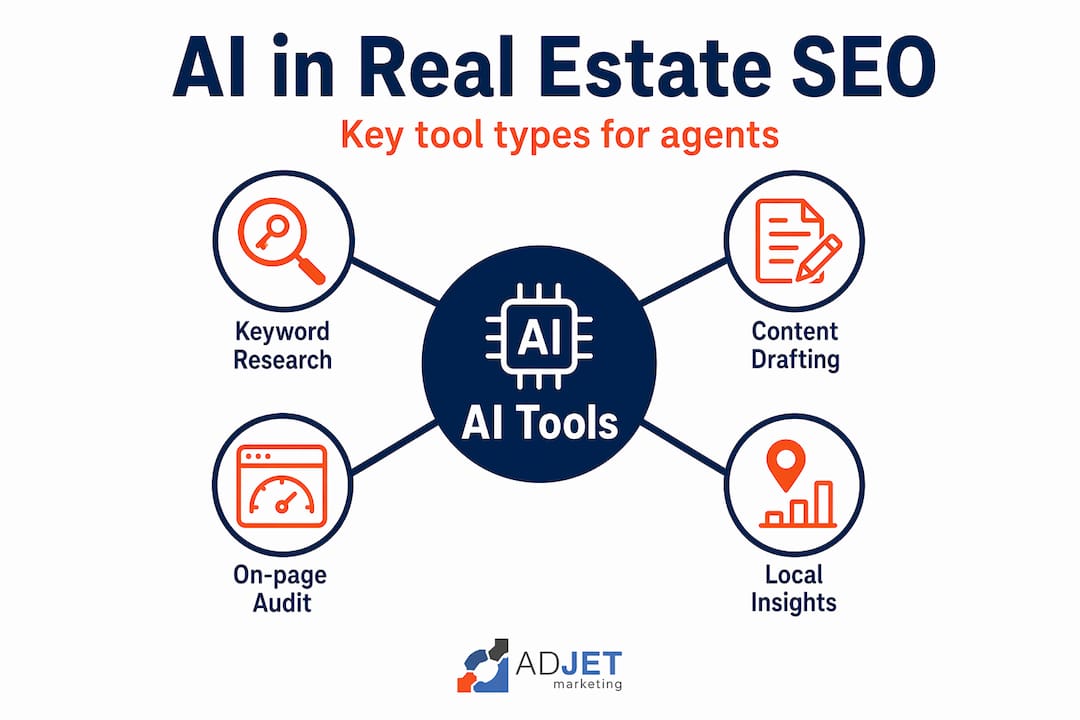
A growing range of AI-powered tools can assist with keyword research, content drafts, and on-page optimization checks. They speed up the research process and help you identify gaps in your content. That said, AI tools work best when they support your voice, not replace it. Content that sounds like a generic marketing template consistently underperforms content that sounds like a real agent with genuine local knowledge.
| SEO approach | How it works | Best use for agents |
|---|---|---|
| Traditional keyword SEO | Target specific phrases, update periodically | Blog posts, neighborhood guides |
| Agentic SEO | AI continuously monitors and updates content | Larger sites with many listing pages |
| Schema markup | Structured data improves rich snippet visibility | Property listings, local business pages |
| AI content tools | Speed up research and drafting | First drafts, keyword gap analysis |
Pro Tip: Use AI tools to generate a first draft or keyword outline, then rewrite it in your own voice with specific local details. That combination gives you speed without sacrificing the authenticity that actually ranks.
Applying SEO knowledge to your real estate digital strategy
Understanding the terms is step one. Putting them to work is where real visibility comes from. Here is a practical sequence that reflects how real estate agent SEO tools and strategies actually connect in the real world.
-
Start with keyword research grounded in intent. Use a free tool like Google Keyword Planner or a paid option to identify phrases your buyers and sellers actually type. People search conversationally and add locations, so target phrases like “best neighborhoods to raise a family in Austin” rather than just “Austin homes.”
-
Build hyperlocal content around specific areas. Write dedicated pages or blog posts for every neighborhood you work in. Answer questions buyers have about schools, commute times, and price trends. Hyperlocal content builds credibility faster than generic market commentary.
-
Optimize your Google Business Profile. Add your current service areas, upload photos, respond to every review, and post updates regularly. This single step has an outsized impact on how often you appear in local map pack results.
-
Fix basic technical SEO issues. Page speed, mobile usability, and a secure HTTPS connection are table-stakes requirements. Use Google’s free PageSpeed Insights tool to identify slow-loading pages and address them. Most real estate websites lose leads simply because they load too slowly on mobile.
-
Build citations and earn backlinks intentionally. Submit your business to local directories, sponsor a community event, or contribute a quote to a local news story. Each of these creates a citation or backlink that strengthens your local presence.
-
Set realistic timelines. SEO takes time. Unlike a Google Ad that can generate calls within hours, organic SEO typically takes three to six months to show meaningful movement. The payoff is that SEO builds long-term visibility that keeps working without a daily budget. Paid ads and SEO are not competitors. They work best together, especially in the early months when your organic presence is still building.
You can learn more about applying local SEO strategies to service-based businesses and how the same principles transfer directly to real estate farm areas and neighborhood targeting.
Common SEO mistakes real estate agents make
Even agents with a solid grasp of SEO terminology can fall into patterns that quietly stall their progress. Knowing these pitfalls in advance saves time and frustration.
-
Keyword stuffing: Repeating a phrase like “homes for sale in Miami” in every sentence signals low-quality content to Google and makes your page unpleasant to read. Write naturally and use variations of your target term.
-
Ignoring Google Business Profile: Many agents set up a GBP once and never return. An incomplete or outdated profile tells Google and prospective clients that you are not actively engaged.
-
Content decay: A neighborhood guide you wrote in 2022 with outdated prices and closed restaurants actively hurts your credibility. Audit your existing content at least twice per year and refresh anything that has gone stale.
-
Relying on broad terms: Trying to rank for “real estate agent” nationally is nearly impossible for an independent agent. Hyperlocal, conversational content builds credibility and ranking potential far faster than chasing high-volume generic terms.
-
Skipping reviews and backlinks: User reviews on Google and third-party sites serve as both social proof and a local SEO signal. Ask satisfied clients for reviews consistently, not just after a transaction closes.
Pro Tip: Set a quarterly calendar reminder to review your top five pages. Check whether the information is still accurate, whether there are new local questions you could answer, and whether the page loads well on mobile. Small updates compound into significant ranking improvements over time.
My honest take on SEO for real estate agents
I’ve worked with enough real estate clients to say this directly: the agents who get frustrated with SEO are almost always the ones who were sold on the idea that ranking is about tricks and formulas.
When I shifted focus from trying to optimize every sentence to just creating genuinely useful, specific local content, the results improved. Not overnight. But sustainably. A detailed guide about buying a home in a specific zip code consistently outperforms a generic “tips for buyers” post, every time.
The AI shift is real and worth paying attention to. I’d recommend exploring what emerging AI-driven SEO approaches look like in practice because agentic SEO is not a future concept anymore. It’s already influencing which pages get surfaced in Google’s AI Overviews right now.
The other thing I’ve learned is that the agents who see the best return treat SEO and paid ads as a team. SEO builds the foundation. Google Ads fills the gap while that foundation is being laid. Neither alone is as effective as both together, managed with a clear strategy.
Understanding your terminology is not an academic exercise. It’s the difference between having an informed conversation with a marketing partner and just nodding along hoping the strategy makes sense.
— Felix
How Adjetmarketing helps real estate agents grow online
At Adjetmarketing, we work directly with real estate agents who want a clear, performance-driven approach to their online visibility. That means no vague promises and no cookie-cutter templates. We build and manage strategies that combine SEO development with Google Ads and high-converting website design, all tailored to your specific market and goals.
If you’re ready to stop guessing about keywords and start building a presence that actually generates leads, explore our digital marketing strategy development services. We’ll help you identify what’s working, fix what isn’t, and create a roadmap that gives you measurable results without wasting your marketing budget.
FAQ
What is the most important SEO term for real estate agents?
Local SEO is arguably the most critical concept. It covers Google Business Profile optimization, NAP consistency, and hyperlocal content, all of which directly affect whether buyers and sellers in your area can find you.
How long does real estate SEO take to show results?
Most agents see meaningful organic traffic improvements within three to six months of consistent effort. SEO compounds over time, unlike paid ads, which stop generating leads the moment you pause your budget.
What are hyperlocal keywords and why do they matter?
Hyperlocal keywords target specific neighborhoods, zip codes, or community features rather than broad city or national terms. Broad terms like “real estate” attract 450,000 monthly searches but are dominated by national portals, making hyperlocal terms far more effective for independent agents.
What is schema markup and should real estate agents use it?
Schema markup is structured code that helps Google understand and display your content more effectively. For real estate agents, combining “LocalBusiness” and “Accommodation” schema types can improve how your listings appear in search results and strengthen your local entity recognition.
Do real estate agents need both SEO and paid ads?
Yes, and they serve different timelines. SEO builds long-term organic visibility that works in the background over months. Paid ads deliver immediate traffic while your SEO presence is still building. Used together, they cover both short-term lead generation and sustainable long-term growth.