









Paid search marketing is not simply buying a top spot on Google. It is a precision-driven, auction-based system where clinics compete for high-intent patient searches, paying only when someone clicks their ad. Many clinic owners assume that throwing money at Google Ads will automatically bring in patients. The reality is that paid search marketing requires ongoing strategy, smart keyword selection, and continuous optimization to generate real appointments. This guide breaks down exactly how it works, why it outperforms other channels for many practices, and the specific tactics that separate clinics scaling their patient volume from those burning through budget.
Table of Contents
- How paid search marketing works for medical clinics
- Advantages of paid search marketing for clinics
- Key strategies for high-ROI healthcare paid search campaigns
- Common mistakes clinics make with paid search (and how to avoid them)
- What most clinics miss about paid search marketing
- How to get expert help for your clinic’s paid search marketing
- Frequently asked questions
Key Takeaways
| Point | Details |
|---|---|
| Paid search defined | Medical clinics bid on keywords to show ads, paying only when a potential patient clicks. |
| Clinic advantages | Paid search offers immediate, measurable, and highly targeted patient leads for clinics. |
| Strategy drives ROI | Ongoing optimization and campaign structure are crucial for maximizing patient acquisition and minimizing waste. |
| Avoid common pitfalls | Regular campaign reviews and proactive adjustments prevent wasted spend and poor results. |
| Expert support available | Specialized help enables clinics to scale paid search profitably and stay ahead of competitors. |
How paid search marketing works for medical clinics
Now that we have clarified what paid search is, let us look at exactly how it functions for medical practices.
Paid search, also called PPC (pay-per-click) or SEM (search engine marketing), puts your clinic’s ad in front of patients who are actively searching for care. When someone types “dermatologist in Dallas” into Google, an instant auction runs behind the scenes. Every advertiser bidding on that keyword competes based on their bid amount and Quality Score, which is Google’s rating of your ad’s relevance and landing page experience. The highest-scoring combination wins the top placement.
Businesses bid on keywords in an auction system and pay only when users click. This is the cost-per-click (CPC) model. If your ad appears 1,000 times but only 50 people click, you pay for those 50 clicks alone. For a clinic, this means your budget goes toward people who are genuinely interested in booking, not passive scrollers.
Here is a breakdown of the key terms every clinic owner should understand:
| Term | Definition | Clinic-specific example |
|---|---|---|
| Keyword | The search phrase triggering your ad | “botox near me,” “knee pain specialist” |
| CPC | Cost per click on your ad | $4.50 per click for “IV therapy Houston” |
| Quality Score | Google’s 1-10 rating of ad relevance | High score = lower CPC for your clinic |
| Ad extension | Extra info added to your ad | Phone number, location, booking link |
| Conversion rate | % of clicks that become leads | 8% of clicks book a consultation |
Understanding healthcare SEO basics alongside paid search gives you a complete picture of how patients find your clinic online.
Key benefits for medical clinics include:
- Immediate visibility on page one within hours of launching
- Precise targeting by zip code, age range, device type, and search intent
- Full budget control with daily and monthly spending caps
- Measurable leads tracked to specific keywords, ads, and landing pages
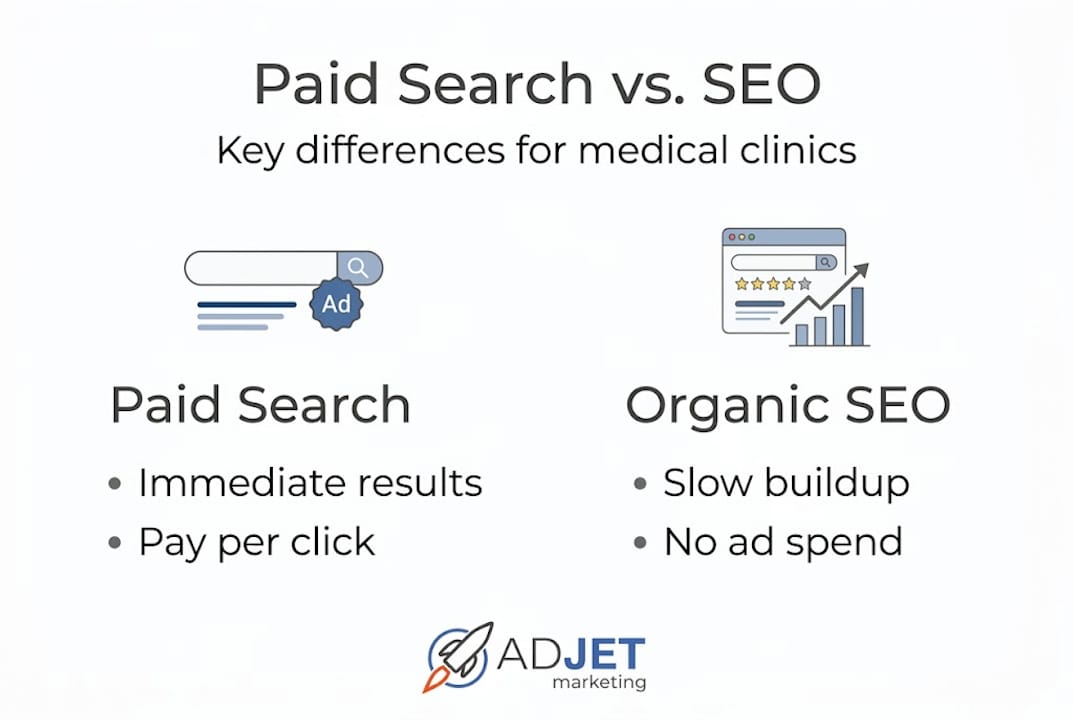
One critical distinction: paid search and organic search are not the same. Organic results take months to build through SEO. Paid ads appear immediately. Confusing the two leads clinics to underinvest in one or misattribute results from the other.
Advantages of paid search marketing for clinics
Understanding the process is key, but why do clinics choose paid search over other marketing options? Let us explore the main advantages.
Paid search enables specific keyword targeting and only charges for clicks, which maximizes returns compared to traditional advertising like print or radio where you pay regardless of response. A billboard on a highway reaches thousands of people who will never need your services. A Google Ad for “sports medicine clinic Phoenix” reaches only people searching for exactly that.
Comparison: paid search vs. organic SEO for clinics
| Criteria | Paid search | Organic SEO |
|---|---|---|
| Speed | Immediate (hours) | Slow (3 to 12 months) |
| Cost structure | Pay per click | Ongoing content and technical investment |
| Targeting | Highly precise (location, intent, device) | Broader, harder to control |
| Measurability | Real-time data, call tracking, conversions | Slower feedback loop |
| Control | Adjust bids and budgets daily | Limited short-term control |
The ROI potential is concrete. Consider a pain management clinic spending $800 per month on Google Ads targeting “back pain specialist near me.” If the average CPC is $8, that generates 100 clicks. With a 10% conversion rate on a well-optimized landing page, that is 10 new patient inquiries. If each new patient is worth $400 in revenue, that is $4,000 generated from an $800 investment, a 5x return.
Key features that drive clinic results:
- Call tracking to know which ads generate phone calls
- Appointment scheduling extensions that let patients book directly from the ad
- Retargeting to re-engage visitors who browsed your site but did not book
- Geo-targeting to focus spend within your service radius
Review PPC tips for clinics for deeper guidance on maximizing these features.
Pro Tip: Track every lead source from day one. If you cannot tell whether a new patient came from Google Ads, organic search, or a referral, you cannot make smart budget decisions. Use UTM parameters and call tracking numbers specific to each campaign.
Key strategies for high-ROI healthcare paid search campaigns
Once you understand paid search’s strengths, applying smart strategy separates winners from wasted budgets. Here is what drives ROI in medical campaigns.
One of the most debated structures in healthcare PPC is SKAG (single keyword ad group) versus STAG (single theme ad group). SKAGs give you maximum control, with one keyword per ad group so your ad copy matches the search term precisely. STAGs group related keywords together, which is easier to manage and often performs well for clinics with limited time to manage campaigns. For most medical practices, a hybrid approach works best: use SKAGs for your highest-value procedures and STAGs for broader service categories.
Focusing on SKAG and STAG structures, combined with A/B testing, optimized load times, and strategic extensions, produces the strongest Quality Scores and lowest CPCs over time.
Steps to build a high-ROI medical paid search campaign:
- Select keywords with clear patient intent. Prioritize terms like “book dermatologist appointment” over vague terms like “skin care.” Learn how to choose the best PPC keywords for your specific practice type.
- Structure your ad groups logically. Group keywords by service line, for example botox, fillers, and laser treatments each in separate ad groups.
- Write compelling ad copy. Address the patient’s concern directly. “Chronic knee pain? Same-week appointments available” outperforms generic headlines every time.
- Optimize your landing pages. Each ad should send traffic to a page matching the exact keyword and offer. A botox ad should not land on your homepage.
- A/B test continuously. Run two versions of each ad simultaneously. Test one variable at a time: headline, call to action, or offer. Let data decide the winner.
- Use ad extensions. Add call extensions, location extensions, and sitelinks to increase your ad’s footprint and click-through rate without extra cost.
Landing page load time is often overlooked but critically important. Pages loading in under three seconds convert significantly better than slower pages. A one-second delay can reduce conversions by up to 7%. For a clinic spending $1,500 per month on ads, a slow landing page could be costing you three to four appointments every month.
Pro Tip: A low Quality Score keyword is not automatically worth pausing. If a keyword with a Quality Score of 4 consistently generates booked appointments at an acceptable cost per acquisition, it is still profitable. Evaluate keywords on conversion data, not just Quality Score alone.
To see how these strategies apply specifically to your practice, explore how to optimize Google Ads for healthcare with campaign-level recommendations.
Common mistakes clinics make with paid search (and how to avoid them)
Even with the best strategy, avoidable mistakes can undermine your success. Let us highlight what to watch out for and fix.
“Simply running paid search without ongoing optimization usually results in wasted spend and poor lead quality.” (Improvado)
This is one of the most consistent patterns we see. A clinic launches Google Ads, sees some early results, and then leaves the campaign untouched for months. Bids drift, competitors adjust, and suddenly the cost per lead doubles while appointment volume drops.
Common mistakes and how to fix them:
- Unclear landing pages. If your ad promises “same-day Botox appointments” but lands on a general services page, patients leave immediately. Fix: build dedicated landing pages for each campaign.
- No negative keywords. Without a negative keyword list, your ads show for irrelevant searches like “free botox” or “botox training course,” wasting budget on people who will never book. Fix: build a negative keyword list before launch and expand it weekly.
- Skipping ad testing. Running one version of an ad indefinitely means you never know if a better message could double your click-through rate. Fix: always run at least two ad variations per ad group.
- Not tracking phone calls. Many clinic appointments start with a phone call, not a form submission. If you are only tracking form fills, you are underreporting conversions and making budget decisions on incomplete data. Fix: implement call tracking with unique numbers per campaign.
- Ignoring brand campaigns. Competitors can bid on your clinic’s name. If you are not running a brand campaign, you may be losing patients who searched specifically for you.
Understanding how to target the right patients with PPC prevents many of these issues before they start.
Quick wins you can implement today: pause keywords with zero conversions after 30 days of spend, add at least 20 negative keywords to each campaign, and set up Google’s call reporting to track every inbound call generated by your ads.
What most clinics miss about paid search marketing
Here is the perspective that separates clinics that consistently grow from those that cycle through agencies and budgets without results.
Most clinic owners treat paid search like a light switch. You turn it on, patients come in, and the work is done. That mindset is the single biggest reason campaigns underperform. The clinics we see generating the strongest patient volume from PPC share one habit: they review their data weekly, not monthly.
Weekly reviews allow you to catch a sudden spike in cost per click before it drains your monthly budget. They let you identify a new competitor bidding aggressively on your core keywords. They reveal which ad copy is resonating with patients right now, not three months ago when you last looked. The market shifts constantly, and your campaigns need to shift with it.
There is also a deeper issue. Many clinics optimize for clicks when they should optimize for booked appointments. A campaign generating 200 clicks per month at $3 each sounds efficient. But if none of those clicks convert to consultations, the $600 is wasted. The fastest-growing practices we work with maintain a monthly checklist that tracks cost per lead, cost per booked appointment, show rate, and revenue per campaign. Every budget decision flows from those four numbers.
Testing is the other discipline that separates scalable clinics from stagnant ones. One IV therapy clinic we supported tested three different headline approaches over 60 days: symptom-focused (“Tired and dehydrated?”), outcome-focused (“Feel 100% in 45 minutes”), and urgency-focused (“Same-day IV therapy available”). The outcome-focused headline generated 34% more bookings at the same spend. That single test was worth more than any bid adjustment.
Explore how PPC for medspas illustrates this testing-first approach in a real aesthetic practice context.
The clinics that win with paid search are not the ones with the biggest budgets. They are the ones that treat every campaign as a live experiment, stay close to their data, and make small adjustments consistently. That discipline compounds over time into a predictable, scalable patient acquisition system.
How to get expert help for your clinic’s paid search marketing
If you want tailored guidance and scalable results, these next steps offer a clear path.
At AdJet Marketing, we specialize in building and managing Google Ads services specifically for medical clinics, med spas, pain management practices, and aesthetic providers. We do not run generic campaigns. Every strategy is built around your service lines, your local market, and your patient acquisition goals. Our team handles keyword research, ad structure, landing page optimization, and ongoing bid management so your budget works harder every month.
We also help clinic owners understand the broader healthcare marketing strategy that connects paid search to SEO, website performance, and long-term growth. For clinics ready to scale, our search engine marketing help covers the full paid search ecosystem, from campaign setup to conversion tracking and monthly reporting. Reach out to learn how we can build a paid search system that delivers consistent, measurable patient leads.
Frequently asked questions
How does paid search marketing differ from SEO?
Paid search delivers immediate visibility through paid ads using an auction-based keyword system, while SEO builds unpaid organic rankings over months. Both strategies work best when used together.
Can small clinics compete with bigger hospitals in paid search?
Yes. Specific keyword targeting and precise audience refinement allow smaller clinics to compete effectively by focusing on niche services and local intent rather than broad, expensive terms.
What is a typical budget range for a clinic starting in paid search?
Most clinics begin with $500 to $1,500 per month to test performance, then scale their budget as campaigns prove their cost per lead and appointment conversion rate.
How long before paid search delivers patient inquiries?
Paid search provides immediate visibility, and most clinics see their first inquiries within days of launching, which is a key advantage over organic SEO strategies that take months to produce results.
Recommended
- Mastering Google Ads For Dental Clinics: A Comprehensive Guide – AdJet Digital Marketing & Google Partner Agency | SEO Development Google Ads Social
- Should We Run Brand Campaigns For Our Clinic Name? Why It Pays – AdJet Digital Marketing & Google Partner Agency | SEO Development Google Ads Social
- Guide To Effective Healthcare SEO
- 20 Tips To Optimize Google Ads For Healthcare