









Healthcare PPC (pay-per-click advertising) is a paid search model where clinics bid to show ads to patients actively searching for their services on platforms like Google Ads, Microsoft Advertising, and, for elective services, Meta Ads. You pay only when someone clicks. Done right, it fills appointment slots within days. Done wrong, it drains budget and risks ad suspension.
Before you spend a dollar, run through these first-30-day checkpoints:
- Confirm whether your specialty requires LegitScript certification or Google advertiser verification
- Segment campaigns by service line, not by practice name
- Build a dedicated landing page for each service you plan to advertise
- Set up call tracking and form tracking before launch
- Define your target cost per lead (CPL) and acceptable cost per patient acquisition (CPA)
- Import offline appointment conversions from your EHR or scheduling system
- Review Google’s healthcare and medicines ad policies for your specific category
Table of Contents
- What is healthcare PPC and where does it run?
- Why use PPC for patient acquisition and how does it fit with SEO?
- How does healthcare PPC work: auction mechanics, keywords, and quality signals?
- What are the core components of an effective healthcare PPC strategy?
- What compliance and policy requirements do you need to know?
- How do you structure and set up a healthcare PPC campaign?
- How should you handle landing pages and conversion tracking?
- What budgets and KPIs should you expect from healthcare PPC?
- How do you optimize healthcare PPC campaigns over time?
- What mistakes do clinics most often make with healthcare PPC?
- How agencies launch compliant healthcare PPC: a practical checklist and timeline
- Key Takeaways
- What the data and agency experience actually tell you
- Working with a healthcare PPC agency
- Useful sources and references
What is healthcare PPC and where does it run?
Healthcare PPC is paid online advertising aimed at patient acquisition. You create ads, set a budget, and pay each time a prospective patient clicks. The goal is to appear at the top of search results when someone types “knee pain specialist near me” or “anxiety therapist accepting new patients.”
The main platforms are:
- Google Ads: Search, Local Services Ads (LSAs), Display, and YouTube. Search and LSAs are the highest-intent placements because the patient is actively looking for care.
- Microsoft Advertising (Bing Ads): Smaller audience, but CPCs tend to run lower for some healthcare terms, making it a cost-efficient complement to Google.
- Meta Ads (Facebook/Instagram): Lower intent than search, but useful for elective services (med spas, cosmetic procedures, weight loss programs) where awareness and social proof drive decisions.
The intent distinction matters. Search and LSA placements capture patients who have already decided they need care. Display, video, and social placements reach people earlier in the decision process. For most clinics focused on appointment volume, search campaigns should get the majority of the budget first.
Platform policies also differ. Google restricts certain healthcare categories outright and requires verification for others. Meta limits targeting options for sensitive health topics and restricts some remarketing uses. You need to understand both before you build campaigns.
Why use PPC for patient acquisition and how does it fit with SEO?
PPC delivers immediate visibility. Approximately 77% of patients research conditions and providers online before booking an appointment, and search engines drive a significant share of that traffic. A well-configured Google Ads campaign can produce booked appointments within days of launch. SEO, by contrast, builds durable organic authority over months.
Use PPC when:
- You open a new location or service line and need immediate patient volume
- You have appointment availability that organic traffic alone cannot fill
- You run elective or time-sensitive services (urgent care, seasonal procedures).
- You want to test messaging before committing to long-term SEO content
Use SEO as the long-term foundation. Pair it with healthcare SEO services to reduce your cost per acquisition over time as organic rankings improve. The two channels reinforce each other: PPC data reveals which keywords convert, and those terms inform your SEO content strategy.
The business case for PPC is measurable. You control the message, the geography, the schedule, and the budget. You can increase spend when you have capacity and pull back when the schedule is full. That level of control is difficult to replicate with organic tactics alone.
Pro Tip: Pair each PPC campaign with a service-specific landing page and an active review strategy. Patients who click your ad will check your Google Business Profile before calling. A strong review profile increases conversion rates from paid traffic.
How does healthcare PPC work: auction mechanics, keywords, and quality signals?
Every time a patient searches on Google, an auction runs in milliseconds. Your ad’s position is determined by your bid multiplied by your Quality Score, which reflects ad relevance, expected click-through rate (CTR), and landing-page experience. A higher Quality Score means you can rank above competitors while paying less per click.
Keywords are the foundation. In healthcare, you want to organize them by intent:
- Transactional (highest intent): “book cardiologist Dallas,” “same-day urgent care near me”
- Symptom-based: “chest pain specialist,” “knee pain treatment options”
- Condition-based: “ADHD diagnosis adult,” “chronic back pain clinic”
- Brand: your practice name and provider names
Match types control how broadly Google interprets your keywords. Exact match gives you the tightest control. Phrase match offers a balance of reach and relevance. Broad match can surface unexpected queries and waste budget if you are not running regular search-term audits.
Targeting options let you layer additional controls:
- Geographic: radius around a clinic, ZIP code, or city
- Device: bid adjustments for mobile (critical for urgent care, where patients call immediately)
- Dayparting: show ads only during hours when your phones are staffed
- Audience: in-market segments for healthcare services (where platform policy permits)
Quality signals that matter most in healthcare are landing-page relevance, conversion rate (calls and form fills), CTR, and your account’s compliance history. An account with prior policy violations carries a higher risk of future disapprovals, which is one reason compliance must come before scale.
What are the core components of an effective healthcare PPC strategy?
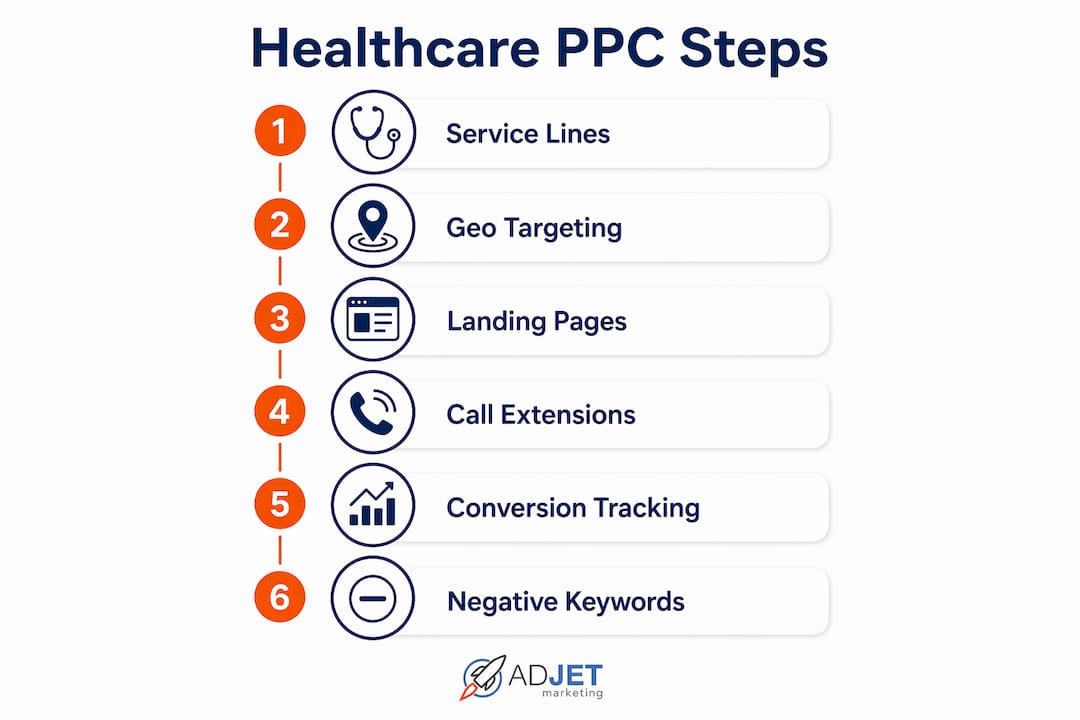
A working healthcare PPC strategy has six non-negotiable components. Miss one and you either waste budget or create compliance exposure.

1. Service-line campaign segmentation
Each service line gets its own campaign. Orthopedics, mental health, and urgent care have different patient intents, different CPCs, and different conversion paths. Mixing them in one campaign makes it impossible to measure or optimize accurately.
2. Geographic and location targeting
Set a radius around each clinic location. Exclude areas outside your service territory. For multi-location systems, use location-specific campaigns with location extensions so patients see the nearest address.
3. Dedicated landing pages
Send paid traffic to service-specific landing pages, not your homepage. A page built for a specific service matches the patient’s search intent and consistently outperforms generic homepage traffic for conversion rate.
4. Call extensions and call-only ads
For urgent care and primary care, phone calls are the primary conversion. Enable call extensions on every campaign. For high-urgency services, test call-only campaigns that skip the landing page entirely.
5. Conversion tracking
Set up conversion actions for phone calls (minimum 60 seconds), form submissions, and offline appointment imports. Without this, you are optimizing blind.
6. Negative keyword strategy
Add negatives from day one: “free,” “jobs,” “salary,” “DIY,” “home remedy,” and any condition names that are adjacent to but not your service. Review search-term reports weekly and add new negatives continuously.
Keyword intent tiers and ad copy
| Intent Tier | Example Keywords | Ad Copy Focus |
|---|---|---|
| Transactional | “book knee surgeon near me” | Availability, insurance accepted, CTA |
| Symptom-based | “chronic knee pain treatment” | Condition expertise, next step |
| Informational | “what causes knee pain” | Education, soft CTA, brand awareness |
| Brand | “[Practice name] orthopedics” | Reputation, credentials, contact |
Ad copy should follow a benefit-credential-CTA structure: lead with what the patient gains (“Same-week appointments available”), add a trust signal (“Board-certified specialists”), and close with a clear action (“Call now” or “Book online”). Use callout extensions for insurance networks, patient satisfaction scores, and years of experience. Structured snippets work well for listing service types or conditions treated.
What compliance and policy requirements do you need to know?
Compliance is not optional, and it is not something to address after launch. Missing a verification step or running a non-compliant ad can result in immediate disapproval or account suspension, and Google’s healthcare and medicines advertising policies are explicit about which categories require certification before any ads run.
Google’s restricted categories
Google restricts or outright prohibits advertising in several healthcare categories:
- Addiction treatment centers: require LegitScript certification
- Online pharmacies: require LegitScript certification and Google verification
- Prescription drugs: prohibited for direct-to-consumer advertising in most cases
- Misleading health claims: “guaranteed cure,” “miracle treatment,” or unsubstantiated outcome claims trigger policy violations
LegitScript certification
LegitScript is a third-party verification service that Google requires for addiction treatment facilities and online pharmacies. Without it, your ads will not run in those categories. The certification process involves submitting documentation about your facility, licensing, and treatment practices. It takes time, sometimes several weeks, so build it into your pre-launch timeline.
HIPAA and tracking
HIPAA’s reach extends to your marketing stack. Protected health information (PHI) includes names, contact details, IP addresses, and any data that could identify a patient combined with a health condition. Sending PHI to Google Ads or Meta through standard pixel tracking creates HIPAA exposure.
Safe tracking practices include:
- Use server-side tagging or a HIPAA-compliant conversion API instead of browser-side pixels for form submissions
- Limit form fields to name and phone number; avoid collecting diagnosis or condition information on ad-linked forms
- Import offline appointment conversions using non-PHI identifiers (hashed email or anonymous booking ID)
- Display a clear privacy notice on every landing page
Platform restrictions also limit personalized remarketing for sensitive health topics. You cannot build remarketing audiences based on health conditions or retarget users who visited pages about specific diagnoses. Design your audience strategy around this constraint from the start.
Pre-launch compliance checklist:
- [ ] Google advertiser verification completed
- [ ] LegitScript certification obtained (if required for your category)
- [ ] Privacy notice visible on all landing pages
- [ ] Form fields reviewed for PHI minimization
- [ ] Server-side or HIPAA-compliant conversion tracking configured
- [ ] Remarketing audiences reviewed against platform health-topic restrictions
- [ ] Ad copy reviewed for prohibited claims
Pro Tip: Complete all verification processes before you write a single ad. Policy-review loops after launch can freeze your account for weeks, and budget allocated during that period is wasted.
How do you structure and set up a healthcare PPC campaign?
A clear account structure makes reporting accurate and scaling predictable. Here is a practical blueprint.

Recommended naming convention
Use a consistent format: [Location] | [Service Line] | [Match Type]. For example: Dallas | Orthopedics | Exact. This makes filtering by location or service line straightforward in any reporting view.
Step-by-step setup
- Create one campaign per service line per location. Keep budgets separate so you can see CPL by service without blending costs.
- Build two to three ad groups per campaign, organized by keyword theme (e.g., “knee pain,” “joint replacement,” “sports injury” within an orthopedics campaign).
- Write three to five ads per ad group using responsive search ad format. Include at least one headline with the service name, one with a location or availability signal, and one with a credential or trust marker.
- Set location targeting to a radius around your clinic. For urban markets, ZIP-code targeting often outperforms radius because it excludes low-conversion areas precisely.
- Enable extensions: call extensions (with your direct scheduling line), sitelinks (to specific service pages), callout extensions (insurance accepted, same-week appointments), and location extensions.
- Set device bid adjustments. Mobile users often convert via phone call at higher rates for urgent care; mobile bids can be adjusted accordingly for those campaigns.
- Configure conversion actions before the campaign goes live: phone calls (60-second minimum), form submissions, and offline appointment imports.
- Run a pilot for 2–4 weeks per service line before scaling budgets. This gives you clean CPL signals without the noise of a broad launch.
Pre-launch QA checklist:
- [ ] Ad copy reviewed for compliance (no prohibited claims)
- [ ] Landing pages match ad headlines and service intent
- [ ] All forms tested and confirmed to submit correctly
- [ ] Call tracking numbers verified and routing confirmed
- [ ] Google Analytics and conversion import connected
- [ ] Negative keyword list applied at campaign and account level
Pro Tip: Run small pilots per service line for 2–4 weeks before scaling. The CPL signals from a focused pilot are far more reliable than data from a broad, multi-service launch.
How should you handle landing pages and conversion tracking?
Landing pages and tracking are where most clinics lose patients they already paid to attract. The ad gets the click; the landing page either converts it or wastes it.
Landing-page design for healthcare
Match the landing page to the ad’s specific service. A patient who clicks an ad for “anxiety therapy Dallas” should land on a page about anxiety therapy, not your general mental health services homepage. Service-specific landing pages limit PHI collection and consistently outperform generic homepage traffic for conversion rate.
Elements that increase trust and conversions:
- Clinician photo, name, and credentials above the fold
- Clear, visible phone number (click-to-call on mobile)
- Insurance logos or “most insurance accepted” statement
- Patient reviews or star rating (without identifying health conditions)
- A simple scheduling form with minimal fields (name, phone, preferred time)
- Privacy notice linked prominently near the form
For urgent care, phone-first design works best. For elective services (cosmetic procedures, weight loss, mental health), a short form with a callback promise often converts better than a direct call prompt.
Phone tracking
Use a HIPAA-aware call tracking platform that does not store PHI in the call recording or metadata. Route calls through a tracking number that forwards to your scheduling line. Set the conversion window to 60 seconds minimum to filter out misdials. For urgent care campaigns, test call-only ads, which show only a phone number and skip the landing page entirely.
Form handling and offline conversion import
Limit form fields to name, phone number, and preferred appointment time. Do not ask for diagnosis, insurance ID, or date of birth on ad-linked forms. Store submissions on a HIPAA-compliant system, not in your ad platform’s lead form native storage.
The offline conversion import workflow:
- Export booked appointment events from your EHR or scheduling system
- Match them to ad clicks using a non-PHI identifier (hashed email or anonymous click ID stored at form submission)
- Import the matched conversions into Google Ads via the offline conversion import tool
This gives your campaigns accurate patient-acquisition data without exposing PHI to the ad platform.
| Tracking Method | Best For | HIPAA Consideration |
|---|---|---|
| Call tracking (60-sec min) | Urgent care, primary care | Use HIPAA-aware platform; no PHI in recordings |
| Form submission (server-side) | Elective services, mental health | Server-side postback; limit fields |
| Offline conversion import | All specialties | Match via non-PHI ID; no health data in platform |
| Click-to-call (mobile) | High-urgency services | No data stored; conversion fires on click |
What budgets and KPIs should you expect from healthcare PPC?
Start with cost per lead (CPL) as your primary metric, then work backward to cost per patient acquisition (CPA) by factoring in your lead-to-appointment conversion rate. Compare CPA to patient lifetime value (LTV) to determine whether the channel is profitable.
Core KPI formulas:
- CPL = Total ad spend / Total leads generated
- CPA = Total ad spend / Total new patients acquired
- Return on ad spend (ROAS) = Revenue attributed to PPC / Total ad spend
- Lead-to-patient rate = New patients / Total leads
Healthcare CPC and CPL benchmark ranges
Healthcare keyword CPCs vary widely, roughly $4–$35 per click depending on specialty and competition. Competitive specialties like dermatology, cardiology, and dentistry tend to sit at the higher end of that range.
| Specialty | Estimated CPC Range | Notes |
|---|---|---|
| Urgent care | $4–$35 | High volume, varies by market |
| Mental health / therapy | $4–$35 | Growing competition; call conversions high |
| Dentistry | $4–$35 | Very competitive in urban markets |
| Dermatology / aesthetics | $4–$35 | Elective; strong landing-page dependency |
| Cardiology / orthopedics | $4–$35 | High LTV justifies higher CPC |
Achieving a target number of new patient leads per month depends on average CPC and landing-page conversion rate, which together determine required clicks and monthly ad spend. Adjust the math for your actual conversion rate and CPC once pilot data is available.
Pilot budget guidance: Single-location clinics should plan for at least $1,500–$3,000 per month per service line during the pilot phase to generate enough data for reliable CPL signals. Multi-location systems typically run parallel pilots per location at similar budget levels per location.
How do you optimize healthcare PPC campaigns over time?
Optimization is a cadence, not a one-time event. Structure your review schedule around what changes fastest.
Daily: Check budget pacing and flag any ad disapprovals. A disapproval left unresolved for 24 hours can pause an entire campaign.
Weekly:
- Run search-term reports and add new negative keywords
- Review impression share and lost-to-budget vs. lost-to-rank ratios
- Check call-tracking logs for call quality and routing issues
- Confirm conversion data is importing correctly
Monthly:
- Run A/B tests on ad headlines and descriptions (change one variable at a time)
- Test landing-page variations (headline, CTA placement, form length)
- Review audience performance and adjust bid modifiers
- Analyze CPL by service line and reallocate budget toward top performers
Quarterly:
- Reassess account structure: are service lines still correctly segmented?
- Review competitor ad copy and positioning using Google’s Auction Insights report
- Evaluate keyword list for new high-intent terms emerging from search-term data
- Reassess remarketing strategy against current platform policy for health topics
Scaling rules: increase budgets by no more than 20% per week on a winning campaign. Larger jumps reset Google’s learning algorithm and can temporarily inflate CPCs. Duplicate winning ad groups rather than editing them mid-test, so you preserve the original’s performance data.
Pro Tip: Use your weekly search-term report as a negative keyword mining tool, not just a performance check. Every irrelevant query you find is money you can redirect to high-intent terms.
What mistakes do clinics most often make with healthcare PPC?
Most budget waste in healthcare PPC comes from a short list of avoidable errors.
- Sending traffic to the homepage. Your homepage is not a landing page. It has too many navigation options, no specific service focus, and no single CTA. Conversion rates from homepage PPC traffic are consistently lower than from service-specific pages.
- Skipping negative keywords. Without negatives, your ads show for “free clinic,” “nursing jobs,” and “home remedies.” These clicks cost money and produce zero patients.
- Running non-compliant ad copy. Phrases like “guaranteed results,” “cure,” or “best doctor” can trigger policy violations. Review every headline against Google’s prohibited claims list before launch.
- Failing to track offline conversions. If your scheduling happens by phone or through your EHR, and you are not importing those bookings back into Google Ads, your campaigns are optimizing toward form fills, not actual patients. The two are not the same.
- Mismatching ad promises with operational reality. If your ad says “same-day appointments available” and your front desk cannot deliver that, you are paying for clicks that convert to frustrated callers who do not book. Sync your ad scheduling with your actual availability before you go live.
- Ignoring call quality. A high call volume with a low booking rate usually means either the wrong patients are calling or the front desk is not converting calls. Both problems require attention before you scale spend.
For a broader look at healthcare marketing mistakes that affect both paid and organic channels, it is worth auditing your full patient acquisition funnel, not just the ad account.
How agencies launch compliant healthcare PPC: a practical checklist and timeline
Here is the agency-style launch process we use at Adjetmarketing. You can adopt it directly or use it to evaluate any agency you are considering.
Phase 1: Discovery (week 1)
- Complete a service-line intake questionnaire covering target conditions, geographic service area, insurance networks, and scheduling capacity
- Audit existing Google Ads account (if one exists) for structure, compliance history, and conversion setup
- Identify which categories require LegitScript or Google advertiser verification
- Map EHR and scheduling system for offline conversion import compatibility
Phase 2: Compliance and verification (weeks 1–4)
- Submit Google advertiser verification documents
- Initiate LegitScript application if required (allow 2–4 weeks for review)
- Configure HIPAA-compliant call tracking and server-side form postbacks
- Draft privacy notice and confirm placement on all planned landing pages
Phase 3: Landing pages and tracking (weeks 2–3)
- Build service-specific landing pages with clinician bios, trust signals, and minimal-field forms
- Set up Google Ads conversion actions: calls, forms, and offline import
- Test all forms, call routing, and conversion firing in a staging environment
- Connect Google Analytics and confirm data flow
Phase 4: Pilot launch (weeks 3–6)
- Launch one campaign per priority service line with exact and phrase match keywords
- Apply initial negative keyword list and set dayparting to staffed hours
- Monitor daily for disapprovals, budget pacing, and call quality
- Run for 2–4 weeks before making structural changes
Phase 5: Optimization and scale (ongoing)
- Weekly search-term audits and negative keyword additions
- Monthly A/B tests on ad copy and landing pages
- Quarterly account structure review and budget reallocation
- Ongoing offline conversion imports and CPL reporting
Pro Tip: Schedule an operational alignment meeting with your front-desk and scheduling teams before launch. They need to know what services are being advertised, what the ad promises, and how to handle the call volume increase.
Key Takeaways
Compliant healthcare PPC requires service-line segmentation, verified tracking, and LegitScript certification where applicable before any budget is allocated.
| Point | Details |
|---|---|
| Compliance before spend | Complete Google verification and LegitScript certification before launching ads to avoid disapprovals. |
| Segment by service line | Each service line needs its own campaign for accurate CPL measurement and bidding control. |
| Track calls and offline bookings | Import appointment data from your EHR to optimize for actual patients, not just form fills. |
| Benchmark CPCs realistically | Healthcare CPCs range broadly across specialties; pilot budgets should be sufficient to generate reliable data. |
| Adjetmarketing’s approach | Adjetmarketing bundles HIPAA-aware tracking, service-line landing pages, and offline conversion import into a compliance-first launch process. |
What the data and agency experience actually tell you
The conventional wisdom in healthcare PPC is to focus on keyword research and bidding strategy. That is not wrong, but it is incomplete. The clinics that struggle most are not losing because of poor keyword selection. They are losing because their tracking is broken, their landing pages are generic, or their ad account is suspended over a compliance issue they did not know existed.
Many clinics come to us after running Google Ads for months with no offline conversion data. They have click reports and form-fill counts, but no way to connect those numbers to actual booked appointments. When we set up proper offline import, the picture changes completely. Some campaigns that looked profitable were not. Others that looked marginal were actually producing high-LTV patients at a reasonable CPA.
The other pattern we see consistently: clinics that treat PPC as a standalone tactic rather than the front end of a patient acquisition system. The ad gets the click. The landing page earns the call. The front desk converts the call. The EHR captures the booking. If any one of those steps fails, the ad spend is wasted. Getting all four right is the actual job.
For specialty-specific examples, the PPC and SEO playbook for psychiatry practices shows how this system works in a high-compliance mental health context.
Working with a healthcare PPC agency
If you want a compliance-first, patient-acquisition-focused approach without building the infrastructure yourself, Adjetmarketing manages the full process: LegitScript coordination, HIPAA-aware tracking setup, service-line landing pages, and ongoing campaign optimization. We work with medical clinics, aesthetic practices, mental health providers, and pain management centers across the U.S.
You can start with a campaign audit, a pilot for a single service line, or full account management. The right starting point depends on where you are now. To find out, review our Google Ads services or explore why medical marketing matters for your practice. If you are ready to talk through your situation, book a strategy call and we will tell you honestly what your account needs.
Useful sources and references
These are the primary sources worth consulting for policy text, platform rules, and deeper tactical guidance.
| Source | Best For | Link |
|---|---|---|
| Google Ads: Healthcare and Medicines Policy | Official policy text, restricted categories, verification requirements | Google Ads policy |
| LegitScript | Certification requirements for addiction treatment and pharmacy advertisers | LegitScript.com |
| Adjetmarketing: HIPAA-Compliant Google Ads | Practical HIPAA tracking guidance for clinic marketers | HIPAA-compliant Google Ads |
| Adjetmarketing: Landing Pages in Healthcare | Service-specific landing-page best practices | Landing pages in healthcare |
| Adjetmarketing: Healthcare PPC Tips | Keyword strategy, compliance, and ad copy tactics | healthcare PPC tips |
| Adjetmarketing: Google Ads Optimization | 20 healthcare-specific optimization tactics | Optimize Google Ads for healthcare |
| BabyLove Growth: Healthcare SEO | Pairing PPC with organic SEO for long-term acquisition | Healthcare SEO services |
| Healthcare Dive: Digital Marketing Guide | Broad digital marketing strategy for hospitals and health systems | Healthcare Dive guide |
This article is general information for educational purposes. Consult a qualified HIPAA compliance officer or healthcare attorney to confirm how current regulations apply to your specific practice and marketing activities.
Recommended
- 10 Healthcare PPC Tips To Improve Your Marketing
- Should We Run Brand Campaigns For Our Clinic Name? Why It Pays – AdJet Digital Marketing & Google Partner Agency | SEO Development Google Ads Social
- Effective Strategies To Improve PPC Results For MedSpas
- Discover The Power Of PPC: Medspas See Enhanced ROI – AdJet Digital Marketing & Google Partner Agency | SEO Development Google Ads Social