









96% of buyers start their home search online, yet most agents still rely on referrals and cold calls as their primary pipeline. That gap is where opportunity lives. Digital lead generation gives you a predictable, scalable way to attract motivated buyers and sellers before your competitors do. This article walks you through a proven, step-by-step framework for building a digital lead generation system that delivers consistent results, from setting up your foundation to optimizing follow-up and growing your referral network.
Table of Contents
- Laying the foundation: Prerequisites for lead generation success
- Step 1: Attracting leads through high-value lead magnets
- Step 2: Leveraging social media and paid ads for real estate leads
- Step 3: Optimizing follow-up: Speed-to-lead and nurturing best practices
- Step 4: Harnessing referrals and repeat business
- Why integrating human connection with digital strategy is the real unlock
- Next steps: Unlock your real estate lead potential with expert support
- Frequently asked questions
Key Takeaways
| Point | Details |
|---|---|
| Fast follow-up wins | Responding to new leads within five minutes dramatically increases your conversion rate. |
| Lead magnets drive results | High-value tools like home valuation reports capture and convert prospects at superior rates. |
| Mix paid and organic | Combining SEO, social ads, and retargeting delivers immediate traffic and long-term growth. |
| Referrals matter most | Repeat clients and referrals yield higher conversions than cold online leads; nurture these relationships. |
| CRM multiplies conversions | Integrated customer relationship management turns leads into clients with automation and personalization. |
Laying the foundation: Prerequisites for lead generation success
Before you run a single ad or publish a lead magnet, your digital infrastructure needs to be solid. Think of it as building a house. You would not start with the roof. The same logic applies here.
Your website is the center of everything. It needs to load fast, display correctly on mobile devices, and be optimized for search engines so buyers and sellers in your market can actually find you. A professionally designed, SEO-optimized site does more than look good. It ranks in search results, builds trust at first glance, and turns visitors into inquiries. If your current site takes more than three seconds to load or has no local keyword strategy, you are losing leads before they ever see your value.
Good website design also means clear calls to action, simple navigation, and landing pages built around what your prospect needs. A home page that tries to say everything ends up saying nothing. Create dedicated pages for buyers, sellers, and each neighborhood or city you serve.
The key assets every agent needs before generating leads
| Asset | Why it matters | Priority |
|---|---|---|
| Professional website | First impression and SEO foundation | High |
| CRM system | Lead capture, tracking, and follow-up | High |
| Lead magnets | Convert visitors into contacts | Medium |
| Email automation | Multi-touch nurturing at scale | Medium |
| Social media profiles | Brand visibility and retargeting | Medium |
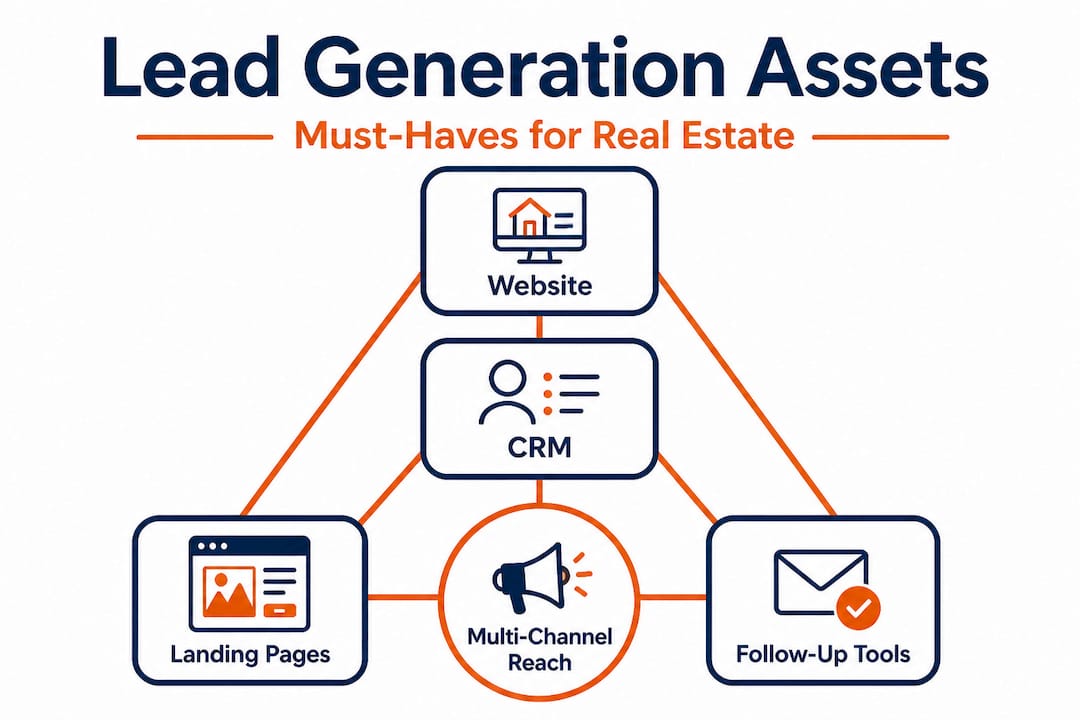
Your CRM (customer relationship management software) connects everything. It captures new leads automatically, assigns follow-up tasks, and tracks every interaction. Agents using CRMs report conversion rates above 20%, compared to industry averages that sit closer to 1 to 3%. That difference is significant and directly tied to how well you manage and nurture your pipeline.
Pro Tip: Set up your CRM to automatically assign a follow-up task within five minutes of any new lead submission. Most agents wait hours or days. The ones who respond fastest win the business.
A multi-channel approach matters too. You want leads coming from organic search, paid ads, social media, and referrals simultaneously. Relying on one channel is like having one source of income. It works until it does not.
Step 1: Attracting leads through high-value lead magnets
With your foundation in place, it is time to engage prospects with irresistible lead magnets that open the door to new relationships.
A lead magnet is a free resource you offer in exchange for a prospect’s contact information. The key word is “value.” Generic downloads no longer cut through the noise. Prospects want tools and information that address their specific situation right now.
Real estate lead magnets like home valuation tools, local market reports, and neighborhood guides convert at significantly higher rates than generic contact forms. Home valuation tools in particular appeal to sellers who are curious about their equity position, making them highly motivated contacts.
Top-performing lead magnets compared
| Lead magnet type | Target audience | Conversion potential | Follow-up complexity |
|---|---|---|---|
| Home valuation tool | Sellers | Very high | Low to medium |
| Neighborhood market report | Buyers and sellers | High | Medium |
| First-time buyer guide | Buyers | Medium | Medium to high |
| School district comparison | Families | Medium | Medium |
| Investment property calculator | Investors | High | High |
Here is how to build a lead magnet pipeline that actually converts:
- Choose a specific pain point. “Download our free real estate guide” is vague. “Find out what your home is worth in 60 seconds” is specific and compelling.
- Build a focused landing page. One offer, one call to action. Remove your main navigation menu from the page so visitors cannot click away before converting.
- Keep the form short. Name, email, and one qualifying question is enough to start. You can collect more details in your follow-up sequence.
- Deliver the resource instantly. Automated email delivery builds trust immediately. Delays create doubt.
- Follow up with a sequence. The lead magnet is just the entry point. Your email sequence is where relationships are built and conversions happen.
Pro Tip: Test two versions of your lead magnet headline. Something as simple as “Get your free home valuation” versus “Find out what your home is worth today” can produce meaningfully different conversion rates. Small copy changes create big differences.
The goal is to move someone from anonymous visitor to known contact. Once they are in your CRM, you control the relationship and the follow-up. That is where your conversion work really begins.
Step 2: Leveraging social media and paid ads for real estate leads
Once your lead magnets are set, amplify your reach using social media and ad strategies that meet prospects right where they are.

Social media advertising for real estate is not about posting listings and hoping for likes. It is about targeted, intentional outreach to specific audiences with the right message at the right moment. Platforms like Facebook and Instagram offer precise audience targeting tools that let you reach people by location, age, income level, homeownership status, and even life events like recent marriage or new job.
Facebook Ads convert at 1.8% on average for real estate, and short-form video content boosts overall ROI by 35%. Those numbers reinforce two practical strategies you should act on immediately.
How to target effectively by platform
- Facebook: Best for audiences aged 35 and older. Use lead forms, carousel ads for property listings, and retargeting campaigns for website visitors. Facebook’s detailed targeting options make it ideal for seller-focused campaigns.
- Instagram: Best for younger buyers, typically under 35. Visual storytelling, Reels, and Stories perform strongly here. Short video walkthroughs and neighborhood spotlights see especially high engagement.
- YouTube: Effective for longer-form video content like community tours or educational “how to buy a home” content that builds authority over time.
- Google Ads: Captures intent-based searches. Buyers typing “homes for sale in [city]” are actively looking. This is some of the most valuable traffic you can capture. Well-managed Google Ads campaigns consistently deliver motivated, purchase-ready leads.
Retargeting (showing ads to people who already visited your website but did not convert) is one of the highest-ROI ad strategies available. A buyer who browsed your listings once is far more likely to engage than a cold stranger. Retargeting keeps your brand visible and draws them back.
Short-form video content is no longer optional. Agents who post consistent Reels, TikToks, or YouTube Shorts showing neighborhood highlights, market updates, or client success stories build trust before the first conversation. Video viewers convert to leads at higher rates because they already feel they know you.
Keep your ad creative focused on one clear message. Cluttered ads with multiple offers confuse prospects and lower click-through rates. Test different images, headlines, and audiences regularly to find what works best for your specific market.
Step 3: Optimizing follow-up: Speed-to-lead and nurturing best practices
Now that you are attracting new leads, make sure you convert them with a fast, consistent, and personal follow-up process.
Speed is the single most underrated factor in lead conversion. Most agents follow up hours after a new inquiry arrives. By then, the prospect has moved on or spoken to someone else. The data is clear on this point.
Following up within 5 minutes of a new lead submission increases your conversion rate by 44%. Five minutes. That is not a long time, but it requires a system because you cannot always be available manually.
“Agents who reach out within the first five minutes are far more likely to qualify leads and set appointments than those who wait even 30 minutes.” This is why automation and CRM integrations are not luxuries. They are competitive necessities.
Multi-channel lead nurturing converts at 9.2%, which is significantly higher than single-channel approaches. That means reaching leads through email, text, phone, and social media over time rather than sending one email and hoping for the best.
Here is a proven follow-up sequence structure:
- Minute 1 to 5: Automated text message confirming receipt and offering to answer questions immediately.
- Minute 5 to 15: Personal phone call attempt. Even a voicemail shows initiative.
- Hour 1: Automated email with the lead magnet resource and a brief intro from you.
- Day 2: Second call attempt plus a personalized follow-up email referencing their specific inquiry.
- Day 5: Value-add email such as a market update, a relevant listing, or a helpful resource.
- Week 2 and beyond: Monthly nurture sequence until they are ready to engage.
Your CRM should handle the automated steps and remind you of the personal touch points. The goal is consistency. Most leads need five to twelve contact attempts before they respond. Agents who stop after two attempts leave enormous amounts of business on the table.
Consistent follow-up strategies also apply directly to your existing pipeline. Not every lead converts immediately. Some take six months or a year. The agents who stay in front of those prospects with value, not pressure, earn the business when the timing is right.
Step 4: Harnessing referrals and repeat business
Beyond digital tactics, the biggest ROI often comes from the people who already know, like, and trust you.
41% of real estate leads from known contacts convert at 10 to 20%, compared to less than 5% for cold online leads. That conversion gap is massive. Referrals are not just warmer. They are fundamentally more likely to close. And yet most agents have no formal system for generating them consistently.
Here is how to build a referral engine that runs alongside your digital strategy:
- Ask at the right moment. The best time to request a referral is right after a successful transaction or a positive interaction, not at a random moment six months later.
- Create a formal referral program. Offer a closing gift, a thank-you gesture, or even a small incentive for introductions. Make the process easy for clients to refer you.
- Stay in touch with past clients. A quarterly email with a market update, a birthday message, or a home anniversary note keeps you top of mind without being intrusive.
- Segment your database. Identify your top 20 to 30 past clients and sphere contacts. These are your “A-tier” referral sources. Invest more personalized time and attention in these relationships.
- Use automation for the rest. For contacts outside your A-tier, automated email sequences and social media engagement keep your name visible at scale.
Pro Tip: Send a handwritten note or a small gift on the one-year anniversary of a client’s home purchase. Almost no agents do this. The ones who do generate an outsized number of repeat and referral transactions because the gesture is genuinely memorable.
Maximizing your network value means treating your database as your most important business asset. It compounds over time. Every satisfied client is a potential source of two or three future referrals if you stay connected and deliver real value.
Why integrating human connection with digital strategy is the real unlock
Here is what most agents overlook when they invest in digital marketing. They treat it as a replacement for relationship-building rather than a multiplier of it.
82% of real estate transactions come from personal networks, even in an era of online search dominance. That number does not go down as digital marketing improves. It stays stubbornly high because buying a home is one of the most emotionally charged decisions a person makes. People want to work with someone they trust, not just someone whose ad they clicked.
The agents who win long-term are not the ones with the biggest ad budgets. They are the ones who use digital tools to stay consistently present in their network’s awareness while also showing up personally at the moments that matter.
Digital marketing earns the first conversation. Relationships earn the signed contract. That distinction changes how you should think about your entire marketing strategy. Your ads, your SEO, your lead magnets, they are all designed to create an entry point. What happens after that entry point is almost entirely relationship-driven.
We work with agents who initially want to outsource their marketing entirely and let automation do the work. The ones who see the best results are those who combine scalable lead generation systems with genuine personal investment in their relationships. High-tech and high-touch together. Not one or the other.
The uncomfortable truth is that no marketing system, regardless of how sophisticated it is, compensates for an agent who does not follow up personally, who does not remember client details, or who treats every interaction as transactional. Your database is your business. Protect it, invest in it, and it will grow your income for years.
Next steps: Unlock your real estate lead potential with expert support
You now have a clear framework for building a digital lead generation system that generates consistent, high-quality leads. But strategy alone only gets you so far. Execution is where results are made. At AdJet Marketing, we build custom real estate agent marketing systems that combine high-converting website design, targeted paid advertising, and data-driven SEO for real estate into one performance-focused strategy. Whether you need to build your digital foundation from scratch or scale what is already working, our team delivers measurable results. Explore our Google Ads management to start capturing motivated buyers and sellers searching for agents in your market today.
Frequently asked questions
What is the best lead magnet for real estate agents?
Home valuation tools consistently convert prospects higher than other lead magnets because they attract sellers with immediate, personalized value tied to their specific property.
How fast should I follow up with real estate leads?
Respond within five minutes. Following up that quickly boosts your conversion rate by 44%, because your prospect is still engaged and has not moved on to another agent.
Are Facebook or Instagram better for real estate lead ads?
Facebook performs best with buyers and sellers over age 35, while Instagram targets younger buyers effectively, and short-form video drives 35% higher conversion rates on both platforms.
How important are referrals versus online leads?
Referrals convert at 10 to 20% while cold online leads average under 5%, making your personal network the highest-ROI lead source you have access to.
What CRM features help real estate agents most?
Automated follow-up sequences, lead segmentation, and personalized messaging are the highest-impact CRM features. Agents using these tools report conversion rates above 20%, well above the industry average.
Recommended
- What’s The Best Way To Get Real Estate Leads? | 10 Scalable Lead Gen Hacks – AdJet Digital Marketing & Google Partner Agency | SEO Development Google Ads Social
- What Are The Best Lead Magnets For Realtors? | Freebies That Actually Work – AdJet Digital Marketing & Google Partner Agency | SEO Development Google Ads Social
- How Do I Market Luxury Real Estate Listings? | Attract High-End Buyers Online – AdJet Digital Marketing & Google Partner Agency | SEO Development Google Ads Social
- How Can I Advertise My Real Estate Business Online? | Digital Tactics That Convert – AdJet Digital Marketing & Google Partner Agency | SEO Development Google Ads Social