









Most real estate agents still believe that yard signs, open houses, and referrals from past clients are enough to fill their pipeline. That belief costs them business every single month. Today’s buyers and sellers begin their journey online, and agents who fail to show up where prospects are searching simply hand those leads to competitors. Real estate lead generation now depends on a coordinated digital presence across search, paid advertising, property portals, and owned websites, backed by fast and consistent follow-up systems that convert attention into signed agreements.
Table of Contents
- How digital marketing drives lead generation in real estate
- Choosing the right mix: SEO, paid search, and portals
- Nurturing digital leads: How email, CRM, and automation close deals
- Key digital marketing benchmarks for real estate in 2026
- What most agents miss about digital marketing
- Unlock your real estate marketing advantage with expert support
- Frequently asked questions
Key Takeaways
| Point | Details |
|---|---|
| Multi-channel approach wins | Relying on several digital marketing channels maximizes your lead quality and reach. |
| Speed versus sustainability | Paid ads provide fast leads while SEO and content marketing yield compounding, long-term results. |
| Lead nurturing is critical | Use email, CRM tools, and automation to convert digital leads into closings efficiently. |
| Benchmark your numbers | Monitor your key metrics against industry benchmarks for mobile share, conversion rates, and bounce rates to stay competitive. |
How digital marketing drives lead generation in real estate
After explaining why digital marketing matters, let’s break down exactly how it powers lead generation for real estate pros.
Digital marketing is not a single tactic. It is a system made up of channels that each attract different types of prospects at different stages of readiness. Understanding how those channels interact is what separates agents who generate consistent leads from those who scramble month to month.
The core lead generation channels available to agents and brokers fall into four main categories:
- Search engine optimization (SEO): Ranking your website organically in Google search results for buyer and seller intent queries in your local market
- Paid search and social advertising: Running Google Ads and Meta/Facebook/Instagram campaigns to capture in-market audiences with targeted messaging
- Listing portals: Syndicating your listings and agent profile on platforms like Zillow and Realtor.com where buyers already browse
- Owned website and content: Building a site that educates, captures emails, and positions you as the local market authority
Each channel delivers leads on a very different timeline. Google Pay-Per-Click (PPC) campaigns can produce leads within one to four weeks. Content marketing and SEO, on the other hand, typically take three to twelve months before you see compounding returns. Knowing this distinction helps you plan your marketing investment against your business goals, not just your current urgency.
“The most effective lead generation strategies layer fast-lead channels with long-term compounding channels. Neither alone is enough to sustain a real estate business through market cycles.”
| Channel | Time to first lead | Relative cost | Effort level |
|---|---|---|---|
| Google PPC | 1 to 4 weeks | Medium to high | Low to medium |
| Social ads (Meta) | 1 to 4 weeks | Medium | Medium |
| Listing portals | 1 to 8 weeks | Medium | Low |
| SEO and content | 3 to 12 months | Low over time | High |
| Email nurturing | Ongoing | Very low | Medium |
Notice that low-cost channels require the most patience. High-speed channels require ongoing budget. The agents who win long-term balance both sides of that equation, rather than defaulting entirely to one approach.

One practical starting point is to offer value even before a prospect is ready to talk. Well-designed lead magnets for realtors like neighborhood guides, buyer checklists, or home valuation tools give prospects a reason to share their contact details and enter your nurture funnel early in their search.
Choosing the right mix: SEO, paid search, and portals
Now that you understand the lead generation landscape, let’s compare channel types so you can choose the right digital marketing mix for your goals.
Not every channel makes sense for every agent at every stage of their business. The right mix depends on three factors: how quickly you need leads, how much budget you can sustain month over month, and how competitive your local market is.
Here is a practical framework for thinking through your channel selection:
- Assess your lead urgency. If you are a new agent who needs closings within 60 to 90 days, paid search and social advertising should anchor your strategy. Budget for Google Ads and Meta campaigns first.
- Evaluate your budget runway. Paid channels stop delivering the moment you pause spend. If your budget is limited or inconsistent, prioritize building SEO assets and content that continue working after you publish them.
- Research portal presence. Zillow and Realtor.com already rank at the top of Google for most local property searches. Maintaining a complete and reviewed profile on those platforms captures buyers who are already in active search mode.
- Audit your existing website. Before spending on traffic, verify that your site loads fast, renders correctly on mobile devices, and has clear calls to action on every page. Paid advertising performance depends heavily on landing page quality, mobile speed, and intent-matched calls to action. Sending paid traffic to a slow or confusing website is one of the fastest ways to waste ad spend.
- Build SEO for long-term compounding growth. Target local keyword phrases such as “homes for sale in [city],” “top buyer’s agent in [neighborhood],” and “how much is my home worth in [zip code].” These searches represent high-intent prospects and organic rankings produce traffic without ongoing cost per click.
Pro Tip: Before launching Google Ads, run your landing page through Google’s PageSpeed Insights tool. A page load time above three seconds on mobile can cut your conversion rate by more than half, meaning you pay for clicks that never become leads.
The SEO versus paid search decision in practice:
SEO builds authority slowly but rewards patience with compounding returns. An agent who invests in local content and technical site optimization over 12 to 18 months can realistically earn top organic rankings that generate free inbound leads for years. You can apply the same logic used in advanced SEO strategies for other competitive local service businesses directly to real estate site optimization.
Paid search delivers speed but demands discipline. Poorly structured campaigns with broad keyword targeting and generic landing pages burn budget fast. Your ads need tightly themed ad groups, geo-targeted bids, and landing pages built for one specific offer or search intent.
Social advertising sits somewhere in the middle. Facebook and Instagram allow precise demographic and behavioral targeting, including life event triggers like “likely to move” or income and homeownership filters. These platforms work well for building brand awareness and remarketing to website visitors, but the leads tend to be earlier in the buying process than those generated through Google search intent.
Nurturing digital leads: How email, CRM, and automation close deals
Generating a lead is just the start. Let’s cover how savvy agents convert online attention into actual closings through targeted follow-up and automation.
Here is a reality that surprises many agents: the majority of your digital leads will not be ready to buy or sell within the first 30 days of contact. Research on strategies successful agents share consistently shows that email and CRM-driven nurturing, organized by lead type and intent level, separates top producers from average performers. The agents who close the most deals are not necessarily generating the most leads. They are the ones who follow up best.
Lead nurturing is the practice of staying in consistent, relevant contact with prospects from the moment they enter your funnel until they are ready to take action. Here is how to build a system that does this without requiring you to manually track every contact:
- Segment your leads by intent. Separate active buyers (searching now, pre-approved) from passive browsers (just curious, 6 to 12 month timeline) and seller leads (considering listing, comparing agents). Each group needs different messaging and different follow-up frequency.
- Use automation for initial responses. Set your CRM to send an immediate response email within five minutes of a form submission. Speed of first contact dramatically increases the probability that a lead will engage. Waiting 24 hours reduces your chance of connection by more than 90%.
- Build drip email sequences. Create a series of five to ten emails that deliver real value over several weeks. For buyer leads, share market updates, mortgage rate trends, and neighborhood guides. For seller leads, provide local comparable sales data and home preparation tips.
- Incorporate SMS follow-up. Many prospects respond faster to text messages than emails, especially for time-sensitive questions. A brief, personalized text within the first hour of contact can significantly increase response rates.
- Schedule periodic check-ins in your CRM. Set task reminders to reach out personally at 30, 60, and 90 days for leads who have not yet converted. A well-timed phone call after weeks of helpful email content often triggers the conversation that leads to a listing appointment.
Pro Tip: You do not need an expensive CRM to start. Even a well-configured free tool like HubSpot CRM, combined with a simple email platform, can automate your follow-up sequences and track lead behavior. The system matters more than the software cost.
The same discipline that drives results in other competitive service industries applies directly to real estate. You can adapt frameworks used in performance-driven marketing strategies to structure your real estate email nurturing cadence around a consistent value-delivery schedule.
Key digital marketing benchmarks for real estate in 2026
To move from strategic planning to tactical execution, you need to know how your digital marketing measures up. Let’s look at the key benchmarks for 2026.
Setting realistic expectations is one of the most underrated parts of building a digital marketing program. Agents who do not know their benchmarks either panic when results seem slow or miss obvious warning signs when campaigns underperform. These numbers give you a baseline.
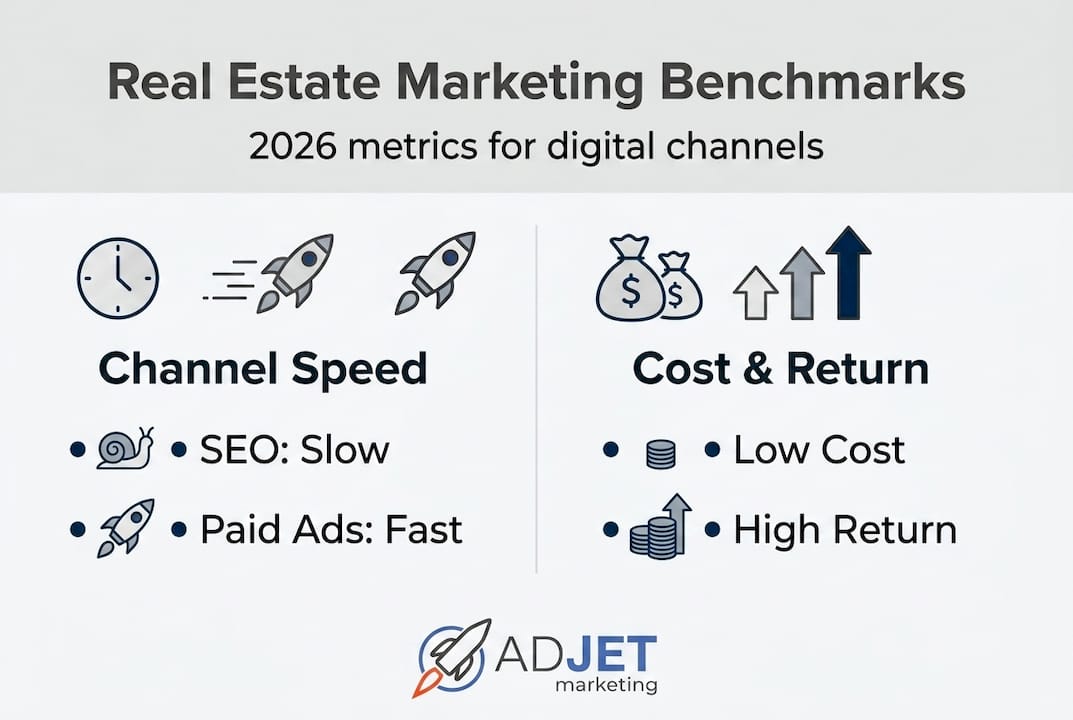
Critical 2026 benchmarks for real estate digital marketing:
According to current real estate site benchmarks, mobile devices now account for approximately 68.5% of all real estate website traffic, and the average bounce rate across real estate sites sits at about 42.5%. Those two figures tell a clear story: if your site is not optimized for mobile speed and usability, you are losing more than two out of every three visitors before they ever see your listings or contact form.
Additional benchmarks worth tracking:
- Google Ads conversion rate: The average real estate PPC conversion rate is approximately 2.5%. That means for every 100 clicks you pay for, you can expect roughly two to three lead form submissions if your landing pages are well-built. Below 1.5% signals a landing page or targeting problem.
- Organic search traffic share: Organic search continues to drive the largest share of traffic to real estate websites, reinforcing that SEO is not optional for agents who want sustainable, cost-efficient lead flow.
- Email open rates: Real estate email campaigns typically achieve open rates between 20% and 28%, which is above the average for most industries. This reflects the high personal relevance of real estate decisions for recipients.
- Cost per lead from paid search: Depending on market competitiveness, real estate Google Ads cost per lead can range from $30 to $150 or more in premium urban markets. Knowing your target cost per lead keeps your ad budget accountable.
How to use benchmarks to diagnose your marketing:
Start by connecting Google Analytics 4 to your website and Google Search Console for organic keyword data. Review your mobile load time monthly using PageSpeed Insights. Track your paid campaign conversion rates weekly inside Google Ads. Compare each metric against these benchmarks and investigate any significant gap immediately.
You can find detailed frameworks for measuring and improving these numbers in this effective SEO guide, which outlines how to monitor traffic quality, search visibility, and on-site conversion metrics in a way that applies directly to local service businesses including real estate.
What most agents miss about digital marketing
Here is the uncomfortable truth about why most agents never see consistent results from their digital marketing: they abandon strategies before those strategies have time to work.
An agent runs Google Ads for six weeks, does not close a deal directly from that campaign, and switches to social media. Three months later they pivot to portal advertising. A year passes and they conclude that “digital marketing doesn’t work for me.” The real problem is incomplete strategy and a lack of iteration, not a fundamental flaw in the channel itself.
The agents we see generate consistent digital leads do something different. They pick a primary channel based on their budget and timeline, run it for at least 90 days with disciplined tracking, then improve based on data before adding the next channel. They do not need every platform. They need the right stack and the patience to optimize it. Testing one variable at a time, whether it is ad copy, landing page layout, or email subject lines, tells you exactly what improves performance and what does not. That iterative habit is what separates producers from experimenters.
Unlock your real estate marketing advantage with expert support
With the practical and strategic insights covered here, the next step is applying them with a partner who knows how to execute. At AdJet Marketing, we help real estate agents and brokers build digital marketing programs that generate consistent, high-quality leads through SEO, Google Ads, and conversion-optimized websites. Whether you are starting from scratch or looking to scale what is already working, our team delivers measurable results tailored to your market and goals.
Explore our dedicated real estate agent marketing services to see how we approach lead generation for agents. If you want a broader view of your options, our resource on ways to get real estate leads covers scalable tactics you can implement immediately. Ready to run paid campaigns that actually convert? Learn more about our Google Ads for real estate program.
Frequently asked questions
Which digital marketing channel brings in the fastest leads for real estate?
Google Ads and paid social campaigns can deliver actionable leads within one to four weeks, making them the fastest option compared to SEO or content marketing, which often takes three to twelve months to produce consistent results.
What is a good conversion rate for real estate Google Ads?
A typical real estate Google Ads conversion rate is approximately 2.5%, but investing in faster-loading landing pages and intent-matched calls to action can push that number meaningfully higher.
How important is mobile optimization in real estate digital marketing?
Over 68% of real estate site traffic now comes from mobile devices, and the average bounce rate sits at 42.5%, meaning a slow or poorly formatted mobile experience costs you the majority of your potential leads before they ever contact you.
Should I focus more on SEO or paid ads as a starting agent?
Paid ads deliver faster results if you need leads quickly, while SEO builds compounding organic visibility over time. Most growing agents benefit from starting with paid search to generate immediate pipeline while building out their SEO foundation in parallel.
Recommended
- What’s The Best Way To Get Real Estate Leads? | 10 Scalable Lead Gen Hacks – AdJet Digital Marketing & Google Partner Agency | SEO Development Google Ads Social
- How Can I Advertise My Real Estate Business Online? | Digital Tactics That Convert – AdJet Digital Marketing & Google Partner Agency | SEO Development Google Ads Social
- How Do I Market Myself As A Real Estate Agent? | Proven Strategies That Work – AdJet Digital Marketing & Google Partner Agency | SEO Development Google Ads Social
- How Do I Get More Listings As A Realtor? | Strategies That Sellers Trust – AdJet Digital Marketing & Google Partner Agency | SEO Development Google Ads Social