









Most dispensary owners assume Google Ads is a closed door. The word “cannabis” triggers visions of rejected ads, suspended accounts, and wasted budgets. That assumption costs you patients every single day. The reality is more nuanced and far more promising. With the right strategy, compliant campaigns, and proper conversion tracking, Google Ads can become one of the most powerful patient acquisition tools in your marketing stack. This guide walks you through exactly how to make that happen, step by step, without guesswork.
Table of Contents
- Why Google Ads matter in dispensary marketing
- Navigating Google Ads policies and cannabis compliance
- Setting up Google Ads for dispensaries: Tracking, targeting, and success metrics
- Optimizing and automating dispensary campaigns for maximum ROI
- What most dispensary owners overlook about Google Ads
- Need help driving patient growth with Google Ads?
- Frequently asked questions
Key Takeaways
| Point | Details |
|---|---|
| Compliance-first campaigns | Adhering to rules and policies enables effective Google Ads strategy for dispensaries. |
| Conversion tracking is vital | Robust tracking is the key to optimizing, scaling, and proving ROI for your Google Ads. |
| Local targeting equals growth | Focusing on local high-intent patients drives real dispensary visits and increased engagement. |
| Automation delivers results | Leveraging automation and remarketing turns ad data into consistent, scalable patient acquisition. |
Why Google Ads matter in dispensary marketing
Competition among dispensaries is intensifying in nearly every legal market. Patients searching for “medical dispensary near me” or “cannabis wellness center” are ready to act. They have high intent. They want answers now. Google Ads puts your dispensary directly in front of those people at the exact moment they are searching.
Here is what makes this channel so valuable for dispensaries:
- High-intent traffic: People typing location-based queries like “dispensary open now” or “medical cannabis consultation” are not browsing casually. They are ready to visit or call.
- Measurable foot traffic: Unlike billboards or print, Google Ads ties ad spend to trackable outcomes such as phone calls, form fills, and store visits.
- Local market visibility: Geo-targeting lets you focus entirely on your city or service radius, so you are not paying for clicks from patients three states away.
- Scalable budgets: You control spending down to the dollar, making it accessible for single-location dispensaries and multi-location operators alike.
One myth worth addressing directly: the idea that any dispensary ad gets automatically disapproved. That is not accurate. Many dispensary owners have run compliant campaigns by focusing on legal wellness services, educational messaging, and age-gated audiences. Using Google Ads for cannabis marketing requires knowing where the lines are, not avoiding the platform entirely.
Conversion tracking setup requires creating specific conversion actions inside your Google Ads account, and verifying them through API resources ensures your data is clean from the start. Without this foundation, you are flying blind on which ads actually drive patients through your door.
“Visibility without measurement is just noise. Dispensaries that invest in proper tracking from day one see dramatically better results from their ad spend.”
Pro Tip: Start small with a tightly geo-targeted campaign focused on one or two high-intent keyword themes. Build your tracking infrastructure before scaling budget.
Navigating Google Ads policies and cannabis compliance
Understanding what Google will and will not allow is not optional. It is the foundation of every successful dispensary campaign. Google’s advertising policies do restrict direct promotion of cannabis products, including flowers, edibles, and concentrates. However, compliant campaigns are possible when structured around general wellness, educational content, and informational messaging.
Here is a clear breakdown of the compliance landscape:
What Google typically allows:
- General wellness and health information pages
- Age-gated educational resources about cannabis
- Brand awareness campaigns that do not reference specific products
- Information about your dispensary location, hours, and services
What Google typically does not allow:
- Direct promotion of cannabis products for sale
- Ads explicitly mentioning THC, edibles, or recreational use
- Landing pages that display product pricing for controlled substances
State regulations add another layer of complexity. California dispensaries operate under a different set of advertising rules than those in Florida or New York. Legal restrictions on cannabis advertising vary significantly by state, and what is compliant in one market may trigger fines in another. Always consult legal counsel before launching.
Here are numbered steps to launch a compliant campaign:
- Audit your landing pages first. Remove any direct product sales language, THC references, or non-compliant imagery before connecting a page to an ad.
- Write ad copy that focuses on your dispensary brand and wellness services, not specific products.
- Enable age verification. Your landing pages should include clear age-gating mechanisms.
- Set audience restrictions using Google’s demographic targeting to limit impressions to legal-age adults in compliant states.
- Review Google’s healthcare and medicines policies before submitting any campaign for approval.
- Monitor ad status daily during the first two weeks. Catch disapprovals fast and revise copy before Google flags your account.
Google Ads conversion tracking guidance emphasizes setting up conversion actions and measuring key events accurately, which matters as much for compliance as it does for performance. Tracking only what you are legally permitted to measure protects both your account and your patients.
It is also worth comparing your approach to SEO vs paid ads for dispensaries to understand how these channels complement each other. Organic rankings build long-term authority; paid ads deliver immediate visibility.
“Compliance is not a barrier to growth. It is the framework that protects your growth and keeps your account active long-term.”
Pro Tip: Create a “safe” ad copy library. Keep 3 to 5 pre-approved headline and description combinations that you know pass review. This speeds up campaign launches and A/B testing significantly.
Setting up Google Ads for dispensaries: Tracking, targeting, and success metrics
Conversion tracking is where dispensary campaigns either take off or stall. Most owners set up an account, launch a campaign, and then stare at click data wondering why ROI is unclear. Clicks are not conversions. You need to measure what actually matters.
Key conversion actions every dispensary should track:
| Campaign Goal | Conversion Action | Measurement Method |
|---|---|---|
| Drive phone calls | Calls from ads | Google call tracking number |
| Increase store visits | Store visit conversions | Google Maps integration |
| Capture patient leads | Contact form submissions | Thank-you page tracking |
| Online consultations | Booking confirmations | GA4 event trigger |
| Brand awareness follow-up | Website return visits | Audience remarketing lists |
Conversion tracking for dispensaries should measure post-click events, not just initial interactions. Implement tracking via Google Analytics 4 (GA4), Google Tag Manager, or server-side tagging depending on your technical setup. Server-side tagging, in particular, reduces data loss from browser privacy restrictions and ad blockers.
Follow these steps to get your tracking infrastructure right:
- Create a Google Ads conversion action for each key patient behavior: phone calls, form submissions, and appointment bookings.
- Connect GA4 to your Google Ads account for cross-channel visibility into the patient journey.
- Install Google Tag Manager on your dispensary website to manage all tracking tags from one central location.
- Set up call tracking using Google’s forwarding numbers so every phone lead is attributed correctly.
- Verify all conversions are firing correctly before spending a single dollar on ads. Use Google Tag Assistant or the real-time view in GA4.
- Define primary vs. secondary conversions. A booked appointment is primary. A page view is secondary. Do not optimize toward secondary actions.
For local targeting, use the following approach: set your campaign location to a specific mile radius around your dispensary, then layer in demographic targeting to restrict to adults 21 and older. Add location extensions so your address and phone number appear directly in the ad.
Optimizing Google Ads for healthcare-adjacent businesses like dispensaries follows many of the same principles as medical clinic advertising, including negative keyword management, landing page relevance scoring, and quality score maintenance.

Pro Tip: Never rely on click data alone. Track calls and form submissions as your primary success metrics. A campaign with 50 clicks and 10 calls outperforms one with 500 clicks and 0 calls every single time.
If your dispensary collects any patient health information, also review HIPAA-compliant Google Ads guidelines to ensure your tracking implementation does not expose protected health information (PHI) through pixel data or URL parameters.
Optimizing and automating dispensary campaigns for maximum ROI
Once your tracking foundation is solid, you can shift from manual management to systematic optimization. This is where dispensaries separate from each other in performance. The ones winning are not necessarily spending more. They are spending smarter.
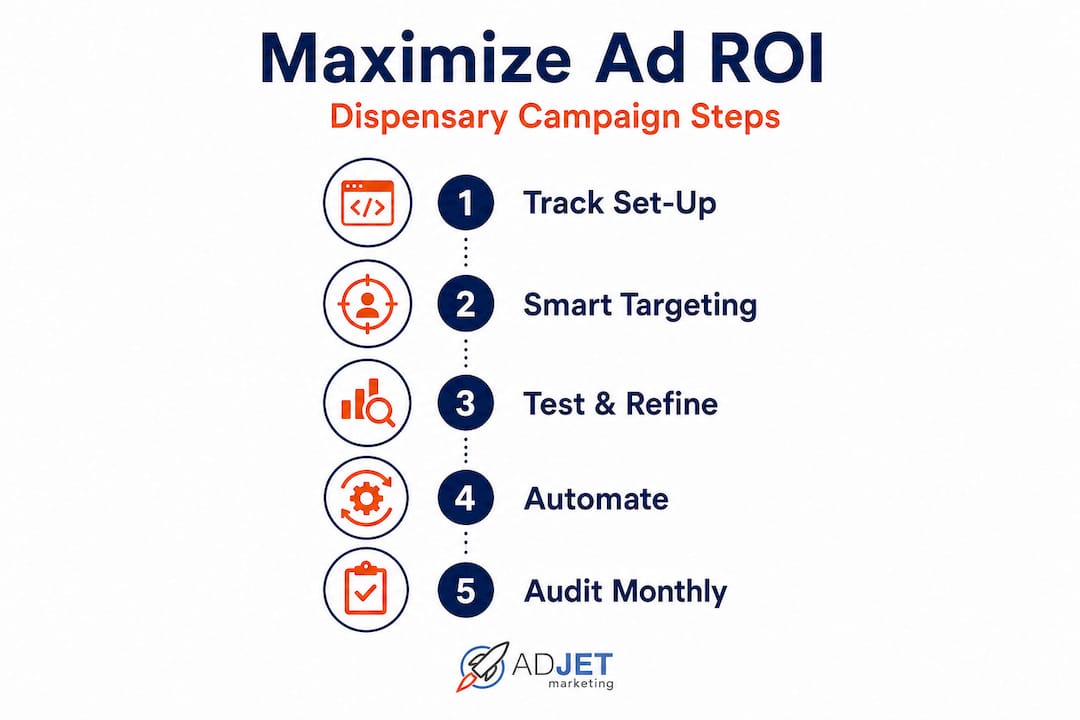
Basic vs. advanced optimization comparison:
| Area | Basic Approach | Advanced Approach |
|---|---|---|
| Bidding | Manual CPC | Target CPA or Target ROAS smart bidding |
| Keywords | Broad match only | Exact and phrase match plus negative keyword lists |
| Audiences | No audience layering | In-market, remarketing, and customer match lists |
| Ad copy | Single ad per group | Responsive search ads with 10+ headline variants |
| Reporting | Weekly click reports | Conversion-weighted attribution models |
| Budget | Flat daily budget | Shared budgets across campaigns with dayparting |
Conversion tracking is the backbone of smart bidding and automation. Google’s algorithms need at least 30 to 50 conversions per month to effectively optimize toward your goals. If volume is low, focus on tracking micro-conversions (calls, site engagement) alongside macro-conversions (bookings) to feed the algorithm enough data.
Routine tasks you can automate to save time and increase efficiency:
- Automated bidding strategies: Let Google’s Target CPA bidding adjust bids in real time based on the likelihood of conversion.
- Ad scheduling: Use performance data to show ads only during hours when patients are most likely to call or visit.
- Responsive search ads: Provide multiple headlines and descriptions, and Google tests combinations automatically to find top performers.
- Budget alerts: Set automated rules to pause campaigns or adjust budgets when spend thresholds are reached.
- Audience list refresh: Automatically update remarketing lists based on website behavior and engagement signals.
Common errors that dispensary advertisers make, and that you should avoid:
- Not using remarketing. Patients who visited your website but did not call are warm leads. Without remarketing, you lose them to competitors.
- Neglecting automated bidding. Manual bidding cannot compete with real-time auction adjustments at scale.
- Failing to update audience targeting. Seasonal patient behavior, new state regulations, and product changes all affect who you should be reaching.
- Ignoring search term reports. Irrelevant searches waste budget fast. Review what triggered your ads weekly and add negatives aggressively.
- Setting it and forgetting it. Google Ads requires regular attention. Algorithms change, competitors adjust bids, and seasonal trends shift.
Remarketing without PHI risk is achievable using cookieless tactics such as consent mode, server-side tracking, and first-party audience data. These approaches let you re-engage past visitors without exposing any protected patient information.
Pro Tip: Set up a monthly conversion audit. Verify that all conversion actions are still firing correctly, that no duplicate conversions are inflating your numbers, and that your primary conversion action still aligns with your business goals. Catching one tracking error early can save thousands in misallocated budget.
What most dispensary owners overlook about Google Ads
Here is the honest truth from working with healthcare-adjacent advertisers: most dispensary owners under-invest in conversion tracking infrastructure. They spend hours crafting ad copy and choosing keywords, then install a basic tracking pixel and call it done. That approach leaves real insight buried under incomplete data.
The dispensaries that pull ahead are obsessing over the details that seem unglamorous. Negative keyword lists. Server-side conversion tracking. Granular geo-targeting by ZIP code versus broad city radius. These are not flashy strategies. They are the foundation of sustained performance.
Another overlooked edge is adaptability. Google’s advertising policies evolve. State regulations change. A dispensary that has built an agile campaign management process, one where ad copy can be revised quickly and landing pages can be updated in hours, will consistently outperform one that treats campaigns as static assets.
The best-performing dispensaries we have observed do not rely on Google Ads in isolation. They combine paid search with local SEO strategies for dispensaries to create compounding visibility. Paid ads deliver immediate traffic while local SEO builds long-term organic authority in Google Maps and search results. Together, they create a patient acquisition engine that is both fast and durable.
The final insight is counterintuitive: more budget does not automatically mean better results. A dispensary spending $1,500 per month with clean tracking, tight targeting, and consistent optimization will frequently outperform one spending $5,000 with sloppy data. Precision beats volume at every stage of campaign maturity.
Need help driving patient growth with Google Ads?
Running compliant, high-performing Google Ads campaigns for a dispensary is achievable, but it requires expertise in both digital advertising and regulatory compliance. At AdJet Marketing, we specialize in Google Ads campaign management for businesses in regulated industries where strategy and compliance must work together. Our team handles campaign setup, conversion tracking, ad copy development, and ongoing optimization so you can focus on running your dispensary. We also offer a complete digital marketing strategy for dispensaries that integrates paid ads with organic search for compounding results. And if your website is not built to convert traffic into patients, explore our work in cannabis website design to see how a high-converting site changes everything.
Frequently asked questions
Can dispensaries legally advertise on Google Ads in 2026?
Dispensaries can advertise on Google Ads if campaigns are carefully designed to comply with both platform rules and state regulations. Google’s advertising policies restrict direct promotion of cannabis but allow for compliance-based approaches focused on wellness and education.
What conversions should dispensaries track with Google Ads?
You should track calls, website visits, contact form submissions, and online orders for the most meaningful measurement. Robust conversion tracking that measures post-click events gives you the clearest picture of which ads drive real patient actions.
How do you ensure Google Ads compliance for dispensary ads?
Follow all content and age restrictions, consult legal guidance, and regularly review policy updates to remain compliant. Google’s conversion tracking guidance also emphasizes accurate measurement, which supports account health and reduces the risk of policy violations.
Why is conversion tracking so important for dispensary marketing?
Conversion tracking lets you see which ads drive patient actions and helps refine ad spend for better ROI. Conversion tracking is the backbone of smart bidding and automation, meaning without it, you cannot fully leverage Google’s optimization tools.
How do advanced tactics like remarketing drive dispensary growth?
Remarketing targets people who visited your website but did not take action, keeping your dispensary visible while they continue their research. This re-engagement increases the likelihood of converting interested visitors into patients without requiring entirely new budget for fresh audience acquisition.
Recommended
- Cannabis SEO Vs Paid Ads: Which Should You Invest In For Long-Term Growth? – AdJet Digital Marketing & Google Partner Agency | SEO Development Google Ads Social
- How To Dominate Google Maps For Dispensary SEO: Local Strategies That Convert – AdJet Digital Marketing & Google Partner Agency | SEO Development Google Ads Social
- Google Ads For Aesthetic Clinics: Grow Patients Safely