









Content marketing in healthcare is the practice of creating and distributing medically accurate, patient-focused content to build trust, attract qualified patients, and support appointment decisions. The role of content marketing in healthcare goes well beyond publishing blog posts. It functions as the primary trust-building system between a clinic and the patients it serves, long before anyone picks up the phone. Content marketing generates three times more leads than traditional outbound methods while costing significantly less. For clinic owners and healthcare marketing professionals, that is not a minor efficiency gain. It is a structural advantage in a market where patient trust determines everything.
How does content marketing build trust and authority in healthcare?
Trust is the single most important factor in a patient’s decision to book with your clinic. Content marketing builds that trust by answering real patient questions with accurate, evidence-based information before the first appointment ever happens.
Google’s YMYL (Your Money or Your Life) guidelines set a high bar for healthcare content. Visible author credentials and medical review stamps are required on all healthcare content to maintain search rankings and patient trust. Content without clinical review risks both ranking suppression and reputational damage. That is a compliance and business risk most clinics cannot afford.

The E-E-A-T framework, which stands for Experience, Expertise, Authoritativeness, and Trustworthiness, is Google’s 2026 standard for evaluating healthcare content quality. Meeting this standard requires more than good writing. It requires clinician involvement, cited sources, and dated review stamps on every published piece.
Healthcare content also functions as what experts call an education engine for patients. It reduces pre-appointment anxiety, answers questions about procedures and costs, and removes friction that would otherwise prevent a patient from booking. A well-written FAQ page about a pain management procedure can convert a hesitant visitor into a confirmed appointment.
Key trust signals your healthcare content must include:
- Named author with professional credentials and title
- Date of last medical review
- Citations to peer-reviewed sources or clinical guidelines
- Clear distinction between general information and personalized medical advice
- Compliance language where required by HIPAA or state regulations
Pro Tip: Assign a clinical reviewer to sign off on every published piece. One factual error in a healthcare article can trigger a YMYL ranking penalty and, more seriously, erode patient confidence in your brand.
What types of content strategies and formats work best for clinics?
A pillar-and-cluster content architecture outperforms scattered blog publishing for healthcare clinics. Google favors specialist content that builds comprehensive expertise around a topic rather than isolated articles with no structural relationship. A pillar page covers a broad topic like “back pain treatment” in depth, while cluster pages address specific subtopics such as “epidural steroid injections” or “physical therapy for herniated discs.” Each cluster links back to the pillar, signaling topical authority to search engines.
The most effective content formats for healthcare clinics include:
- Educational blog posts that answer common patient questions in plain language
- Procedure explainer pages that walk patients through what to expect before, during, and after treatment
- Video content and patient testimonials that increase engagement and build social proof
- Email newsletters that maintain patient relationships and drive return visits
- Condition-specific landing pages built for local SEO and paid ad campaigns
Distribution matters as much as creation. Publishing a well-researched article and leaving it on your website without promotion is a missed opportunity. SEO, social media, and email channels each serve different stages of the patient journey. Medical SEO drives organic discovery, while paid amplification accelerates reach for high-value service pages.
| Content Format | Primary Purpose | Best Channel |
|---|---|---|
| Educational blog posts | Organic search visibility | SEO |
| Procedure explainer pages | Conversion and trust | Website, Google Ads |
| Video testimonials | Social proof and engagement | Social media, YouTube |
| Email newsletters | Patient retention | |
| Condition landing pages | Local search and paid ads | SEO, Google Ads |
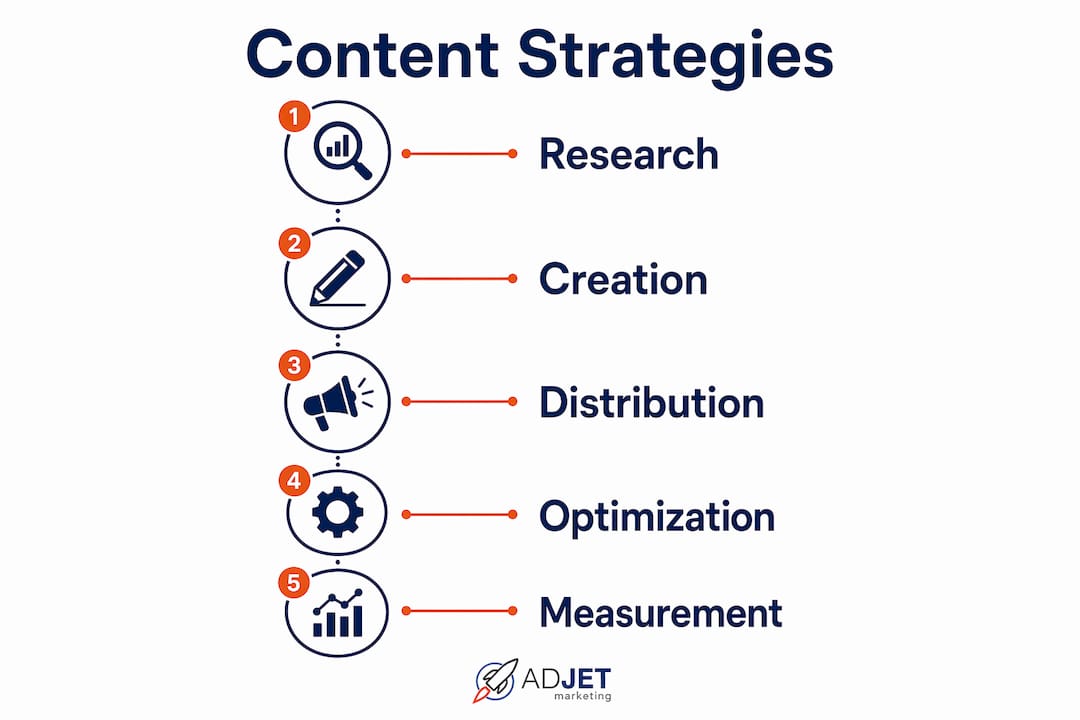
Data-driven optimization closes the loop. Tracking which content pieces correlate with appointment bookings, not just page views, tells you where to invest next. Content integrated with SEO and paid ads lowers patient acquisition costs and improves qualified inquiry volume over time.
How should clinics integrate content into their full digital marketing strategy?
Content marketing is not a blog add-on. It is a business-critical operating system that connects every stage of the patient acquisition process. Treating it as a standalone tactic is one of the most common healthcare marketing mistakes clinic owners make.
The most effective approach maps content assets to specific stages of the patient journey:
- Symptom research stage. Patients search for information about their condition. Educational blog posts and symptom guides capture this traffic and introduce your clinic as a credible source.
- Treatment comparison stage. Patients evaluate options. Procedure comparison pages, FAQ content, and provider credential pages build confidence and differentiate your clinic.
- Booking stage. Patients are ready to act. Clear calls to action, appointment request forms, and follow-up email sequences convert intent into confirmed bookings.
- Post-visit retention stage. Patients who receive relevant follow-up content, such as aftercare guides or condition management tips, are more likely to return and refer others.
Collaboration between marketing and clinical teams is not optional in this model. Clinician involvement prevents factual errors, satisfies YMYL requirements, and produces content that patients actually trust. Marketing handles structure, SEO, and distribution. Clinicians validate accuracy and add credibility.
Set realistic expectations on timelines. Organic content marketing typically requires 6–12 months to produce measurable search visibility gains. Paid amplification of content assets can accelerate results in the short term. The combination of SEO and Google Ads gives clinics both immediate visibility and long-term compounding returns.
Pro Tip: Move from a content calendar to a content architecture model. Map every asset to a patient journey stage and subject it to medical, legal, and regulatory review before publishing. This is the standard that separates clinics that rank from those that do not.
What does the market data say about content marketing in healthcare?
The numbers behind healthcare content marketing make a clear case for prioritizing it now. The healthcare digital content creation market is projected to reach $32.28 billion by 2030, with digital ad spend in healthcare expected to hit $29.2 billion by 2028. Digital channels already account for 46% of total U.S. healthcare ad spend. That share will only grow.
Healthcare spending in the U.S. reached $4.5 trillion in 2022 and is projected to exceed $6.2 trillion by 2028. Clinics that build content authority now will capture a disproportionate share of that patient volume. Those that wait will face a much more competitive and expensive acquisition environment.
The patient behavior data reinforces this urgency. Patients actively research symptoms and providers online before choosing a clinic. Content that meets patients at this research stage drives qualified traffic and nurtures leads through the decision process. Patients who engage with educational content are 60% more likely to book appointments and 40% more likely to refer others. Those are not marginal improvements. They represent a measurable shift in patient acquisition economics.
Content marketing is also 62% more cost-effective than traditional marketing methods. For clinics managing tight marketing budgets, that efficiency gap is a strong argument for reallocating spend toward content-driven digital strategies. The growth in healthcare digital advertising reflects what clinic owners are already discovering in practice.
Key Takeaways
Content marketing in healthcare builds patient trust, drives qualified appointments, and outperforms traditional marketing on both cost and lead volume when executed with clinical accuracy and a clear patient journey strategy.
| Point | Details |
|---|---|
| Trust requires clinical review | Every piece of healthcare content needs visible author credentials and a dated medical review to meet Google’s YMYL standards. |
| Architecture beats volume | A pillar-and-cluster content structure builds topical authority faster than frequent, unrelated blog posts. |
| Map content to the patient journey | Assign each content asset to a specific stage: symptom research, treatment comparison, booking, or retention. |
| Integration multiplies results | Combining content marketing with SEO and paid ads lowers acquisition costs and increases qualified inquiry volume. |
| Market timing favors early movers | With healthcare digital ad spend approaching $29.2 billion by 2028, clinics that build content authority now will hold a structural advantage. |
Why most clinics underinvest in content and pay for it later
After working with medical clinics across multiple specialties, I have seen the same pattern repeat. A clinic invests in Google Ads, gets decent traffic, and wonders why the conversion rate stays flat. The answer is almost always the same: the content on the site does not build enough trust to convert a cautious patient.
Patients researching a pain clinic, a mental health therapist, or a med spa are not just looking for a service. They are looking for a reason to trust you with something personal. Generic content written for SEO volume does not do that job. Clinically reviewed, patient-centric content does.
The clinics I have seen grow consistently are the ones that treat content as a business asset with a clear return. They publish fewer pieces but invest more in each one. They involve clinicians in the review process. They track which articles drive appointment requests, not just traffic. That discipline is what separates a content program that compounds over time from one that just fills a blog archive.
The competitive pressure in healthcare digital marketing is real and increasing. Clinics that build content authority in 2026 will find it significantly harder to displace in 2027 and beyond. The ones that delay will face higher paid acquisition costs and less organic visibility precisely when the market is growing fastest.
— Felix
How Adjetmarketing helps clinics build content that converts
Adjetmarketing works with medical clinics, med spas, pain management practices, and private healthcare providers to build content programs that produce real patient growth. The approach combines medically accurate content creation, SEO for healthcare practices, and paid advertising into a single, measurable system. Every content asset is built to meet YMYL compliance standards, map to the patient journey, and support appointment conversions. If your clinic is ready to treat content marketing as a growth asset rather than a checkbox, medical marketing in 2026 is the place to start. Adjetmarketing builds the strategy, manages the execution, and tracks the results so you can focus on patient care.
FAQ
What is content marketing for clinics?
Content marketing for clinics is the practice of creating medically accurate, patient-focused content to attract, educate, and convert patients online. It includes blog posts, procedure pages, video content, and email campaigns mapped to the patient journey.
How does content marketing improve patient acquisition?
Patients who engage with educational healthcare content are 60% more likely to book appointments and 40% more likely to refer others, making content a direct driver of patient acquisition and retention.
What is the role of E-E-A-T in healthcare content?
E-E-A-T (Experience, Expertise, Authoritativeness, Trustworthiness) is Google’s 2026 standard for evaluating healthcare content. Meeting it requires visible author credentials, clinical review stamps, and cited sources on every published piece.
How long does healthcare content marketing take to show results?
Organic content marketing typically requires 6–12 months to produce measurable search visibility gains. Combining content with paid advertising accelerates short-term results while SEO builds long-term compounding returns.
Is content marketing cost-effective for healthcare clinics?
Content marketing is 62% more cost-effective than traditional marketing methods and generates three times more leads, making it one of the highest-ROI tactics available to clinic marketing budgets.