









Conversion optimization for real estate websites is the practice of systematically improving site elements, such as calls to action, page speed, and content structure, to convert more visitors into qualified leads. The average real estate website converts at approximately 2.9%, while top-performing sites reach 5.6% or higher. That gap is not accidental. It reflects deliberate decisions about architecture, content, and testing. This guide covers the highest-impact strategies agents and brokers can apply right now to close that gap and generate more qualified leads from existing traffic.
What key website elements drive real estate conversion rates?
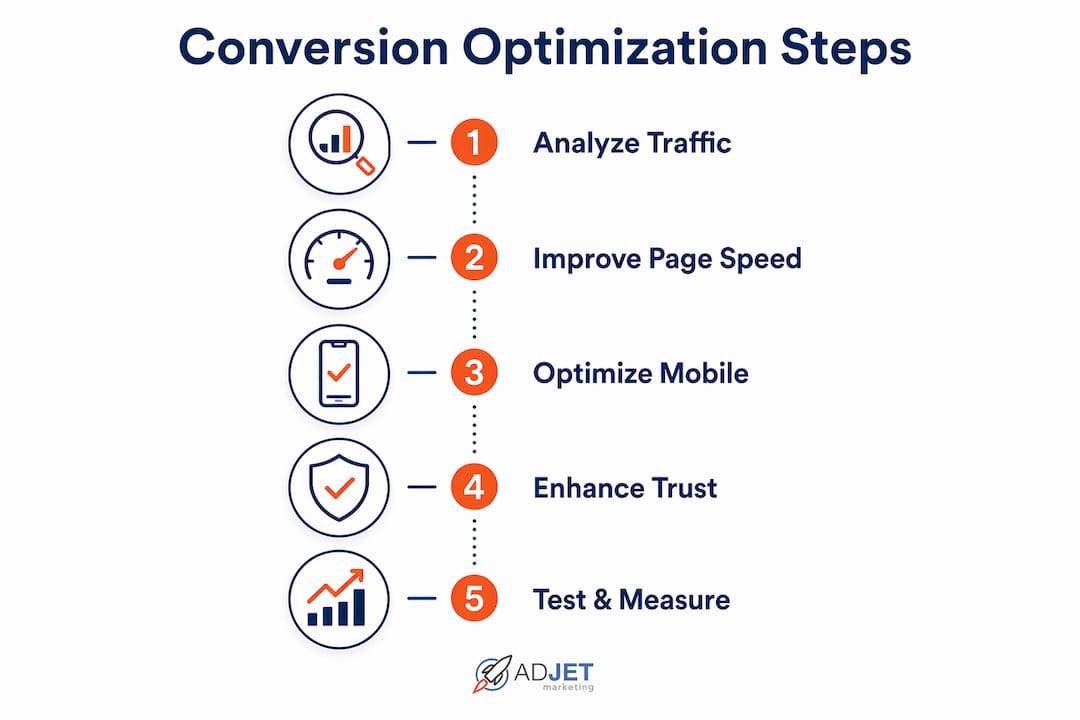
The highest-impact conversion elements on a real estate website are calls to action, page speed, mobile experience, and trust signals. Getting these right does not require a full redesign. It requires understanding what visitors need at each stage of their decision.

Calls to action
CTA placement and copy directly determine whether a visitor takes the next step. CTA optimization tests show a 35% win rate, meaning more than one in three tests produces a measurable lift. The most effective CTAs use specific language tied to visitor intent. “See homes in [neighborhood]” outperforms “Contact us” because it matches what the visitor is already thinking.
- Place the primary CTA above the fold on every key page
- Use action verbs tied to the visitor’s goal, not the agent’s goal
- Test button color, copy, and position separately, not simultaneously
- Avoid multiple competing CTAs on a single page
Page speed and Core Web Vitals
Site speed is a direct conversion driver. Each second of delay can reduce conversion by 12–18%, and Google research shows 53% of mobile visitors abandon pages that load slower than 3 seconds. Real estate sites are especially vulnerable because they often carry large listing images, IDX plugins, and third-party scripts that compound load time.
Mobile experience
Mobile visitors now represent the majority of real estate web traffic. A site that works well on desktop but poorly on a phone loses a significant portion of its audience before they ever see a listing. Mobile-specific issues include oversized tap targets, text that requires zooming, and forms that are difficult to complete on a small screen.
Pro Tip: Run your site through Google PageSpeed Insights and focus on the mobile score first. A score below 50 signals serious friction for the majority of your visitors.
Trust signals
Testimonials, Google reviews, local market statistics, and agent credentials all reduce the hesitation a visitor feels before submitting a form. Trust signals work best when they appear near conversion points, not buried in a sidebar or footer. A single well-placed client review next to a contact form can meaningfully increase form completions.
How can content and site architecture improve lead quality?
Real estate websites are better structured as decision-making systems than digital brochures. The goal is not to display inventory. The goal is to guide a specific type of visitor, whether buyer, seller, or investor, toward a specific action.
Neighborhood pages vs. listing pages
The conversion difference between page types is significant. Neighborhood landing pages convert at 4–7%, while listing detail pages convert at only 0.5–1.5%. Agent bio pages, when optimized with video and reviews, convert at 3–5%. This data points to a clear priority: invest in neighborhood and agent content before adding more listings.
| Page type | Typical conversion rate | Primary conversion driver |
|---|---|---|
| Neighborhood landing page | 4–7% | Local expertise, community content |
| Agent bio page (optimized) | 3–5% | Video, reviews, personal credibility |
| General listing detail page | 0.5–1.5% | Property specifics, IDX search |
Neighborhood pages work because they answer the question a buyer is actually asking: “Is this the right area for me?” A listing page answers a different question: “What are the specs of this property?” Visitors who are still in the area-selection phase need neighborhood content, not a property grid.
Routing visitors by intent
Segmenting your site by visitor type reduces friction and improves lead quality. A buyer researching schools in a specific zip code has different needs than a seller wanting a home valuation. Build separate entry points for each audience and route them accordingly.
- Create a “Buyers” section with neighborhood guides, school data, and market trends
- Create a “Sellers” section with valuation tools, recent sales data, and agent credentials
- Use homepage hero messaging that lets visitors self-select their path
Staged forms and message matching
Long forms kill conversions. A two-step form, where the first step asks only one or two questions, increases completion rates because the visitor has already committed before seeing the full form. Conversion architecture mismatches such as sending targeted ad traffic to generic pages destroy conversion rates. If your Google Ad targets “3-bedroom homes in Austin,” the landing page must show exactly that. Any disconnect between ad copy and page content creates doubt and raises bounce rates.
Pro Tip: Match the headline of every landing page to the exact ad or campaign that drives traffic to it. Word-for-word alignment between ad and page is the single fastest way to lift paid campaign conversions.
What testing practices improve real estate website conversions?
Systematic testing is the only reliable way to know what actually works on your specific site with your specific audience. Opinions and best practices are starting points. Data from your own visitors is the answer.
Starting with A/B testing
A/B testing compares two versions of a single element to determine which performs better. Multi-variable testing, where you change several elements at once, is less effective early on because it makes it impossible to identify which change drove the result. Start with one variable at a time.
The recommended test priority order for real estate sites:
- Hero section headline and CTA copy. This is the first thing visitors see and the highest-leverage test.
- CTA button placement and color. Small changes here often produce measurable lifts quickly.
- Mobile form layout. Simplifying the mobile form experience frequently reduces drop-off.
- Landing page headline alignment. Test whether matching ad copy to page headline improves paid traffic conversions.
- Trust signal placement. Move testimonials closer to CTAs and measure the effect.
Landing page tests have the highest conversion win rate at 50%, beating CTA-only or form-only changes. This means if your paid campaigns are underperforming, audit the landing page before adjusting ad spend.
Measurement beyond form submissions
Form submissions are a starting metric, not the final measure of success. Lead-to-appointment rates rise significantly with fast follow-up under 5 minutes and context-rich handoffs. Track what happens after the form is submitted. A site generating 100 leads per month that converts 10 into appointments outperforms a site generating 200 leads that converts 5.
Segmenting conversion data by traffic source is equally important. PPC visitors, organic search visitors, and referral visitors behave differently and convert at different rates. One blended average conversion rate hides the real story. Measure each source separately.
Pro Tip: Set up Google Analytics 4 goals for form submissions, phone call clicks, and map direction requests. Real estate leads often call before they fill out a form, and that behavior is invisible without proper tracking.
How does site performance reduce visitor drop-off?
A fast, well-structured site removes friction. A slow, cluttered site creates it. The technical side of real estate website performance is where many agents lose leads they never knew they had.
Speed fixes that move the needle
The most common causes of slow real estate sites are large uncompressed images, too many plugins, and shared hosting that cannot handle traffic spikes. The fixes are straightforward:
- Compress all listing images before uploading, targeting files under 200KB
- Use a caching plugin to serve static versions of pages to repeat visitors
- Lazy-load images below the fold so the page renders before all images download
- Defer non-critical JavaScript so the browser loads interactive elements last
Deferring non-critical JavaScript and lazy-loading IDX iframes can move a site’s Lighthouse mobile score from the 20s to the 70s. That improvement translates directly into lower bounce rates and higher conversion rates.
IDX integration done right
IDX search is a useful feature, not a homepage strategy. Prioritizing IDX on the homepage causes higher bounce rates because visitors arrive to a wall of generic inventory before they have any reason to trust the agent. IDX works best as a secondary feature, accessible after the visitor has engaged with neighborhood content or an agent bio.
Treat IDX as a tool visitors reach after they trust you, not as the first impression you make. Build your homepage around your expertise, your market knowledge, and your value to the client. Then offer the search tool as a next step.
Simplified navigation
Navigation with too many options forces visitors to make decisions before they are ready. Limit your main navigation to five or six items. Prioritize the paths that lead to conversion: neighborhood guides, agent bio, home valuation, and contact. Every additional menu item dilutes attention and increases the chance a visitor leaves without acting.
Key Takeaways
Real estate website conversions improve most when agents prioritize content architecture, page speed, and systematic testing over simply driving more traffic.
| Point | Details |
|---|---|
| Neighborhood pages convert best | Pages focused on local areas convert at 4–7%, far above generic listing pages at 0.5–1.5%. |
| Speed directly affects leads | Each second of load delay reduces conversions by 12–18%; fix images and JavaScript first. |
| Match ads to landing pages | Sending ad traffic to a mismatched page kills conversions; align headline copy exactly. |
| Test one variable at a time | A/B test hero copy, CTAs, and forms separately to identify what actually drives improvement. |
| Measure by traffic source | Blended conversion averages hide performance gaps; segment data by PPC, SEO, and referral. |
What most agents get wrong about their website
From working on real estate marketing projects, the pattern I see most often is agents who invest heavily in traffic while ignoring the site those visitors land on. They spend money on Google Ads, generate clicks, and then wonder why the leads are thin. The answer is almost always the landing page.
The second most common mistake is treating IDX as the centerpiece of the site. I understand the instinct. Agents want visitors to search listings. But a visitor who lands on a generic property grid has no reason to contact you specifically. They can get the same grid from any portal. What they cannot get anywhere else is your knowledge of the neighborhood, your track record, and your specific value as an agent. Lead with that.
The agents who see the best results from their websites are the ones who think about the site as a system. They ask: “What does a buyer in the early research phase need to see? What does a seller ready to list need to feel confident about?” Then they build pages that answer those questions before asking for anything in return. That approach, combined with consistent A/B testing and fast follow-up on every lead, is what separates a 2.9% conversion rate from a 5.6% one.
You do not need a bigger traffic budget. You need a site that earns the leads your current traffic is already capable of generating.
— Felix
How Adjetmarketing helps real estate agents convert more leads
Adjetmarketing works with real estate agents to build and manage websites that are designed around conversion from the ground up. That means neighborhood pages built for local search intent, landing pages aligned with paid campaigns, and real estate lead generation strategies grounded in data, not guesswork. The team handles technical performance, page structure, and Google Ads management so agents can focus on clients rather than code. If your site is generating traffic but not enough qualified inquiries, the issue is almost always fixable. Adjetmarketing’s Google Ads management and website optimization services are built specifically for agents who want measurable results from their digital presence.
FAQ
What is conversion optimization in real estate?
Conversion optimization in real estate is the process of improving website elements, such as CTAs, page speed, and content structure, to turn more visitors into qualified leads. It focuses on systematic testing and user experience rather than simply increasing traffic.
What is a good conversion rate for a real estate website?
The average real estate website converts at approximately 2.9%, while top-performing sites reach 5.6% or higher. Rates vary significantly by traffic source, with PPC and referral traffic typically converting differently than organic search visitors.
Which pages convert best on a real estate website?
Neighborhood landing pages convert at 4–7%, making them the highest-performing page type. Agent bio pages optimized with video and reviews convert at 3–5%, while generic listing detail pages convert at only 0.5–1.5%.
How does page speed affect real estate lead generation?
Each second of page load delay can reduce conversions by 12–18%. Compressing images, deferring JavaScript, and using caching are the fastest ways to improve speed and reduce visitor drop-off.
Should IDX search be the main feature on a real estate homepage?
IDX search works best as a secondary feature, not the homepage centerpiece. Prioritizing IDX before trust-building content causes higher bounce rates because visitors have no reason to contact that specific agent over any other source.