









Most clinic owners assume digital marketing means running a few Facebook posts or boosting an ad when the schedule gets slow. That assumption is costing you patients every single day. Digital marketing in healthcare is a structured, multi-channel system that combines search visibility, paid advertising, reputation management, and strict compliance requirements. When you understand how each piece works together, you can attract more qualified patients, build lasting trust in your community, and grow your practice without putting it at legal risk. This guide covers everything you need to know.
Table of Contents
- What is digital marketing for healthcare?
- Digital marketing channels and strategies in clinics
- Compliance and privacy: Digital marketing’s non-negotiable rules
- The power of reputation: Reviews, trust, and patient decision-making
- How to measure digital marketing ROI in healthcare
- A truth most clinics miss: Digital marketing is not a “set it and forget it” tool
- Ready to elevate your clinic with proven digital marketing?
- Frequently asked questions
Key Takeaways
| Point | Details |
|---|---|
| Multi-channel is essential | Using more than one channel increases patient reach and builds trust. |
| Compliance protects your clinic | Strict HIPAA rules apply to all online marketing—ignore them at your peril. |
| Reputation drives growth | Your online reviews and patient responses often decide if new patients choose your clinic. |
| ROI is measurable | Track leads, bookings, and revenue from each marketing channel to understand true results. |
| Consistency beats quick wins | Long-term adaptation and monitoring always outperform “set and forget” tactics. |
What is digital marketing for healthcare?
Digital marketing is not one thing. It is a collection of online strategies that work together to connect your practice with patients who are actively searching for the care you provide.
As Forbes defines it, “digital marketing” is the practice of promoting businesses, products, or services using online channels such as search engines, social media, email, websites, and paid advertising. In healthcare, that definition carries extra weight. Every channel you use must protect patient privacy, maintain trust, and comply with federal regulations like HIPAA (Health Insurance Portability and Accountability Act).
“Healthcare marketing is not just about reach. It is about reaching the right patient, with the right message, in a way that protects their privacy and earns their trust.”
For clinics, digital marketing covers six core channels:
- Search engine optimization (SEO): Ranking your website organically when patients search for services like “botox near me” or “pain management clinic in [city]”
- Paid advertising: Running Google Ads or Meta ads to appear at the top of search results or social feeds
- Website design and conversion: Building a site that loads fast, explains your services clearly, and converts visitors into booked appointments
- Social media: Sharing educational content, patient success stories (with consent), and practice updates to build community trust
- Email marketing: Sending appointment reminders, health tips, and promotions to existing patients
- Reputation management: Actively monitoring and responding to online reviews across Google, Healthgrades, and Yelp
Each channel plays a different role in the patient journey. Explore key healthcare strategies to see how these channels fit into a complete growth plan. If you run a surgical practice, the approach shifts further, as outlined in our guide to digital marketing for surgeons. You can also find real-world healthcare marketing stories that show how clinics have applied these principles effectively.
Digital marketing channels and strategies in clinics
With a clear definition in mind, here is how top practices use each digital channel, and what to watch out for in your clinic.

The table below gives you a fast comparison of the five major channels across the factors that matter most to clinic owners.
| Channel | Estimated monthly cost | Effort level | Patient targeting | HIPAA risk level |
|---|---|---|---|---|
| SEO | $500 to $3,000+ | High (ongoing) | Broad to local | Low |
| Google Ads | $1,000 to $10,000+ | Medium | High intent | Low to medium |
| Social media | $300 to $2,000+ | Medium | Interest-based | Medium |
| Email marketing | $100 to $500+ | Low to medium | Existing patients | High |
| Website design | $2,000 to $10,000 (one-time) | High (setup) | All visitors | Low |
As digital marketing continues to expand across every industry, clinics that use multiple channels consistently outperform those that rely on a single tactic. Here is a step-by-step process to match channels with your clinic’s actual goals.
- Define your primary goal. Are you trying to fill a new service, grow your patient base, or retain existing patients? Your goal determines which channels to prioritize first.
- Audit your current online presence. Check your Google Business Profile, website speed, and existing review count before spending on ads.
- Start with owned channels. Optimize your website and local SEO before investing in paid traffic. Traffic without a converting website is wasted money.
- Layer in paid advertising. Once your site converts well, Google Ads can accelerate patient acquisition quickly. Review our clinic marketing guide for a detailed walkthrough.
- Add social and email. Use social media to build awareness and trust. Use email to retain and re-engage existing patients.
- Track everything. Set up conversion tracking from day one so you know which channels are producing real bookings.
Our healthcare SEO tactics guide goes deeper on step three. For aesthetic practices specifically, our medspa marketing strategies article covers channel prioritization in detail.
Pro Tip: Never rely on a single channel. If Google changes its algorithm or Meta restricts your ad account, a multi-channel approach protects your patient pipeline. Clinics with three or more active channels recover from disruptions far faster than those running a single campaign.
Compliance and privacy: Digital marketing’s non-negotiable rules
Before you launch any campaigns, you need to know: healthcare marketing has unique legal responsibilities that most general marketing agencies overlook entirely.
HIPAA applies to your marketing. Full stop. Any time your digital marketing touches protected health information (PHI), which includes patient names, IP addresses combined with health conditions, appointment data, or any identifier that could reveal someone’s health status, you are in regulated territory.
Here are the compliance essentials every clinic must follow:
- Tracking pixels: Tools like the Meta Pixel or Google Tag can capture PHI through URL paths and IP addresses. For example, if a patient visits a page titled “/hiv-treatment-consultation,” that page visit combined with their IP address can constitute PHI. You must configure these tools carefully or use cookieless remarketing tips to avoid exposure.
- Retargeting campaigns: Retargeting requires de-identification of any patient data used to build audiences. You cannot upload a patient email list to Meta and run health-related ads to that list without violating HIPAA.
- Email and SMS marketing: All patient communications that include health information must be encrypted. Sending appointment reminders with diagnosis details in plain text is a violation.
- Meta advertising: No health targeting on Meta; retargeting needs de-identification; email/SMS must encrypt PHI. Meta explicitly prohibits using health conditions as targeting criteria, and clinics have faced significant fines for violating this rule.
- Business Associate Agreements (BAAs): Any vendor that touches PHI on your behalf, including your email platform, CRM, or analytics tool, must sign a BAA with your practice.
The financial consequences of a PHI breach are serious. HIPAA fines range from $100 to $50,000 per violation, with annual caps reaching $1.9 million per violation category. Beyond fines, a public breach destroys patient trust in ways that no ad budget can repair.
Pro Tip: Before launching any new campaign, run a compliance checklist. Confirm that tracking pixels are configured to exclude PHI, all patient-facing emails are encrypted, and your marketing vendors have signed BAAs. Our guide to compliant healthcare advertising walks through this process step by step.
The power of reputation: Reviews, trust, and patient decision-making
Beyond ads and content, your reputation is often the deciding factor for new patients.
When a prospective patient searches for your clinic, the first thing they check after your website is your reviews. A clinic with 12 reviews averaging 3.8 stars loses patients to a competitor with 85 reviews averaging 4.7 stars, even if your clinical outcomes are superior. That is a hard truth, but it is the reality of how patients make decisions online.
“Weak online profiles lose patients to competitors before those patients ever contact the clinic. Reputation is not a soft metric. It is a direct driver of patient acquisition.” Clinic Marketing Strategies
The data below illustrates the real-world difference reputation makes for clinics.
| Metric | Clinics with strong reviews | Clinics with weak reviews |
|---|---|---|
| Average Google rating | 4.5 to 5.0 stars | 3.0 to 3.9 stars |
| Monthly new patient inquiries | 40 to 80+ | 10 to 25 |
| Conversion rate from profile visits | 15 to 25% | 3 to 8% |
| Year-over-year patient growth | 20 to 40% | Flat or declining |
Here is how to build and protect your online reputation consistently:
- Ask every satisfied patient for a review. Train your front desk staff to request Google reviews at checkout. A simple verbal ask, combined with a follow-up text link, dramatically increases review volume.
- Respond to every review, positive and negative. Thank patients for positive feedback. For negative reviews, respond professionally and never include any clinical details. A HIPAA-safe response acknowledges the concern and invites the patient to call the office directly.
- Monitor your profiles weekly. Set up Google Alerts for your clinic name and check Healthgrades, Yelp, and Zocdoc regularly. Unmonitored profiles with unanswered negative reviews signal neglect to prospective patients.
- Correct inaccurate information immediately. Wrong hours, outdated phone numbers, or incorrect addresses on your Google Business Profile cost you appointments every day.
For a detailed action plan, our online reputation tips guide covers the full process. You can also review reputation guidance for doctors for additional perspective on managing your digital presence professionally.
How to measure digital marketing ROI in healthcare
Once your digital marketing is in motion, how do you know it is working, and what should you fix if it is not?
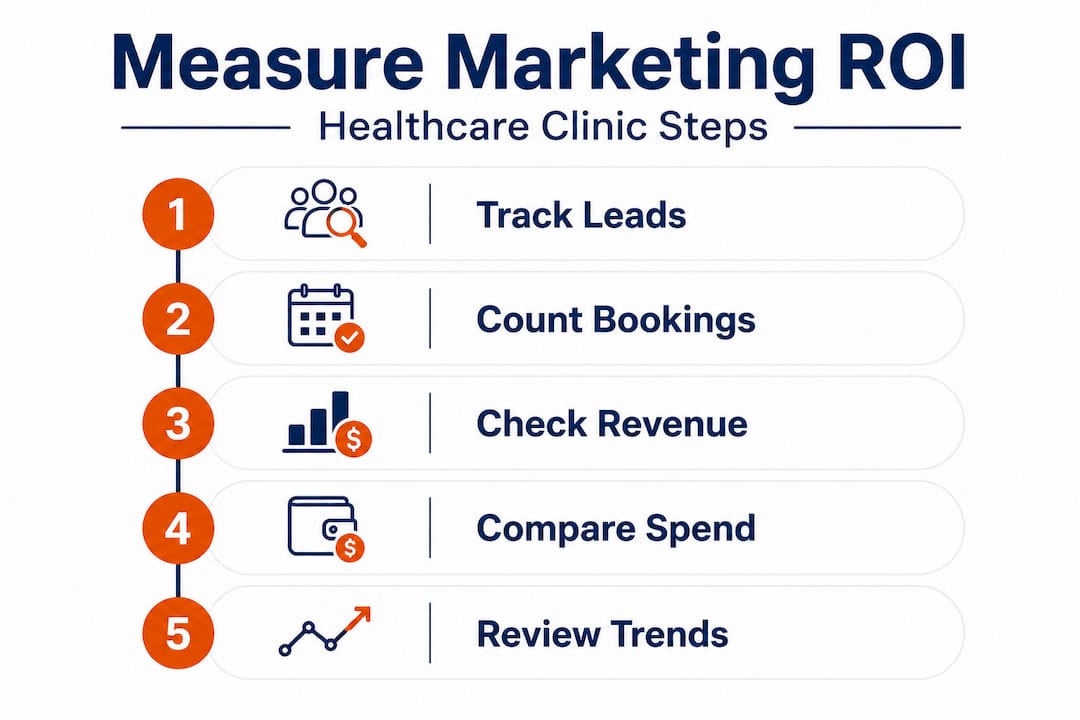
ROI in digital marketing means one thing: are you generating more revenue from new patients than you are spending on marketing? A simple example: if you spend $3,000 per month on Google Ads and those ads generate 15 new patients who each spend $400 on their first visit, your gross return is $6,000. That is a 2x return before accounting for lifetime patient value, which in many specialties can be 5 to 10 times the initial visit value.
Here is a step-by-step process for tracking your results accurately.
- Set up conversion tracking. Install Google Analytics 4 and configure goal completions for phone calls, form submissions, and appointment bookings. Without this, you are guessing.
- Use call tracking software. Tools like CallRail assign unique phone numbers to each marketing channel, so you know exactly which ad or page generated a call.
- Track leads to appointments. Connect your marketing data to your practice management system. Know how many leads from each channel actually became booked patients.
- Calculate cost per acquisition (CPA). Divide your total monthly marketing spend by the number of new patients acquired. Compare this to your average patient lifetime value.
- Review data monthly, not daily. Digital marketing results fluctuate week to week. Monthly reviews reveal real trends and give campaigns enough time to optimize.
- Benchmark against your specialty. Review healthcare marketing benchmarks to understand what realistic performance looks like for your clinic type.
As digital marketing channels continue to evolve, the clinics that measure consistently are the ones that improve consistently. If results lag expectations after 60 to 90 days, audit your landing pages first. Poor conversion rates on your website are almost always the root cause of underperforming campaigns.
Pro Tip: Focus on trends over time, not individual weeks. A campaign that looks slow in week two might be your top performer by month three. Give strategies time to gather data before making major changes.
A truth most clinics miss: Digital marketing is not a “set it and forget it” tool
We work with clinic owners across specialties, and the pattern we see most often is this: a practice invests in digital marketing for 60 to 90 days, sees uneven results, and pulls back. Then they wonder why their competitors keep growing.
Digital marketing is not a one-time project. It is an ongoing operational function, the same way patient care protocols are updated regularly. The clinics that generate consistent ROI are not the ones with the biggest ad budgets. They are the ones that show up every month, review their data, adjust their messaging, and stay ahead of compliance changes.
Here is what that looks like in practice. The best-performing clinics we work with do three things consistently. They monitor their compliance setup every time a platform updates its tracking tools, because what was compliant last quarter may not be compliant today. They test new content and ad creative regularly, because patient preferences shift and what resonated six months ago may not convert now. And they keep reputation management as a standing agenda item, not an afterthought.
The stakes in healthcare are also categorically different from retail or e-commerce. A single PHI breach does not just result in a fine. It can trigger a federal investigation, generate local news coverage, and permanently damage the trust you have built with your patient community. Shortcuts that work in other industries simply do not apply here.
We also encourage clinic owners to stay current with 2026 marketing trends in healthcare, because the regulatory and technology landscape changes faster than most practices realize. Staying informed is not optional. It is part of running a compliant, competitive practice.
The clinics that treat digital marketing as a living system, one that requires regular attention, honest measurement, and a genuine commitment to patient trust, are the ones that build sustainable growth. That is the standard we hold ourselves to, and the standard we encourage every clinic owner to adopt.
Ready to elevate your clinic with proven digital marketing?
Strategic digital marketing transforms how clinics attract, convert, and retain patients. But it only works when strategy, compliance, and execution are aligned. Understanding why marketing matters in healthcare is the first step. From there, building a strong foundation in SEO for healthcare and scaling with advanced medical spa SEO gives your practice a measurable, compounding advantage. At AdJet Marketing, we build and manage compliant, high-performing digital marketing systems for medical clinics and aesthetic practices. If you are ready to stop guessing and start growing, let us show you what a structured approach can do for your patient pipeline.
Frequently asked questions
Can healthcare clinics use Google or Facebook ads safely?
Yes, clinics can use these platforms, but must avoid health-based targeting and ensure no PHI is captured or exposed, as health targeting on Meta is prohibited and retargeting requires de-identification.
What’s the first digital marketing tactic a new clinic should try?
Start by optimizing your website, local SEO, and online reputation profiles before investing in paid ads, since digital marketing channels like search engines and websites deliver the most durable returns when built first.
How do clinics measure ROI from digital marketing?
Track new patient leads, bookings, and revenue from each digital channel against your total marketing spend, since digital marketing is most effective when results are measured consistently over time.
Why do some clinics lose patients online despite advertising?
Weak online profiles lose patients to competitors before those patients ever make contact, meaning poor review volume or low ratings can override even well-funded ad campaigns.
Is HIPAA compliance needed for clinic email campaigns?
Absolutely. Email and SMS must encrypt PHI, and plain-text messages containing any patient health information are a direct HIPAA violation regardless of intent.
Recommended
- Mastering Google Ads For Dental Clinics: A Comprehensive Guide – AdJet Digital Marketing & Google Partner Agency | SEO Development Google Ads Social
- Guide To Effective Healthcare SEO
- Online Marketing For Dentists: A Beginner’s Guide | Dental Marketing
- Choosing The Best Digital Marketing Agency For Your Dental Clinic – AdJet Digital Marketing & Google Partner Agency | SEO Development Google Ads Social
- Choosing an Online Weight Care Clinic | RenewMD