









Medical marketing is the targeted promotion of healthcare services designed to increase patient volume, build trust, and educate communities about health risks and treatment options. Unlike general advertising, it operates within a framework of ethical standards, regulatory compliance, and patient psychology that most industries never encounter. Clinic owners and medical professionals who understand why choosing medical marketing matters gain a measurable edge: more booked appointments, stronger community presence, and a practice that grows with intention rather than by accident. This guide breaks down the core benefits, the strategies that work, and what separates effective healthcare promotion from wasted spend.
Why choose medical marketing to grow patient volume and revenue
The financial case for healthcare marketing is concrete. Integrated healthcare marketing that connects clinical and operational teams can generate $16 in attributable revenue for every $1 spent within six months, producing over 7,000 new patients and 70,000 verified visits. That is not a theoretical return. It reflects what happens when marketing stops functioning as a branding exercise and starts operating as a growth function tied to real patient data.
The same approach produced a 60% increase in unaided brand awareness within that six-month window. Brand awareness matters in healthcare because patients rarely choose a provider on impulse. They research, compare, and return to names they recognize. A practice with strong visibility earns consideration before a competitor even enters the conversation.

Revenue recovery is another underappreciated benefit. One regional health system recovered millions in annual revenue by identifying referral leakage patterns through marketing data connected to claims analysis. Patients were leaving the network for follow-up care, and no one knew until marketing tools made it visible. That kind of insight turns marketing from a cost line into a financial protection mechanism.
Pro Tip: Track downstream revenue, not just new patient volume. Referral retention and repeat visits often represent more total revenue than first-time appointments.
Marketing also guides patients through the decision process. A clinic that publishes clear information about procedures, recovery timelines, and expected outcomes reduces the friction between awareness and booking. Patients arrive better informed, which shortens consultation time and increases conversion rates.
How ethical marketing builds patient trust and public health awareness
Ethical healthcare advertising increases patient trust and encourages early screening and treatment, particularly for stigmatized health conditions like depression, anxiety, erectile dysfunction, osteoporosis, diabetes, and several cancers. This is one of the most undervalued benefits of medical promotion. When patients see a condition discussed openly and professionally, they feel less shame about seeking care. That shift in perception directly increases appointment volume for conditions that patients previously avoided addressing.
The Coalition for Healthcare Communication frames this clearly: marketing is not separate from clinical care. It is a delivery mechanism for clinical value. Patients who receive accurate, accessible health information through marketing are more likely to act early, which leads to better outcomes and lower long-term treatment costs.
Marketing establishes medical organizations as thought leaders aligned with Google’s E-E-A-T principles, which stand for Experience, Expertise, Authoritativeness, and Trustworthiness. Search engines reward content that demonstrates these qualities. A practice that publishes well-sourced, clinically accurate content ranks higher, attracts more organic traffic, and builds credibility with both patients and referring physicians.
Effective educational marketing covers:
- Condition awareness: Explaining symptoms, risk factors, and when to seek care
- Treatment transparency: Describing procedures, expected outcomes, and realistic timelines
- Prevention content: Offering guidance on lifestyle factors that reduce disease risk
- Community health campaigns: Aligning with public health priorities from bodies like the WHO and CDC
“The perception of conflict between marketing and clinical care is false. Ethical marketing acts as a clinical value delivery mechanism, ensuring patients receive the resources they need to make informed decisions.”
This framing matters for clinic owners who feel uncomfortable with promotion. Marketing done correctly does not compromise clinical integrity. It extends it.
Why specialized medical marketing agencies outperform generalist teams
Generalist marketing agencies often fail to understand healthcare’s high-stakes decision-making environment, making dedicated medical marketing agencies the more effective choice for compliant, results-driven strategies. The gap is not about creativity or technical skill. It is about context. A generalist team optimizing a Google Ads campaign for a pain clinic may inadvertently use ad copy that violates HIPAA guidelines or triggers a platform policy rejection. A specialized agency knows these boundaries before the campaign launches.
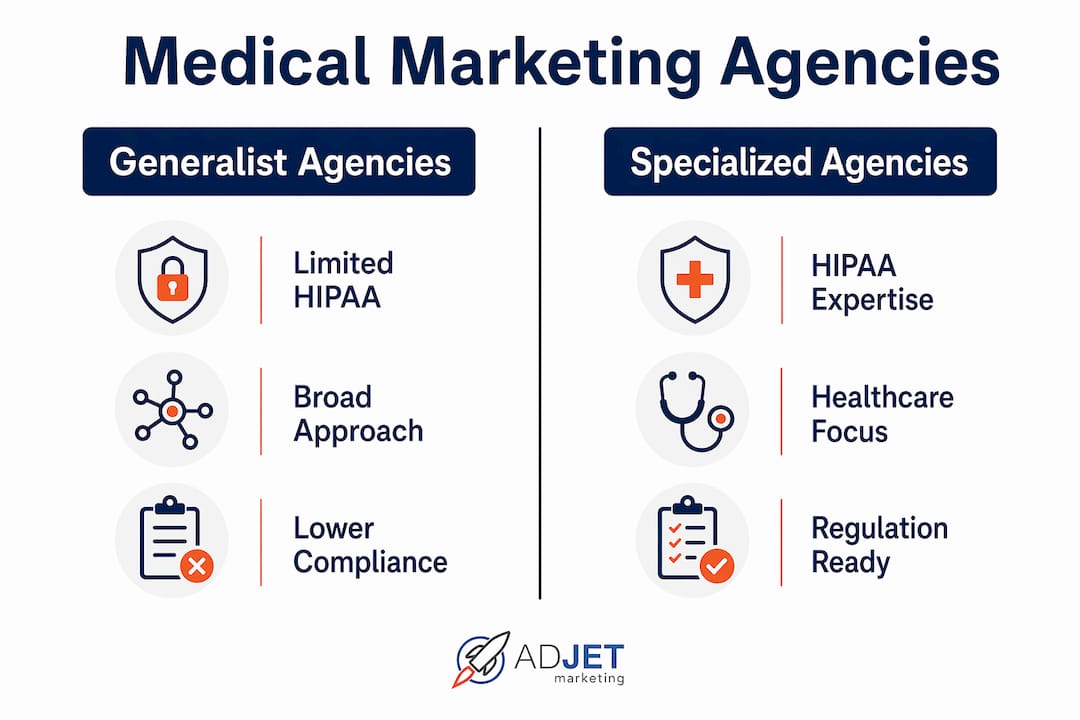
Healthcare marketing must comply with HIPAA and related regulations, and navigating those requirements demands specific knowledge that generalist teams rarely carry. Mistakes in this area are not just costly in terms of wasted budget. They can result in regulatory penalties and reputational damage that takes years to repair.
Patients also make healthcare decisions differently than they make consumer purchases. Patients make high-stakes, deliberate decisions over extended timeframes, which means impulse-based marketing tactics do not work. A specialized agency builds nurturing sequences, retargeting strategies, and content funnels that match how patients actually research and decide. That alignment between patient psychology and marketing strategy is what produces consistent appointment volume rather than unpredictable spikes.
| Approach | Generalist agency | Specialized medical agency |
|---|---|---|
| HIPAA compliance knowledge | Limited or absent | Built into every campaign |
| Patient decision-cycle awareness | Impulse-based tactics | Long-term nurturing strategies |
| Healthcare data integration | Rarely available | EMR and referral data integration |
| Industry-specific ad copy | Generic messaging | Clinically accurate, compliant language |
Pro Tip: Before hiring any marketing agency, ask specifically how they handle HIPAA-compliant tracking and what their process is for reviewing ad copy against healthcare advertising guidelines.
Specialized agencies also bring existing relationships with healthcare-specific platforms, data vendors, and compliance tools. That infrastructure takes years to build. Hiring a generalist team means paying for their learning curve with your budget and your patients.
Core medical marketing strategies that deliver results in 2026
Integrated digital marketing strategies across SEO, Google Ads, and content marketing increase clinic visibility and patient engagement in competitive healthcare markets. No single channel dominates. The practices that grow consistently use a coordinated approach where each channel reinforces the others.
The most effective combination in 2026 follows this structure:
- SEO (Search Engine Optimization): Targets patients actively searching for your services. A well-optimized clinic website ranks for condition-specific and location-based queries, producing consistent organic traffic without ongoing ad spend.
- Google Ads (PPC): Captures high-intent patients at the moment of search. Paid search for medical clinics delivers fast visibility and measurable cost-per-lead data, making it the fastest path to new appointments.
- Content marketing: Builds authority over time. Blog posts, procedure pages, and FAQ content address patient questions before they ever call, which increases trust and reduces the sales friction at the front desk.
- Social media: Maintains visibility between patient visits and supports referral generation through shareable health content.
- Conversion optimization: Ensures that traffic from every channel actually turns into booked appointments. A well-designed landing page with a clear call to action can double conversion rates without increasing ad spend.
Data-driven healthcare marketing integrates EMR systems and referral claims data to monitor patient acquisition and retention, enabling precise ROI measurement and strategic growth decisions. This is the difference between knowing your ads ran and knowing your ads produced revenue. When marketing data connects to clinical data, you can see which campaigns generated patients who completed treatment, not just patients who called.
Digital platforms that improve healthcare admissions efficiency also play a role here. Intake processes that connect to marketing funnels reduce drop-off between inquiry and first appointment, which directly improves the return on every marketing dollar spent.
Key Takeaways
Medical marketing is a measurable growth function, not a branding expense, and practices that treat it as such consistently outperform those that do not.
| Point | Details |
|---|---|
| ROI is measurable and significant | Integrated healthcare marketing can return $16 for every $1 spent within six months. |
| Ethical marketing improves outcomes | Addressing stigmatized conditions through advertising increases early treatment rates and patient trust. |
| Specialized agencies reduce compliance risk | Healthcare-specific agencies understand HIPAA, patient psychology, and clinical data integration. |
| Multi-channel strategies outperform single-channel | SEO, Google Ads, content, and conversion optimization work together to produce consistent patient volume. |
| Data integration unlocks revenue recovery | Connecting marketing to EMR and referral data reveals leakage patterns and protects downstream revenue. |
What I’ve learned after years of working with medical practices
The clinics that come to us after working with generalist agencies share a common frustration. They spent real money, saw some traffic, and booked very few patients. The problem was almost never the budget. It was the strategy. Generic ad copy, landing pages built for clicks rather than conversions, and no understanding of how a patient actually decides to book an appointment.
What I’ve found is that medical marketing works when it respects the patient’s decision process. A person researching a pain management clinic is not buying a product. They are making a decision about their body, their time, and often their finances. That requires a different kind of marketing. It requires content that answers real questions, ads that speak to real concerns, and a website that earns trust before it asks for a phone number.
The other thing I’ve seen consistently is that practices underestimate the value of referral retention. New patient acquisition gets all the attention, but a clinic that loses 20% of its referrals to competing providers is leaving significant revenue on the table every month. Marketing data, when connected to claims and referral patterns, makes that leakage visible and fixable. That is not a marketing insight. It is a clinical operations insight delivered through marketing tools.
My honest advice: treat marketing as a function that sits alongside clinical operations, not below it. The practices that grow sustainably in 2026 are the ones where the marketing team understands the clinical workflow and the clinical team understands what marketing data reveals. That alignment is rare, but it is the difference between a practice that grows and one that stays flat.
— Felix
How Adjetmarketing supports healthcare providers with specialized marketing
Adjetmarketing works exclusively with medical clinics, aesthetic practices, mental health therapists, pain management providers, and related healthcare businesses. As a Google Partner agency, Adjetmarketing builds and manages SEO campaigns, Google Ads accounts, and high-converting websites designed specifically for patient acquisition. Every campaign is built with HIPAA compliance in mind and tracked against real appointment data, not vanity metrics. If you want to understand why marketing matters for your practice or avoid the most common healthcare marketing mistakes, Adjetmarketing provides the expertise and infrastructure to get there without the trial-and-error cost of working with a generalist team.
FAQ
What is medical marketing?
Medical marketing is the targeted promotion of healthcare services to attract patients, build trust, and educate communities about health conditions and treatment options. It operates within regulatory frameworks including HIPAA and ethical advertising standards.
Why invest in medical marketing instead of relying on referrals?
Referrals alone leave practices vulnerable to leakage and competitive loss. Marketing data connected to referral claims analysis can identify and recover that lost revenue while also generating new patient volume through digital channels.
How does healthcare marketing differ from general marketing?
Healthcare marketing requires HIPAA compliance knowledge, an understanding of long-cycle patient decision-making, and the ability to integrate with clinical data systems like EMRs. Generalist marketing approaches built for consumer purchases do not transfer effectively to medical contexts.
What digital channels work best for medical clinics?
SEO and Google Ads consistently deliver the highest ROI for medical clinics because they target patients at the moment of active search. Content marketing and conversion optimization support both channels by building trust and turning traffic into booked appointments.
How long does it take to see results from medical marketing?
Paid search campaigns can generate new patient inquiries within days of launch. SEO typically builds measurable organic traffic over three to six months. Integrated strategies that combine both channels produce the fastest and most sustainable growth.