









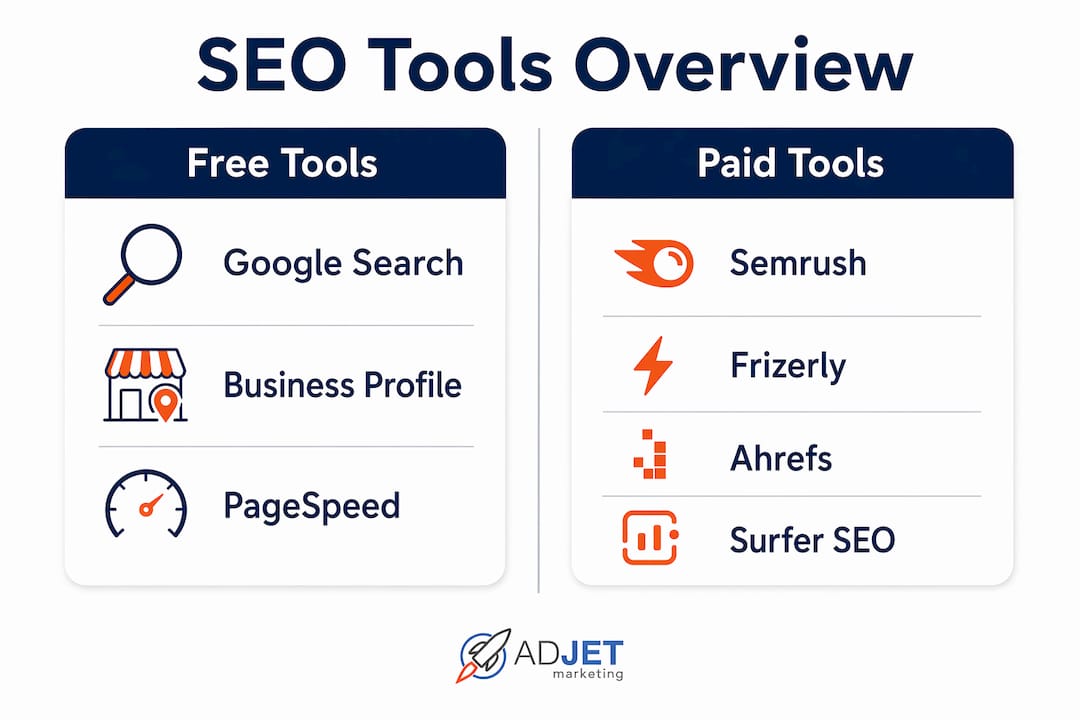
For most private psychiatry practices, the right starting stack is Google Search Console + Google Business Profile + one paid tool (Frizerly for content-first local growth, Semrush for full-site audits, or Ahrefs for competitive backlink research). If you are short on time or running multiple locations, Adjetmarketing’s done-for-you SEO service is the most direct path to measurable patient growth without building internal marketing capacity.
Here is the fast verdict on each tool:
- Frizerly — Best for local and healthcare-focused content automation; publishes E-E-A-T-aligned blog posts and FAQ schema weekly, designed specifically for therapists and private practice clinicians.
- Semrush — Best for complete site audits, keyword research, and local rank tracking; the most versatile paid tool for small-to-mid-size clinics.
- Ahrefs — Best for backlink analysis and competitive gap research; pairs well with GSC data to build local authority.
- Surfer SEO — Best for on-page content scoring; helps clinician-authored service pages align with SERP intent and E-E-A-T signals.
- Google Search Console (GSC) + PageSpeed Insights — Mandatory free tools; GSC is the only reliable source for query-level impressions and clicks, while PageSpeed Insights reports Core Web Vitals, a direct mobile ranking factor.
- Adjetmarketing — Best for practices that want agency-managed SEO, GBP optimization, schema implementation, and clinician-authored content without handling it in-house.
Quick decision cue: Solo practices should start with GSC, a verified Google Business Profile, and one low-cost content or local tool. Multi-location or high-growth practices should budget for Semrush or Ahrefs, or consider agency support. Your immediate next steps: claim and verify your GBP, connect your site to GSC, run a PageSpeed Insights test, and pick one paid tool to cover audits or content optimization.
Table of Contents
- How do the top SEO tools for psychiatry practices compare?
- What does each SEO tool actually do for your psychiatry practice?
- When should your psychiatry practice invest in a dedicated SEO tool?
- How do you choose the right SEO tool for your private psychiatry practice?
- A 7-step SEO framework for your psychiatry practice
- What does Google actually require for psychiatric content to rank well?
- Key Takeaways
- Why most psychiatry practices get SEO wrong (and what actually works)
- How Adjetmarketing helps private psychiatry practices grow online
How do the top SEO tools for psychiatry practices compare?
| Tool | Best for | Core features | Pricing | Ease of use | Integrations | Healthcare/YMYL support | Security notes | Support & training |
|---|---|---|---|---|---|---|---|---|
| Frizerly | Local & healthcare-focused content | Auto-published blog posts, keyword research, AI citation tracking, FAQ schema, competitor gap analysis | Paid plans (pricing not publicly listed per tier) | Low learning curve; managed setup | WordPress, Wix, Squarespace, SimplePractice | E-E-A-T-compliant content templates, FAQ structured data, therapy-specific keyword targeting | Focused on public-facing marketing data only; no PHI contact | Managed onboarding; team setup included |
| Semrush | Full site audits & keyword research | Site audit, keyword research, local rank tracking, backlink analysis, content marketplace | Free tier limited; paid plans from ~$140/mo | Moderate; dashboard-heavy but well-documented | GSC, GA4, GBP, WordPress, CMS plugins | Content templates, on-page SEO checker; no native physician schema builder | No HIPAA BAA; do not pass PHI through the platform | Live chat, onboarding guides, Semrush Academy |
| Ahrefs | Backlink & competitive research | Backlink explorer, site audit, keyword explorer, content gap, rank tracker | No free tier; paid plans from ~$129/mo | Moderate to steep; powerful but data-dense | GSC, GA4, WordPress | No healthcare-specific templates; strong for authority-building workflows | No HIPAA BAA; treat as a marketing analytics tool only | Help docs, Ahrefs Academy, email support |
| Surfer SEO | On-page content optimization | Content editor with SERP scoring, NLP analysis, audit tool, content planner | Paid plans from ~$99/mo | Low to moderate; content editor is intuitive | WordPress, Google Docs, Jasper | Content briefs support author fields; no native schema builder | No HIPAA BAA; marketing use only | Live chat, onboarding calls, template library |
| GSC + PageSpeed Insights | Primary diagnostic data (free) | Query-level impressions/clicks, Core Web Vitals, index coverage, mobile usability | Free | Low; Google-native UI | Native Google ecosystem (GA4, GBP, Search Console) | Google-origin data; no schema builder but flags structured data errors | Google’s standard data handling; no PHI should be processed | Google documentation, Search Central community |
| Adjetmarketing | Done-for-you agency SEO | GBP management, technical SEO, clinician-authored pages, schema, citation management, content workflows | Monthly retainer (custom quote) | No learning curve; fully managed | All major CMS, GSC, GBP, GA4, EHR-adjacent workflows | Clinician authorship workflows, schema implementation, medical-review signoffs, HIPAA-adjacent compliance guidance | Agency-level compliance guardrails; no PHI processed in marketing stack | Dedicated account management, strategy calls |
On budget: Solo practices typically spend nothing on Google tools plus a modest monthly fee on one paid tool. Mid-size clinics running content and audits in parallel often have moderate monthly tool expenses. Multi-location practices with active content programs and agency support typically allocate significant monthly budgets when factoring in managed services.
Your Google Business Profile is the single most critical local SEO asset for any psychiatry practice. Every tool in this table should connect to or inform your GBP strategy.
What does each SEO tool actually do for your psychiatry practice?

Frizerly
Frizerly is purpose-built for therapists and private practice clinicians, which makes it the most immediately relevant paid tool for most psychiatry practices. It auto-publishes weekly blog posts optimized for therapy and mental health keywords, structures content for E-E-A-T compliance, and generates FAQ schema that improves both Google rankings and AI citation visibility (ChatGPT, Gemini, Perplexity).
How it helps a psychiatry practice: Frizerly targets patient-intent keywords like “psychiatrist near me” and “anxiety treatment [city]” without requiring you to write content yourself. Its FAQ structured data directly supports the kind of question-and-answer format that Google surfaces in featured snippets for mental health queries.
Integrations: WordPress, Wix, Squarespace, SimplePractice, and custom-built sites. Managed setup means your team does not need to configure anything technical.
Healthcare/YMYL notes: Content is structured for E-E-A-T signals, but you should still add clinician attribution and medical-review metadata to each published post. Frizerly handles the content engine; the clinician byline is your responsibility.
Pricing: Paid plans (specific tier pricing is not publicly listed on the main pricing page; contact Frizerly for a quote).
Pros: Healthcare-specific content focus, low operational burden, AI citation tracking dashboard, FAQ schema automation.
Cons: Less suited for deep technical audits or backlink research; clinician authorship still requires manual input.
Semrush
Semrush is the most complete general-purpose SEO suite available to small and mid-size clinics. Its site audit crawls for technical errors, broken links, HTTPS issues, and missing metadata. The keyword research tool surfaces patient-intent search terms, and the local rank tracker monitors your position for city-specific queries like “psychiatrist in [city]” day by day.
How it helps a psychiatry practice: Semrush’s content marketplace and on-page SEO checker give you a structured workflow for creating and improving service pages. The position tracking feature lets you monitor how your practice ranks against competing clinics and directories like Psychology Today or Zocdoc.
| Feature | What to use it for in a psychiatry practice |
|---|---|
| Site Audit | Find crawl errors, HTTPS issues, missing schema |
| Keyword Magic Tool | Identify patient-intent and local search terms |
| Position Tracking | Monitor rankings for specialty + city keywords |
| On-Page SEO Checker | Improve existing service pages against SERP benchmarks |
| Backlink Analytics | Assess your authority vs. competing practices |
Integrations: GSC, GA4, GBP, WordPress, and most major CMS platforms.
Healthcare/YMYL notes: Semrush does not have a native physician schema builder, but its audit tool flags missing structured data. Combine with a developer or schema plugin for full implementation. Do not pass any patient data through Semrush; it is a marketing analytics tool with no HIPAA Business Associate Agreement (BAA).
Pricing: Paid plans start at approximately $140/month. A free tier exists but limits audit depth and keyword data significantly.
Pros: Comprehensive audit coverage, strong keyword and local tracking, well-documented onboarding.
Cons: Steeper learning curve than Frizerly or Surfer; no healthcare-specific content templates.
Pro Tip: Use Semrush’s Position Tracking to monitor your top 20–30 specialty and city keywords weekly. Set up alerts for ranking drops so you catch algorithm changes before they affect your patient inquiry volume.
Ahrefs
Ahrefs is the strongest tool in this list for backlink research and competitive gap analysis. For a psychiatry practice, that means understanding which local directories, medical associations, and health publications are linking to competing practices, and then building a targeted outreach list to close that gap.
How it helps a psychiatry practice: Tools like Semrush and Ahrefs are recommended for technical audits and backlink research; the key is combining their data with GSC query-level information rather than treating third-party metrics as ground truth. Ahrefs’ Content Gap tool identifies keywords your competitors rank for that your practice does not yet target, which is particularly useful for condition-specific pages (ADHD, PTSD, OCD treatment).
Integrations: GSC, GA4, WordPress. No native GBP integration, but Ahrefs data informs the content and authority-building work that supports local rankings.
Healthcare/YMYL notes: No healthcare-specific templates. Use Ahrefs for research and authority-building; pair with Surfer SEO or Frizerly for content creation.
Pricing: Paid plans start at approximately $129/month. No free tier; a limited free account provides basic site overview data.
Pros: Best-in-class backlink data, strong competitor gap analysis, reliable site audit.
Cons: No free tier, no healthcare content templates, data-dense interface requires some ramp-up time.
Surfer SEO
Surfer SEO focuses on one thing: helping you write and optimize content pages that match what Google is already rewarding for a given search query. Its content editor scores your page in real time against the top-ranking results, flagging word count, keyword usage, heading structure, and NLP entity coverage.
How it helps a psychiatry practice: When a clinician writes a service page for “depression treatment” or “medication management psychiatry,” Surfer’s editor shows exactly how the page compares to what is currently ranking. This is particularly valuable for YMYL content because it reduces the guesswork around what depth and structure Google expects.
Integrations: WordPress, Google Docs, Jasper. Content briefs support author fields, which you can use to embed clinician attribution directly into the writing workflow.
Healthcare/YMYL notes: Surfer does not build schema, but its content briefs can include author and credential fields as part of your standard template. Pair with a schema plugin (Rank Math, Yoast, or a custom implementation) for full structured data coverage.
Pricing: Paid plans start at approximately $99/month.
Pros: Intuitive content editor, strong SERP-alignment scoring, useful for clinician-authored page optimization.
Cons: Limited to on-page content; no backlink analysis, no local rank tracking, no GBP integration.
Google Search Console and PageSpeed Insights
These two free tools are non-negotiable for any psychiatry practice with a website. GSC shows you exactly which search queries are driving impressions and clicks to your site, which pages are indexed, and where structured data errors exist. PageSpeed Insights reports your Core Web Vitals scores, including Largest Contentful Paint (LCP) and Cumulative Layout Shift (CLS), which are direct mobile ranking factors.
What to prioritize in GSC:
- Pages with high impressions but low click-through rate (CTR) — these are your first optimization targets.
- Index coverage errors that prevent Google from crawling key service pages.
- Structured data errors flagged under the “Enhancements” tab.
What to prioritize in PageSpeed Insights:
- Mobile LCP score (target under 2.5 seconds).
- CLS score (target under 0.1).
- Any “Opportunities” flagged for image compression or render-blocking resources.
Integrations: Native Google ecosystem. GSC connects directly to GA4, GBP Insights, and most major SEO tools including Semrush and Ahrefs.
Security note: GSC may surface sensitive search terms in aggregate query data. This is anonymized and does not involve PHI, but be aware that query data reflects what patients are searching for. Handle that data with the same discretion you apply to any patient-adjacent information.
When should your psychiatry practice invest in a dedicated SEO tool?
The honest answer is that most practices wait too long. By the time inquiries are flat or falling, directories like Psychology Today and Zocdoc have often already displaced your practice in local search results, and catching up takes longer than getting ahead would have.
Decision triggers that indicate it is time to invest:
- Your GBP is claimed but not actively managed (no recent posts, few reviews, incomplete service categories).
- Organic inquiries have been flat or declining for two or more consecutive quarters.
- You are opening a second location or adding a telehealth service.
- A competing practice or directory consistently outranks you for your core specialty and city keywords.
- You want to reduce dependence on paid directories that charge $30–$80/month per listing with no compounding return.
Budget ranges and what to expect:
- $0–$300/month: GSC, PageSpeed Insights, GBP (free), plus one entry-level paid tool. Suitable for solo practices with time to manage content and local optimization themselves.
- $300–$1,500/month: A mid-tier toolset (Semrush or Ahrefs plus Surfer or Frizerly) with occasional freelance content support. Appropriate for growing practices targeting 5–10 specialty keywords.
- $2,000+/month: Full-service agency management or enterprise tool stack. Necessary for multi-location practices, high-competition markets, or practices with rapid patient-volume goals.
Timeline expectations:
| Timeframe | What you can realistically expect |
|---|---|
| 30 days | GBP verified and optimized, GSC connected, PageSpeed issues identified, 1–2 service pages published |
| 6–12 months | Local citation consistency improved, early ranking movement for low-competition keywords, first clinician-authored pillar pages live |
| 6–12 months | Measurable ranking gains for specialty + city keywords, GBP inquiry volume increasing, content library building authority |
| 6–12 months | Sustained organic lead growth, reduced directory dependence, multi-location or telepsychiatry pages ranking |
A multi-location practice that consolidates local SEO assets (individual GBP per location, location-specific pages, consistent citations) can displace directories in 6–12 months with sustained investment. Solo practices with consistent content and local work typically see measurable organic ranking and lead growth in the same window.
How do you choose the right SEO tool for your private psychiatry practice?
Start with these four questions before committing to any tool or vendor.
Evaluation checklist:
- Does the tool surface GSC data directly, or does it require a separate integration? Tools that make GSC data actionable inside their own dashboard save significant time.
- Does it support schema markup or flag missing physician and MedicalBusiness structured data?
- Does it include local rank tracking and a GBP workflow, or is it purely a content or audit tool?
- Are there content brief templates that include author fields, credential sections, and medical-review metadata?
Questions to ask vendors during demos:
- What are your primary data sources, and how do you handle GSC integration?
- Do you have documented case studies or results from healthcare or mental health clients?
- What is your onboarding timeline for a solo practice with no existing SEO setup?
- How does your platform handle sensitive search query data, and do you offer a HIPAA BAA?
- Can your content templates accommodate clinician authorship and medical-review workflows?
Red flags to watch for:
- Opaque or tiered pricing with no clear explanation of what each tier includes.
- No documented healthcare clients or case studies.
- Content templates that ignore clinician authorship and treat a psychiatry page like a plumber’s service page.
- Promises of guaranteed rankings or specific traffic numbers within a fixed timeframe.
- No integration with GSC or GBP.
On HIPAA and SEO tools: No standard SEO tool (Semrush, Ahrefs, Surfer, Frizerly) offers a HIPAA BAA, because they operate on public-facing marketing data, not protected health information. The compliance risk is not in the tool itself. It arises when practices inadvertently route PHI through marketing platforms, such as embedding appointment details in tracking URLs or using analytics events that capture patient identifiers. Keep your marketing stack and your EHR/practice management system completely separate. If you are unsure where the line is, consult a healthcare compliance attorney before connecting any third-party tool to patient-facing forms or booking systems.
Pro Tip: Prioritize tools that make GSC data immediately actionable. A tool that surfaces your highest-impression, lowest-CTR pages in one click is worth more to a busy clinician than one with 200 features you will never use.

A 7-step SEO framework for your psychiatry practice
This sequence is designed so you can assign each step to the right person (clinician, admin, or agency) and know what outcome to expect.
-
Baseline and quick wins (Admin or agency — Week 1–2): Claim and verify your GBP, connect your site to GSC, and run a PageSpeed Insights test. Fix any critical mobile Core Web Vitals issues flagged as “Poor.” This step costs nothing and often produces ranking movement within 30 days for practices with previously unclaimed or incomplete profiles. Expected outcome: GBP live and optimized, GSC data flowing, mobile performance baseline established.
-
Local clean-up (Admin + clinician — Week 2–4): Audit your NAP (name, address, phone) consistency across directories including Psychology Today, Zocdoc, Healthgrades, and your state licensing board. Inconsistent NAP data suppresses local Map Pack rankings. Set up a weekly review-request workflow so patients receive a follow-up prompt after appointments. Local Map Pack rankings are driven by relevance, distance, and prominence — reviews and citations are the prominence levers you control directly. Expected outcome: consistent citations, early review growth, GBP inquiry volume beginning to increase.
-
Technical audit (Developer or agency — Week 3–6): Run a full site audit in Semrush or Ahrefs. Fix crawlability errors, confirm HTTPS is properly configured across all pages, and implement or correct Physician and MedicalBusiness schema markup. Flag any pages missing meta titles, descriptions, or canonical tags. Expected outcome: clean crawl report, schema implemented, no critical technical errors.
-
Clinician-authored service pages (Clinician + writer — Month 1–2): Create condition- and service-specific pages for your core specialties (depression, anxiety, ADHD, medication management, telepsychiatry). Each page should carry explicit clinician attribution: name, degree, board certification, and NPI. Front-load the clinician bio on the page, not buried in a footer. High-impact quick wins include adding clinician bios and credentials to top service pages and publishing 1–2 pillar pages within the first 30 days. Expected outcome: E-E-A-T signals on core pages, indexed service content targeting patient-intent keywords.
-
Content optimization and on-page scoring (Writer + developer — Month 2–3): Run existing and new service pages through Surfer SEO’s content editor. Align heading structure, keyword coverage, and content depth to SERP benchmarks. Add Service schema and appointment links to telepsychiatry pages, and include reviewer name and date metadata on clinical pages. For telepsychiatry, build separate state-targeted landing pages that state licensure and telehealth availability explicitly. Expected outcome: improved on-page scores, structured data in place, telepsychiatry pages targeting remote patient queries.
-
Authority and local links (Agency or admin — Month 2–4): Outreach to local referral sources (primary care physicians, hospitals, community mental health centers) for backlinks and co-referral mentions. Submit to professional association directories (APA, state psychiatric associations). Prioritize links from sources with genuine domain authority in healthcare. Expected outcome: growing backlink profile from health-adjacent sources, improved local authority signals.
-
Track, iterate, and scale (Clinician + agency — Ongoing): Set KPIs in GSC and GA4: local pack position for specialty keywords, organic traffic growth, contact form submissions by source, and GBP call volume. Review quarterly. Use the mental health SEO checklist to audit progress against benchmarks. When capacity allows, expand into telepsychiatry landing pages and condition-specific content clusters. Expected outcome: compounding organic growth, reduced paid directory spend, measurable patient inquiry attribution.
What does Google actually require for psychiatric content to rank well?
Psychiatric content is classified as YMYL (Your Money or Your Life), which means Google evaluates clinical pages at a higher standard than general informational content. Meeting that standard requires explicit E-E-A-T signals, not just good writing.
E-E-A-T checklist for psychiatry pages:
- Visible clinician authorship on every service and condition page (full name, degree, board certification, and state license).
- Medical-review metadata: reviewer name, credentials, and review date displayed on clinical pages.
- Citations to authoritative sources (APA guidelines, PubMed studies) where claims are made about treatments or conditions.
- Explicit disclosure of telehealth states served and licensing jurisdiction.
- A detailed clinician bio page linked from every authored page.
Schema and structured data:
Implementing Physician and MedicalBusiness schema explicitly tags clinician credentials, including board certifications and NPI numbers, in a format search engines can read and verify. This technical signal often differentiates higher-ranked medical pages from otherwise similar content. Schema for physicians is frequently overlooked by small clinics, yet it is relatively inexpensive to implement with a developer or a schema plugin like Rank Math or a custom JSON-LD block.
Specifically, tag your ABPN board certification, NPI number, and practice address in your MedicalBusiness schema. Where possible, link clinician bios to recognized authority records (NPI registry, ABPN verification pages) to reduce ambiguity for Google’s search quality raters.
How tools support E-E-A-T implementation:
- Frizerly: Publishes E-E-A-T-compliant content with FAQ structured data; you add clinician attribution.
- Semrush: Flags missing structured data in site audits; content templates include on-page optimization fields.
- Surfer SEO: Content briefs include author fields; use these to build clinician attribution into every writing workflow.
- GSC: Flags structured data errors under the Enhancements tab, including missing or malformed schema.
Agency practice tip: Store medical-review signoffs in your CMS as a custom field (reviewer name, credentials, date). This makes it easy to display reviewer metadata on the front end and update it when content is refreshed. AI-generated content can speed production but must be paired with clinician review and explicit attribution to meet E-E-A-T for medical pages. A page written by AI and published without a clinician byline will not meet the standard Google applies to YMYL content.
Practices commonly underinvest in clinician-focused metadata and structured data; adding explicit author credentials and reviewer metadata measurably improves trust signals for YMYL pages. The fix is not expensive. It is just consistently overlooked.
Pro Tip: Use GSC’s Enhancements tab to identify structured data errors on your service pages. Fix Physician schema errors before investing in new content — a technically sound page with correct schema will outperform a well-written page with broken or missing markup.
Key Takeaways
The most effective SEO strategy for a private psychiatry practice combines Google-native diagnostic tools (GSC and PageSpeed Insights), one paid tool matched to your practice stage, and clinician-authored pages with explicit E-E-A-T signals — not any single tool alone.
| Point | Details |
|---|---|
| Start with free Google tools | Claim your GBP, connect GSC, and run PageSpeed Insights before spending on any paid tool. |
| Match the tool to your stage | Solo practices: Frizerly or Surfer SEO. Growing or multi-location clinics: Semrush or Ahrefs plus agency support. |
| E-E-A-T signals are non-negotiable | Every service page needs visible clinician authorship, board certification, and medical-review metadata to rank for YMYL queries. |
| Schema is a low-cost differentiator | Physician and MedicalBusiness schema is inexpensive to implement and frequently overlooked by competing practices. |
| Adjetmarketing for done-for-you SEO | Adjetmarketing manages GBP, technical SEO, schema, and clinician-authored content for practices that prefer a fully managed approach. |
Why most psychiatry practices get SEO wrong (and what actually works)
The pattern we see most often at Adjetmarketing: a practice claims its GBP, sets up a basic website, and then waits. Six months later, inquiries are flat, and the practice owner assumes SEO does not work for psychiatry. What actually happened is that the GBP was never actively managed, the website has no clinician-authored service pages, and the practice is invisible for every keyword except its own name.
The second pattern is the opposite problem: a practice invests in a full Semrush subscription, runs an audit, gets a list of 200 technical issues, and does nothing because the list is overwhelming and there is no one internally to act on it. Tools are only as useful as the workflow behind them.
What actually works is a sequenced approach: fix the free stuff first (GBP, GSC, PageSpeed), then build clinician-authored service pages, then layer in content and authority work. Paid tools accelerate that sequence; they do not replace it. And paid ads, while useful for immediate visibility, do not compound the way organic rankings do. A well-optimized service page for “ADHD psychiatrist [city]” keeps generating inquiries for years. A Google Ads campaign stops the moment you stop paying.
The realistic warning about timelines: most practices that come to us have been told by a previous vendor that results would come in 30–60 days. Organic SEO for YMYL content in a competitive market takes 6–12 months of consistent work. Anyone promising faster results without a clear explanation of how is either targeting very low-competition keywords or overstating what is achievable.
How Adjetmarketing helps private psychiatry practices grow online
If you would rather focus on patient care than manage keyword research, schema implementation, and content calendars, Adjetmarketing handles the full SEO stack for private psychiatry practices across the U.S.
Our work for mental health and psychiatry clients covers GBP optimization, clinician-authored service pages, Physician and MedicalBusiness schema implementation, local citation management, and ongoing content workflows with medical-review signoffs built in. We do not use one-size-fits-all templates. Every content brief is built around your specialties, your location, and the patient-intent keywords your practice actually needs to rank for.
Multi-location practices, solo clinicians adding telehealth, and practices recovering from poor lead quality through directories have all worked with us to build organic patient pipelines that reduce directory dependence over time. If you are weighing DIY tools against agency support, the deciding factor is usually internal bandwidth, not budget.
See how medical marketing works for practices like yours, or review our mental health SEO services to understand what a managed engagement looks like. If you want a direct conversation about your practice’s current visibility gaps, reach out for a diagnostic call.
Useful sources and further reading
- Google Search Console — Primary source for query-level impressions, clicks, and structured data errors.
- PageSpeed Insights — Core Web Vitals reporting and mobile performance diagnostics.
- SEO for Psychiatrists in Private Practice — Clicks Geek — Practical overview of GBP and GSC priorities for psychiatry.
- Why Mental Healthcare SEO Matters For Psychiatrists — SEOSandWitch — E-E-A-T and YMYL requirements for mental health content.
- Psychiatrist SEO — Authority Specialist — Schema, multi-location strategy, and local authority building.
- SEO for Psychiatrists: The Complete Guide — SEOTakeoff — Quick wins, content workflows, and AI content guidance.
- Frizerly — SEO Tool for Therapists — Healthcare-focused content automation and AI citation tracking.
- Adjetmarketing Mental Health SEO Services — Agency-managed SEO for mental health and psychiatry practices.
- Adjetmarketing SEO Strategies for Clinics — Clinician-authorship workflows and compliance-aware content guidance.
- Adjetmarketing PPC + SEO Playbook for Psychiatry — Paid and organic channel integration for psychiatry patient acquisition.
This article is general marketing and SEO guidance, not legal, medical, or HIPAA compliance advice. Confirm current regulations and compliance requirements with a qualified healthcare attorney or compliance professional for your specific practice situation.
Recommended
- The Role Of SEO In Private Practice: 2026 Guide
- Private Practice Marketing Services: Your 2026 Growth Guide
- The Therapist’s Guide To Mastering SEO: Attract More Clients Online – AdJet Digital Marketing & Google Partner Agency | SEO Development Google Ads Social
- How Do We Get More Psychiatry Patients Online? A PPC + SEO Playbook That Works – AdJet Digital Marketing & Google Partner Agency | SEO Development Google Ads Social