









Healthcare SEO usually takes three to six months to show measurable movement, and six to 12 months or more to affect booked appointments in a competitive market. Medical sites sit under stricter quality standards than most industries, so the timeline tends to run toward the longer end. Below is what typically happens in each phase, what speeds it up, what slows it down, and how to judge progress before the leads arrive.
TL;DR
- Expect early signals (indexing, impressions, branded search) in months 1 to 3. Expect real lead growth later, often after month 6.
- Industry guidance puts general SEO at three to six months for measurable results, and six to 12 months in competitive fields. Healthcare is usually competitive.
- Google treats health content as YMYL (Your Money or Your Life), so credentials, authorship and expert review affect how fast trust builds.
- Site age, local competition, the state of your current website and how fast changes get approved all move the timeline.
- If you need patients in the first 90 days, pair SEO with paid search rather than waiting.
Table of Contents
- Why healthcare SEO is slower than most
- The healthcare SEO timeline, phase by phase
- What speeds the timeline up or slows it down
- SEO versus Google Ads: a balanced comparison
- How to measure progress before the leads show up
- Our perspective on healthcare SEO timelines
- Setting a realistic budget and plan
- FAQ
- Sources
Why healthcare SEO is slower than most
Search engines need time to find your changes, process them and decide whether your site deserves to rank. That part is true in every industry. Healthcare adds a second layer: a quality bar.
Google has applied tougher criteria to medical sites since the 2018 “Medic” update. A peer-reviewed study of that update examined why health and medical sites lost visibility. Its focus was on content purpose, site authority and the expertise of the people behind the content. Sites that cannot show who wrote a page, or that the information was reviewed by a qualified professional, carry more risk.
Google’s own documentation says its systems prioritize helpful, reliable, people-first content over content made to manipulate rankings. For a clinic, that means a page written quickly and generically is unlikely to hold a ranking, however much you spend promoting it.
So the early months are rarely about “ranking”. They are about building a site Google can trust enough to rank.
The healthcare SEO timeline, phase by phase
These ranges are planning estimates, not promises. Your starting point changes them. A new practice with a new domain and a three-page site is in a different position from a ten-year-old clinic with reviews and a decent site.
| Phase | What usually happens | What we focus on |
|---|---|---|
| Months 1 to 3 | Better indexing, more impressions, early growth in branded searches. Few new patients. | Technical audit, site speed, Google Business Profile, service page structure, tracking |
| Months 4 to 6 | Ranking movement on lower-competition terms. First trickle of form fills and calls. | Service and location pages, expert-reviewed content, local citations, review generation |
| Months 7 to 12 | First-page visibility for some service terms. Lead volume becomes measurable. | Authority building, internal linking, content expansion, conversion improvements |
| Months 12 and beyond | More stable rankings. Clearer cost per lead from organic search. | Refreshing content, defending positions, expanding into new services |
Months 1 to 3: foundation
This phase feels quiet, and that is normal. The work is mostly invisible to patients.
- Tracking first. Before anything changes, call tracking, form tracking and Google Search Console need to work. Without a baseline you cannot tell what SEO produced.
- Technical audit. Crawl errors, slow pages, mobile problems, duplicate pages and missing HTTPS are fixed before new content is added on top of them.
- Google Business Profile. For most clinics, the map results drive more calls than the organic listings. Categories, services, hours, photos and consistent name, address and phone details come first.
- Page structure. One page per core service, and per location where you have more than one, each with its own purpose.
What to watch: impressions in Search Console, indexed pages, and searches for your clinic name. If those are rising, the foundation is working. Our guide to on-page SEO in healthcare covers the page-level work in more detail.
Months 4 to 6: first movement
New and improved service pages start to move from page four or five toward page two or three, and some lower-competition terms reach page one. You may see the first organic form fills and calls. Expect them to be small and uneven.
This is also where content quality shows. Pages with clear authorship, credentials, and clinical review tend to be the ones that keep their gains. For a practical view of what that work looks like, see our medical SEO overview for clinics.
Months 7 to 12: where leads start to matter
If the foundation is sound, this is typically where the numbers become useful. First-page positions for some service-plus-city searches, a growing review base, and stronger internal links make the site more competitive. The question shifts from “are we ranking?” to “which rankings produce booked appointments?”
That is why conversion work belongs here. A page that ranks but has a weak call to action, a slow form or a confusing layout wastes the traffic you earned. Our piece on how website design drives lead generation for clinics explains what to fix.
Month 12 and beyond: compounding and defending
Organic traffic does not stop when you stop paying for each click, which is the main reason clinics choose SEO. But rankings are not permanent. Competitors publish, Google updates its systems, and medical content ages. The second year is about refreshing pages, adding services and protecting positions.
What speeds the timeline up or slows it down
No agency controls these factors fully, and anyone who quotes you an exact date is guessing.
- Domain age and history. An established site with real reviews and mentions starts ahead of a brand-new one.
- Local competition. Ranking for “dermatologist” in a small town differs from ranking for “med spa” in Houston or Dallas. Competitive specialties and big metros take longer.
- Specialty. Cosmetic procedures, mental health and pain management each have different search behavior and different levels of competition.
- Current site condition. A site with technical errors or thin pages needs repair before it can grow.
- Content credibility. Anonymous or unreviewed medical content is a drag on trust.
- Speed of approval. This one is in your hands. In healthcare, clinical review and compliance sign-off are common bottlenecks. Pages that sit in an approval queue for six weeks push every later phase back.
- Number of locations and services. More of either means more pages to build and more profiles to maintain.
One caution on shortcuts. Mass-produced, lightly edited content is a common way to try to speed things up. Google’s guidance is clear that content made primarily to rank is not what its systems reward, and in health topics the downside is larger.
SEO versus Google Ads: a balanced comparison
Clinics often ask which to choose. They do different jobs, and the honest answer depends on your cash flow and your timeline.
| SEO | Google Ads | |
|---|---|---|
| Time to first leads | Months | Days to weeks |
| Cost behavior | Front-loaded effort, lower cost per lead over time | Pay per click, costs continue as long as you run ads |
| Control | Indirect, you influence rankings | Direct, you set budget, keywords and geography |
| Best for | Long-term, steady lead flow | New launches, new service lines, filling schedules fast |
| Risk | Slow start, results vary | Wasted spend if landing pages or targeting are weak |
Many clinics run both. Ads cover the first months while SEO matures, and the data from ads (which searches convert) informs what the SEO team builds. Our 20 tips for optimizing Google Ads for healthcare covers the paid side.
How to measure progress before the leads show up
Patient leads are a lagging indicator. In the first six months, look at these leading ones:
- Indexed pages and crawl errors in Google Search Console.
- Impressions and average position for your target service terms.
- Branded search volume (people searching your clinic name).
- Google Business Profile views, calls and direction requests.
- Organic sessions to service pages, not just the homepage.
- Tracked calls and form submissions from organic sources.
If impressions are flat after four to six months of consistent work, something is wrong. It might be technical, content-related or a mismatch between the keywords chosen and what the site can realistically win. That is the point to ask for a reassessment, not to wait another six months.
Our perspective on healthcare SEO timelines
Many clinics come to us after a bad experience. Typically they paid for six months of SEO, got a report full of impressions and no new patients, and concluded SEO does not work. When we look at those sites, the cause is usually one of three things: the site was never fixed technically, the content did not reflect real clinical expertise, or the pages ranked for terms that do not bring patients.
We set expectations early because the alternative is a relationship built on false hope. We tell clinic owners that months 1 to 3 are for the foundation, that lead volume usually shows later, and that we cannot guarantee a ranking or a date. Search results depend on factors outside any agency’s control, including Google’s own changes.
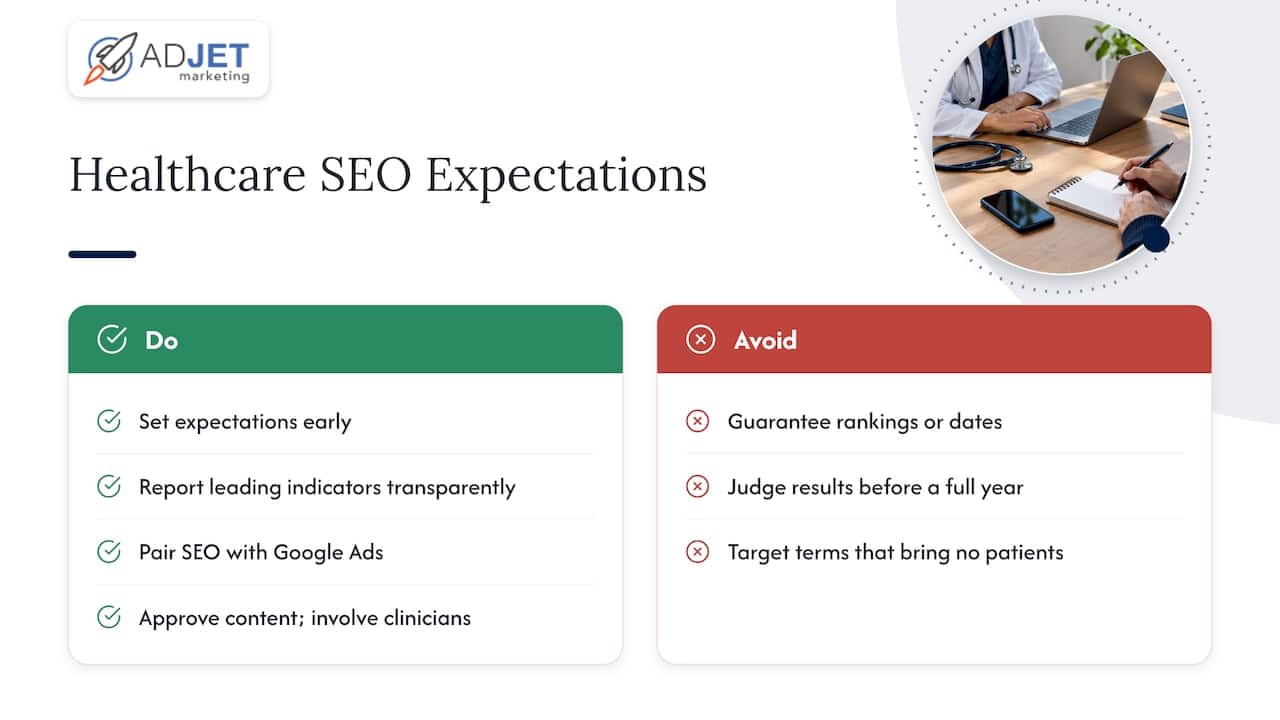
What we do commit to is transparent, data-backed reporting, so you can see whether the leading indicators are moving. We work as a Google Partner agency with HIPAA-compliant processes, which matters when tracking and forms touch patient information. We also prefer to pair SEO with Google Ads for clinics that need patients sooner, because waiting nine months with an empty schedule is a business problem, not a marketing one.
The pattern we see most: the clinics that do best are the ones that approve content quickly, involve their clinicians in review, and give the work a full year before judging it.
— Felix
Setting a realistic budget and plan
Treat SEO as a 12-month decision with a three-month checkpoint. A reasonable approach looks like this:
- Month 0: agree on what a new patient is worth to your practice, and what you would pay to acquire one.
- Month 3: review the foundation. Is tracking working, are technical errors fixed, are core pages live?
- Month 6: review early movement. Are rankings and impressions rising on target terms? Are there any tracked leads?
- Month 12: review cost per lead and booked appointments against your target, then decide where to invest next.
Be skeptical of anyone promising page-one rankings in 30 days. Those promises usually rely on very low-competition terms that do not produce patients.
If you want a team to run this with you, our SEO services are built around this phased approach for medical clinics, aesthetic practices, therapists and other local providers. If you are still deciding what to do first, our medical clinic marketing checklist is a good starting point, and our Google Ads services can cover the gap while SEO builds.
FAQ
How long does SEO take for a new medical practice?
Plan on three to six months for early movement and often 12 months before organic search is a dependable source of new patients. A new domain has no history, so it usually starts slower than an established clinic site. Paid search can cover the gap.
Can a clinic see SEO results in 30 days?
You may see improvements in indexing, impressions or Google Business Profile activity within a month, especially after technical fixes. Meaningful lead growth in 30 days is unusual, particularly for competitive services. Be cautious of guarantees on that timeline.
Why does medical SEO take longer than SEO for other businesses?
Google holds health content to a higher standard for expertise, authoritativeness and trust, as the research on the Medic update describes. Building credible authorship, clinical review and reputation takes time. Competition for high-value services also tends to be strong.
What should I do if I see no results after six months?
Start with an audit rather than waiting. Check whether tracking is accurate, whether the site has technical problems, whether the content shows real clinical expertise, and whether you are targeting terms patients actually search. Flat impressions after months of work point to a strategy problem, not a patience problem.
Should I choose SEO or Google Ads first?
If you need patients within weeks, start with Google Ads and build SEO alongside it. If you have runway and want lower long-term acquisition costs, invest in SEO as well. Most clinics benefit from a mix, with ads informing which SEO pages to prioritize.
Sources
- How long does SEO take to work? SEO timeline and results explained (Search Engine Land)
- Google Medical Update: Why Is the Search Engine Decreasing Visibility of Health and Medical Information Websites? (PMC)
- Creating Helpful, Reliable, People-First Content (Google Search Central)