









A healthcare PPC budget should be built backward from the number of new patients you want, not forward from a round number you feel comfortable spending. Start with the booked appointments you need each month, divide by your realistic conversion rate to get the clicks required, then multiply by your cost per click. Add the cost of managing the account and the cost of tracking it in a HIPAA-safe way. That total is your budget.
Most clinics that come to us have already spent money on ads. The problem is rarely that the number was too small. It is usually that the budget was never tied to a patient goal, so nobody could say whether it was working.
TL;DR
- Set your budget from a patient goal: appointments needed, conversion rate, cost per click, then ad spend plus management and tracking costs.
- Budget for the whole system: ad spend, account management, a landing page that converts, and compliant tracking. Ad spend alone is only one line.
- Judge results by booked appointments and revenue per patient, not clicks. Give a new campaign at least a few months of data before making big cuts.
- HIPAA and Google’s health policies affect what you can track and target, so build that into the plan before launch.
- PPC and SEO work on different timelines. Most practices do best running both, weighted by how soon they need patients.
Table of Contents
- What a healthcare PPC budget actually includes
- How to calculate a starting budget from patient goals
- What budget range is realistic?
- How to allocate the budget
- Compliance costs belong in the budget
- Tracking whether the budget is working
- PPC or SEO: where should the money go?
- Perspective: what we see in clinic accounts
- Where AdJet fits
- FAQ
- Sources
What a healthcare PPC budget actually includes
When clinic owners ask “what should I spend on PPC,” they usually mean the amount Google charges per click. That is ad spend. A working budget has four parts:
- Ad spend. The money paid to Google for clicks.
- Management. Someone has to build the account, write ads, adjust bids, add negative keywords, and report. That is an agency fee, an employee’s time, or software.
- Conversion assets. A landing page, call tracking, and a booking form. Sending paid traffic to a slow or generic page wastes ad spend. Our guide on the role of landing pages in healthcare marketing explains why.
- Compliant measurement. Tracking has to be configured so protected health information (PHI) does not leak to ad platforms. More on that below.
Keeping these separate matters when you compare quotes. One provider may quote a low monthly fee and leave out the landing page. Another may bundle everything. If you compare only the headline number, you are comparing different things. For a deeper look at the management line specifically, see our breakdown of Google Ads management cost for healthcare.
How to calculate a starting budget from patient goals
This is the method we use with clinic owners. It is simple arithmetic, and the value comes from being honest about each input.
Step 1: Set the appointment goal
Pick the number of new-patient appointments you want to add each month. Be specific about service line. A med spa adding 15 consultations a month is a different plan from an imaging center adding 40 referrals.
Step 2: Estimate the conversion rate
Two conversion rates matter:
- Click to lead: the share of visitors who call, submit a form, or book online.
- Lead to appointment: the share of those leads your front desk actually books and who show up.
You will not know either number precisely before launch. Use your own website and phone data if you have any. If you do not, plan with a conservative guess and revise after the first few weeks of real data. Front-desk response speed changes the second rate more than most owners expect.
Step 3: Estimate cost per click
Cost per click (CPC) varies by specialty, city, and keyword. Cosmetic and surgical terms in large metros cost more than general terms in smaller markets. Do not rely on a national average. Use the keyword planner inside a Google Ads account for your exact terms and location, and treat the result as a range.
Step 4: Do the math
Here is a hypothetical example, not a benchmark. Suppose a pain management clinic wants 10 new patients a month.
| Input | Assumption |
|---|---|
| New patients wanted | 10 |
| Lead to patient rate | 25% |
| Leads needed | 40 |
| Click to lead rate | 8% |
| Clicks needed | 500 |
| Cost per click | $6 |
| Monthly ad spend | $3,000 |
The cost per new patient from ads alone in this example is $300. Management and tracking costs come on top. Whether $300 plus overhead is acceptable depends on one more number.
Step 5: Compare against patient value
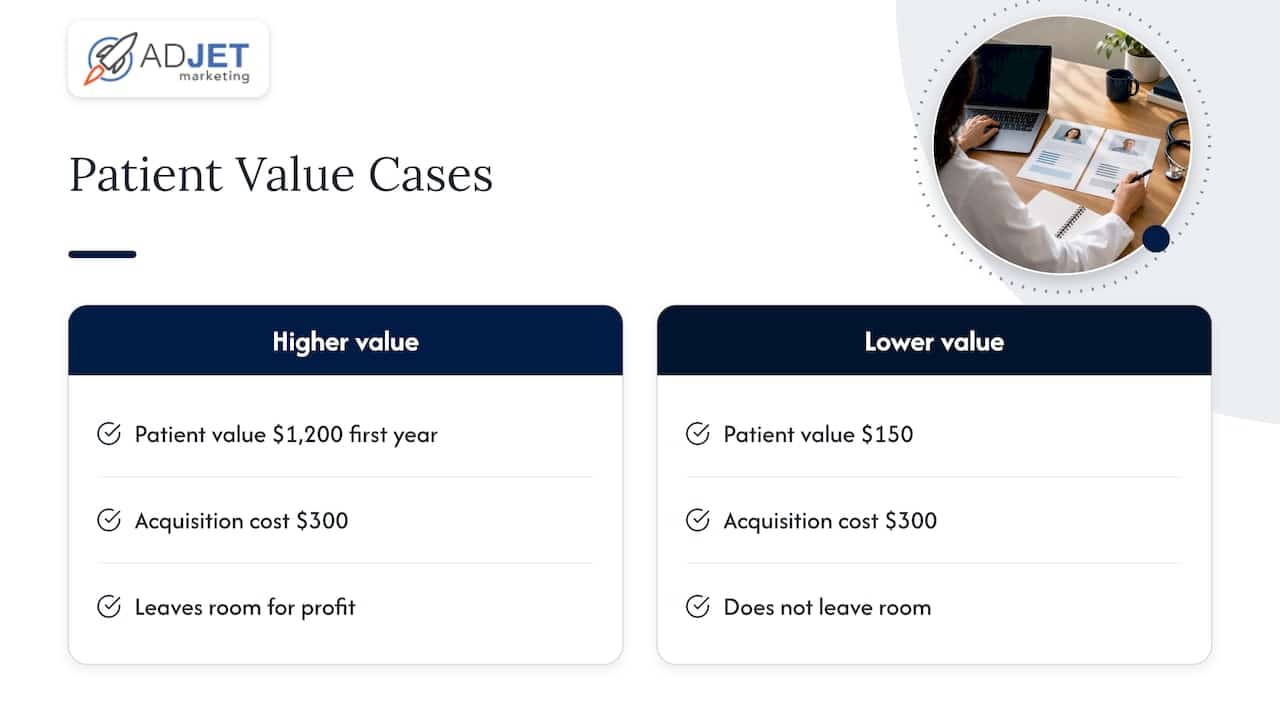
What is a new patient worth over time? A single visit and a multi-year treatment relationship are very different. If a patient is worth $1,200 in revenue over their first year, a $300 acquisition cost leaves room for profit. If a patient is worth $150, it does not. This is the reason we build budgets around lifetime value (LTV) and not around what competitors appear to spend. Our page on a clinic PPC budget built on LTV and HIPAA tracking walks through a version of this with a $1,500 to $5,000 monthly starting range, and our Google Ads profit calculator lets you test your own inputs.
What budget range is realistic?
There is no single correct number, and any article that gives you one without knowing your specialty and market is guessing. What we can say from working with clinics:
- Small markets, narrow service focus. A single-location practice advertising one or two services can often learn something useful on a modest budget, but a very small budget produces so little data that decisions become guesswork.
- Mid-size and large metros, high-value services. Competitive terms cost more per click, so the same patient goal needs more spend.
- Multiple locations or service lines. Budget grows roughly with the number of distinct campaigns you need to fund properly.
Our starting range of $1,500 to $5,000 per month in ad spend is where we typically see a single-location clinic collect enough clicks to evaluate performance. It is a starting point, not a promise of results. Smaller budgets can work for narrow, local, high-intent searches, but they take longer to teach you anything.
We do not publish a price for Google Ads management because scope varies by account size, number of locations, and the work involved. You can read about our Google Ads services and ask for a quote based on your goals.
How to allocate the budget
Once you have a total, the next question is how to divide it. Spreading money evenly across everything is the most common mistake.
By service
Fund your highest-margin, highest-demand services first. A practice offering ten services should not run ten thin campaigns. Pick the two or three that pay best and give each enough budget to collect data. Add others later.
By location
Each location with its own patient base needs its own budget and its own geographic targeting. Pooling everything into one campaign hides which clinic is performing and which is not.
By keyword intent
Searches like “pain clinic near me” or “botox consultation” show someone ready to book. Searches like “what causes back pain” show research. Most of your spend belongs on the first kind. Negative keywords keep budget away from irrelevant searches such as job seekers, students, and free-service hunters. We keep a list in our guide to negative keywords for healthcare Google Ads.
By campaign type
| Campaign type | Best use | Typical share of budget |
|---|---|---|
| Search | Patients actively looking for a service | Largest share, usually most of the spend |
| Brand search | Protecting your own name from competitors | Small |
| Display or video | Awareness and staying visible | Small, and only after search is working |
| Retargeting | Reminding past visitors | Handle with care; see compliance below |
These shares are our working approach, not an industry standard. Adjust them to your account data.
Hold back a testing reserve
We suggest keeping a portion of the budget for testing new ad copy, new keywords, and new landing page versions. Without a test reserve, an account stops improving.
Compliance costs belong in the budget
Healthcare advertisers face rules that other industries do not, and they affect both targeting and measurement.
HIPAA and tracking
HHS guidance states that regulated entities must follow HIPAA when tracking technologies collect or disclose PHI, and must have a business associate agreement (BAA) in place when a tracking vendor qualifies as a business associate. You can read the details in the HHS guidance on online tracking technologies. The same guidance says a cookie banner asking visitors to accept or reject tracking does not count as valid HIPAA authorization to disclose PHI.
Enforcement attention is real. In 2023, HHS and the FTC warned hospital systems and telehealth providers that tracking tools such as Google Analytics and Meta Pixel may disclose sensitive health data in violation of HIPAA and the FTC Act.
What this means for your budget: set aside time and money to configure tracking so that conversion data does not carry patient identifiers, especially on pages tied to a specific condition or appointment. If you use Meta advertising, read our explanation of Meta Pixel and HIPAA. Have your privacy officer or healthcare attorney review the setup. We are a marketing agency, not a law firm, and your legal counsel should make the final call for your practice.
Google Ads health policies
Google limits how health-related data can be used for ad personalization. Its personalized advertising policy states that it will not associate identifiers with sensitive categories, including health, when showing personalized ads. In practice, that restricts some remarketing options for clinics.
Google also requires certification for certain categories. Eligible advertisers can apply for healthcare-related advertising permission to use prescription drug terms or to target restricted addiction-related keywords. If your service falls into those categories, plan for the approval process before you plan launch dates. Ads that are disapproved sit idle while budget planning continues, which is why we wrote a Google Ads compliance checklist for clinics.
Tracking whether the budget is working
Clicks and impressions are not results. A budget is working when it produces booked appointments at a cost you can afford.
A practical measurement setup includes:
- Call tracking with unique numbers per campaign, so you know which ads generate calls.
- Form and booking tracking configured without sending PHI to ad platforms.
- Unique links or landing pages for each campaign. This lets you match bookings to specific ads, calculate the profit from those bookings against ad cost, and adjust ads and pages accordingly. Tebra describes this approach for independent practices.
- Front-desk notes. Ask every new patient how they found you and log it. Phone calls are where many ad leads are won or lost.
When to adjust spending
We look at four signals:
- Cost per booked appointment compared with your target.
- Lead quality. If leads are plentiful but few book, the problem may be keywords, the landing page, or phone handling, not the budget.
- Search impression share. If a campaign that converts well is losing impressions because of budget, that is a reason to increase it.
- Volume of data. Do not make large cuts after a week or two. Low click counts produce noisy numbers. We usually wait for enough data to see a trend before making major changes.
Increase budget on campaigns that book appointments at an acceptable cost. Cut or restructure the ones that do not. If you are unsure where the waste is, a Google Ads audit for healthcare is a reasonable first step.
PPC or SEO: where should the money go?
This is a question we hear from nearly every new clinic client, and the honest answer is that they do different jobs.
| Factor | PPC | SEO |
|---|---|---|
| Time to first patients | Can start within days of launch, though learning takes weeks | Typically builds over months |
| Cost behavior | You pay per click, and traffic stops when you stop paying | Upfront and ongoing work, but traffic can continue after |
| Control | High: you choose keywords, location, schedule, and budget | Lower: rankings depend on many factors |
| Best for | New practices, new service lines, fast launches, competitive terms | Long-term visibility and lower cost per patient over time |
| Risk | Wasted spend if tracking and landing pages are weak | Slow start, uncertain timing |
A new practice that needs patients this quarter usually leans on PPC while investing in SEO for the following year. An established practice with strong organic rankings may spend less on ads and focus them on high-margin services or gaps. We cover the trade-offs in more depth in SEO vs. PPC: the battle for online visibility, and you can see how we approach search engine optimization alongside paid.
Perspective: what we see in clinic accounts
We have audited enough healthcare accounts to see the same patterns repeat. Many clinics come to us after poor lead quality, not after poor traffic. The ads produced clicks. The clicks did not become patients.
Usually the cause is one of four things. The budget was spread across too many services. The campaign targeted broad, informational searches. The landing page was a generic homepage. Or nobody measured what happened after the lead came in.
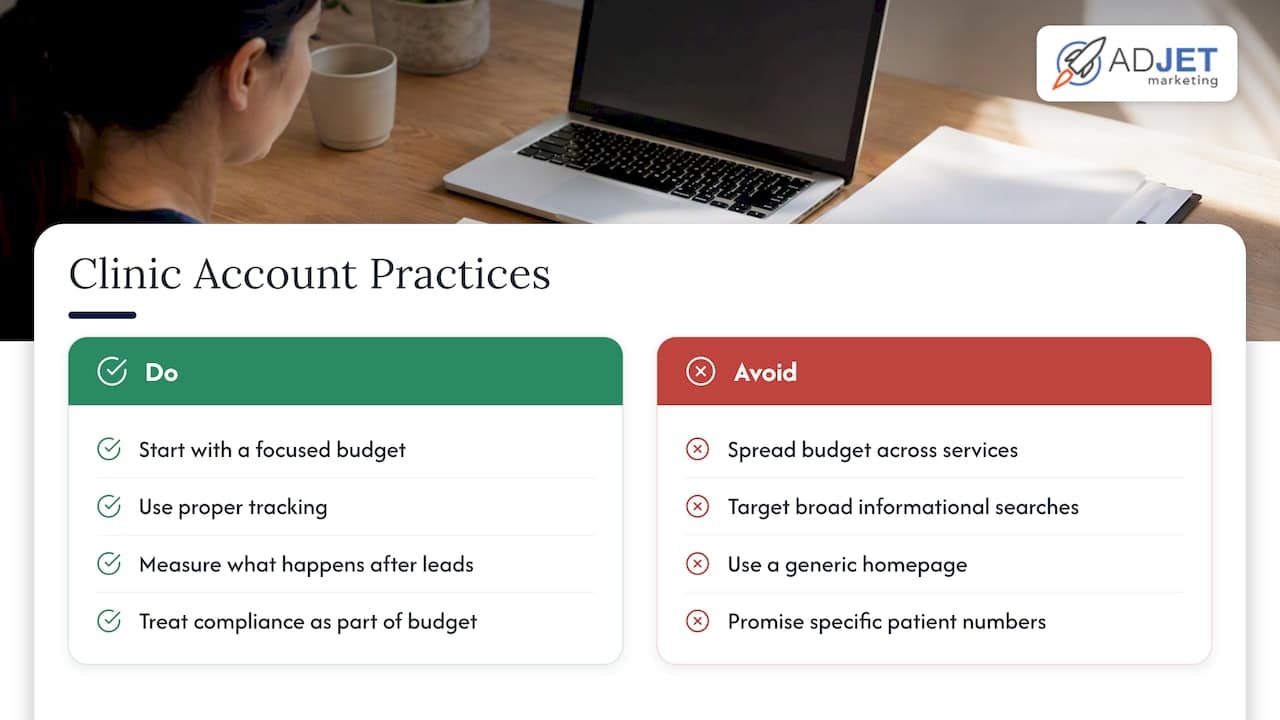
We would rather start a clinic at a smaller, focused budget with proper tracking than at a large one with none. A well-structured account on a moderate budget gives you data. A badly structured one on a large budget only gives you a bigger bill. We also avoid promising specific patient numbers. Costs per click shift, competitors change bids, and front-desk performance varies from clinic to clinic. What we can promise is that you will see where the money goes.
One more point on compliance. We treat it as part of the budget, not as an obstacle to it. A clinic that has to pause a campaign over a policy violation or a privacy complaint loses more than the cost of doing it right the first time.
— Felix
Where AdJet fits
If you want help turning these numbers into a working account, we manage Google Ads for medical clinics, med spas, pain management practices, and other healthcare providers. We can build the campaign, the landing page, and the reporting so you see cost per booked appointment, not just clicks. Our landing page options include a Starter Plan at $299 per month and a Premium Plan at $1,500 per month, listed on our landing page design page. Ad spend is paid to Google separately. If you would like a budget built around your own patient goals, start with our Google Ads services.
FAQ
How much should a small clinic spend on PPC per month?
It depends on your specialty, location, and the value of a new patient. We suggest starting from your patient goal and working backward, as in the calculation above. As a general starting point, our clinic budget guidance runs from $1,500 to $5,000 per month in ad spend, but a narrow local campaign can start lower if you accept slower learning.
Is the management fee part of my PPC budget?
Yes, you should count it. Ad spend goes to Google, and management fees go to whoever runs the account. Some agencies charge a flat retainer, and others charge a percentage of spend. Ask for a written scope so you can compare quotes fairly.
How long before I know if PPC is working?
You can see clicks and calls within days. Judging cost per booked appointment takes longer, usually several weeks to a few months, depending on your click volume and how quickly leads become appointments. Avoid major budget cuts based on the first week.
Can I use remarketing for my healthcare practice?
It is restricted. Google’s personalized advertising policy limits using sensitive health categories, and HHS guidance covers tracking on pages where PHI may be involved. Talk with your compliance officer or attorney before running remarketing, and build any such campaign with them.
Should I choose PPC or SEO first?
If you need patients soon, PPC is usually the faster channel. SEO takes longer but builds lasting visibility. Many practices run both, and shift the balance as organic rankings improve.
Sources
- HHS: Use of Online Tracking Technologies by HIPAA Covered Entities and Business Associates
- HHS and FTC warning on online tracking technologies, 2023
- Google Ads Help: About privacy and personalized ads
- Google Ads Help: Apply for healthcare-related advertising
- Tebra: Healthcare marketing budget benchmarks for independent practices