









There is no single national advertising policy for pain clinics. Your ads answer to four layers at once: state pain clinic laws, medical ethics standards, federal truth-in-advertising rules, and the policies of the platforms you buy ads on. The state layer is the one that surprises clinics most, because in some states the words you use in an ad can decide whether your practice is legally a “pain clinic” at all.
This guide walks through each layer, shows which claims draw extra attention, and gives you a review process you can run on your website, landing pages and Google Ads before anything goes live.
TL;DR
- No federal law sets a pain-clinic-specific ad policy. State laws, the FTC, the FDA (for drug promotion) and ad platforms each set their own rules, and you must satisfy all that apply.
- In some states, advertising “pain management” can classify your practice as a pain clinic, which brings registration and extra oversight.
- Tennessee and West Virginia require specific details in pain clinic ads, such as licensed name, license number and a responsible physician.
- Google prohibits ads for prescription opioid painkillers, with narrow exceptions. Keep ad copy about conditions, procedures and consultations.
- Keep substantiation for every objective claim and a dated archive of every ad you run.
Table of Contents
- Why there is no single national policy
- State laws: where the specific requirements live
- What draws extra scrutiny in ad copy
- Federal rules: truthfulness and substantiation
- Google Ads policy for pain clinics
- A practical review process for your ads and pages
- Our perspective
- Paid ads or SEO: which carries more policy risk?
- Where we can help
- FAQ
- Sources
Why there is no single national policy
Pain clinic oversight grew out of state efforts to control prescribing, so the rules live in state law and state medical board regulations. The federal layer is general: it governs truthfulness, not pain clinics specifically.
The American Medical Association’s ethics guidance sets the baseline for physicians. It says there are no restrictions on physician advertising except those justified to protect the public from deceptive practices. Communications must not mislead through omission of necessary material information, through false or misleading statements, or in any other way that deceives.
That gives you wide freedom to advertise, and it puts the responsibility on you. The AMA places the obligation on the advertiser to make sure each message is truthful, both explicitly and by implication, before it is published.
So the practical question is not “what is the policy?” It is “which of these layers applies to my state, my services and my channels?”
State laws: where the specific requirements live
State rules are the most detailed and the most varied. Three examples show the range.
Tennessee: required content and record keeping
Tennessee’s regulation on pain management clinic advertising requires ads to include the clinic’s official licensed name, its licensure or certification number, and the medical director’s name. It also requires you to retain each advertisement for at least two years after its last communication and to submit it to the Department for review on request. The medical director is responsible for all advertising content.
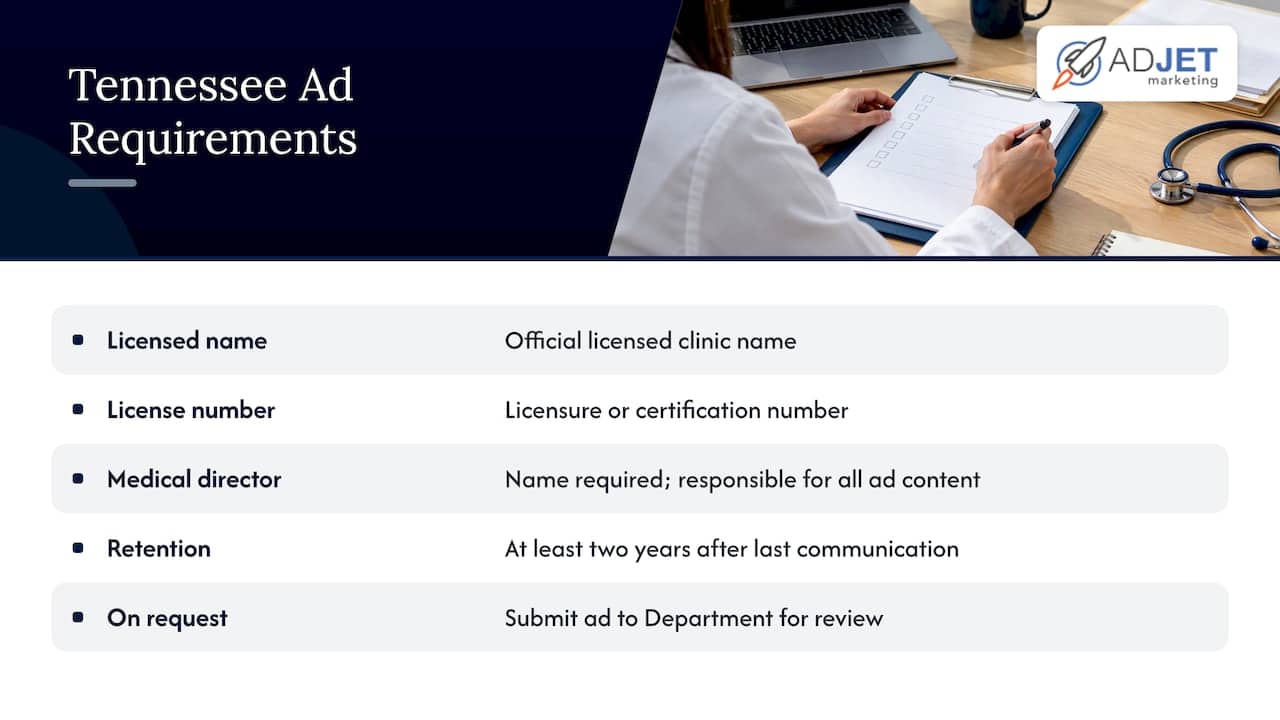
If you operate in Tennessee, that has direct consequences for your marketing workflow. Your website footer, landing pages and ad extensions need to carry the required identifiers, and someone has to archive every version of every ad.
West Virginia: a named physician owner
West Virginia law says advertisements about a pain management clinic’s treatment of chronic pain must include the name of at least one physician owner who is responsible for the content of the advertisement. Check the current statute text before you publish, since state codes are amended.
Mississippi: your ads can define you
Mississippi defines a pain management practice as one where at least 50% of patients regularly or recurrently receive specified prescriptions for chronic non-cancerous, non-terminal pain, or one that advertises or holds itself out as providing pain management services. A law firm’s analysis of the rule warns that providers should avoid advertising “pain management” care or services if they do not intend to be regulated as a pain practice.
This is the part many clinics miss. Your prescribing volume may be low, but a headline reading “Pain Management Center” can still pull you into the definition.
Marketing-based definitions across the country
A 2018 academic review of state pain clinic definitions found that five states used marketing-based definitions, which capture facilities that advertise themselves as places where pain is treated or managed. Clinics covered by these definitions must register and become subject to extra oversight. Definitions change, so treat that count as a snapshot and confirm your own state’s current language.
One Georgia rule chapter shows the same logic in its own wording: a pain management clinic is a medical practice advertising “treatment of pain” or using “pain” in the clinic’s name or the practice’s name. Check the current rule text for your state before you rely on any summary, including this one.
How to check your own state
- Search your state medical board’s rules for “pain management clinic” and “advertising.”
- Read the definition section first. Look for any trigger based on advertising, the name of the practice, or the percentage of patients on controlled substances.
- Read any rule on required ad content and record retention.
- Ask your healthcare attorney to confirm how the definition applies to your actual services.
What draws extra scrutiny in ad copy
The AMA guidance names several patterns that move an ad toward “deceptive.” You will recognize them from typical clinic marketing:
- Claims of exclusive or unique skills. “The only doctor in the region who…” needs proof you can show.
- Results not comparable to typical outcomes. A headline about a patient who became pain-free, with no context, implies an outcome most patients will not see.
- Testimonials that do not reflect standard results. Selecting your best story and presenting it as typical is the problem, not the testimonial itself.
- Unjustified medical expectations. Language that implies a cure for chronic conditions falls here.
- Misleading medical illustrations. Before-and-after imagery or anatomical graphics that overstate what a procedure does.
The AMA’s opinion also says including the physician’s name in advertising may help assure that its guidelines are being met. That lines up with the Tennessee and West Virginia requirements, and it is a sensible habit even where no law demands it.
Clinic names and service labels
Because some states look at the word “pain” in a clinic or practice name, naming deserves a legal check before you print signage or register a domain. Describing services by condition or procedure (for example, “spine injections for sciatica” or “knee pain evaluation”) can read very differently under a statute than a broad “pain management” label. We are not lawyers, and the right wording depends on your state and your services.
Federal rules: truthfulness and substantiation
FTC standards
The FTC’s health products guidance says advertising must be truthful and not misleading, and that objective product claims need adequate substantiation before the ad runs. For health claims, that generally means competent and reliable scientific evidence. Any qualifying disclosure should be clear and conspicuous and explain significant limitations or risks.
Three practical points follow:
- Substantiation comes first. Gather the evidence before the claim goes into a headline, not after a complaint.
- Testimonials do not prove a claim. In a case about health apps, the FTC challenged anti-acne claims as unsupported by science and said that consumer endorsements do not substantiate health claims.
- Disclose material connections. An FTC order in another health marketing case requires defendants to clearly disclose any material connection with anyone giving an endorsement. If you reward patients for reviews or pay an influencer, the relationship needs to be visible.
The same FTC guidance adds that a disclosure should not contradict or mitigate the ad’s main claim. Fine print cannot rescue a headline that promises too much.
FDA and prescription drug promotion
The FDA regulates promotion of prescription drugs. Its final rule, effective May 20, 2024, requires the major statement about side effects in direct-to-consumer television and radio drug ads to be presented in a clear, conspicuous and neutral manner. That rule targets broadcast drug advertising by drug promoters, so it will not apply to most clinic ads directly. It does show the direction of federal expectations: risk information must be visible and fair. If your clinic mentions a specific medication, treat that as a signal to get a compliance review first.
Google Ads policy for pain clinics
If you use paid search, platform policy often constrains you more tightly than the law does, because it is enforced automatically.
Google prohibits ads for prescription opioid painkillers, with exceptions for qualifying medication-assisted treatment for opioid use disorder and a few limited policy exceptions. Advertisers must also meet any healthcare certification requirements that apply to their products or services.
In practice, we see the difference between approved and disapproved pain ads come down to what the ad is selling:
| Ad subject | Typical outcome | Why |
|---|---|---|
| Conditions (sciatica, migraine, neck pain) | Generally allowed | Describes a condition and a consultation |
| Procedures (epidural injections, nerve blocks, radiofrequency ablation) | Generally allowed | Describes a service, not a drug |
| Consultation or evaluation booking | Generally allowed | Appointment-focused |
| Prescription opioid names or “get your prescription” language | Restricted or prohibited | Falls under the opioid painkiller policy |
| Addiction treatment | Restricted, needs certification | Healthcare certification rules apply |
This table reflects our experience with account reviews, not a guarantee. Google updates its policies, so read the current policy page before building a campaign. For a deeper look at how restrictions play out in accounts, see our Google Ads compliance checklist for clinics, and for campaign structure, our pain management Google Ads strategy guide.
A practical review process for your ads and pages
The AMA and Tennessee rules point the same way: a named person owns advertising content, and records exist. Here is a workflow that covers all four layers.
- Name an owner. One physician, ideally the medical director or a physician owner, signs off on every ad, landing page and social post.
- Check the state definition. Confirm whether your wording could classify you as a pain clinic, and decide on purpose whether that is acceptable.
- Add required identifiers. Licensed name, license number and physician name belong in the footer, on landing pages and in ad copy where your state requires it.
- Audit claims. For each objective claim (“reduces pain,” “90% of patients,” “fastest recovery”), attach the evidence or remove the claim.
- Review testimonials and imagery. Make sure they are not presented as typical when they are not, and label any material connection.
- Scan for platform triggers. Remove drug names and prescription language from ads and headlines unless you have confirmed they are allowed.
- Archive everything. Save a dated copy of each ad, landing page version and approval. Tennessee’s two-year retention rule is a good benchmark even outside Tennessee.
- Recheck on a schedule. State rules and platform policies change, so put a review on the calendar at least twice a year.
If your site collects patient inquiries, the privacy side matters as well. We cover it in our guide to HIPAA-compliant marketing with Google Ads.
Our perspective
Many clinics come to us after one of two experiences: a Google Ads account that sat suspended for weeks, or a campaign that drove calls from people who wanted a prescription, not a procedure. Both problems start in the same place. The clinic described itself in the broadest possible terms, “pain management,” when the actual service was something specific, such as image-guided injections, regenerative procedures or a spine consultation.
We write pain clinic ads around conditions, procedures and consultations, for three reasons. The wording attracts patients who match what you offer. It stays clear of the opioid policy that platforms enforce automatically. And in states with marketing-based definitions, it avoids announcing a regulatory status you did not choose.
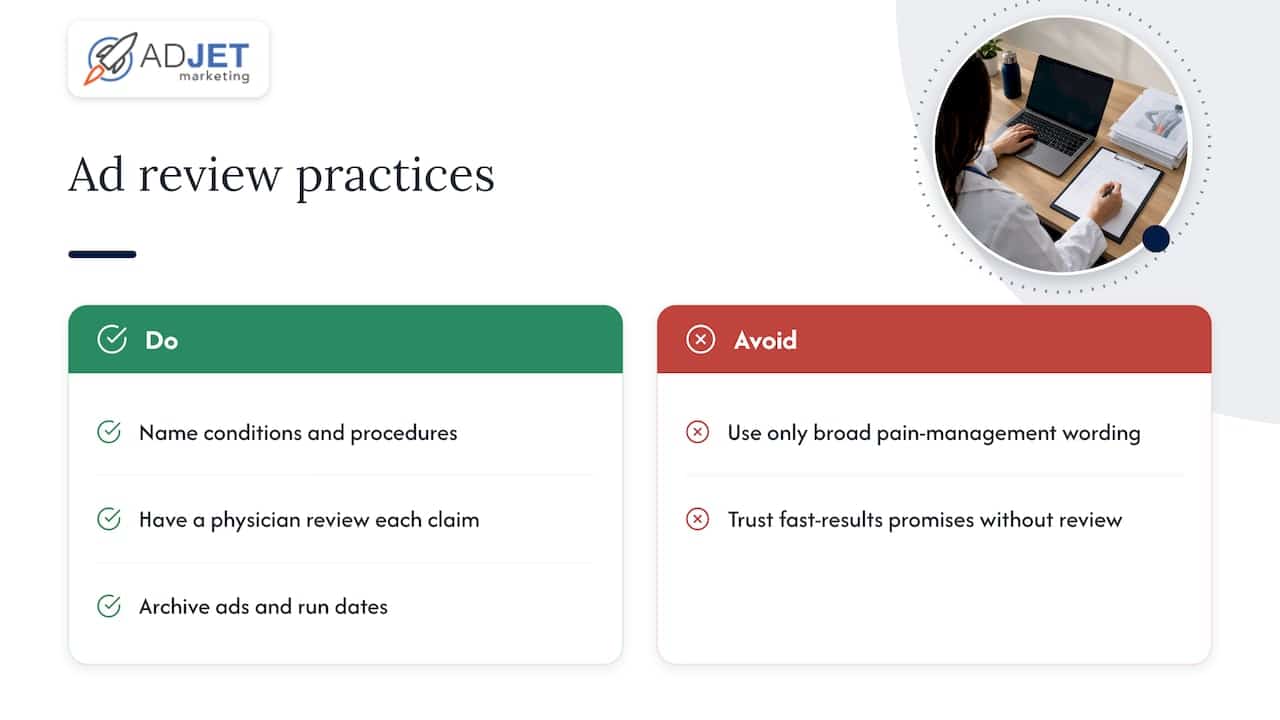
We also push for a documented sign-off. A physician who reviews each claim, and an archive that shows what ran and when, protect you more than any single wording choice. Timelines matter too. A compliant account takes time to build trust with the platform, and organic search takes months, not weeks. If an agency promises fast results with pain keywords and no review step, ask how it handles state definitions and platform policy.
This is marketing guidance from our agency experience. It is not legal advice. Your healthcare attorney should confirm how your state’s rules apply.
— Felix
Paid ads or SEO: which carries more policy risk?
Both carry risk, in different forms.
- Google Ads carries platform risk. Policies are enforced quickly, and a disapproval can pause spend while you fix it. You control the message precisely, and you can change it fast.
- SEO carries content risk. Nobody disapproves a page automatically, but a regulator or a competitor can still read it. Pages are public for a long time, so old claims linger.
A balanced plan uses both. Paid search gives you early lead flow while organic content builds. SEO adds durable visibility that does not depend on a policy decision. Our guides on SEO for pain clinics and the 90-day pain clinic marketing plan show how we sequence the two.
Where we can help
If you want compliance built into your website and ad structure from the start, we build landing pages and manage Google Ads for pain management clinics. Our landing page plans start with the Starter Plan at $299 per month, and our landing page design offers show every option on one page. For paid search, see our Google Ads management services. Ad budgets are separate from management, and we set expectations on timeline and spend before you commit.
FAQ
Is there a federal advertising policy specific to pain clinics?
No. Federal rules are general: the FTC requires truthful, substantiated advertising, and the FDA regulates prescription drug promotion. Pain clinic-specific rules, including definitions, registration and ad content requirements, come from states and their medical boards.
Can the word “pain” in my clinic name or ads trigger regulation?
In some states, yes. Several states use marketing-based definitions that capture practices advertising pain treatment, and some look at “pain” in the practice name. Check your state’s definition and ask a healthcare attorney before choosing names or headlines.
Can I advertise opioid prescriptions on Google?
No. Google prohibits ads for prescription opioid painkillers, with narrow exceptions such as qualifying medication-assisted treatment for opioid use disorder. Advertise conditions, procedures and consultations instead, and read the current policy before launching.
Do patient testimonials create compliance problems?
They can. The AMA warns against testimonials that do not reflect standard patient results, and the FTC says endorsements do not substantiate health claims. Use testimonials carefully, do not present them as typical, and disclose any material connection with the endorser.
How long should I keep copies of my ads?
It depends on your state. Tennessee requires pain management clinics to keep each ad for at least two years after its last communication. Keeping dated records of every ad and landing page version is a sound practice anywhere.
Sources
- AMA Code of Medical Ethics: Advertising and Publicity
- Tenn. Comp. R. & Regs. 1200-34-01-.16, Advertising
- West Virginia Code §16B-7-10, Advertisement
- Can Ads Accidentally Make Your Hospital or Clinic a Mississippi Pain Practice
- Pain clinic definitions in the medical literature and U.S. state laws
- Georgia Rules, Chapter 360-8 Pain Management Clinics
- FTC Health Products Compliance Guidance
- FTC: Truth in app-vertising
- FTC: You had me at aloe?
- Federal Register: Direct-to-Consumer Prescription Drug Advertisements
- Google Advertising Policies: Prescription opioid painkillers