









Having a professional clinic website is a good start. But here’s the reality: if patients can’t find you on Google, that website isn’t generating appointments. Medical SEO, which stands for search engine optimization applied specifically to healthcare settings, is the process of making your clinic visible to the right patients at the exact moment they’re searching for care. This article breaks down what medical SEO is, why it works differently than general SEO, and the specific strategies you can use to attract more patients and build lasting trust online.
Table of Contents
- What is medical SEO and why does it matter?
- Core elements of effective medical SEO
- Practical strategies for clinic SEO success
- Building patient trust with medical SEO
- What most clinics miss about medical SEO
- Power up your clinic’s growth with expert medical SEO support
- Frequently asked questions
Key Takeaways
| Point | Details |
|---|---|
| Medical SEO builds trust | Using clinician authorship and authoritative citations increases patient confidence. |
| Regular content updates matter | Maintaining up-to-date information boosts site credibility and search performance. |
| Practical SEO strategies work | Actions like Google Profile optimization and keyword targeting attract more patients. |
| Compliance strengthens visibility | SEO-aligned medical compliance reinforces both rankings and patient trust. |
| Holistic approach beats technical fixes | Combining trust-building with technical SEO delivers lasting growth for clinics. |
What is medical SEO and why does it matter?
Medical SEO is the practice of optimizing a healthcare website so it ranks higher in search engine results pages for clinically relevant queries. It’s not just about traffic. It’s about attracting people who are actively looking for the services your clinic provides, whether that’s pain management, aesthetic treatments, mental health therapy, or imaging services.
General SEO focuses on keywords, backlinks, and site structure. Medical SEO does all of that, but it adds a critical layer: credibility and clinical accuracy. Google applies stricter ranking standards to health-related content because incorrect information can directly harm users. This falls under what Google calls “Your Money or Your Life” (YMYL) content, and the bar for ranking is significantly higher.
Here’s a quick comparison:
| Factor | General SEO | Medical SEO |
|---|---|---|
| Content authorship | Optional | Clinician-authored or reviewed |
| Citations required | Preferred | Required for trust |
| Content updates | Recommended | Mandatory for accuracy |
| Audience stakes | Moderate | High (health decisions) |
| E-E-A-T emphasis | Standard | Elevated |
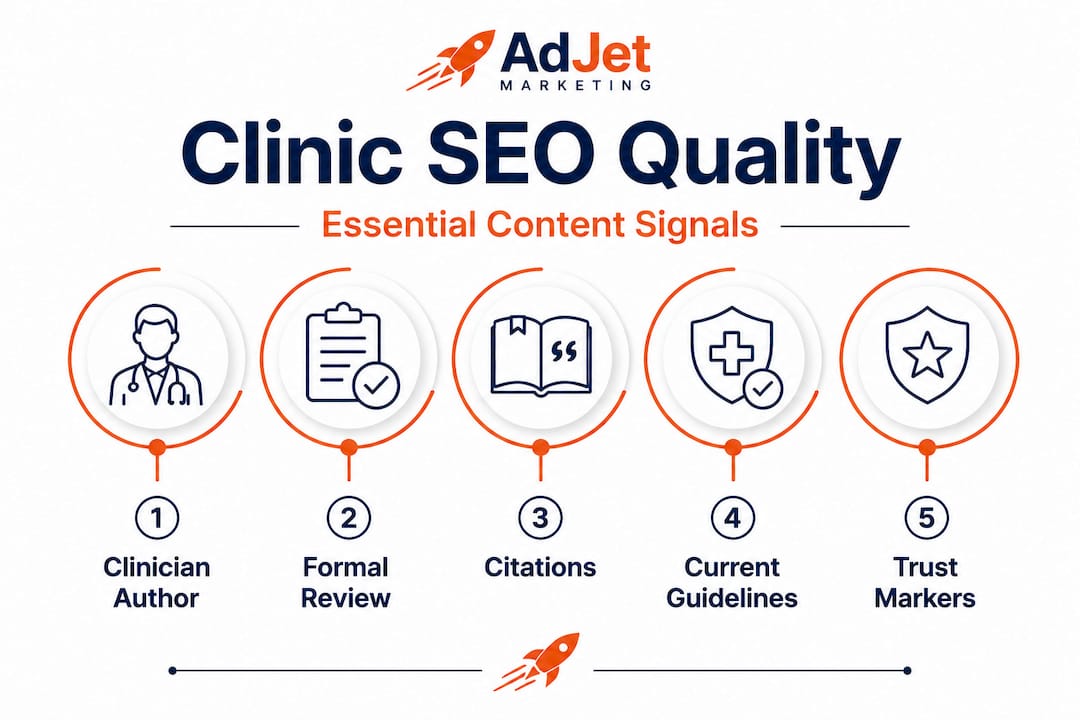
E-E-A-T stands for Experience, Expertise, Authoritativeness, and Trustworthiness. For healthcare websites, these signals are operationalized through clinician authorship, editorial review processes, citations to authoritative medical sources, and regular content update practices. Google uses these signals to assess whether a healthcare page should rank in front of patients.
The direct impact on your clinic is real. When your site satisfies E-E-A-T requirements, you rank higher. When you rank higher, more patients find your clinic before they find a competitor. That translates directly to more appointment requests and booked visits.
For a broader look at how this plays out across healthcare settings, our healthcare SEO guide walks through the full process. If you run a therapy practice or behavioral health clinic, our mental health SEO resources address the unique ranking challenges in that space.
“The clinics that rank consistently well aren’t just technically optimized. They demonstrate real clinical expertise through every page on their site.”
Core elements of effective medical SEO
Having defined medical SEO, it’s crucial to understand the inner mechanisms that make it work for clinics. There are five core pillars, and each one contributes directly to how well your clinic performs in search results.
1. Keyword research aligned to patient intent
Effective keyword research for clinics goes beyond obvious terms like “back pain doctor.” You need to understand how patients phrase their concerns. Someone searching “is my knee pain serious” is in an earlier research phase. Someone searching “knee pain specialist near me” is ready to book. Your content strategy needs to address both stages.
Map your keywords to intent: informational pages for early-stage searchers, and service or location pages for high-intent traffic. This structure helps Google understand who each page is for, and it helps patients navigate your site naturally.
2. Clinician-authored and reviewed content
Google’s guidance makes it clear that medical content quality depends on named authors, formal review processes, reputable citations, and ongoing maintenance practices. In practical terms, this means every health-related article or service page on your site should display the name and credentials of the author or reviewer. A physical therapist’s blog post reviewed by an MD carries far more authority than anonymous content.
3. Technical SEO: speed, mobile experience, and structure
Technical SEO refers to the behind-the-scenes factors that affect how search engines crawl and rank your site. For clinics, the most critical elements are:
- Page load speed (under 3 seconds is the target)
- Mobile responsiveness (most patients search from a smartphone)
- Secure HTTPS connection
- Clean URL structure and internal linking
- No broken pages or crawl errors
A site that loads slowly or breaks on mobile devices loses patients before they even read a word of content.

4. Structured data and local citations
Structured data (sometimes called schema markup) is code you add to your website that tells search engines exactly what your content means. For clinics, this includes your practice name, services offered, location, hours, and physician credentials. Local citations, meaning consistent listings of your clinic’s name, address, and phone number across directories like Healthgrades, Zocdoc, and Google Business Profile, reinforce your local authority and help your clinic appear in map results.
5. Ongoing content maintenance
This is where most clinics fall short. Medical content needs to be reviewed and updated regularly. If you published an article about a treatment two years ago and the clinical guidelines have changed, that outdated page can hurt your credibility with both patients and Google. Showing a “last reviewed” date on clinical content signals that your site is actively maintained.
Pro Tip: Schedule a quarterly content audit. Review your top 10 pages for accuracy, check that all citations link to current sources, and update any statistics or treatment references that have changed.
For actionable steps across multiple clinic types, see our resource on essential healthcare marketing strategies. If you’re also running paid campaigns alongside SEO, our guide on optimizing healthcare Google Ads will help you align both channels. And if you manage a med spa and want to apply these principles to blog content, our breakdown of SEO for medspa blog posts covers the specifics.
Practical strategies for clinic SEO success
Understanding the core components sets you up for implementing real-world strategies that yield results. Here are the highest-impact actions you can take right now.
Claim and fully optimize your Google Business Profile
Your Google Business Profile (GBP) is often the first thing a patient sees when they search for your clinic by name or specialty. A complete, accurate, and frequently updated GBP dramatically improves your chances of appearing in the local map pack, which shows the top three local results above organic listings.
Fill out every field: hours, services, photos, accepted insurance, and your clinic’s description. Add a booking link if your system supports it. Respond to every review, positive or negative, because Google tracks engagement as a trust signal.
Showcase credentials and patient testimonials prominently
Don’t bury physician credentials in a footer or an obscure “About” page. Place credentials directly on service pages, blog posts, and landing pages. Patients deciding between two clinics online will trust the one that clearly shows who is treating them.
Patient testimonials also play a dual role. They build social proof for prospective patients and contribute to the type of user engagement signals that support rankings. Real outcomes, described in a patient’s own words, carry significant weight. As research on personalized care in wellness highlights, patients respond strongly to content that reflects their personal health journey.
Keep content aligned with current medical guidelines
Every service page, blog post, and FAQ on your site should reflect current clinical standards. This isn’t just good SEO practice. It’s an ethical responsibility to the patients reading your content. Google’s guidance is straightforward: clear authorship, medical review, and regular updates are foundational requirements for both patient trust and search relevance.
Use local keywords and dedicated location pages
If your clinic operates in multiple cities or has more than one location, create a dedicated page for each one. Each location page should include the specific city name, neighborhood references, directions, staff bios for that location, and patient reviews from that area. This approach dramatically improves visibility for location-specific searches like “botox clinic in Austin” or “pain management Scottsdale.”
Pro Tip: Use Google’s “People also ask” section and the autocomplete suggestions when you type your primary service keyword into the search bar. These are direct windows into how your future patients phrase their searches. Build content around those exact phrases.
For a deep look at how these principles apply to aesthetic practices, our guide on effective medspa SEO provides specific tactics for high-competition beauty and wellness markets.
Building patient trust with medical SEO
Let’s look deeper at how building trust through SEO doesn’t just drive rankings. It reassures and retains your patients.
Trust is the central currency in healthcare. A patient choosing a clinic online is essentially trusting a stranger with their health. Your website needs to eliminate doubt and build confidence before they ever walk through your door. Medical SEO, done correctly, is one of the most effective tools for doing exactly that.
Here’s how to operationalize trust across your site:
- Display author credentials on every content page. Include the author’s name, degree, specialty, and years of experience. If a physician reviewed the content, include their credentials too.
- Cite reputable medical sources. Link to peer-reviewed journals, the CDC, NIH, or major specialty associations. This shows patients and Google that your content is grounded in evidence.
- Show the last reviewed date. A page reviewed six months ago tells patients the information is current. A page with no date creates doubt.
- Protect patient privacy in content. Never include identifiable patient information in case studies or testimonials without explicit written consent. Frame success stories in general terms or with first-name-only attribution where appropriate.
- Align your content with healthcare regulations. Content that makes unsupported medical claims or guarantees specific outcomes can expose your clinic to compliance risk. Keep language accurate and qualified.
“Trust signals, including clear authorship, expert reviews, authoritative citations, and consistent update protocols, are what underpin medical content authority and real patient confidence.”
These elements don’t just help with rankings. They reduce bounce rates because patients stay longer when they feel confident in what they’re reading. They increase conversion rates because a patient who trusts your site is more likely to call or book online. And they support long-term retention because patients return to sources they believe in.
For specific tactics that are proven to work in 2025 and beyond, our resource on SEO for medspas covers what’s actually moving the needle right now.
What most clinics miss about medical SEO
After working with clinics across multiple specialties, we’ve noticed a consistent pattern: most owners focus entirely on technical fixes and ignore the trust-building layer that actually sustains growth.
A fast, mobile-friendly website with clean code is necessary. But it’s a floor, not a ceiling. The clinics that consistently grow their patient volume aren’t just technically sound. They treat their website as an ongoing expression of clinical expertise. They update content when guidelines change. They credit their physicians and staff by name. They write content that answers the questions patients are actually afraid to ask out loud.
Here’s the uncomfortable truth: Google’s algorithm is increasingly good at detecting the difference between content that looks authoritative and content that is authoritative. Thin pages stuffed with keywords used to work. They don’t anymore. What works now is depth, accuracy, and visible expertise.
Many clinic owners also underestimate how much the “last reviewed” date matters to a prospective patient. If someone is researching a treatment and sees that your competitor’s page was reviewed last month by a board-certified physician, while your page has no date and no author, they will click to that competitor’s site. It’s a small detail with a large impact.
We believe medical SEO is best understood not as a technical checklist but as a long-term patient engagement strategy. When you approach it that way, you stop asking “how do we rank?” and start asking “how do we earn the trust of every patient who finds us?” That shift in mindset is what separates clinics that plateau from those that scale. Our breakdown of advanced medspa SEO strategies gets into the specifics of how that looks in a high-growth practice.
Power up your clinic’s growth with expert medical SEO support
Ready to put medical SEO principles into practice? AdJet Marketing specializes in building and executing tailored healthcare SEO strategies for clinics, med spas, pain management centers, and private healthcare providers. Whether you’re starting from scratch or trying to scale an existing patient acquisition funnel, our team delivers measurable results. For specialty practices like therapy and behavioral health, our mental health SEO resources address the specific challenges of that market. And if you want to understand why investing in digital visibility is a business-critical priority, our resource on the importance of healthcare marketing provides the full picture.
Frequently asked questions
How is medical SEO different from general SEO?
Medical SEO requires content reviewed or authored by clinicians, citations to medical authorities, and regular updates to maintain patient trust and ensure compliance with clinical accuracy standards.
What are the most important ranking factors for clinic websites?
Relevant keywords mapped to patient intent, visible medical credentials, authoritative citations, fast mobile user experience, and consistent content updates are the most critical ranking factors for clinic websites.
How often should clinic websites update their content for SEO?
Clinics should review and update website content at least every 12 months, or immediately when new medical guidelines are released, since showing a reviewed date is a key trust signal for both patients and search engines.
Does medical SEO help with patient trust?
Yes, medical SEO builds patient trust through visible clinician expertise, authoritative citations and reviews, and accurate, up-to-date information that reassures patients before they book an appointment.
Can medical SEO impact patient conversion rates?
Absolutely. Clinics with strong SEO foundations see higher search visibility, more inbound inquiries, and better conversion rates because trust signals and search relevance work together to move patients from discovery to booking.
Recommended
- Mental Health SEO – AdJet Digital Marketing & Google Partner Agency | SEO Development Google Ads Social
- SEO For Medspas: What Actually Works In 2025 – AdJet Digital Marketing & Google Partner Agency | SEO Development Google Ads Social
- Case Studies – AdJet Digital Marketing & Google Partner Agency | SEO Development Google Ads Social
- Guide To Effective Healthcare SEO