









Medical schema markup is structured data, usually written in JSON-LD, that tells search engines and AI systems exactly what a health page is about using Schema.org’s dedicated medical vocabulary. The single highest-impact step is adding MedicalCondition, Physician, and MedicalWebPage markup that links every clinical claim to a credentialed clinician with verifiable credentials. Everything else, from code vocabularies to multi-location templates, builds on that foundation.
TL;DR:
- Properly implementing MedicalCondition, MedicalProcedure, and Physician schema with verifiable credential links improves search trust and AI recognition, especially for YMYL content.
- Use JSON-LD in the head or footer, and build entity chains with @id references to avoid duplication and ensure accurate linking across condition, treatment, and clinician data.
- Regularly validate schema with Google’s Rich Results Test and schema validators, and monitor structured data reports to prevent errors from invalid or outdated markup.
- Link clinician entities to authoritative profiles like NPI or state medical boards to enhance verification and AI trustworthiness, especially when referencing authors or reviewedBy properties.
- Tailor schema types to specific page needs, such as MedicalCondition on symptom pages, FAQPage on question pages, and MedicalProcedure on treatment pages, to optimize clarity and relevance.
Table of Contents
- What Medical Schema Markup Actually Does for Healthcare Sites
- Which Schema.org Types Do Healthcare Sites Actually Need?
- How Do You Actually Implement Medical Schema Step by Step?
- How Do You Validate and Monitor Medical Schema at Scale?
- Why Structured Credentials Matter More Than a Byline
- Common Pitfalls That Undermine Medical Schema
- What Does Medical Schema Look Like on Different Page Types?
- How Should Multilingual Healthcare Sites Handle Medical Schema?
- How Often Should You Update Medical Schema Markup?
- Does Medical Schema Actually Move Search Performance?
- Agency Perspective: Timelines, Budgets, and Real Obstacles
- How AdJet Marketing Can Help
- Sources
- FAQ
What Medical Schema Markup Actually Does for Healthcare Sites
Schema.org’s medical types exist to make health content machine-readable for search engines, not to replace clinical data systems. The health and medical types documentation is explicit about this: these types serve web discovery, and they were never built for clinical data exchange between electronic health records or hospital systems. If your team is trying to sync patient records with schema markup, you’re solving the wrong problem with the wrong tool.
The practical benefits are concrete. Properly tagged condition and treatment pages become eligible for richer search features, get pulled into voice and AI-generated answers more reliably, and index with clearer topical signals than plain HTML alone provides. A symptom page marked up as MedicalWebPage with a linked MedicalCondition entity gives Google a structured reason to trust what the page claims, instead of guessing from body text.
Choosing the right wrapper type matters too. Use MedicalWebPage for condition, treatment, and procedure pages meant for patient audiences. Reserve FAQPage for genuine question-and-answer content, and don’t stack both on a page that’s really just an article. For anything touching diagnosis, treatment, or drug information, the YMYL stakes are real: Google’s own guidance on expert review for YMYL content treats unreviewed medical claims as a trust liability, not a technical afterthought.
Which Schema.org Types Do Healthcare Sites Actually Need?
A handful of types cover most of what a medical or clinic site will ever need to mark up. Trying to use all of Schema.org’s medical vocabulary is a waste of time. Trying to get by on generic Article schema is a missed opportunity. Here’s the shortlist that matters:
- MedicalCondition: Use
name,associatedAnatomy,possibleTreatment,riskFactor, andcodeto link a diagnosis to controlled vocabulary identifiers like ICD or SNOMED-CT. - MedicalProcedure and MedicalTherapy: Describe interventions with
procedureType,bodyLocation, andcode, distinguishing surgical procedures from ongoing therapies. - Drug: Cover medication pages with
activeIngredient,dosageForm,administrationRoute, andcodereferencing RxNorm. - Physician (a Person subtype): Populate
medicalSpecialty,worksFor, andsameAslinks to registries like the NPI database or a state medical board. - MedicalOrganization or MedicalClinic: Include
address,medicalSpecialty, andisAcceptingNewPatientsfor location and availability signals. - MedicalWebPage or MedicalScholarlyArticle: Add
lastReviewed,reviewedBy, andmedicalAudienceto show the content has a review cycle.
The MedicalEntity type is the parent class behind most of these, and it’s worth understanding because nearly every medical subtype inherits its code and recognizingAuthority properties. That inheritance is what lets you attach a controlled vocabulary code to almost anything on a clinical page, from a diagnosis to a lab test.
How Do You Actually Implement Medical Schema Step by Step?
JSON-LD belongs in the <head> of the page, or just before the closing </body> tag, as a single <script type="application/ld+json"> block. Google recommends JSON-LD over microdata or RDFa because it sits separately from your visible HTML, which means your design team can redesign the page without a developer having to untangle inline schema attributes from the markup.
Here’s a working sequence for rolling this out across a healthcare site:
- Audit your page types first. Sort your URLs into buckets: condition pages, treatment pages, clinician bios, location pages, and drug information pages. Each bucket gets a different schema pattern.
- Build the clinician layer before anything else. Every
Physicianentity needs a stable@id, amedicalSpecialty, andsameAslinks to the NPI registry, a state board profile, or a hospital directory listing. This is the entity everything else will reference. - Add MedicalOrganization at the site level. One organization block, referenced by
@id, covers your practice’s name, address, and specialty. Don’t repeat it verbatim on every page. - Tag condition and treatment pages with code values. Wrap ICD, SNOMED-CT, or RxNorm identifiers inside a
MedicalCodeobject rather than typing a bare string. A minimal pattern looks like this:
{
  "@type": "MedicalCondition",
  "name": "Plantar Fasciitis",
  "code": {
    "@type": "MedicalCode",
    "code": "M72.2",
    "codingSystem": "ICD-10"
  },
  "possibleTreatment": {"@id": "#extracorporeal-shockwave-therapy"}
}
- Chain entities with
@idinstead of duplicating data. AMedicalConditionreferences itsMedicalTherapyby@id, which references thePhysicianwho performs it, which references theMedicalOrganizationthey work for. This is what separates a professional implementation from disconnected, isolated schema blocks scattered across a site, according to practitioner guidance on schema markup. - Deploy through templates, not hand-coding. WordPress sites can use a plugin to inject JSON-LD by page type, but the template still needs manual field mapping for
code,sameAs, andlastReviewed. Automated plugins rarely populate those correctly out of the box.
For multi-location practices, keep each clinic and each clinician on its own page, linked with practicesAt and worksFor, rather than cramming several providers into one generic “our team” page. That approach also aligns with local SEO guidance for multi-location businesses, which treats duplicate content across location pages as a ranking liability, not just a schema inconsistency.
Pro Tip: If you’re managing schema across ten or more locations, build one canonical JSON-LD template with placeholder fields for address, clinician, and specialty, then generate each page’s block from that single source. Hand-editing JSON-LD per location is how sites end up with five different address formats and three expired phone numbers scattered across their own markup.
How Do You Validate and Monitor Medical Schema at Scale?
Writing the JSON-LD is the easy part. Catching errors before Google does is where most sites fall short. Run every new template through Google’s Rich Results Test first, since it flags missing required properties and shows exactly which rich features a page qualifies for. Follow that with a general schema validator, which checks broader syntax issues the Rich Results Test doesn’t always catch, like malformed nested objects or duplicate @id values.
Once a template is live, don’t treat validation as a one-time task.
- Add a schema linting step to your deployment pipeline so a broken JSON-LD block never ships silently with a routine content update.
- Run automated smoke tests that fetch a sample of pages after each deploy and confirm the schema block parses without errors.
- Check Google Search Console’s structured data reports weekly during rollout, then monthly once things stabilize, watching for a sudden spike in “invalid items.”
- Spot-check a handful of pages manually inside AI search results and voice assistants to see whether your structured data is actually surfacing, not just validating.
The most common errors are predictable: a missing required property like name on a MedicalCondition, a code value with no codingSystem attached, or a sameAs URL that returns a 404 because a clinician left the practice and nobody updated the schema. Most of these take five minutes to fix once you know where to look, but they can sit undetected for months without monitoring in place.
Why Structured Credentials Matter More Than a Byline
A name at the bottom of an article isn’t accountability. A Person or Physician entity with a sameAs link to an NPI record or state medical board profile is. That distinction is exactly what separates thin author attribution from the kind of structured accountability Google’s E-E-A-T guidance for YMYL content is asking for.
The chain that matters looks like this: an Article or MedicalWebPage references its author or reviewedBy property to a Physician entity, which links via sameAs to that clinician’s NPI number, state board listing, and hospital affiliation, and separately connects to the MedicalOrganization they practice under. That’s four connected entities instead of one static name, and it gives both search engines and AI systems something they can actually verify. This kind of entity-linking is increasingly what separates sites that get cited by AI answer engines from ones that don’t, since a chained, verifiable identity gives a language model a reason to trust the claim behind it. Our guide to on-page SEO for healthcare sites covers how to structure this at the page level.
Common Pitfalls That Undermine Medical Schema
Most schema failures aren’t technical. They’re strategic shortcuts that look fine in a validator but fall apart under scrutiny.
- Checkbox mentality: adding schema because a plugin makes it easy, without mapping properties to the content that’s actually on the page.
- Generic Article schema on clinical pages: a diagnosis page tagged as a plain
Articleloses every property that would let it carry acode,riskFactor, orpossibleTreatmentvalue. - Blending web schema with clinical standards: schema.org properties are not a USCDI substitute, and treating them as interchangeable confuses two systems built for different jobs.
- Duplicate or conflicting schema blocks: two JSON-LD scripts on one page describing the same entity differently will get one of them ignored, or worse, both flagged as invalid.
Pro Tip: Keep JSON-LD lean by referencing entities through @id rather than repeating full clinician or organization data on every page. A site with 40 condition pages doesn’t need 40 copies of the same physician’s bio embedded inline; it needs 40 references to one clinician entity.
Schema also isn’t a substitute for medical review or the legal disclaimers your compliance team requires. Document your templates, keep one source of truth for clinician metadata, and update it in one place rather than hunting through dozens of pages when a doctor changes practices.
What Does Medical Schema Look Like on Different Page Types?
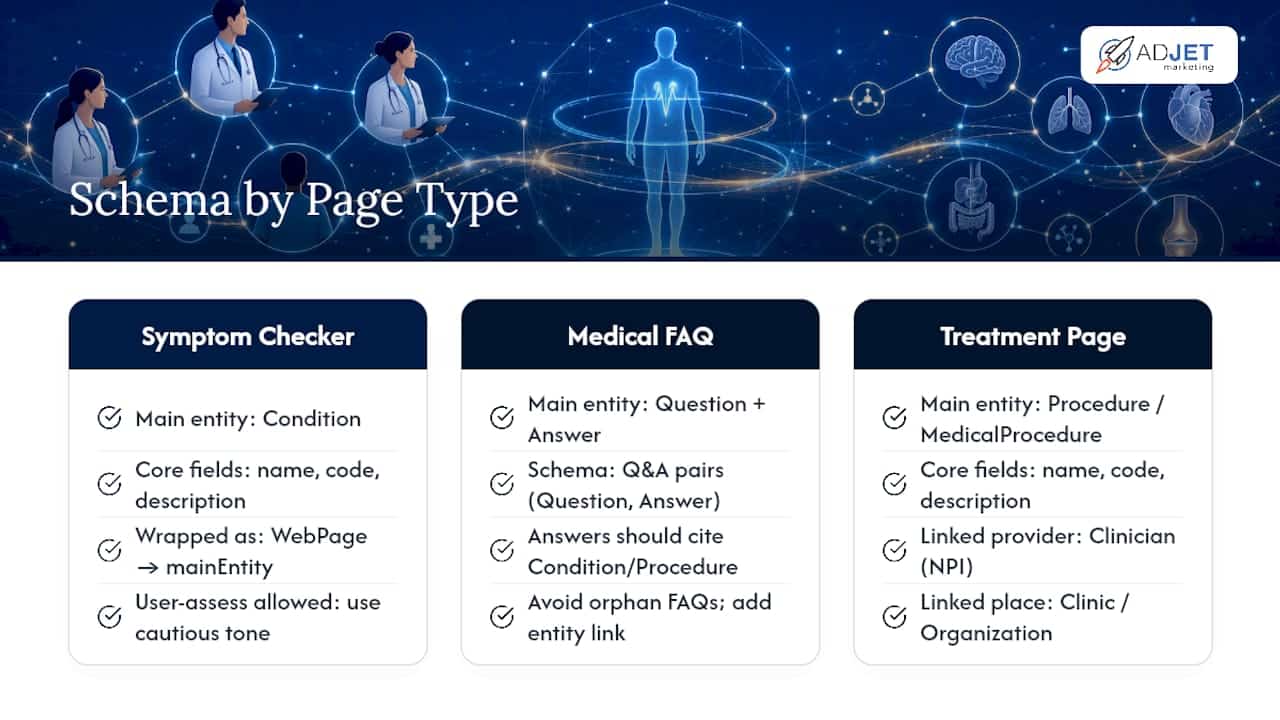
A symptom checker page, an FAQ page, and a treatment page each need a different schema shape, even though they might share the same MedicalCondition entity underneath.
On a symptom checker or condition page, the core block is MedicalCondition with signOrSymptom, possibleTreatment, and riskFactor populated, wrapped in a MedicalWebPage that carries lastReviewed and reviewedBy. If the page lets users self-assess symptoms, keep the language cautious in both the visible copy and the schema description, since overstating certainty here is a direct YMYL risk.
On a medical FAQ page, FAQPage schema pairs each question with an acceptedAnswer, but the answers themselves should still reference the relevant MedicalCondition or Drug entity by @id where a claim needs backing. A generic FAQ about “how long does recovery take” tagged with no connection to the specific procedure entity gives search engines nothing to verify the claim against.
On a treatment page, the primary entity is MedicalProcedure or MedicalTherapy, with procedureType, preparation, and followup properties filled in, and a direct @id link to the Physician who performs the procedure and the MedicalOrganization where it’s offered. This is the page type where the entity chain matters most, since a treatment claim without a linked, credentialed provider is the weakest form of medical content from a trust standpoint.
Each of these patterns reuses the same underlying entities. That’s the point: build the clinician and organization data once, then reference it everywhere it’s relevant instead of rebuilding it per page.
How Should Multilingual Healthcare Sites Handle Medical Schema?
Translate the visible schema property values, like name and description, into each language version of the page, but keep code values in their original controlled vocabulary regardless of language. ICD-10 code M72.2 for plantar fasciitis doesn’t change between an English and Spanish page. Only the human-readable label does.
Pair each translated page with hreflang tags pointing to its language variants, and give each language version its own MedicalWebPage block rather than trying to stuff multiple languages into one schema instance. If your Spanish-language condition page and English-language condition page describe the same underlying MedicalCondition, consider whether they should share an @id or maintain separate ones. Sites with genuinely distinct content per locale, not just a translated copy, generally benefit from separate entities to avoid signaling that one page is a duplicate of the other.
Watch sameAs links carefully in multilingual setups. A bilingual clinic with one physician should still point every language version of that physician’s bio to the same NPI and state board profile. Splitting credential links across language versions dilutes the entity signal you’re trying to build.
How Often Should You Update Medical Schema Markup?
Medical information changes. Treatment guidelines shift, drug interactions get reclassified, and clinicians move between practices. Schema that reflects last year’s clinical consensus is a liability, not an asset.
Set a review cadence tied to your content review cycle, not a separate schema-only process. When a clinician updates the medical accuracy of a condition or treatment page, the lastReviewed date in the MedicalWebPage schema should update in the same edit, not as an afterthought weeks later. If your CMS separates content editing from schema fields, that gap is exactly where stale data accumulates.
Clinician turnover deserves its own checklist item. When a physician leaves a practice, their Physician entity’s worksFor property needs updating everywhere it’s referenced, and any @id links from condition or treatment pages pointing to that clinician need reassignment to whoever now handles that care. Treat clinician data as a single source of truth that other schema blocks reference, so one update in one place propagates correctly instead of requiring a manual hunt across dozens of pages.
Does Medical Schema Actually Move Search Performance?
The mechanism is straightforward even without a universal benchmark: structured data gives search engines and AI systems a verified, machine-readable version of a claim instead of an inference drawn from unstructured text. Pages eligible for rich results, FAQ accordions, or featured snippets tend to occupy more visual space on a results page, which is the main lever behind any click-through improvement.
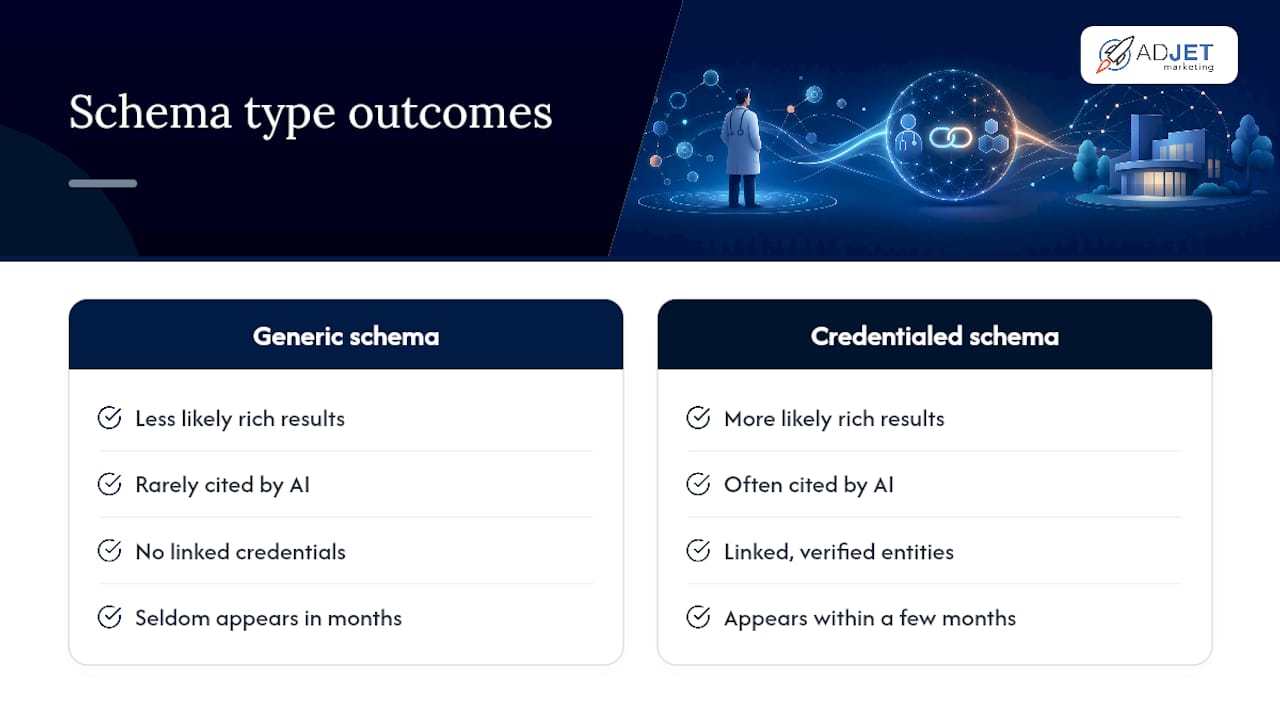
For AI-generated answers specifically, the effect compounds. A structured data guide covering more than 30 rich result types makes the case that structured markup is increasingly the raw material AI systems pull from when assembling an answer, since it’s far easier for a model to extract a verified MedicalCondition entity than to parse ambiguous prose. Pages with chained, credentialed schema are the ones most likely to get quoted or cited when a user asks an AI assistant a health question.
We’ve seen this pattern show up in a practical way with clinic clients: pages that had generic Article schema and a byline with no credential links rarely showed up in AI-generated health summaries, while comparable pages rebuilt with MedicalCondition and linked Physician entities started appearing in those summaries within a few months of the update. That’s not a guaranteed outcome for every site, and timelines vary based on how competitive the specialty is, but the direction of the effect is consistent with how these systems are built to weigh verifiable structured claims over unstructured text.
Agency Perspective: Timelines, Budgets, and Real Obstacles
A full schema rollout usually runs in three phases: a two to three week audit mapping page types to schema gaps, a phased implementation running four to eight weeks depending on site size, then ongoing monitoring. Small fixes, like adding code values to existing condition pages, cost far less than an architectural rebuild connecting clinician entities site-wide.
The real blockers are rarely technical. Legacy CMS platforms without JSON-LD support and fragmented clinician data spread across three different systems slow rollouts more than the schema syntax itself. Many clinics come to us after who had a previous vendor add generic schema that validated fine but never linked to a credentialed clinician, which meant it did nothing for YMYL trust signals. Fixing that gap is usually where the real work begins.
— Felix
How AdJet Marketing Can Help
Some agencies offer technical schema audits that map every condition, treatment, and clinician page against the properties Google and AI systems reward, then implement JSON-LD with proper code references and Physician entity linking. They may also build monitoring layers, tracking Search Console structured data reports to catch errors before they affect visibility.
The goal isn’t rich snippets alone. It’s better organic and AI visibility that translates into measurable booking attribution, a result clinics can tie back to marketing spend. If your site’s schema was set up years ago, or never touched at all, see how AdJet Marketing’s medical marketing services can fit into a broader plan, and reach out for an audit to see exactly where your current markup stands.
Sources
Start with Schema.org’s medical types documentation and the MedicalEntity type page, test markup with Google’s Rich Results Test, and review USCDI standards to keep clinical data separate from web schema.
This article is general information, not a substitute for advice from a qualified doctor. Consult a qualified healthcare professional about your own circumstances before acting on anything here.
- Health and medical types
FAQ
What Is a Schema Markup Example for a Medical Page?
A basic example is a MedicalCondition block with name, code (referencing ICD-10 or SNOMED-CT), and possibleTreatment linked by @id to a MedicalTherapy entity, all wrapped in a MedicalWebPage script tag.
How Is SEO Used in Healthcare?
Healthcare SEO combines technical work like medical schema markup and site speed with content strategy, local optimization for clinic locations, and credential-backed authorship to meet Google’s YMYL standards. It works alongside paid channels like Google Ads, not instead of them, since organic visibility typically takes months to build while ads can generate leads immediately.
Is Schema Markup Still Relevant?
Yes. Structured data remains a primary way search engines and AI systems verify and extract claims from a page, and its role has grown as AI-generated answers increasingly rely on machine-readable entities rather than parsing unstructured text.
How Do I Know if My Website Has Schema Markup?
Run any page through Google’s Rich Results Test or view the page source and search for a <script type="application/ld+json"> tag; if none appears and no rich results are flagged, the page likely has no structured data at all.
Does AdJet Marketing Implement Medical Schema for Clinics?
Yes, technical schema audits and JSON-LD implementation, including Physician credential linking, are part of Adjetmarketing’s medical marketing services for clinics and healthcare practices.