









For a medical website, E-E-A-T means showing Google, and the patient reading the page, that a real, qualified person or organization stands behind every health claim. Google treats health content as high stakes, so clinics are held to a higher standard than most businesses. The practical answer is to put visible credentials, named authors and reviewers, cited sources and honest practice details on every page that discusses treatment, and to keep those pages current.
This guide is for medspas, plastic surgeons, therapists and counselors, pain and psychiatry clinics, imaging centers, and other practices that publish content about health or services that affect patients’ decisions. It covers what Google’s guidelines say, what they do not say, and what to change on your site.
TL;DR
- E-E-A-T stands for experience, expertise, authoritativeness and trustworthiness. Google says trust is the most important of the four.
- E-E-A-T is not a single ranking factor. Google’s systems use a mix of signals that identify it, and those signals count for more on health topics.
- Medical pages should name who wrote them, show the credentials of the clinician who reviewed them, cite real sources and carry a review date.
- Raters do not control rankings. Your goal is a site a cautious patient would trust, which is also what the guidelines describe.
- Trust builds over months of consistent work, so plan for a steady program rather than a one-time cleanup.
Table of Contents
- What E-E-A-T Stands For and Where It Comes From
- Why Medical Sites Face a Higher Bar
- What E-E-A-T Is Not
- How to Show Each E-E-A-T Signal on a Clinic Site
- A Page-by-Page Audit You Can Run This Month
- What Each Type of Practice Should Prioritize
- Common E-E-A-T Mistakes on Clinic Websites
- Realistic Timelines and Expectations
- Our Perspective
- How We Help Clinics Put This Into Practice
- FAQ
- Sources
What E-E-A-T Stands For and Where It Comes From
E-E-A-T is Google’s shorthand for experience, expertise, authoritativeness and trustworthiness. It began as E-A-T. Google added the extra E for experience in December 2022 in its updated rater guidelines, to better judge content created from first-hand involvement, such as having used a product or visited a place.
The four parts mean this in plain terms:
- Experience: the author has done or lived what they describe. For a clinic, that is a provider describing procedures they perform, or a therapist describing the process they guide patients through.
- Expertise: the author has the knowledge or training the topic requires, such as a license, board certification or years of practice.
- Authoritativeness: the author or the site is recognized as a go-to source on the topic, by patients, peers and other reputable sites.
- Trustworthiness: the page is accurate, honest, safe and reliable. Google’s Search Quality Rater Guidelines define trust in those terms. Rater guidelines are the manual Google gives human reviewers to judge search quality.
Google’s documentation also says content does not have to show all four. Experience may matter most on one topic and formal expertise on another. Trust is the one that holds the rest together.
Why Medical Sites Face a Higher Bar
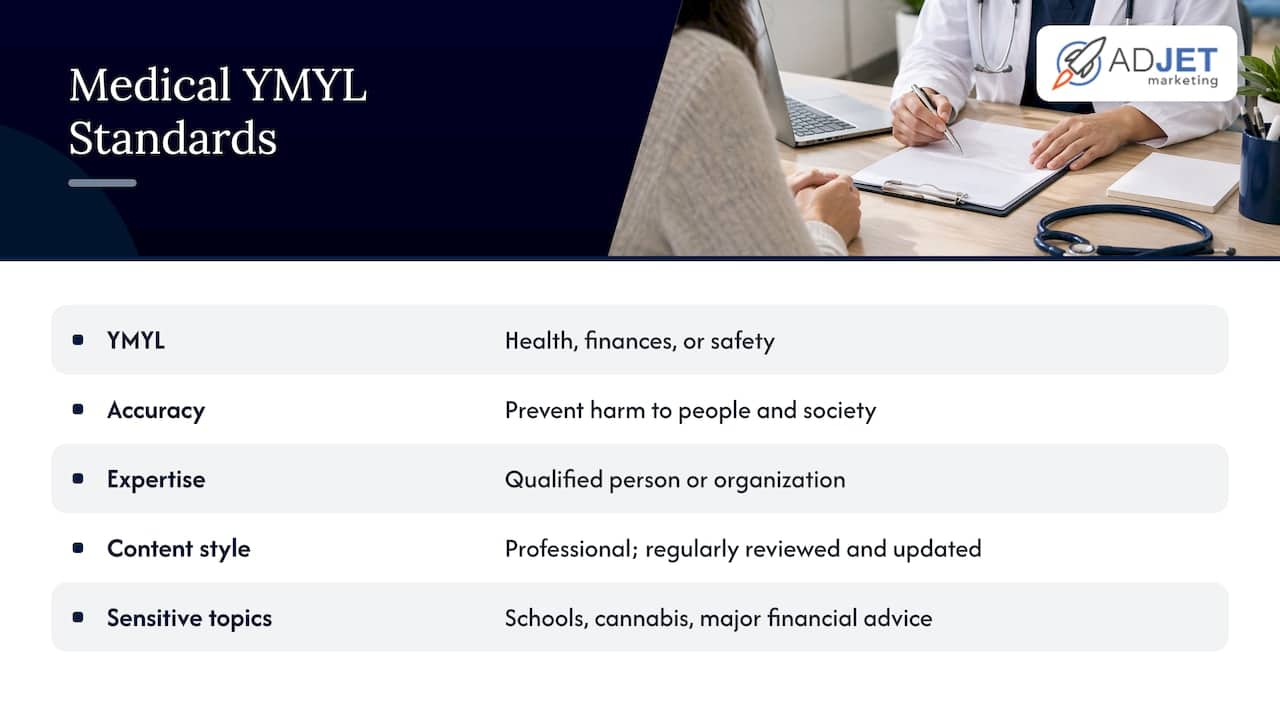
Google groups topics that could affect a person’s health, financial stability or safety under the label YMYL, short for Your Money or Your Life. Medical advice sits squarely in that group. The rater guidelines say informational pages on clear YMYL topics must be accurate to prevent harm to people and society. They also say high-quality medical advice should come from a person or organization with appropriate medical expertise, written in a professional style, and be regularly edited, reviewed and updated.
Google has explained the reasoning publicly. In 2020, Danny Sullivan wrote that sites with authoritativeness and expertise are less likely to publish false or misleading information, which is why those signals are a key defense against low-quality content on health and finance topics. The most recent rater guidelines were published on September 11, 2025, and that edition updated the YMYL definitions and added examples, including some involving AI Overviews.
For a clinic, the consequence is direct. A blog post about Botox aftercare, a page on how ketamine therapy works, or a guide to spinal injections is judged against a stricter standard than a post about your office hours.
This also reaches beyond obvious medical pages. A private school’s admissions or special-needs pages, a cannabis retailer’s dosing and safety pages and a real estate agent’s guidance on major financial decisions can all fall into sensitive territory. The same habits apply: name who is speaking, show why they are qualified and keep information accurate.
What E-E-A-T Is Not
Two misunderstandings cost clinics time and money.
It is not a score. Google’s documentation says E-E-A-T is not a specific ranking factor. Its automated systems use a mix of factors that can identify content with strong E-E-A-T, and those factors are weighted more heavily for YMYL topics.
Raters do not decide your rankings. Google states that raters have no control over how pages rank and that their data is not used directly in its ranking algorithms. Their feedback helps Google judge whether its systems are working as intended.
So there is no E-E-A-T plugin, badge or schema field that earns trust by itself. The guidelines describe what a trustworthy page looks like, and the work is to make your site match that description honestly.
How to Show Each E-E-A-T Signal on a Clinic Site
Experience: show the work is real
Google describes experience as first-hand involvement, such as using a product, visiting a place or communicating what someone went through. For a practice, that looks like:
- Provider-written explanations of what a procedure or session is actually like, from consultation to follow-up.
- Real photos of your treatment rooms, your equipment and your team, not stock images.
- Patient stories used with proper written authorization. If you handle protected health information (PHI), get this right before publishing anything, and keep it out of tracking tools and forms that are not set up for it.
- Before-and-after results only where your regulatory and consent obligations are met.
Expertise: name the people and their credentials
Google’s documentation points creators to clear authorship, with bylines that link to author or About pages, and to evidence of expertise. The National Institutes of Health Office of Dietary Supplements gives similar advice to consumers evaluating health sites: they should look for who is responsible for the site, the credentials of the people who prepared or reviewed the material, and the evidence behind the facts. That is the checklist your patients are being taught to use.
In practice:
- Add a byline and a short bio to each treatment or condition page, with license type, specialty, school or board certification and years in practice.
- Show a “medically reviewed by” line with the reviewer’s name and credentials, and link it to their bio page.
- Do not invent authors or credentials. Google warns that fabricated creator profiles, including AI-generated headshots, made-up names and false credentials, are deceptive and make pages untrustworthy.
Authoritativeness: be the recognized source locally
Authority is what others say about you. For a practice, it usually comes from:
- Consistent, accurate listings across your Google Business Profile, professional directories and state licensing records.
- Reviews from real patients, responded to professionally and without disclosing patient information.
- Mentions or links from hospitals, associations, local news and professional bodies you actually work with.
- Speaking, teaching or published work by your clinicians.
This is slow to build, and it cannot be bought in bulk. Google’s spam policies say techniques meant to manipulate Search can lead to lower rankings or removal from results, so shortcuts here carry real risk.
Trustworthiness: make accuracy and honesty obvious
Trust is where most clinic sites have the easiest gains. The NIH guidance recommends that health sites cite the medical and scientific evidence behind their facts, separate opinion from evidence-based information, and post a recent review or update date, even if the content has not changed. The Stanford Web Credibility Project makes complementary points: show that a real organization stands behind the site, for example with a physical address and photos of the office, and show the people behind it through employee bios and photos.
Translated into a checklist:
- Full practice name, address, phone number and hours on every page footer.
- A privacy policy and, where relevant, clear information on how patient data is handled.
- Citations to government agencies, journals and professional associations for every clinical statement.
- A last-reviewed date on every medical page, updated when a clinician actually reviews it.
- A secure site with working forms, clear pricing language where you can offer it and no misleading claims about outcomes.
A well-built treatment page does this in one place. A page that explains medical weight management in plain terms, names the services and describes what the patient can expect is a good model for the structure patients look for.
A Page-by-Page Audit You Can Run This Month
Start with the pages that discuss treatments, conditions, medications or outcomes. Work through them in this order:
- List every page that makes a health claim. Include blog posts, service pages and FAQs. Many sites find old posts written years ago with no author.
- Assign an author and a clinical reviewer to each. If no one qualified can stand behind a page, rewrite it or remove it.
- Check each claim against a primary source. Replace weak or outdated citations with government, academic or professional-association pages, and link them where the claim appears.
- Add the review date and author bios. Make the bio pages real, with credentials, photos and a way to verify the license.
- Fix the basics. Confirm address, phone number, hours and business name match across your site and profiles.
- Remove or soften promises. Language that guarantees results or compares you to others without support damages trust with both patients and Google.
- Set a review schedule. High-risk pages, such as medication, injectable and procedure pages, deserve a regular clinician review. Pick an interval you can keep.
This is also the point where technical and content work meet. Authorship markup, clean page structure and fast loading support the signals above, and our guide to medical website technical SEO covers that side. Content planning is covered in our look at content marketing in healthcare.
What Each Type of Practice Should Prioritize
| Practice type | Strongest signal to build first | Practical move |
|---|---|---|
| Medspa and aesthetics | Experience and trust | Provider bios with injector credentials, real treatment-room photos, clear consent and safety information |
| Plastic surgeon | Expertise | Board certification stated and verifiable, surgeon-written procedure pages, reviewed recovery information |
| Therapist, counselor, psychiatry | Expertise and trust | Licensure and state shown, clear scope of practice, crisis resources on relevant pages |
| Pain management | Expertise and accuracy | Physician review on every condition and procedure page, cited evidence, a review date |
| Imaging center | Trust | Plain explanations of each scan, preparation and safety, referral and insurance information |
| Private school | Trust and authority | Named leadership and faculty, accreditation information, accurate policy pages |
| Cannabis retailer | Trust | Licensing details, accurate product and safety information, no unsupported health claims |
| Real estate agent | Experience and authority | Local transaction experience, licensing, market knowledge shown in agent-written pages |
In each row, the pattern is the same: someone real, qualified and identifiable stands behind the page.
Common E-E-A-T Mistakes on Clinic Websites
- Unsigned content. Posts attributed to “admin” or “the team” give neither Google nor patients a person to trust.
- Content written for keywords, not patients. Google’s documentation describes people-first content. Pages stuffed with phrases and thin on substance do not read as expert work.
- Unreviewed AI text. The documentation says auto-generated or uncurated AI text represents little to no effort, one of the four attributes raters consider alongside originality, skill and accuracy. Any AI-assisted draft needs a clinician’s edit and fact check.
- Outdated treatment information. A page that describes a protocol that has changed hurts trust even if the rest of the site is strong.
- Overpromising. Phrases about guaranteed results or cures contradict the accuracy standard for YMYL pages and can run into FDA and FTC rules on health claims.
- Hiding the practice. No address, no staff pages and no way to verify a license make a site look anonymous.
Realistic Timelines and Expectations
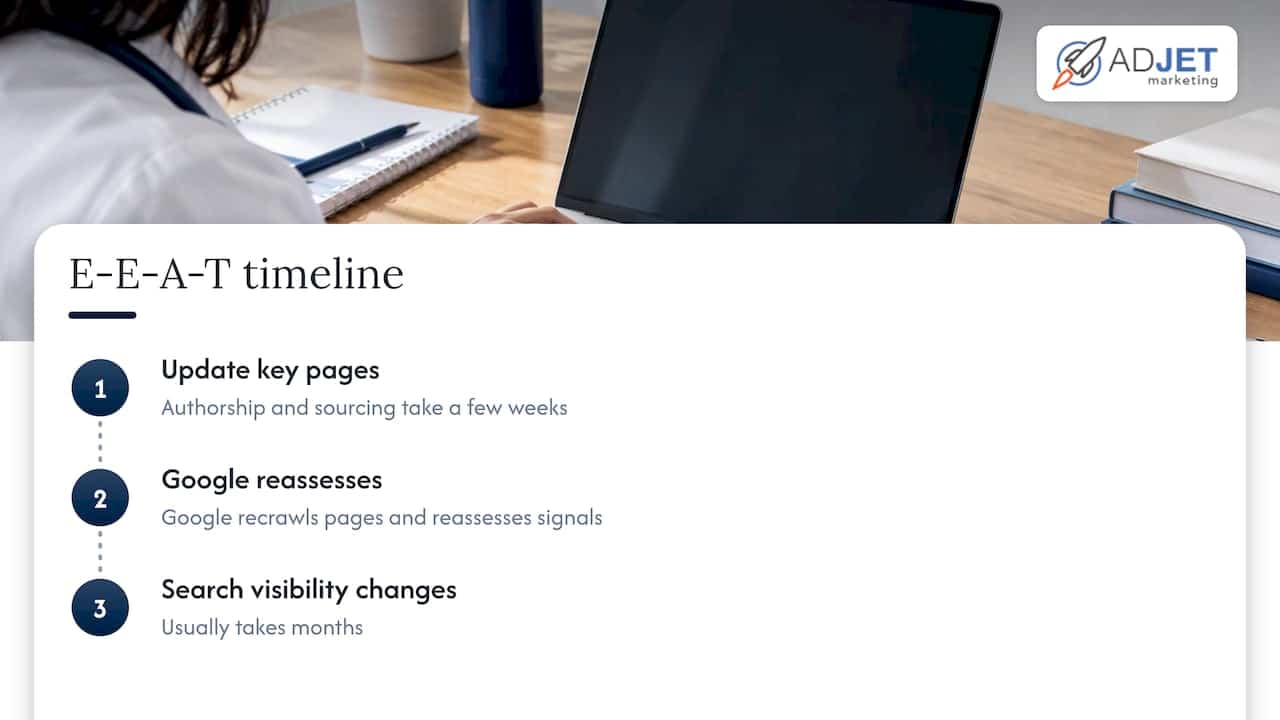
E-E-A-T work is not a switch. Updating authorship and sourcing on your key pages can take a few weeks. The effect on search visibility usually takes months, because Google needs time to recrawl, reassess and see signals from the wider web, such as reviews and mentions, accumulate. No one can promise a specific ranking or lead number from this work, and you should be wary of anyone who does.
The benefit also is not limited to search. A patient who reads a clear bio, sees a reviewed date and finds sources behind a claim is more likely to book. That is why this work pairs well with conversion optimization and with the basics of healthcare SEO.
Our Perspective
We approach E-E-A-T as a trust problem before it is an SEO problem. Clinics worry about two things at the same time: being found and staying compliant. In our experience those goals support each other. A page with a named clinician, a clear scope and a cited source is easier to defend to a patient, easier to keep compliant and easier for Google to understand.
That is why our work with healthcare and service businesses combines SEO, Google Ads, website design and conversion work with HIPAA-compliant processes. Trust signals that live only on paper do not help. They have to be built into the pages, the forms and the way leads are handled.
Our advice to owners is practical. Start with the pages that matter most to revenue, put real names and credentials on them, cite real sources, and set a review date you can keep. Then build outward: reviews, local mentions, clinician-written content. Expect it to take months, and treat any promise of fast results with caution.
Felix
How We Help Clinics Put This Into Practice
If you would rather not rebuild authorship, sourcing and page structure on your own, our SEO service is built around healthcare and local service businesses, and we are a Google Partner agency. For practices that need a site designed with these trust elements from the start, our custom branded websites start from $249 per month.
FAQ
Is E-E-A-T a ranking factor for medical websites?
No. Google says E-E-A-T is not a specific ranking factor. Its systems use a mix of factors that identify content with strong E-E-A-T, and those factors carry more weight for health topics, so the practical effect on medical sites is larger than on most others.
Do I need a doctor to review every page?
Pages that give medical, treatment or safety information should be written or reviewed by someone with appropriate credentials. Google’s guidelines say high-quality medical advice should come from a person or organization with medical expertise and be regularly reviewed and updated. Pages about parking or office hours do not need clinical review.
Does E-E-A-T apply to therapists, schools and cannabis retailers?
Yes, to the extent they publish information that could affect someone’s health, safety or major decisions. The signals are the same: named authors with credentials, accurate sourcing, clear business details and honest claims. The strongest emphasis depends on your field.
How long does it take to see results?
Site changes can be made in weeks, but search visibility typically responds over months as Google recrawls pages and the wider web reflects your reputation. Results vary by market and competition, so plan for a sustained effort.
What changed in Google’s most recent guidelines?
The current Search Quality Rater Guidelines were published September 11, 2025. They updated YMYL definitions and added examples, including some for AI Overviews. The core idea, that trust is central and high-stakes topics need more care, did not change.
Sources
- Creating Helpful, Reliable, People-First Content, Google Search Central
- Our latest update to the quality rater guidelines, Google Search Central Blog
- Search Quality Evaluator Guidelines, Google
- How Google delivers reliable information in Search
- How To Evaluate Health Information on the Internet, NIH Office of Dietary Supplements
- The Web Credibility Project: Guidelines, Stanford University
- Spam Policies for Google Web Search