









A lead magnet for a clinic is a free, useful resource, such as a procedure guide, a pre-visit checklist or a short assessment, that a prospective patient receives in exchange for contact details. The best ones answer one specific question a person asks before booking, and they ask for only what you need to follow up. Done well, they turn anonymous website traffic into inquiries from people who already understand what you do. Done carelessly, they collect the wrong leads or create privacy exposure.
This guide covers what works for medspas, plastic surgeons, therapists, pain clinics, imaging centers and similar practices, how to build a magnet from content you already have, and where HIPAA changes how you collect and use the information.
TL;DR
- Pick a lead magnet that answers one decision-stage question, such as cost, recovery, what the first visit involves or how to prepare. Broad “ultimate guides” attract browsers, not patients.
- Build from content you already own: service pages, FAQs, intake instructions and aftercare sheets.
- Keep the form short. Name, email and preferred contact method are usually enough. Never ask for symptoms or health details in a sign-up form.
- HIPAA generally requires written authorization before protected health information is used for marketing, and tracking tools on pages that handle health information carry real risk.
- A magnet only works with a dedicated landing page, a clear follow-up routine and a way to see which leads became appointments.
Table of Contents
- What a lead magnet does for a clinic
- How to choose the right lead magnet
- Lead magnet ideas by type of practice
- Build the magnet from content you already have
- Privacy and HIPAA: what to settle before you collect anything
- Build the landing page that carries the magnet
- Promote the magnet and follow up
- Perspective
- Where AdJet can help
- FAQ
- Sources
What a lead magnet does for a clinic
Most people who visit a clinic website are not ready to book. They are comparing options, checking prices, or trying to understand whether a treatment fits their situation. A lead magnet gives them a reason to share an email address or phone number now, so you can continue the conversation when they are ready.
For a clinic, that has three practical effects:
- It captures visitors who would otherwise leave. Paid clicks and search traffic are expensive to earn, and a page that offers only “Book now” loses everyone who is not ready.
- It pre-qualifies. Someone who downloads a guide to preparing for a consultation about a specific procedure is a different lead from someone who downloads a general wellness tip sheet.
- It builds trust before the first visit. A clear, honest resource shows how you explain things, which matters in sensitive services like mental health, pain management and cosmetic surgery.
One point of realism: a lead magnet does not create demand. It converts demand you already attract through search, ads, referrals or social media. If you are still building that traffic, our guide to patient lead generation for clinics covers the wider picture.
How to choose the right lead magnet
The common mistake is choosing a format first (an ebook, a quiz) and then inventing content to fill it. Reverse the order.
- Start with the question. List the five questions prospective patients ask most before booking. Your front desk and intake team already know them: Will it hurt? How much does it cost? How long is recovery? Do I need a referral? What happens at the first appointment?
- Match the question to the service value. A high-value service like a surgical consultation can support a more substantial resource. A lower-priced recurring treatment may only justify a short checklist or a first-visit offer.
- Choose the lightest format that answers it. A one-page checklist often outperforms a 30-page ebook because it is read.
- Make sure it leads somewhere. Every magnet should point to one next step: a consultation request, a call, or a booking page.
- Check the privacy implications before you build. Some formats, like symptom quizzes, invite people to submit health information. Decide in advance how that data will be handled.
Signs a magnet attracts the wrong leads
- It offers a discount or giveaway unrelated to your services, so sign-ups come from people who only want the freebie.
- It is so general that it could be sent by any clinic in any specialty.
- It asks for too much information up front, which depresses sign-ups, or too little, which makes follow-up impossible.
Many clinics come to us after months of paying for leads that never answer the phone. In our experience the cause is usually a mismatch between the promise of the offer and the service the clinic wants to sell, not the ad platform.
Lead magnet ideas by type of practice
The table below pairs common practice types with formats that fit how their patients decide. Treat these as starting points and adapt the wording to your own services and state rules.
| Practice | Lead magnet idea | Why it fits |
|---|---|---|
| Medspa and aesthetics | Treatment guide with what to expect, downtime and aftercare; a “before your first appointment” checklist | Visitors compare treatments and worry about results and recovery |
| Plastic surgery | Procedure planning guide with consultation questions to ask a surgeon; recovery timeline | Long decision cycles reward a resource people can return to |
| Therapists, counselors, psychiatry | “What to expect in your first session” guide; how to choose a therapist; how insurance and self-pay work at your practice | Reduces the anxiety of reaching out; avoids asking for clinical details |
| Pain management | Guide to the consultation process and the questions to bring; a symptom-tracking worksheet patients keep for themselves | Gives people something to do before the appointment |
| Imaging centers | Preparation checklist by scan type; how to get a referral and an order; what to bring | Practical, low-friction, and aimed at people already told they need a scan |
| Private schools | Admissions timeline checklist; tour-day question list | Parents plan around deadlines and want a clear process |
| Cannabis retailers | Educational product-category guide for adults in a state where sales are legal; store visit guide | Answers first-timer questions; keep within your state’s advertising rules |
| Real estate agents | Local market snapshot; buyer or seller prep checklist | Offers value tied to a specific decision and area |
| ADA therapists and similar services | Intake process guide; what a first assessment covers | Sets expectations for a service many people have not used before |
A few of these deserve a note.
Checklists and prep guides are the safest and often the strongest format for clinics. They help the reader act, they are cheap to produce, and they do not require the reader to disclose health details.
Quizzes and assessments can convert well, but they are the format most likely to collect sensitive information. If you use one, keep the questions general and the results educational. Do not ask for diagnoses, medications or symptoms in an open form.
Free consultations and first-visit offers work as a magnet, though they are closer to a direct offer than a content resource. They suit services where the first appointment is the real hurdle.
Webinars and live Q&A sessions suit procedures that need more explanation, and the recording can be reused as content.
Build the magnet from content you already have
You rarely need to start from a blank page. Audit what the practice already publishes and look for material that answers a decision-stage question.
- Service pages. Pull the explanation of how a treatment works and who it suits into a short guide.
- FAQ sections. A page of 10 questions becomes a printable “questions to ask at your consultation” sheet.
- Intake and preparation instructions. The handout you give new patients is often a ready-made checklist. Put it online before the visit.
- Aftercare sheets. Turn them into a recovery guide that prospective patients can read to see what the process looks like.
- Blog posts. Combine three or four related posts into one organized guide with a clear introduction and a next step.
Have the clinical team review the final text so that it is accurate, uses your approved language, and does not promise outcomes. For regulated services, avoid before-and-after claims or guarantees unless your compliance reviewer has cleared them. Our digital marketing guide for healthcare clinics explains how this sort of content fits into the rest of your marketing.
A simple build process
- Choose the question and the target service.
- Outline the answer in five to seven short sections.
- Draft using your existing pages, then rewrite for plain language.
- Have a clinician and your compliance contact review it.
- Design it as a clean PDF or a gated web page with your branding and a single call to action on the last page.
- Add a short thank-you page that tells people what happens next and how to reach you.
Privacy and HIPAA: what to settle before you collect anything
This is the part many marketing guides skip, and it is where clinics have the most to lose. The points below come from federal guidance. They are general information, not legal advice. For your specific forms and workflows, confirm the details with your compliance officer or healthcare attorney.
Marketing uses of patient information need authorization
HHS guidance explains that a covered entity (a health care provider, health plan or clearinghouse that falls under HIPAA) generally needs an individual’s written authorization to use or disclose protected health information for marketing. The exceptions are face-to-face communications and promotional gifts of nominal value. Covered entities also may not sell patient lists to third parties without each person’s authorization. You can read the rule in the HHS marketing guidance.
A state health authority’s privacy toolkit adds a useful definition: HIPAA treats marketing as a communication about a product or service that encourages people to buy or use it, and disclosing PHI for that purpose requires patient authorization under 45 CFR 164.508(a)(3), as the Washington State Health Care Authority toolkit explains.
What this means in practice:
- Do not mine your patient records to decide who gets a promotional lead magnet unless your compliance process allows it.
- Do not hand a contact list, even a clean-looking one, to an outside vendor without confirming the legal basis.
- Keep marketing lists for people who opted in through a form you control, and keep them separate from your clinical records.
Our article on patient email marketing covers what is allowed and what works once someone is on your list.
Keep the sign-up form minimal
The simplest way to lower risk is to collect less. A lead magnet form that asks for a first name, an email address and a preferred contact method gives you what you need to follow up. A form that asks “What condition are you seeking treatment for?” collects health information through a page that may also carry advertising and analytics scripts.
Good rules for forms:
- No free-text box that invites people to describe symptoms or conditions.
- No pre-checked consent boxes. State plainly what the person will receive and how often.
- Store submissions in a system your practice has vetted for health-related data, and know who has access.
Tracking tools on landing pages
The analytics and advertising pixels that make lead magnets measurable are also the main compliance hazard. HHS has stated that tracking technology vendors that create, receive, maintain or transmit PHI on behalf of a regulated entity are business associates, and the entity must have a signed business associate agreement with them. The details are in the HHS guidance on online tracking technologies.
In July 2023, HHS’s Office for Civil Rights and the Federal Trade Commission sent a joint warning to about 130 hospital systems and telehealth providers about tools such as the Meta pixel and Google Analytics. The notice also stated that companies not covered by HIPAA still have to protect against unauthorized disclosure of personal health information, which can violate the FTC Act and the Health Breach Notification Rule.
So the practical question for every landing page is: what does this page send to third parties, and could that include health information? A page for “first-session guide for anxiety counseling” tells an ad platform something about the visitor just by existing, which is a reason to review the setup rather than assume it is fine. If you want the technical detail, see our explainers on Meta Pixel and HIPAA and on GA4 setup and lead tracking for clinics.
Phone calls are another channel where lead data and health information mix. A call analytics privacy checklist shows the kinds of questions to ask about recorded calls and third-party processing, even though its framework is European.
Build the landing page that carries the magnet
A lead magnet that sits in a website footer rarely produces leads. It needs a dedicated page with one job.
A strong lead magnet landing page has:
- A headline that names the question the guide answers.
- Three to five bullet points on what the reader will learn.
- A short form with as few fields as possible.
- A visible way to call or book if the visitor is ready to skip the guide.
- Trust signals that your practice can support: credentials, licensure, location, real reviews with permission.
- A brief privacy note that explains how contact details are used.
Speed and mobile layout matter because most clinic searches happen on phones. Keep the page free of navigation links that lead away from the form. For a deeper look at page structure, read the role of landing pages in healthcare marketing and our guide to designing high-converting landing pages.
Promote the magnet and follow up
A magnet needs traffic, and traffic needs a plan.
Search. Place the magnet on service pages that already rank, using a short inline offer. Our guide to SEO strategies that boost patient leads explains how to choose the pages.
Paid ads. A well-matched magnet can lower the barrier for people who are not ready to book. Send ad traffic to the dedicated landing page, never to the home page. Plan for a testing period before you judge results, since small budgets need time to gather enough data.
Email and existing relationships. Mention the guide in your newsletter and at the end of related blog posts, within the consent rules above.
Social and community. Share excerpts, then link to the full guide.
The follow-up routine
The lead magnet is the start. What happens in the next 48 hours decides whether the lead becomes a patient.
- Deliver immediately. Send the resource by email as soon as the form is submitted.
- Send one helpful follow-up a few days later with a related answer and a clear way to book or call.
- Have a person ready to respond to replies and calls, during hours when people actually reach out.
- Do not send clinical advice by marketing email. Keep it educational and invite them to a consultation for personal questions.
- Make unsubscribing easy and honor it promptly.
Measure what matters
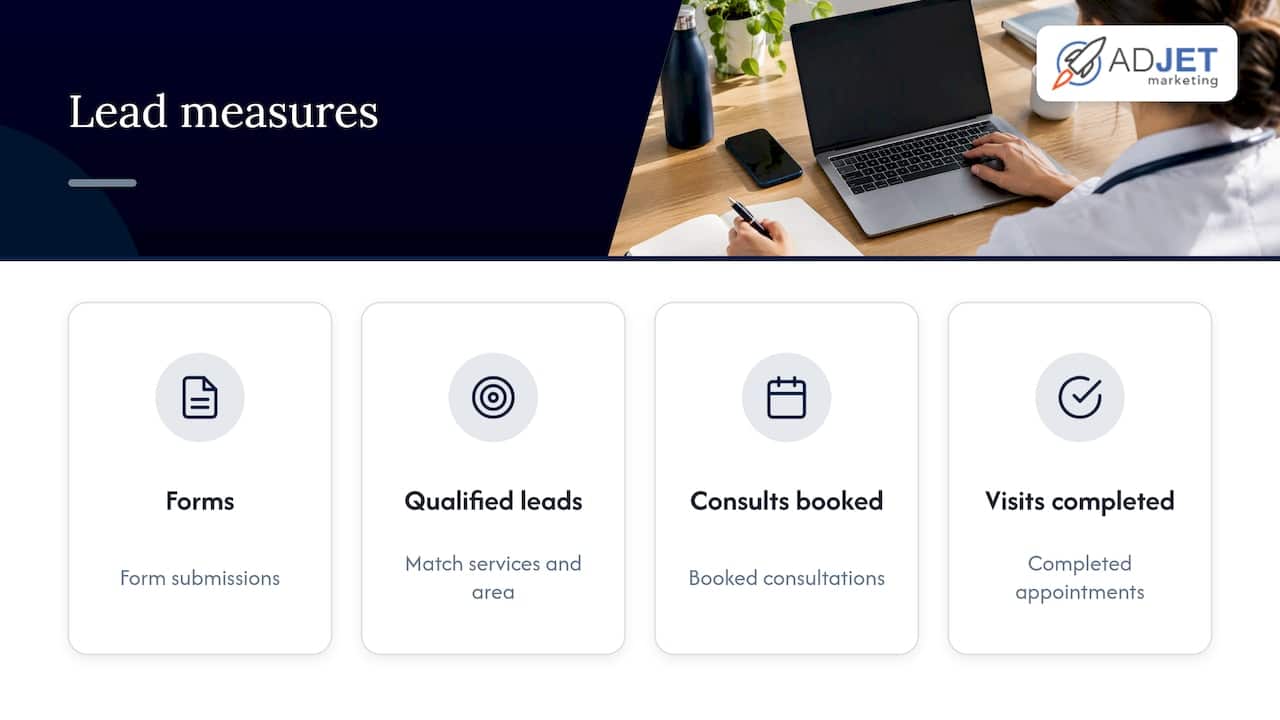
Sign-ups alone are a vanity number. Track four things: form submissions, qualified inquiries (people who match your services and area), booked consultations and completed appointments. If sign-ups rise but booked consultations do not, revisit the offer, the follow-up speed or the targeting before spending more.
Set expectations on timing as well. Organic search rankings take months to build, and paid campaigns need a learning period. Neither should be judged on the first week of data.
Perspective
We approach lead magnets from the clinic side of the desk, not the template side. The pattern we see again and again is a practice that collects a lot of sign-ups and books very few of them, because the offer was built to look attractive rather than to match a service the clinic wants to grow.
Our advice is to treat the magnet, the landing page, the ad and the follow-up as one system. A good guide on a weak page wastes the traffic. A strong page with an offer that does not match the ad wastes the click. And a tracking setup that nobody has reviewed for HIPAA can turn a good campaign into a liability.
That is why our processes are built around compliance from the start, and why we report on booked appointments rather than only form fills. We would rather tell you that a magnet needs another month of testing than hand you a spreadsheet of unanswered leads.
Felix
Where AdJet can help
If you want the landing page, the offer and the tracking built together, we are a Google Partner agency based in Texas working with medical clinics, aesthetic practices and other local businesses. Our landing page options include a Starter Plan at $299 per month, a Single Landing Page at $2,000 one-off, and a Premium Plan at $1,500 per month, all described on our landing page design page. Medspas can also see custom landing pages from $99 per month on our medspa marketing page. If your lead magnet needs traffic, we manage Google Ads and SEO for healthcare practices.
FAQ
What is the best lead magnet for a medical clinic?
There is no single best format, but a short checklist or first-visit guide tied to one specific service is the most dependable starting point. It answers a real question, it is quick to produce, and it does not require patients to share health details. Choose the question your prospective patients ask most often, then build the guide around it.
Can a clinic collect health information through a lead magnet form?
It is safer not to. Keep the form to name, email and contact preference, and avoid open text fields about conditions or symptoms. HIPAA rules on marketing and on tracking technologies are detailed, so have your compliance officer or healthcare attorney review any form that could capture health information.
Do lead magnets work for therapists and mental health practices?
Yes, when the content reduces the uncertainty of reaching out. Guides on what a first session looks like, how to choose a therapist, or how payment and insurance work suit these practices well. Avoid quizzes that ask for diagnoses or symptoms on a public page.
How long does it take to see leads from a lead magnet?
If you send paid traffic to a finished landing page, sign-ups can begin quickly, though you need a testing period to learn what converts. Organic traffic to the same page builds over months as search rankings develop. Judge the magnet on booked consultations over a few months, not on the first week.
Do I need a landing page for every lead magnet?
One dedicated page per magnet is the cleanest approach. It keeps the message consistent from ad or search result to form, and it lets you measure that offer separately. A shared page with several offers splits attention and muddies the data.
Sources
- Marketing | HHS.gov
- Use of Online Tracking Technologies by HIPAA Covered Entities and Business Associates | HHS.gov
- HHS Office for Civil Rights and the FTC warn hospital systems and telehealth providers about online tracking technologies, July 2023
- Washington Health Care Privacy Toolkit, HCA 60-0077