









Why your online reputation is the most critical asset you have as a realtor
Your online reputation determines whether a prospect calls you or your competition. That is not an exaggeration. 97% of consumers research businesses online before making contact with an agent, and the agents they contact first are the ones with strong review profiles on Google, Zillow, and Realtor.com.

The importance of online reputation for realtors goes beyond marketing. It functions as reputational capital, a filter that reduces perceived risk in a transaction that often involves hundreds of thousands of dollars. Clients read reviews carefully, look for patterns, and check multiple platforms before they ever pick up the phone.
Here is what the data shows about where the bar sits in 2026:
- Agents with very few reviews are routinely skipped, regardless of their actual track record.
- A rating above a certain positive threshold is the minimum for most prospects to take you seriously.
- Agents with many positive reviews rank in the top tier for local search visibility and buyer confidence.
- 88% of buyers return to the same agent or refer others, but only after finding strong reviews first.
Your digital presence on specialized platforms like Zillow and Realtor.com also feeds lead routing algorithms directly. More on that below.
How to ask for and manage client reviews effectively
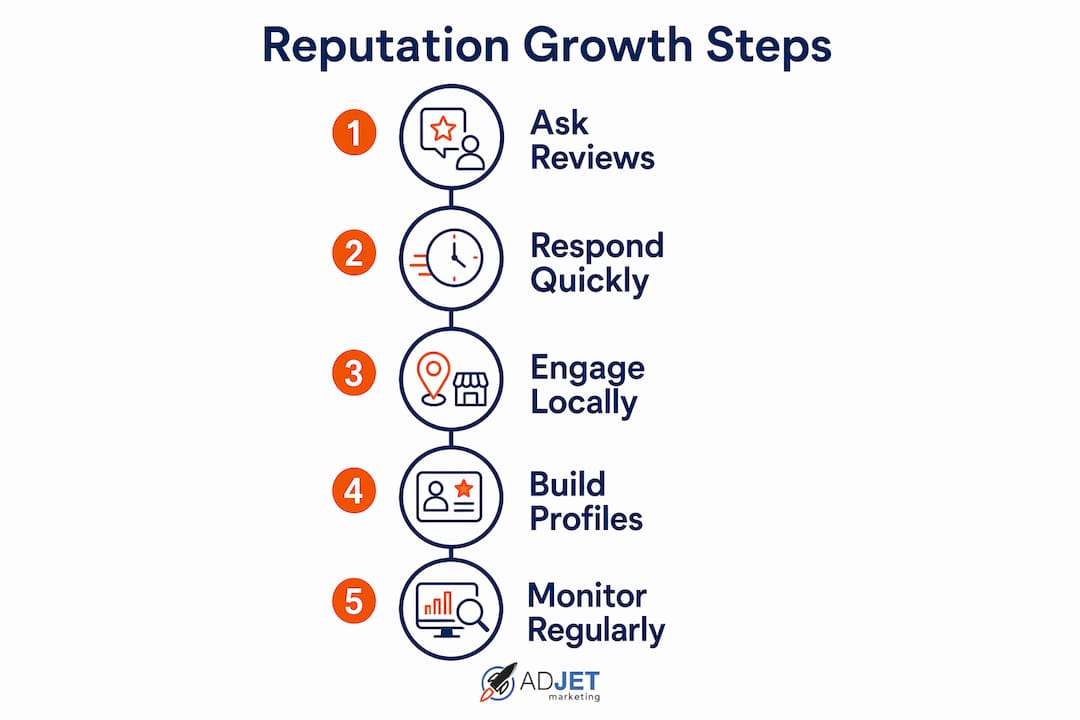
Asking for reviews is a skill, not a chore. The agents who build strong profiles treat review collection as a regular part of closing a transaction, not something they remember to do once a year.
- Ask at the right moment. The best time is within 48–72 hours of closing, when the experience is fresh and the client’s satisfaction is highest.
- Make the ask personal. A brief, genuine message explaining that you are building your online presence converts far better than a generic automated email. Past clients who had positive experiences typically respond well to a direct, honest request.
- Coach the content, not just the click. Generic five-star reviews (“Great agent!”) carry little weight. Guide clients toward mentioning the specific challenge you solved, what you did, and the outcome. Reviews that describe real situations (“she called us at 9 PM to walk us through the counteroffer”) are far more persuasive to prospects.
- Work your backlog. If you have closed 50 transactions but only have 8 reviews, you have untapped potential. A simple outreach to past clients asking for a review, if they were happy, can convert a meaningful portion of them.
- Keep it consistent. Reputation management is a daily sales activity, not a one-time project. An agent with 40 reviews from 2022 and nothing recent looks less active than one with 20 reviews from the past six months.
Pro Tip: Consolidating your review requests across Google, Zillow, and Realtor.com at the same time maximizes your profile freshness on all three platforms simultaneously, which matters for both search rankings and lead routing.
Responding to real estate reviews to build trust
How you respond to reviews tells prospects more about you than the reviews themselves. A thoughtful response to a complaint shows exactly how you handle conflict under pressure, which is precisely what clients are evaluating before they hire you.

For positive reviews: Acknowledge the specific detail the client mentioned. A response that references the actual transaction (“It was a pleasure helping you navigate that competitive multiple-offer situation”) reads as genuine rather than templated.
For negative reviews: Respond calmly, acknowledge the concern, and avoid any defensive language. Ignoring or responding defensively to a complaint causes more damage than the original review. Your goal is not to win the argument. It is to show every future prospect reading that thread that you are professional and solution-focused.
Common mistakes to avoid:
- Responding with excuses or shifting blame to the client.
- Leaving negative reviews unanswered for weeks.
- Copying and pasting the same response to every positive review.
- Deleting or flagging reviews that are critical but not policy-violating.
Pro Tip: Before responding to any negative review, check your brokerage’s compliance guidelines. Some state real estate commissions have rules about what you can disclose publicly about a transaction. Keep your response general and professional to stay within ethical and legal boundaries.
The long-term fix for a negative review is volume. An agent with 4 reviews and one bad one has a real problem. An agent with 80 reviews and one bad one looks human.
How a strong reputation directly impacts your real estate career
The financial case for reputation management is concrete. A higher average rating can lead to a significant increase in revenue. For a high-producing agent, moving from a lower star rating to a top rating could mean a substantial additional amount in business.
Beyond revenue, reputation shapes your entire career trajectory:
- Lead generation. More recent positive reviews improve your local search rankings, which drives more website traffic and inbound calls without paid advertising spend.
- Referral velocity. Even referral-based businesses depend on online reputation. When a friend recommends you, the first thing the prospect does is search your name. A thin or mixed profile kills warm referrals before they convert.
- Premium pricing. Agents with high reputation often command premium commission rates because clients see demonstrated value in proven expertise.
- Brokerage recruitment. Top brokerages check your online presence before recruiting. They want agents who generate business independently, and your review profile is the clearest signal of that.
- Team-building. If you plan to build a team or open your own brokerage, your personal reputation becomes the foundation of that business. Clients follow agents they trust.
Your reputation also protects you when things go wrong. Research on brand reputation and asset prices shows that reputation shocks can be large and persistent, with price discounts appearing immediately after a negative event. The same dynamic applies at the individual agent level. Building a strong profile before a problem occurs gives you a buffer that a thin profile cannot provide.
Key platforms every realtor needs to manage
Not all review platforms carry equal weight in real estate. Focus your energy where buyers and sellers actually look.
- Google Business Profile. This is your most important platform. When someone searches your name or “real estate agents near me,” your Google profile appears first with your star rating, review count, and recent activity. A well-maintained profile also improves your local search visibility directly.
- Zillow. Zillow’s Premier Agent program uses reviews for algorithmic lead routing, meaning adverse reviews suppress both your profile visibility and the volume of leads sent to you. A Zillow profile with 60 or more reviews and detailed sale history can generate consistent inbound leads on its own.
- Realtor.com. Buyers and sellers use Realtor.com specifically when evaluating agents. A strong profile here reinforces your credibility with clients who are already in active search mode.
- Facebook Recommendations. Your Facebook rating is visible to your social network, which overlaps heavily with your referral base. Local Facebook groups surface agent recommendations regularly, and your rating here affects how warm leads from your network convert.
- Yelp and agent directories. Yelp matters less in real estate than in hospitality, but it still appears in search results. Keep your profile claimed, accurate, and responsive.
The key principle across all platforms: build your own profile independent of your brokerage. If your brokerage closes or you change firms, you keep your reputation.
What the data says about reputation management effectiveness
Brand reputation statistically influences home purchase decisions, functioning as a prerequisite to winning listings and a key factor in buyer evaluation. The research confirms what agents already sense: clients are not just evaluating the property, they are evaluating you.
| Metric | What the data shows |
|---|---|
| Consumer research behavior | 97% of buyers research agents online before making contact |
| Revenue impact | A one-star rating increase drives a 5%–9% revenue gain |
| Referral behavior | 88% of buyers reuse or refer their agent after a positive experience |
| Lead routing | Zillow and Realtor.com use review scores to determine lead distribution volume |
| Review threshold | Agents below 15 reviews are routinely skipped by prospects |
Consolidating reviews and social signals across platforms improves visibility and trust without requiring manual check-ins on every site. Agents who treat reputation management as a daily sales activity rather than a quarterly project consistently outperform those who treat it as a one-time fix.
How your reputation shapes client trust at every stage
Trust is the product you are actually selling in real estate. The transaction is the house; the relationship is built on confidence that you will communicate honestly, solve problems, and protect the client’s interests under pressure.
Your online reputation is the evidence clients use to assess that confidence before they ever meet you. Reviews that describe specific behaviors (“he called us every step of the way during a difficult inspection period”) carry far more weight than star ratings alone. They give prospects a preview of what working with you actually feels like.
This trust dynamic also affects how quickly deals close. Clients who already trust you from your review profile spend less time second-guessing your advice, which shortens the decision cycle and reduces friction during negotiations.
Common reputation pitfalls that cost realtors business
Most reputation problems are self-inflicted. The patterns we see repeatedly:
- Ignoring Zillow in favor of Google. Buyers use Zillow specifically to evaluate agents. A thin Zillow profile loses leads you never even knew about.
- Treating reviews as a one-time project. An agent who collected 40 reviews in 2022 and stopped looks less active than one with 20 reviews from the last six months.
- Responding defensively to complaints. One poorly written response can do more damage than the original negative review.
- Relying entirely on your brokerage’s profile. If you move firms, you lose everything tied to that profile.
- Asking only your happiest clients. This creates a biased profile and misses honest feedback that could help you improve.
- No Google Business Profile at all. Some agents still operate without one. Without it, you are invisible in local search.
Using social media to protect and build your reputation
Social media does not replace review platforms, but it reinforces them. An agent with an active, professional presence on LinkedIn or Instagram looks more credible than one who last posted in 2021. Two or three quality posts per week showing local market knowledge and client success stories builds social proof over time.
Community engagement matters too. Being mentioned in local news, sponsoring neighborhood events, or staying active in local Facebook groups creates positive associations that are hard to manufacture through reviews alone. These signals give prospects context that you are embedded in the community they are moving into.
Regular social media activity also creates a content record that prospects review alongside your ratings. A consistent posting history signals that you are active, current, and invested in your market.
What separates agents with strong reputations from those without
The contrast between a well-managed and a neglected online reputation plays out in concrete business outcomes. An agent with 80 five-star reviews on Google will consistently out-earn a more experienced agent with 12 mixed reviews, even if the experienced agent is the better negotiator. The prospect never gets far enough to discover the difference.
Agents with strong profiles also attract better opportunities beyond individual clients. Top brokerages actively recruit agents with strong digital presence because those agents generate business independently. Agents with weak or absent profiles, regardless of their actual skill, limit their own career options at every stage, from landing their first client to building their own brokerage.
The gap between these two outcomes is not talent. It is consistency in managing reputation as a business asset rather than an afterthought.
Ready to turn your reputation into a lead generation engine?
At Adjetmarketing, we work with real estate agents to build the kind of digital presence that generates high-quality real estate leads consistently. From local SEO to digital marketing strategy, we help you show up where clients are already looking and convert that visibility into real business.
Key Takeaways
Your online reputation is your most measurable competitive advantage as a realtor, and agents who manage it consistently generate more leads, earn higher commissions, and attract better career opportunities.
| Point | Details |
|---|---|
| Review threshold matters | Agents with very few reviews are routinely skipped; an agent with 60 or more reviews can generate consistent inbound leads |
| Revenue impact is direct | A one-star rating increase drives a 5%–9% revenue gain, worth $100,000–$180,000 for a $2M producer. |
| Platform selection is critical | Google, Zillow, and Realtor.com each feed different lead sources and algorithms; all three require active management. |
| Responses build trust | How you respond to negative reviews signals your professionalism to every future prospect reading that thread. |
| Reputation is ongoing | Agents who treat review collection as a daily activity consistently outperform those who treat it as a one-time project. |