









The blog topics that work fall into five buckets: evergreen clinical explainers, client logistics and booking-friction posts, niche authority content for your specialty, timely or seasonal hooks, and interactive formats like journal prompts. If you write nothing else this month, publish one logistics post, something like “What to Expect in Your First Telehealth Session,” because it removes the exact hesitation that keeps a visitor from booking. Everything below gives you the templates and reasoning to keep that momentum going.
TL;DR:
- Blog topics should focus on specific client problems that are searchable and relevant to the target audience, not broad wellness themes.
- A balanced publishing ratio of approximately 70% evergreen clinical content and 30% logistics posts optimizes both visibility and conversion.
- Seasonal and timely posts tackling holiday stress, back-to-school anxiety, or awareness month themes should be published two to three weeks before peak moments.
- Niche-specific content that showcases your expertise, such as trauma grounding techniques or LGBTQ+ issues, helps build trust and differentiates your practice.
- Practical logistics content like first session expectations and insurance guides directly address barriers that prevent prospective clients from booking.
Table of Contents
- Why Blogging Matters for Therapy Practices
- How to Choose the Right Blog Topics for Your Practice
- Reliable Evergreen Therapy Blog Topic Ideas
- Timely and Seasonal Topic Ideas
- Niche Prompts by Specialization
- Client-Focused Topics That Actually Convert
- Formats and Templates You Can Copy
- AdJet’s Perspective: Common Patterns and Realistic Outcomes
- How AdJet Helps Therapists Turn Blog Traffic Into Booked Sessions
- Where to Learn More
- Sources
- FAQ
Why Blogging Matters for Therapy Practices
Prospective clients rarely book a therapist cold. They search their symptom or situation, read a few posts, and decide whether the person writing them sounds like someone they’d trust with something personal. A blog is often the first real conversation you have with a future client, even though they never send a message.
Blog goals split into two categories, and confusing them is the most common mistake practices make. Awareness content covers broad clinical topics that build your reputation and search visibility over time. Conversion content answers the practical questions that sit between “I think I need therapy” and “I just booked a consultation.” Both matter, but they do different jobs:
- Awareness posts widen your reach and establish clinical credibility.
- Conversion posts (fees, insurance, what a session looks like) close the gap between interest and action.
- Topic-specific, user-focused posts consistently outperform generic wellness pieces in engagement and return visits.
Practices that treat their blog as a marketing checkbox tend to publish the same recycled advice everyone else does. The ones that grow treat it as a filter, attracting the exact clients they want to serve.
How to Choose the Right Blog Topics for Your Practice
Start with your ideal client, not with a list of trending mental health hashtags. If you can’t name three specific problems that client typed into Google last week, you’re guessing.
- Map three common client problems. Pull them from actual intake calls, not assumptions. “Panic attacks at work” and “my teenager won’t talk to me” are searchable; “mental wellness” is not.
- Match each topic to a stage of intent. Awareness topics answer “what is this,” consideration topics answer “which approach helps,” and booking topics answer “how do I start.”
- Run a quick viability check before you write. Ask whether the topic has real search interest, whether it’s timely for your audience, whether it signals booking intent, and whether it lets you demonstrate real clinical expertise rather than generic reassurance.
- Set a publishing ratio. Aim for roughly 70% evergreen authority content and 30% bottom-of-funnel logistics posts, so you’re building long-term visibility while still converting people who are close to booking.
Pro Tip: Keep a running note in your phone titled “things clients say.” Half your best blog topics are sitting in your session notes disguised as ordinary conversation, not in a keyword tool.
This framework also keeps you from chasing every viral wellness trend, as seen in examples of content marketing that boost brand visibility. A well-aimed post about what blog topics attract high-intent patients will outperform a broad one about “self-care” almost every time, because it speaks to a person already looking for help.
Reliable Evergreen Therapy Blog Topic Ideas
Evergreen posts are the backbone of a therapist blog. They keep bringing in search traffic years after publication, and they’re what most new visitors read first when they land on your site.
Clinical explainers, reframed for clients (not colleagues):
- “How CBT Helps Panic Attacks at Work”
- “What Actually Happens in EMDR (No Jargon)”
- “Is Couples Counseling Worth It? What the Research Says”
Lists that validate a reader’s concerns before they ever call you:
- “7 Signs Your Anxiety Might Need Professional Support”
- “5 Signs of Burnout That Aren’t Just ‘Being Tired’”
- “When Sadness Becomes Depression: A Simple Checklist”
Coping skills and short interventions people can use immediately:
- A grounding exercise for panic attacks, written step by step.
- A “how to calm down before a hard conversation” script.
- A five-minute breathing sequence with a plain explanation of why it works.
Resource lists, structured as a short intro, then a clearly labeled list of books, apps, or workbooks, with one sentence on who each resource fits best. These consistently perform well because readers bookmark and return to them, and directories like GoodTherapy are worth referencing when you explain how clients can verify a therapist’s credentials or find specialists outside your practice.
Personal and professional reflections that build trust without oversharing. A post on why you chose your specialty, or what you wish more people understood about starting therapy, does more for rapport than another generic “benefits of therapy” listicle. The line to watch: reflect on your clinical philosophy, not your personal life. “Why I focus on trauma-informed care” works. “What my own therapy taught me” usually doesn’t belong on a professional site.
A few “hard to talk about” topics, handled carefully, also signal that your practice is a safe space. Writing about topics like sex in therapy can build trust with clients who feel embarrassed bringing up the subject elsewhere, as long as you pair it with clear scope-of-practice language and referral information when the topic sits outside your specialty.
Timely and Seasonal Topic Ideas
Seasonal posts give you a reason to show up in someone’s feed at exactly the moment they’re struggling, and they tend to get shared more than static evergreen content.
- November to January: Holiday family stress, grief during the holidays, New Year goal setting without the burnout (“Why ‘New Year, New You’ Sets You Up to Fail”).
- August to September: Back-to-school anxiety, for both kids and the parents managing it.
- April to May (finals season): Exam stress and academic pressure, especially for practices serving students or young adults.
- Awareness months (May for Mental Health Awareness, September for Suicide Prevention): Use these to publish something substantive, not a generic “let’s talk about mental health” post. If your topic touches suicide, self-harm, or trauma, include a content note at the top and a crisis resource line at the bottom every time.
Publish seasonal posts two to three weeks ahead of the moment they address. A back-to-school post that goes live in September has already missed the search spike.
Niche Prompts by Specialization
Generic advice reads as generic no matter how well it’s written. Specialty-specific posts are where you actually prove you understand the client in front of you.
Couples therapy:
- “The Communication Pattern That Predicts Divorce (and How to Break It)”
- “What a ‘Repair Attempt’ Looks Like After a Fight”
Trauma-informed care:
- “A Grounding Exercise for When Flashbacks Hit”
- “What a Safety Plan Actually Includes”
LGBTQ+ affirming care:
- “Coming Out Later in Life: What to Expect Emotionally”
- “Navigating Family Rejection Without Losing Yourself”
Teens and adolescents:
- “Is My Teen’s Screen Time a Symptom or the Problem?”
- “Social Anxiety in Teens: What Parents Miss”
Perinatal and postpartum:
- “Postpartum Rage Is Real. Here’s Why It Happens.”
Substance recovery:
- “What Relapse Prevention Actually Looks Like Day to Day”
Pro Tip: Any post touching self-harm, active addiction, or abuse needs two things every time: a brief content note near the top and a referral line at the bottom pointing to crisis resources or a higher level of care. Skipping this on one post while including it on another creates an inconsistency that reflects poorly on clinical judgment, not just SEO.
Client-Focused Topics That Actually Convert
Clinical content builds authority, but logistics content is what gets the phone to ring. Many clinician marketers find that answering practical “how do I book” questions outperforms even a well-written clinical explainer, because it removes the exact friction stopping someone from reaching out.
- “What to Expect in Your First Session” (write separate versions for in-person and telehealth, they’re different experiences).
- “Do You Take My Insurance? A Plain-English Guide to Fees, Insurance, and Sliding Scale.”
- “Telehealth 101: What You Need and How It Actually Works.”
- Every logistics post should end with a direct, low-pressure call to action linking to your booking or contact page. Don’t bury it in the sidebar.
Formats and Templates You Can Copy
You don’t need to reinvent the structure every time you sit down to write. A handful of reusable templates will carry most of your content calendar.
Headline templates worth reusing:
- “5 Signs You Might Need [Specialty] Therapy”
- “How to Start [Specific Coping Strategy] Today”
- “Is [Common Assumption] True? What Therapists Actually Think”
Interactive elements to build in: a short journal prompt at the end of a post, or a three-question self-check readers can answer before they finish reading. Content that includes journal prompts and interactive elements tends to hold readers longer and bring them back, which also helps your search rankings over time.
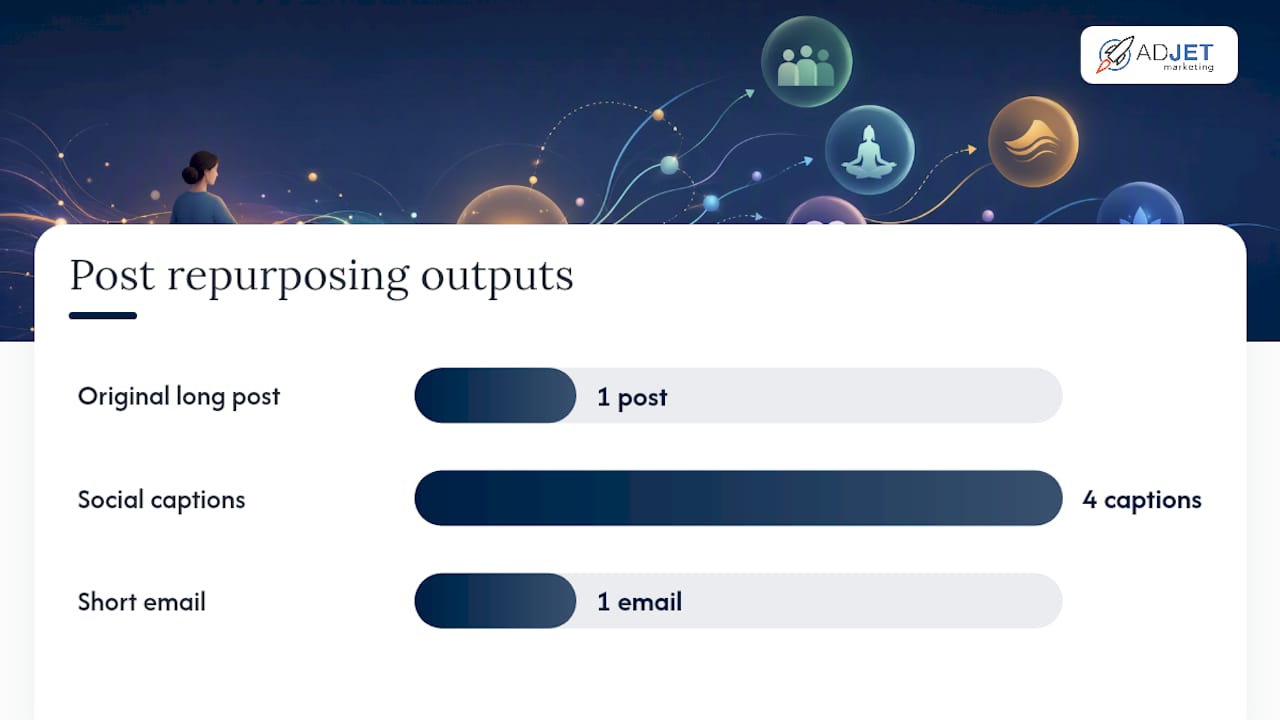
Repurposing rule: one solid 1,200-word post can become four social captions and a short email. Write the long version first, then pull the strongest paragraph, the sharpest stat, and the most quotable line as separate pieces, an approach covered in more depth in creating engaging content for therapy practices.
On-page structure that supports both SEO and conversion: a clear H2 every 150 to 250 words, a short “what this means for you” callout near the top for nonclinical readers, and one soft call-to-action box near the end. HubSpot’s blogging research backs this kind of structured, skimmable format as a driver of higher engagement across industries, not just healthcare.
AdJet’s Perspective: Common Patterns and Realistic Outcomes
The clinics we see underperform almost always share the same habit: they write broad wellness posts about stress or self-care because those topics feel safe, and then wonder why the blog isn’t converting. A post titled “5 Ways to Manage Stress” competes with ten thousand identical posts. A post titled “What to Expect in Your First EMDR Session” competes with almost nobody, and it speaks directly to someone who’s already decided they need help.
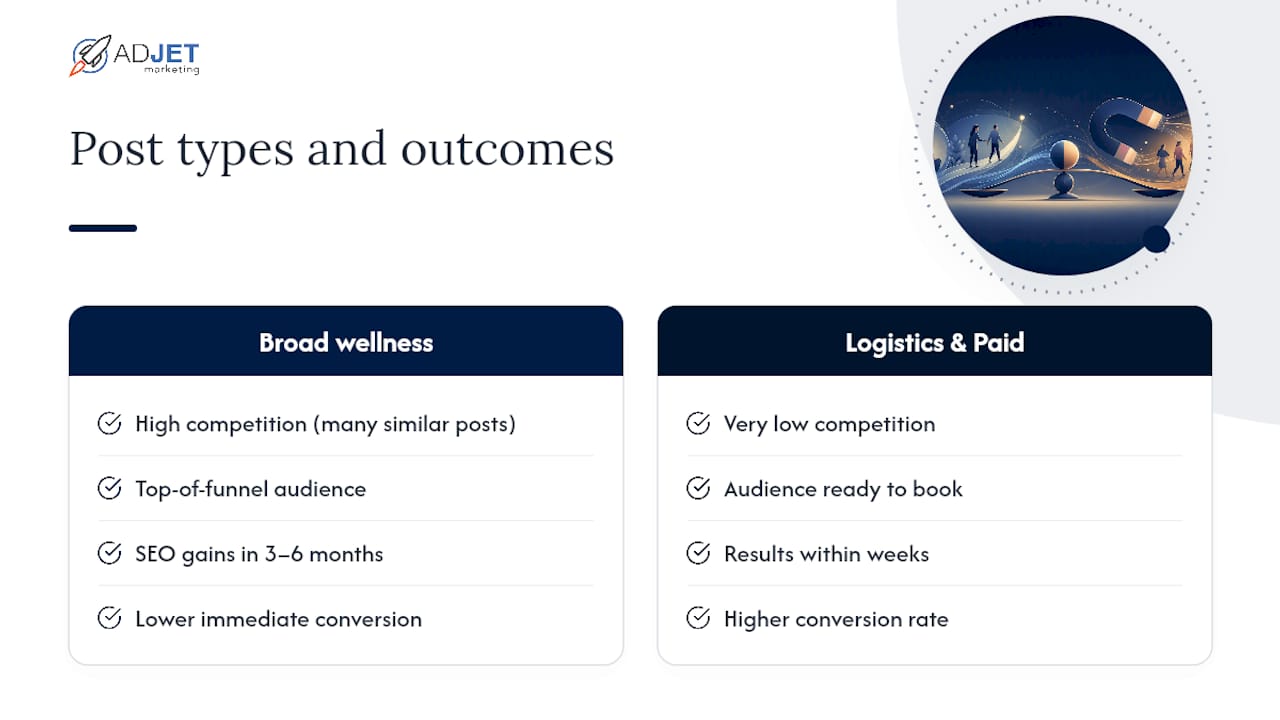
Timelines matter here too. Organic SEO gains from evergreen content usually take three to six months to show up meaningfully in search traffic. Conversion-focused logistics posts and paid campaigns move faster, often within weeks, because they meet people who are already close to booking. That’s why we usually recommend pairing the two rather than picking one.
Hire outside help when the real bottleneck isn’t ideas, it’s bandwidth or technical execution: inconsistent publishing, a website that isn’t structured for search, or a backlog of topics with no time to write them.
— Felix
How AdJet Helps Therapists Turn Blog Traffic Into Booked Sessions
Compared to hiring a full-time content writer or trying to keep up a publishing schedule solo, A digital marketing agency can provide therapy practices a built-in system: content strategy, SEO, and paid campaigns working together instead of as separate, disconnected efforts. We build out the mental health SEO foundation so your evergreen posts actually rank, and we pair that with Google Ads for therapists when you need faster visibility while the organic content matures.
DIY works fine if you have the time and consistency to publish regularly. If your posts are sitting half finished, or your site isn’t converting the traffic it already gets, that’s usually where an outside team earns its keep. Download the Medical Clinic Marketing Checklist to see where your current content and site setup stand, and reach out if you’d like a content audit built around your specialty and caseload goals.
Where to Learn More
- GoodTherapy: a reputable directory for verifying credentials and understanding how prospective clients search for therapists.
- 90+ Mental Health Blog Topic Ideas: a broad list useful for filling gaps in your content calendar.
- HubSpot’s State of Blogging: benchmark data on publishing cadence and content formats.
This article is general information, not a substitute for advice from a qualified doctor. Consult a qualified healthcare professional about your own circumstances before acting on anything here.
Sources
- 50 High-Impact Mental Health Blog Post Ideas for 2026: The ultimate E-E-A-T content strategy
- GoodTherapy
- HubSpot: State of blogging
- 90+ Mental Health Blog Topic Ideas for ANY Niche
FAQ
What are some good topics for a therapist’s blog?
The strongest topics combine a specific client problem with a clear angle, things like “How CBT Helps Panic Attacks at Work” or “What to Expect in Your First Telehealth Session,” rather than broad wellness advice.
What are some good topics for therapy sessions that translate into blog posts?
Common in-session themes like communication breakdowns in couples, trauma grounding techniques, and burnout recovery all make strong posts because they mirror what clients are already searching for.
What is the two-year rule in therapy?
There’s no single, universally recognized “two-year rule” in clinical practice or ethics codes; if you’ve heard the term used in a specific licensing or insurance context, check your state board or payer guidelines directly rather than relying on a general definition.
What are some good blog topics about mental health?
Beyond clinical explainers, strong mental health blog topics include seasonal stress guides, resource lists of books and apps, and logistics posts covering insurance, telehealth, and what a first session looks like.
How often should a therapist publish blog posts?
Consistency matters more than volume. One well-researched post every two to three weeks, following a 70/30 mix of evergreen to logistics content, tends to build steady traffic without burning out your writing time.