









Google Ads management for a healthcare practice has two separate costs: the ad spend you pay Google, and the management fee you pay whoever runs the account. Agencies price the second one as a flat monthly retainer, a percentage of ad spend, a hybrid of both, or a one-time project fee for audits and setup. The right number depends on your specialty, your market and how much compliance work sits on top of the campaigns.
This guide explains how each cost works, what to expect on timing, where healthcare-specific expenses hide, and how to tell whether a quote is reasonable. We are an agency, so we will also be plain about what we publish and what we don’t.
TL;DR
- You pay two bills: media (the clicks Google charges you for) and management (the people and tools that run the account). Compare quotes on both.
- Management is usually priced as a flat retainer, a percentage of spend, a hybrid, or a one-time project. Each model fits a different budget and stage.
- Healthcare adds costs that general-business quotes skip: policy review, HIPAA-aware tracking, compliant landing pages and restricted-terms certification.
- Judge results by cost per booked appointment, not by cost per click. Clicks are getting more expensive across most industries, but conversion rates are rising too.
- Plan on a few months before you can read the data with confidence.
Table of Contents
- The two bills: ad spend and management fees
- How agencies price Google Ads management
- What drives your media cost
- Healthcare costs that general quotes miss
- What costs look like by specialty
- Ad spend versus SEO: a balanced view
- Timelines and realistic expectations
- Our perspective
- How to evaluate a quote
- Working with AdJet Marketing
- FAQ
- Sources
The two bills: ad spend and management fees
With cost-per-click bidding, Google charges you only when someone clicks your ad. You set the most you’re willing to pay for a click and a daily budget. That is the media cost, and it goes to Google no matter who manages the account.
The management fee is separate. It pays for strategy, keyword research, ad copy, landing page recommendations, conversion tracking, bid and budget adjustments, reporting and, in healthcare, compliance checks.
Owners often mix these up. A quote of “$2,000 a month” could mean $2,000 of ad spend with the fee on top, or $2,000 all in. Ask which one before you compare anything.
How agencies price Google Ads management
We won’t give you a single “average” fee here, because the figures quoted online vary by agency, specialty and account size, and a single number hides more than it shows. What you can compare reliably is the structure.
| Fee model | How it works | Best fit | Watch for |
|---|---|---|---|
| Flat monthly retainer | Fixed fee regardless of spend | Stable budgets, ongoing optimization | Make sure the scope (campaigns, calls, reports) is written down |
| Percentage of ad spend | Fee scales with what you spend | Growing budgets across several locations or service lines | The agency earns more when you spend more, so tie goals to appointments |
| Hybrid | Base fee plus a smaller percentage | Mid-size practices with changing budgets | Check where the base fee ends and the percentage begins |
| Project or hourly | One-time audit, setup or cleanup | Fixing an account that underperforms, or a first launch | Ask what happens after the project ends |
None of these is automatically better. A percentage model can work well when the agency also reports on bookings. A flat retainer can work badly if the scope is vague. Read the contract for what you get, not just what you pay.
What a management fee should include
Before you sign, confirm in writing that the fee covers:
- Conversion tracking for calls, forms and booked appointments, not just clicks
- Campaign structure by service line (for example, one campaign per treatment or specialty)
- Negative keyword management, so you stop paying for irrelevant searches
- Ad copy that meets Google’s healthcare policies
- Landing page recommendations or builds
- Monthly reporting that you can read without a glossary
- A named person you can contact
What drives your media cost
Cost per click is set in an auction. It moves with competition, your quality score, your location and your bidding strategy. A cosmetic surgery keyword in a large metro is a different auction from an urgent care keyword in a mid-size town.
Two patterns are worth knowing. First, costs are rising broadly. Search Engine Land reported that 87% of industries saw higher cost per click in 2025. Second, the same report found that 65% of industries also improved conversion rates. Higher CPC does not automatically mean worse performance. It means you should watch what the click turns into.
That is why we steer clinic owners toward cost per lead and cost per booked appointment, and away from cost per click as a headline number.
A worked example (illustrative only)
These numbers are made up to show the arithmetic. They are not benchmarks and not a forecast.
Suppose a clinic spends $3,000 a month on ads and pays a management fee on top. Say the ads produce 60 leads (calls and forms). That is $50 per lead in media. If the front desk books 20 of those 60 into appointments, media cost per booked appointment is $150, before the management fee.
Now change one thing. The same campaigns send traffic to a page that converts better, and the clinic gets 80 leads and 30 bookings from the same spend. Media cost per booked appointment drops to $100. The ad account did not change. The page and the follow-up did.
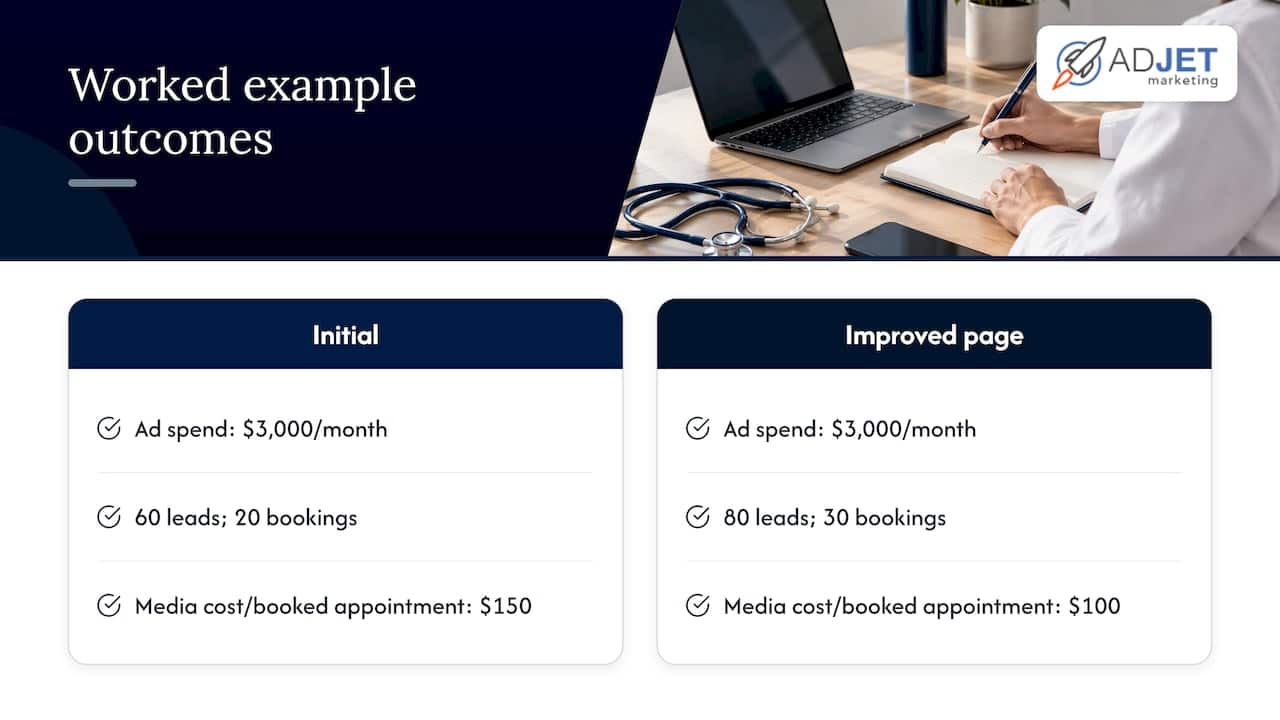
Two lessons follow. Fixing conversion is often cheaper than buying more clicks. And your own intake process (how fast you call back, how well you qualify) is part of the cost equation.
Healthcare costs that general quotes miss
A generic agency quote assumes you can use any keyword, any tracking tag and any audience list. Healthcare cannot. Budget for these items.
Policy review and restricted terms
Google treats health as a sensitive category. Its policy on restricted drug terms in personalized advertising covers prescription medications and information about them. Since July 1, 2025, a certification application is required if you want to use personalized targeting to promote such products to healthcare professionals acting in their professional capacity. Without it, ads can be disapproved or the account restricted.
If you market prescription products or services built around them, ask any agency how it handles this. It is time spent on setup and monitoring, and it belongs in the scope.
HIPAA-aware tracking
This is the line item most practices underestimate. HHS has said that tracking technologies on regulated entities’ websites and apps can expose protected health information to third parties, including on authenticated pages such as patient portals. In July 2023, HHS and the FTC sent warning letters to hospital systems and telehealth providers about these tools.
The FTC adds a second layer. Its guidance says that if you make privacy promises to consumers, the FTC Act requires you to keep them, whether or not HIPAA covers you. It also says sharing health information for advertising without proper consent can be an unfair or deceptive practice, as laid out in its guidance on consumer health information.
In practice this means someone has to audit your tags, decide what is collected and where, and set up remarketing carefully or not at all. That takes expertise and hours. We walk through it in our four-step audit for healthcare remarketing PHI leaks and in our piece on whether HIPAA-compliant marketing is possible with Google Ads. This is general information, not legal advice. Your compliance officer or healthcare attorney should sign off on how your practice handles patient data.
Landing pages and call handling
Sending paid traffic to a homepage is one of the most common ways clinics waste budget. A page built around one service, with a clear call to action and tracked phone numbers, usually earns its cost back in better conversion. Budget for it, whether you build it in-house or with an agency.
What costs look like by specialty
Specialty changes the economics. A high-value procedure can justify a higher cost per lead than a low-value visit. A few examples of how we think about it:
- Aesthetic clinics and med spas: Treatments often have strong margins and repeat visits, but competition is intense and ad policies are strict. See our guide to Google Ads for aesthetic clinics.
- Pain management: Searches are high-intent, and keyword selection matters a great deal. Our pain management Google Ads strategy guide covers it.
- Therapists and mental health practices: Smaller practices often run lean budgets, so tight geographic targeting and careful keywords matter. We outline the setup in Google Ads for therapists.
- Dental practices: Local, service-specific campaigns tend to work well. We cover this under dental practice Google Ads management.
The cost of a new patient varies widely between these categories, so benchmark yourself against your own specialty and market, never against a national average.
Ad spend versus SEO: a balanced view
Owners often ask whether to put the money into ads or into organic search. They do different jobs.
- Google Ads can put you in front of patients who are searching right now, and you can start and stop it. You pay for every click, and the traffic stops when the budget does.
- SEO builds visibility that keeps working without per-click charges, but it takes longer to show results and the outcome is less predictable.
Many practices start with ads to get early data and bookings while SEO builds. We compare the two in more depth in SEO vs. PPC. If you want both, our SEO service and Google Ads service can be scoped together.
Timelines and realistic expectations
No honest agency can promise a patient count. What we can say from experience is how a typical engagement unfolds.
- Weeks 1 to 2: Tracking setup, compliance review, account structure, landing pages and ad copy.
- Weeks 3 to 6: Campaigns collect data. Search terms reveal what patients actually type, and negative keywords go in.
- Months 2 to 3: Bids, budgets and pages are adjusted based on lead quality, not just lead volume.
- Month 3 onward: There is enough data to decide what to scale, pause or rebuild.
A budget that is too small for your market can leave you with so few clicks that you cannot learn anything. Google’s own troubleshooting guidance for Demand Gen campaigns says that budget constraints are the main reason for low delivery in the large majority of cases. The same logic applies to search: if your daily budget is below what a single click costs in your auction, the account cannot get traction.
Our perspective
Many clinics come to us after a bad first attempt. The usual story is a small test campaign that sent traffic to the homepage, produced calls from people who were not a fit, and burned a few hundred dollars with nothing to show. The owner concludes that Google Ads doesn’t work for healthcare.
In our experience the problem is rarely the channel. It is usually one of four things: tracking that counts the wrong events, campaigns that mix every service together, keywords that attract research traffic instead of patients, or a page that doesn’t make the next step obvious.
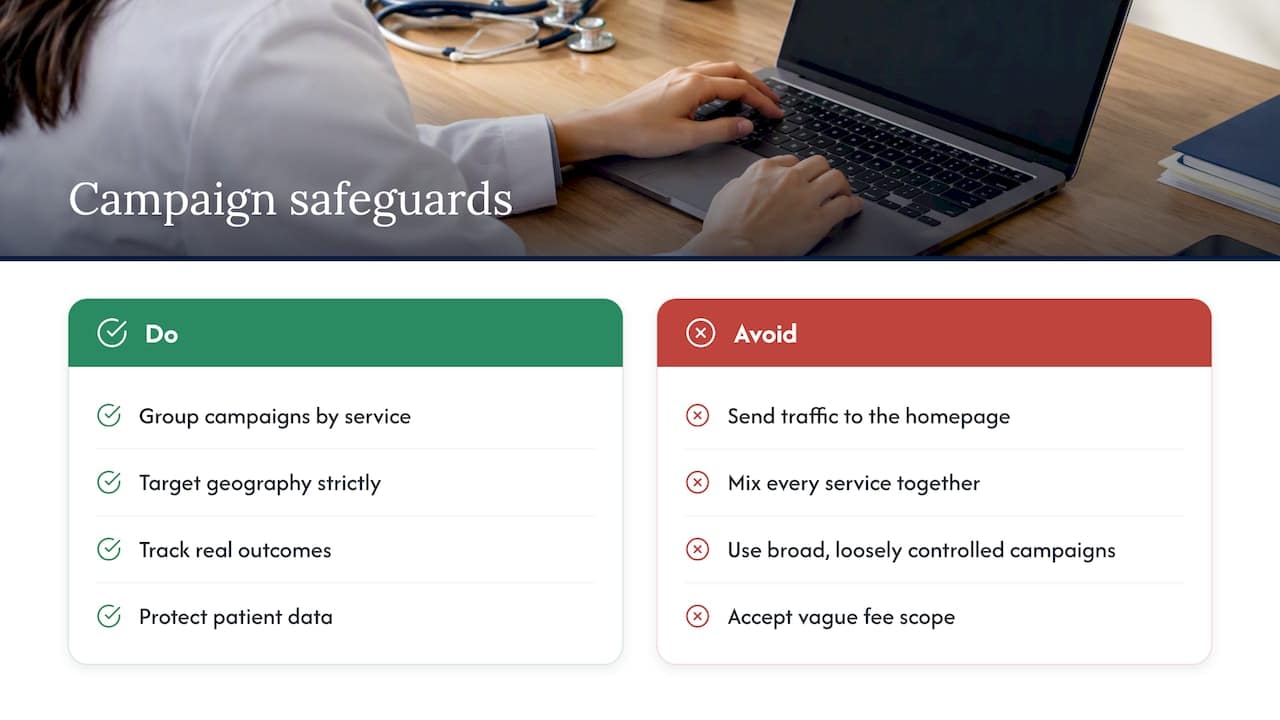
We avoid broad, loosely controlled campaigns in healthcare. We prefer tightly grouped campaigns by service, strict geographic targeting and conversion tracking that records real outcomes. We also treat privacy as a design requirement. As a Google Partner agency with HIPAA-compliant processes, we set up tracking and remarketing so that patient data is not exposed to ad platforms.
On price, our advice is to be suspicious of two extremes: a very low fee that cannot cover the work, and a very high one with vague scope. Ask what you get each month, what is measured, and what happens if the numbers do not move after a few months.
— Felix
How to evaluate a quote
Use this checklist when you compare proposals:
- Is ad spend listed separately from the management fee?
- Does the scope mention HIPAA-aware tracking and Google’s healthcare policies?
- Will you own the Google Ads account and all data?
- Are goals set around booked appointments or qualified calls, not impressions or clicks?
- Are landing pages included, or do you need to supply them?
- How often are reports sent, and who explains them?
- What is the minimum contract length, and how do you exit?
Our companion article on how to optimize Google Ads for medical clinics and our 20 tips for Google Ads in healthcare show what good work looks like in the account itself.
Working with AdJet Marketing
We manage Google Ads for medical clinics, aesthetic practices, therapists and other local providers from our base in Texas. Pricing for Google Ads management is not published, because it depends on your specialty, market and goals. We scope it after looking at your account or your situation.
If your conversion problem sits on the page, we publish pricing for landing page plans: the Starter Plan is 299 USD per month, the Premium Plan is 1500 USD per month, and the optimization plan runs from 300 to 1500 USD per month. A single landing page is 2000 USD one-off. These cover page work, not ad management or ad spend.
FAQ
How much should a healthcare practice spend on Google Ads?
There is no universal figure. Start from what a new patient is worth to you, what share of leads become appointments, and what clicks cost in your market, then work backward to a budget that can produce enough clicks to learn from. Treat the first three months as a data-gathering period.
Is $10 a day enough for Google Ads in healthcare?
It can work for a very narrow, local campaign in a lower-cost market, but in competitive specialties it may only buy a handful of clicks a day. That is often too little data to optimize. If your budget is small, focus on one service, one location and one landing page.
Does Google Ads management cost include ad spend?
Usually not. The management fee pays the agency, and ad spend is billed by Google directly to your account. Confirm this in the proposal, since some quotes bundle both and others keep them apart.
Do healthcare Google Ads cost more because of compliance?
The clicks themselves are priced by the auction, not by compliance. The extra cost is in the work around them: policy review, careful tracking, compliant landing pages and, for some advertisers, certification for restricted drug terms. A quote that ignores these is probably leaving something out.
Sources
- Google Ads costs rise again, but conversions improve (Search Engine Land)
- Using Google Ads for online marketing (Google Ads Help)
- Restricted drug terms in personalized advertising (Google Advertising Policies Help)
- Use of Online Tracking Technologies by HIPAA Covered Entities and Business Associates (HHS)
- HHS OCR and FTC warn hospital systems and telehealth providers about online tracking (HHS, 2023)
- Health Privacy (FTC)
- Collecting, Using, or Sharing Consumer Health Information? (FTC)
- Troubleshoot: Demand Gen campaigns not running or low traffic (Google Ads Help)