









Geo targeting for medical ads means showing your ads only to people in, or searching about, the places your practice actually serves. Done well, it keeps your budget inside your patient catchment area. Done carelessly, it wastes spend on people you can’t treat, and in health care it can also create privacy exposure. The approach that works for most clinics is simple: target by city, ZIP or a realistic drive-time radius, choose the right presence setting, exclude what you can’t serve, and never build a targeting list out of patient data or the area around a care facility.
This guide is for practices that pay for local patients: med spas, plastic surgeons, therapists and counselors, pain and psychiatry clinics, imaging centers, and similar businesses, including real estate agents and private schools that follow the same location logic.
TL;DR
- Start with the places your patients really travel from, then choose presence targeting settings that match how those patients search.
- Radius targeting has minimums and privacy thresholds, so very small circles can underdeliver. Build from cities, counties and ZIP codes when you need precision.
- Exclusions override inclusions. Use them to remove areas outside your license, service range or insurance network.
- State health-data laws now restrict geofencing around care facilities and the use of precise location for health ads. Keep your targeting broad enough to be non-sensitive.
- Measure by booked appointments per area, not clicks, and review the location report on a regular schedule.
Table of Contents
- What geo targeting actually does
- Choose locations from your patient data, not a guess
- Radius, cities or ZIP codes: which to use
- Pick the right presence setting
- Use exclusions to protect budget
- The rules that make health care different
- A note on sensitive conditions
- A setup routine you can follow
- Measuring whether geo targeting is working
- Perspective
- Where AdJet can help
- FAQ
- Sources
What geo targeting actually does
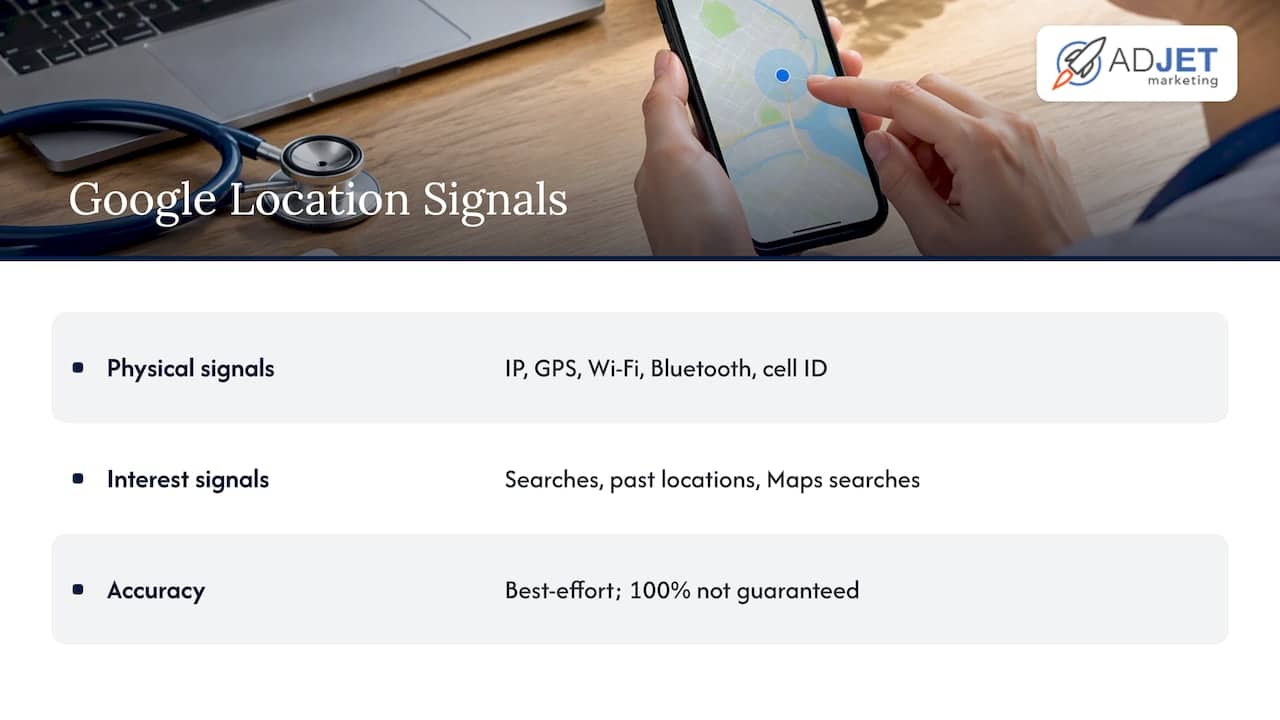
Google lets advertisers target people who are in a location, regularly in it, or who have shown interest in it. Google’s own help page explains that it uses physical-location signals such as IP address, GPS, Wi-Fi, Bluetooth and cell ID, plus “location of interest” signals like location-based searches, past locations and Maps searches. The same page says targeting is best-effort and 100% accuracy is not guaranteed.
That matters for a clinic in a practical way. A person searching “med spa near me” while sitting in your city is a very different lead from someone in another state who typed your city’s name while planning a trip. Your settings decide which of them sees your ad.
The available target types, per Google’s location targeting setup page, are countries, areas within a country, a radius around a location, and location groups. For most local practices, the useful ones are cities, ZIP codes, counties and radius.
Choose locations from your patient data, not a guess
Many clinics come to us having picked a radius around the office because it felt reasonable. A 25-mile circle looks tidy on a map but ignores how people really travel. A downtown plastic surgeon may draw patients from across a metro area and from out of town for consultations. A therapist offering in-person sessions may realistically serve a 10-minute drive.
Before you set anything, pull three lists from your own records:
- Where booked patients live. Use ZIP codes from your scheduling system, in aggregate, to see which areas produce appointments. Keep this analysis internal and never upload patient lists to an ad platform.
- Where revenue is highest. A ZIP with fewer patients but higher-value procedures may deserve more budget than a busy low-value one.
- Where you can’t serve. Licensing, state lines, insurance networks and telehealth rules all set hard edges.
For licensed clinicians, the legal edge is often the state. If you offer virtual care, state telehealth rules decide who you may treat, and a resource on California telehealth therapy laws shows how much those rules can vary and why your ad locations should match the states where you are authorized to practice.
Radius, cities or ZIP codes: which to use
| Method | Best for | What to watch |
|---|---|---|
| City or county | Practices serving a whole market | Boundaries can be broader than your real drive time |
| ZIP codes | Practices with a clear catchment pattern | Large lists take time to maintain |
| Radius around the office | Single-location practices in compact areas | Minimum size and privacy thresholds apply |
| Multiple radii or locations | Multi-office groups | Overlap needs exclusions and separate budgets |
Two details from Google’s documentation are worth knowing. Radius targeting requires a radius of at least 1 km, and very small radii may show ads intermittently or not at all. The same page says Google only permits location targets that meet minimum privacy thresholds for area size and user counts. If you expected a tight half-mile ring around your building to work, this is why it often doesn’t.
A practical rule: use a radius for a single-location practice with one dominant market, and use named cities or ZIP codes when you want to include some areas and drop others.
Pick the right presence setting
The most overlooked geo setting is whether you reach people physically in your area or also people showing interest in it. For a practice that treats people locally, “presence” targeting (people in or regularly in your area) usually protects the budget better than “presence or interest,” which can include someone researching your city from elsewhere.
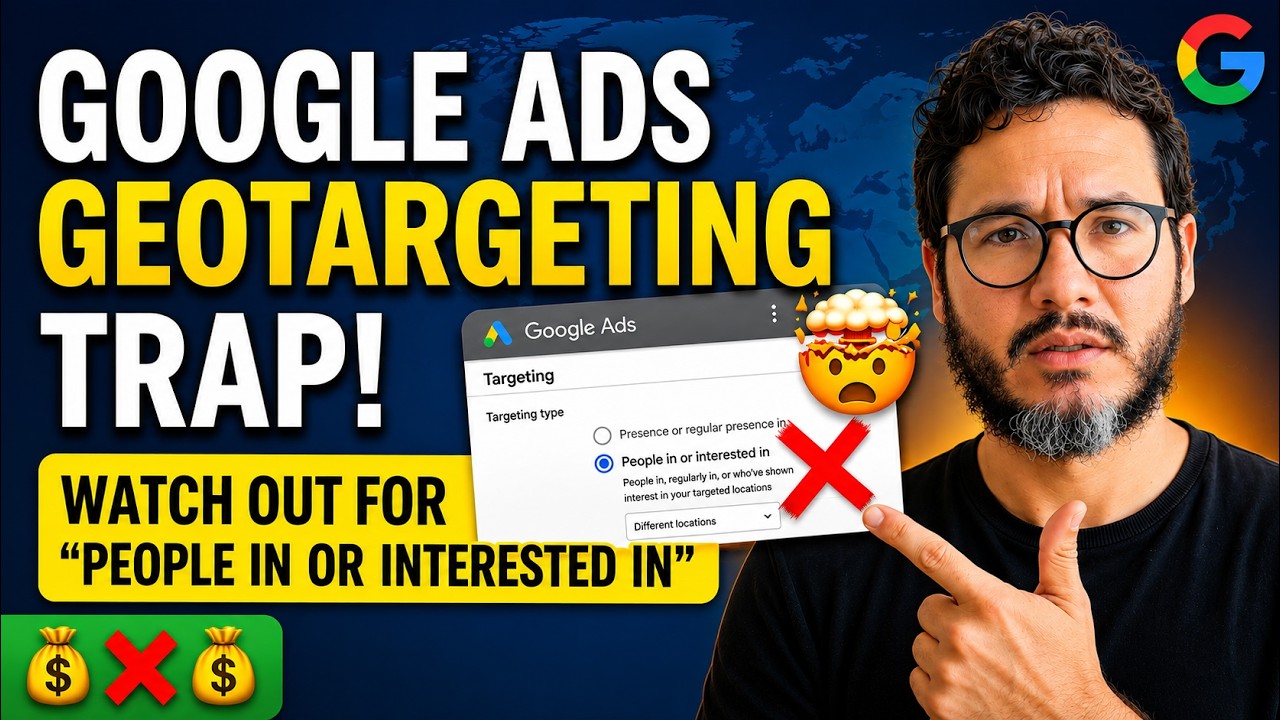
There are exceptions. A plastic surgery or aesthetic practice that draws destination patients may benefit from interest-based reach, with clear landing page content about travel and recovery. A mental health or pain practice serving only local in-person patients rarely does.
Google also points out that for a business in a sensitive vertical with strict targeting limitations, presence targeting is worth considering. Health care is one of those verticals.
Use exclusions to protect budget
Exclusions are as important as inclusions. Per Google, exclusions can be added one at a time or in bulk, and an exclusion takes priority when an area is both included and excluded. Excluding a state excludes every city in it, even one you also targeted. The same page notes that Google Ads location targeting does not determine geographic borders, so check the result against a map.
Common exclusions for clinics:
- States where your clinicians are not licensed.
- Neighborhoods outside your realistic travel range.
- Areas served by a different location of your own group, so two campaigns do not compete for the same searcher.
- Regions where you cannot legally advertise a particular treatment.
If you want to automate or audit locations at scale, each state, city or postal region has a Criterion ID that can be looked up through the Google Ads API location targeting documentation. For New York state, that ID is geoTargetConstants/21167. Most practices won’t need the API, but it helps when reconciling a long location list.
The rules that make health care different
Targeting a pizza shop and targeting a psychiatry clinic use the same buttons. The consequences are not the same. Four layers apply.
Platform policy
Google’s healthcare policy says ads and landing pages must follow applicable laws and industry standards, and some healthcare content cannot be advertised at all. For many healthcare categories, a campaign that targets allowed locations with a properly certified domain is labeled “Eligible (limited)” and runs only in allowed locations. A location choice can therefore decide whether your ad runs at all. Our Google Ads compliance checklist for clinics walks through the approvals that tend to stall campaigns.
Audience restrictions
Google’s personalized advertising policy for health says advertiser-curated audiences cannot be used when promoting in sensitive interest categories, which include health, because they may contain sensitive signals. Predefined Google audiences are allowed because sensitive signals are excluded automatically. In practice, location plus keyword intent is the safe backbone of a healthcare campaign, and customer-list or remarketing audiences built from patient behavior are where clinics get into trouble. If you use remarketing, our 4-step audit for fixing remarketing PHI leaks shows what to check.
State health-data laws
This is the area that has moved fastest. According to 4As Health’s September 2026 landscape report, California’s AB 45 outlawed geofencing around healthcare facilities for ad targeting as of January 1, 2026, and Virginia’s SB 338 banned the commercial sale of precise geolocation data as of July 1, 2026. The same report says state health-data laws now treat precise location near care facilities, and inferred health interests, as consumer health data requiring explicit, separate opt-in consent.
The lesson for a practice: do not draw ad boundaries around clinics, hospitals, or competitors’ offices to catch patients who walk in. Target markets, not buildings. Because these laws differ by state and change often, ask your attorney to confirm what applies where you advertise.
Federal oversight
HIPAA’s Privacy Rule generally prohibits covered entities that transmit health information electronically from using or disclosing protected health information without proper authorization, with limited exceptions. Beyond HIPAA, the FTC has acted under Section 5 of the FTC Act, which prohibits unfair and deceptive practices. A peer-reviewed article describes an enforcement action over sharing location data and advertising identifiers to build targeted profiles. The same 4As Health report adds that the FTC’s amended Health Breach Notification Rule has applied since July 29, 2024, and that it treats unauthorized transmission of personal health records to ad platforms through pixels or APIs as a breach.
The safe pattern is the one that avoids patient data entirely: broad geography, search intent, and a landing page that collects only what a form needs.
A note on sensitive conditions
If you promote services tied to a sensitive or rare condition, keep your targeting wide and your frequency modest. The NAI’s health targeting guidance says that when modeled segments are used, they should be at least 10% of a targeted region’s population with a minimum size of 100,000. It also says that demographic-only segments such as age, gender and region are not themselves inferences about a health condition, while historical precise location and health-related browsing are not demographic. The same document urges limiting ad frequency to individual devices for rare or sensitive conditions. These are industry norms for ad networks, but they point the same direction as the legal trend: region-level targeting is defensible, person-level health inference is not.
A setup routine you can follow
- Define the service area from internal ZIP-level appointment data, plus licensing and network limits.
- Build campaigns by location group. Separate campaigns for your core city, your outer suburbs and any destination market let you set different budgets and bids.
- Set presence targeting that matches how patients reach you, usually people in or regularly in the area.
- Add exclusions for areas you can’t serve, and check them against a map.
- Write location-specific ad copy and landing pages. Mention the neighborhood, parking, hours, and whether you accept the insurance common in that area. Our guide to the role of landing pages in healthcare marketing explains why this page is where geo targeting pays off.
- Skip facility-based geofences and patient-list audiences.
- Review the location report on a set schedule and adjust.
Budget realism matters. A small radius with a few hundred searches a month can’t produce a steady stream of appointments, however well it is configured. If your market is thin, widen the geography before raising bids, and give any new setup several weeks of data before judging it. SEO works on a longer clock than ads, so many practices run both, with paid search covering demand while local organic visibility builds.
Measuring whether geo targeting is working
Clicks from the right ZIP codes are not the goal. Booked appointments are. A workable measurement routine:
- Track the actions that matter: calls, form submissions and online booking requests, each tagged to a conversion action.
- Break results down by location in your Google Ads location report, then compare cost per booked appointment across areas, not cost per click.
- Ask intake staff where callers are located and compare it with the ad report. A mismatch usually means a presence setting or exclusion needs adjusting.
- Follow leads to revenue. An area with cheap leads that rarely show up is worse than a pricier area that fills the schedule.
- Watch the lead quality note: if many inquiries come from outside your service area, tighten the settings before cutting spend.
Keep tracking privacy-conscious: use conversion events rather than passing identifiable health details into analytics. Our Google Ads audit checklist for healthcare covers the tracking and settings review in more detail, and our online booking conversion guide addresses what happens after the click.
Perspective
Most of the clinics that come to us after disappointing results have the same story: the campaign was aimed at a radius that looked sensible on a map, the presence setting was left on its default, and the leads came from people who could never become patients. Geography is rarely the whole problem, but it is the cheapest one to fix.
We build location structure from a practice’s own appointment data, keep exclusions current, and design campaigns so they don’t depend on sensitive audience data. That is the part of health care advertising we care most about getting right, because compliance and performance point the same way here: broad, intent-based targeting with strong local landing pages.
Our team is a Google Partner agency based in Texas, and our processes are built with HIPAA in mind. We would rather set realistic expectations about timelines and budgets up front than promise a number. Good geo targeting protects spend, and reporting should show you exactly where each appointment came from.
Felix
Where AdJet can help
If you would rather not manage location groups, exclusions, compliance approvals and conversion tracking yourself, our Google Ads services cover campaign structure, targeting and reporting for medical and aesthetic practices. Landing pages built for each service area are available through our landing page plans, where the Starter Plan is listed at $299 per month and the Premium Plan at $1,500 per month.
FAQ
Is geo targeting medical ads legal?
Yes, targeting by city, county, ZIP code or radius is a standard practice. What state laws restrict is geofencing around healthcare facilities and using precise location data to infer health interests. California’s AB 45, effective January 1, 2026, is one example, so confirm your state’s rules with an attorney.
What radius should a medical practice target?
There is no universal number. Start from where your booked patients actually live, then test a radius or a list of cities and ZIP codes against appointment data. Google requires a radius of at least 1 km, and small circles may show ads intermittently, so very tight rings rarely work.
Can I target people who visited my competitors or a hospital?
We advise against it. Drawing boundaries around care facilities to reach visitors is the kind of practice recent state laws target, and it can expose you to consumer health data consent requirements. Target the market and the search intent instead.
Should I use presence or presence-or-interest targeting?
For a practice that treats people in person, presence targeting usually keeps the budget focused on people who can actually visit. Use interest-based reach only when you attract destination patients and have content that speaks to them.
How do I know if my geo targeting is working?
Compare cost per booked appointment by location, not clicks. Check your location report against what intake staff hear from callers, and exclude areas that generate inquiries you can’t serve.
Sources
- About targeting geographic locations, Google Ads Help
- Target ads to geographic locations, Google Ads Help
- Exclude ads from geographic locations, Google Ads Help
- How do I set up location targeting, Google Ads Help
- Location targeting, Google Ads API documentation
- Healthcare and medicines, Google Advertising Policies Help
- Health in personalized advertising, Google Advertising Policies Help
- The Evolving 2026 Landscape of U.S. Health Data Privacy, 4As Health
- Sensitive Health Information, NAI (2023)
- Demographic Health Advertising Best Practices, NAI (2023)
- Beyond HIPAA: The FTC’s Expanding Role in Digital Health, SMU Science and Technology Law Review
- California telehealth therapy laws checklist