









Healthcare display ads are the visual banner, image and video ads that appear on websites, apps, YouTube and Gmail while people read, watch or browse. For a clinic, they work best for awareness and consideration: keeping your name in front of local people before they are ready to book. They do this with privacy-safe targeting such as geography, demographics and page context, and with compliant creative that leads to a landing page built for one service.
This guide covers how display differs from search, what ads look like in practice, how to target without touching sensitive health data, which rules apply, and how to plan and measure a campaign.
TL;DR
- Display ads reach people while they browse. Search ads reach people while they look for a service. Most clinics need both, in different roles.
- Target by region, age, gender and page context. Avoid audiences built from health conditions, prescriptions or past activity tied to a diagnosis.
- Every claim in a healthcare ad needs evidence before it runs, and Google’s healthcare policy limits some categories entirely.
- Judge display on the right metrics: reach, qualified clicks, leads and booked appointments, not clicks alone.
- Send display traffic to a focused landing page for one service, not your homepage.
Table of Contents
- What healthcare display ads are, and how they differ from search ads
- Where healthcare display ads appear
- Examples of healthcare display ads
- Targeting display ads without misusing health information
- Rules that apply to healthcare display advertising in the U.S.
- Perspective: how we plan display for clinics
- How to plan a healthcare display campaign
- What display costs and which metrics to compare
- Display, search and SEO: how they work together
- Work with a team that handles the compliance side
- FAQ
- Sources
What healthcare display ads are, and how they differ from search ads
Display ads are banner and small-box ads placed on websites, articles and videos. Google’s own guidance explains the split: search ads appear when someone searches for what you offer, while display ads appear as people visit sites across the Google Display Network. Search catches a need that already exists. Display reaches people earlier, before they have typed anything.
That difference shapes everything else:
| Search ads | Display ads | |
|---|---|---|
| When the ad appears | Someone searches for a service | Someone browses a site, app, video or inbox |
| Reader’s mindset | Actively looking | Reading something else |
| Best role for a clinic | Capturing demand that exists now | Building familiarity and nudging consideration |
| Creative | Text | Images, headlines, logos, video |
| Typical risk | Paying for clicks on expensive keywords | Paying for reach that never turns into a visit |
Many clinics come to us after one of two experiences. Either they ran only search and hit a ceiling on how many people they could reach, or they tried display with a vague goal and could not tell what it produced. Both problems are about role, not format. Display is a tool with a specific job.
If you are still deciding where to start, our guide to the benefits of Google Ads for medical clinics explains how search campaigns fit before you add display.
Where healthcare display ads appear
According to Google Ads, display campaigns serve visual ads across websites, apps, YouTube and Gmail. Responsive display ads combine the images, headlines, logos, videos and descriptions you upload, and Google assembles them to fit the ad spaces available.
Google also says Display campaigns can be built for sales, leads, traffic, awareness or consideration, and can reach people at different stages of the buying cycle. For a clinic, that means you choose the objective first, then the setup follows. A campaign meant to introduce a new location is set up differently from one meant to fill consultation slots for a single procedure.
Programmatic buying is the broader, automated way of purchasing display placements across many sites through bidding systems. Google’s network is one route. Other platforms exist, and they differ in which sites they reach and what targeting controls they offer. The principles below, objective first and privacy-safe targeting always, apply to any of them.
Examples of healthcare display ads
Examples help most when you look at what the ad said and who it addressed.
- A children’s hospital campaign. Miami Children’s Hospital’s “Sam and Friends” campaign used five display ads that highlighted the hospital’s national rankings, three ranked subspecialties and a fictional child-success story. According to the award case study, it generated more than 38 million impressions and increased consultation requests week over week.
- A bariatric program. MedStar Franklin Square Medical Center used web display ads with healthy-lifestyle imagery and messaging about cholesterol, blood pressure and blood sugar rather than appearance alone. The ads invited people to register for an information session and, per the report, produced nearly 20 million targeted impressions.
These are large hospital programs from several years ago, so treat them as illustrations of approach, not as benchmarks for a single-location practice. Two lessons carry over to any clinic:
- One audience, one message. Each ad spoke to a defined group about a defined benefit.
- A low-friction next step. An information session or consultation request asks for less commitment than “book surgery now.”
For a med spa, the same logic might mean a seasonal skin-health message to adults in a ten-mile radius that points to a single consultation page. For a therapy practice, it might mean a calm, stigma-free message about getting started, placed on general lifestyle and wellness content. Our guide to Google Ads for therapists covers the campaign setup side in more detail.
Targeting display ads without misusing health information
This is the part that separates healthcare display from display in other industries. The question is not only “who might buy?” but “what do we know about this person, and how did we learn it?”
Prefer demographic and geographic audiences
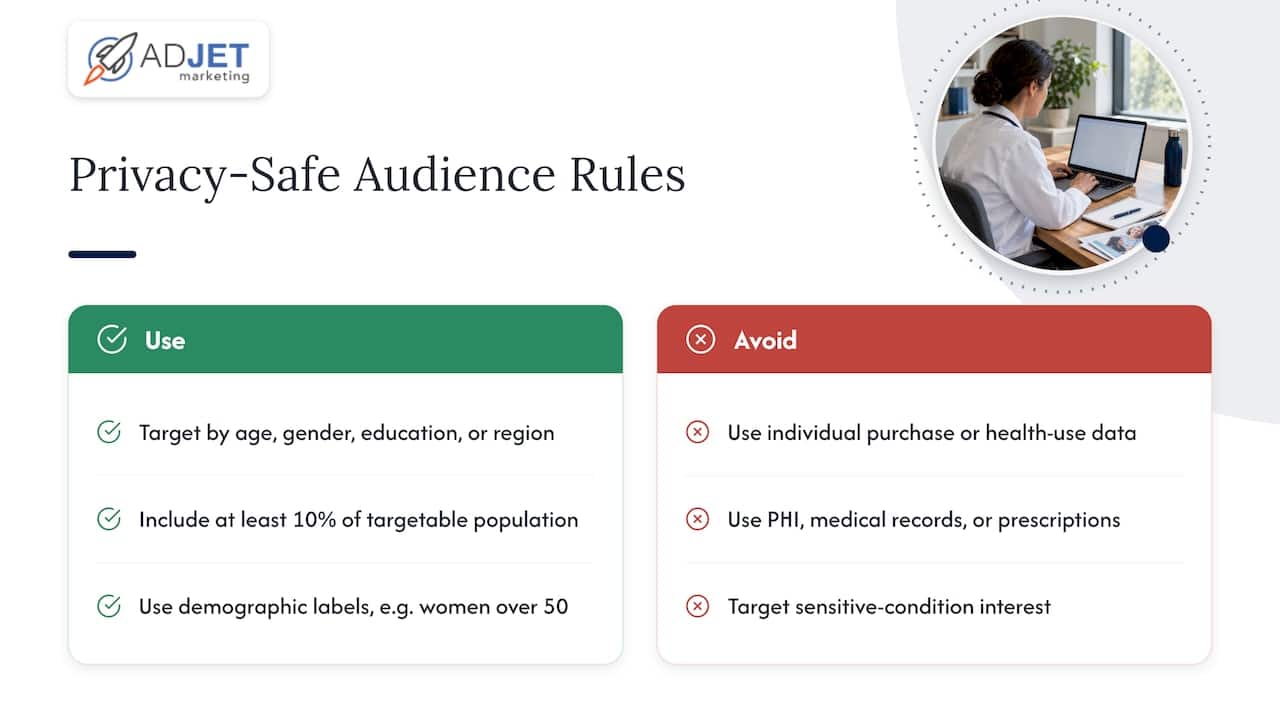
The Network Advertising Initiative (NAI) recommends demographic audiences based only on factors such as age, gender, education, presence of children or region. It distinguishes these from individual purchase data and health-related browsing or app-use data.
The NAI gives a plain example: advertising an arthritis treatment to consumers believed to be over 60, without inferring that any particular person has arthritis. It also notes that an all-male audience for a prostate-cancer treatment can rest on a population-level observation rather than an individual diagnosis.
Adobe Advertising’s published policy takes a similar line. Acceptable health segments must rely only on demographics such as age, gender, education or residential setting, include at least 10% of the targetable population, and use demographic labels such as “women over 50” rather than condition labels. It rejects segments based on PHI, medical records, prescriptions, or prior activity expressing interest in sensitive conditions.
Use context instead of tracking
Contextual targeting matches the ad to the content someone is reading rather than following an individual across the web. Definitive Healthcare describes it as matching ads to the content professionals are consuming, instead of tracking individual behavior across websites. For a clinic, placing an ad beside general articles on sleep, skin care or back health reaches interested readers without building a profile of any one person.
Be careful with remarketing
Remarketing to people who visited a condition-specific page is where many clinics create risk, because the visit itself can reveal health information. We walk through how to find and close those gaps in our 4-step audit for healthcare remarketing PHI leaks, and our article on HIPAA-compliant marketing with Google Ads explains what a compliant setup looks like.
A practical rule: if the audience definition would read as “people who may have condition X,” rebuild it as “adults in this region” or “people reading content about this general topic.”
Rules that apply to healthcare display advertising in the U.S.
Three layers apply: platform policy, federal enforcement on health data, and advertising law on claims.
Platform policy
Google’s healthcare-and-medicines policy says some healthcare content cannot be advertised, while other content requires Google certification and approved locations. Ads and landing pages must comply with applicable laws and industry standards. Online pharmacies, pharmaceutical manufacturers and some prescription-related services are among the categories that may need certification. Most local clinics fall outside those categories, but a quick policy check before launch avoids weeks of rejected ads. Our Google Ads compliance checklist for clinics lists what we check.
Federal enforcement on health data
The FTC’s order against GoodRx is the clearest recent signal. It permanently bars GoodRx from disclosing health information to third parties for advertising purposes, with a narrow exception for non-personalized contextual advertising during a consumer’s current interaction with GoodRx’s own sites or apps. The same order separates advertising disclosures from statistical reporting, traffic analysis, ad-delivery measurement and conversion measurement, which it lists as excluded purposes.
For a clinic, the takeaway is practical: sending patient or visitor health information to ad platforms for targeting is the problem. Measuring whether your ads led to a form fill, handled carefully, is a different activity. Have your privacy officer or healthcare attorney review your tracking setup.
Claims in the ad itself
Manatt’s overview of FTC healthcare advertising standards says an ad is deceptive when it is likely to mislead, a reasonable consumer’s interpretation is misleading, and the representation or omission is material. It also says advertisers must substantiate express and implied claims before the ad runs. A comparison such as the shortest emergency-room wait times needs evidence for the relevant geography and competitive set.
That applies directly to display creative, where a short headline invites big claims. “Best,” “fastest,” “most experienced” and “results you can trust” all need support on file before they ship. Product and drug claims raise the same question of what status a product actually has, and this explanation of FDA approval and RUO materials shows how easily regulatory language gets misread. Keep a document for each ad listing the claim and the evidence behind it.
Perspective: how we plan display for clinics
We rarely start a healthcare client with display. We start with the question of where patients are already raising their hand, usually search, and make sure that foundation is solid: tracking, landing pages, compliant ad copy.
Then display earns a role. It extends reach to people who are not searching yet, supports a new service line or a new location, and keeps a practice familiar to people who have already seen it. We do not promise that display alone will fill a calendar, and we would not build a plan that depends on it doing so.
Our approach is to keep the audience definitions simple and defensible, write creative that makes only claims the practice can document, and send every click to a page built for one service. Many clinics come to us after poor lead quality from broad campaigns. Tightening geography, audience and message usually does more than raising budget.
As a Google Partner agency with HIPAA-compliant processes, we report on what matters to the practice: leads and booked consultations, not impressions alone.
Felix
How to plan a healthcare display campaign
Work through these steps in order. Skipping the first two is the most common reason a campaign cannot be evaluated later.
- Choose one service-line objective. “More consultations for injectables” is usable. “More brand awareness” is hard to judge. Google’s campaign objectives (leads, traffic, awareness, consideration) give you a menu to match.
- Set the geography. Most local practices should start with the area patients can realistically travel from, and widen only with evidence.
- Define a privacy-safe audience. Use region, age range, gender or contextual placements, as described above.
- Prepare compliant creative. Build several image and headline options, keep claims documented, and avoid imagery that implies a viewer’s condition. A headline like “Struggling with [condition]?” speaks to an individual’s health and is best avoided.
- Build the landing page first. Display traffic arrives with less intent than search traffic, so the page must explain the service quickly, show credentials, and offer a clear next step such as a short form or online booking. Our guide to online booking conversion optimization covers that final step.
- Set up conversion tracking. Count form submissions, calls and booked appointments, and review offline outcomes such as which leads actually showed up.
- Review on a schedule. Check placements, exclude poor sites and apps, and rotate creative.
What display costs and which metrics to compare
A single number for “how much display costs” would mislead you, because pricing depends on how the campaign is bought. Compare these metrics, in this order of importance:
- Cost per lead or booked appointment. This is the figure that ties spend to patients. It depends on your landing page and your intake process as much as on the ads.
- Cost per click (CPC). Useful for diagnosing creative and audience, but a cheap click that never converts is still expensive.
- Cost per thousand impressions (CPM). Useful when the goal is reach or awareness and you are paying for views.
- Click-through rate. Display click-through rates are typically much lower than search, because people were not looking for you. A low rate alone does not mean the campaign is failing.
Because published averages vary by specialty, region and year, build your own baseline instead. Start with a modest test budget, run it long enough to collect a meaningful number of leads, and compare against your search campaigns. We also suggest reading our clinic conversion rate benchmarks so your landing page expectations are realistic, and using the Google Ads profit calculator to translate lead cost into return based on what a new patient is worth to you.
Realistic expectations matter here. Display usually needs weeks of data before patterns emerge, and its effect is often indirect: more branded searches, more direct visits, more people who recognize your name when they finally book. Attribution should account for that.
Display, search and SEO: how they work together
A balanced plan assigns each channel a job:
- Search ads capture people who are ready now. Results can start within days of launch, and spend is controllable.
- SEO builds durable visibility on the searches that matter. It takes longer to show results, and the value compounds as pages earn rankings.
- Display builds familiarity and supports specific campaigns, with its value showing up in assisted conversions and branded demand.
If budget is limited, start with search and a strong landing page, then add display once you have conversion data. If you already have steady search performance, display is a reasonable way to widen reach. Our Google Ads audit checklist for healthcare and 20 tips for optimizing Google Ads for healthcare help you check the foundation first.
Work with a team that handles the compliance side
If you want display ads run with the compliance questions above built in, our Google Ads management covers campaign structure, tracking and reporting for clinics. Display traffic needs a page that converts, and we build those too. Our landing page design offers include a Starter Plan at $299 per month, a Premium Plan at $1,500 per month and a single landing page at $2,000 one-off. Pricing for ad management is scoped to your practice, so the first step is a conversation about your goals and service lines.
FAQ
What are examples of display ads in healthcare?
Common examples are a hospital banner highlighting a ranked specialty, a bariatric program ad inviting people to an information session, and a clinic ad promoting a free consultation to adults in a nearby region. Each pairs one message with one next step.
What does “display ads” mean?
Display ads are visual ads, such as banners, images and video, shown on websites, apps, YouTube and Gmail. They appear while people browse, which is how they differ from search ads that appear in response to a query.
Can a clinic target display ads by health condition?
It is safer not to. Industry guidance such as the NAI’s recommends demographic audiences like age, gender or region, and Adobe’s policy rejects segments based on PHI, prescriptions or activity tied to sensitive conditions. Contextual placement next to general health content is another option. Have a healthcare attorney review any audience you are unsure about.
How should I measure whether display ads are working?
Track leads and booked appointments first, then cost per lead, then supporting numbers like CPC, CPM and click-through rate. Also watch assisted conversions and branded search, since display often influences patients who book later through another channel.
Sources
- Google Display Network targeting, Google Ads
- About Display ads and the Google Display Network, Google Ads Help
- Miami Children’s Hospital “Sam and Friends” campaign, IAC Awards
- How a bariatric surgery campaign generated 20M impressions, HealthLeaders
- Demographic Health Advertising Best Practices, NAI
- Adobe Advertising acceptable health segments
- Programmatic contextual advertising to reach HCPs, Definitive Healthcare
- Healthcare and medicines policy, Google Ads
- GoodRx Stipulated Order for Permanent Injunction, FTC
- Healthcare Advertising: Understanding the FTC’s Role, Manatt
- FDA approval and RUO materials