









The full content marketing process for therapists runs six steps: discovery → strategy → create → publish → distribute → measure and iterate. The single most important shift your agency can make is adopting a balanced awareness allocation framework from the McCance Method that segments pages by symptom, problem, solution, and practice awareness levels. Most therapy sites do the opposite, stacking service pages and “about us” content while leaving symptom-level search intent completely unserved.
Start this week with these five tasks:
- Pull the most recent pages from your client’s site and tag each one by awareness level.
- Flag every page aimed at solution- or practice-aware intent with no symptom-level counterpart.
- Identify the top three symptom searches in the client’s specialty (e.g., “why do I feel numb after a breakup,” “can’t stop worrying at night”).
- Draft one symptom-aware landing page brief using the template in Section 5.
- Set a GA4 goal for consult bookings before publishing anything new.
Adjetmarketing runs this exact process for mental health and therapy clients across the US, combining the McCance Method pyramid with Reframe Practice’s quality-over-volume discipline.
Table of Contents
- Who this playbook is for and what to expect
- The step-by-step content marketing process for therapists
- What page types actually convert for therapy practices
- Content brief template and editorial workflow
- SEO and HIPAA-aware compliance checklist
- How to distribute therapist content for bookings and organic growth
- KPIs and how to measure content that converts to booked appointments
- Realistic timelines and budget ranges
- Ethical considerations and professional boundaries in therapist content marketing
- Managing client confidentiality beyond HIPAA in marketing materials
- Guidelines for culturally sensitive and inclusive content
- How to handle sensitive mental health topics without alienating readers
- Crisis management protocols for content that may affect vulnerable readers
- Legal disclaimers and consent for testimonials and case studies
- Key Takeaways
- What actually works for therapy clients — and what agencies keep getting wrong
- Adjetmarketing builds compliant content programs for therapy practices
- Sources and further reading
Who this playbook is for and what to expect
This guide is written for agency strategists, copywriters, and project managers running content programs for solo therapists, small group practices, and specialty mental health clinics. It covers the full production cycle from intake to reporting.
Realistic outcomes for a well-executed program include improved consult booking rates within a few months of publishing intent-matched pages, measurable lead quality improvement by the third month, and increasing organic visibility over time. Paid search delivers immediate traffic; SEO builds durable returns.
Content marketing produces significantly more leads than traditional marketing while costing considerably less, according to Ensora Health. That efficiency gap is why therapy practices with limited marketing budgets benefit disproportionately from a structured content program.
Three non-negotiable legal guardrails apply from day one:
- No protected health information (PHI) in any public-facing marketing content.
- Written consent required before publishing any client testimonial or case study.
- All CTAs must route clinical questions to intake forms, not public comment fields or social DMs.
The step-by-step content marketing process for therapists
Step 1: Discovery
Inputs: Client intake form, existing site audit, competitor gap analysis.
Outputs: Client persona, awareness-level content map, top 20 keyword targets.
Roles: Agency strategist leads; client provides clinical context and specialty focus.

Step 2: Strategy
Inputs: Discovery outputs, 40/30/20/10 allocation framework.
Outputs: 90-day content roadmap, channel priority list, budget split recommendation.
Compliance checkpoint: Confirm testimonial consent process before scheduling any case study content.
Step 3: Create
Inputs: Content briefs (see Section 5), keyword targets, clinical reviewer notes.
Outputs: Draft pages, meta data, schema markup, internal link map.
Roles: Copywriter drafts; clinician reviews for accuracy; SEO lead reviews for on-page elements.
Step 4: Publish
Inputs: Approved drafts, design assets, schema snippets.
Outputs: Live pages with canonical tags, structured data, and CTA placements confirmed.
Compliance checkpoint: No PHI in page copy, alt text, or URL slugs.
Step 5: Distribute
Inputs: Published pages, email list segments, ad account access.
Outputs: Email nurture sequence, paid search campaigns, social posts, local citation updates.
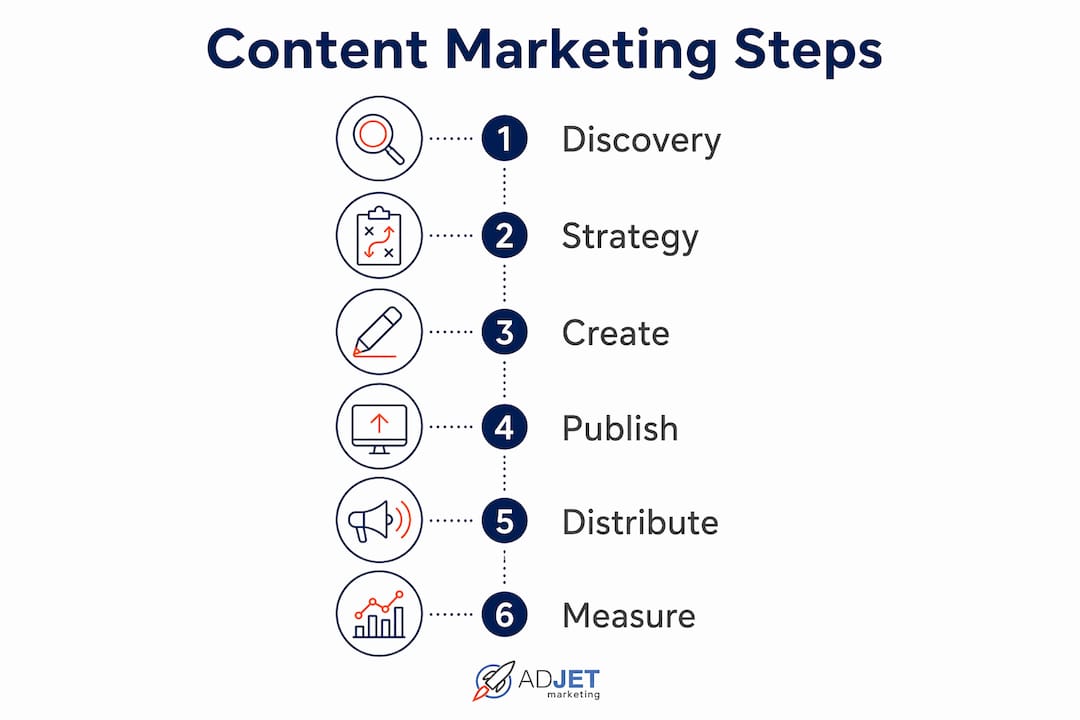
Step 6: Measure and iterate
Inputs: GA4 data, CRM conversion records, call tracking logs.
Outputs: Monthly performance report, A/B test queue, content refresh list.
Roles: Account manager owns reporting; strategist owns iteration decisions.
| Role | Responsibility | Owned By |
|---|---|---|
| Strategist | Roadmap, brief approval, iteration decisions | Agency |
| Copywriter | Drafts, meta data, internal links | Agency |
| SEO lead | Schema, technical review, keyword mapping | Agency |
| Clinical reviewer | Accuracy check, compliance sign-off | Client |
| Admin/scheduler | Calendar management, publish coordination | Client or Agency |
Many practices over-index on solution-aware content and miss the symptom-level searches that drive the highest-volume, lowest-competition traffic. Flag this in every discovery call.
What page types actually convert for therapy practices
Fewer high-quality, intent-matched pages outperform large volumes of generic blog posts. Build these six types first.
Symptom-aware landing pages
Headline formula: “Feeling [symptom]? You’re not broken — here’s what’s happening.”
Intro: Validate the experience in plain language. No clinical labels in the first paragraph.
CTA: “Talk to someone who gets it → [Book a free consult]”
Problem-to-solution guides
Headline: “Why [problem] keeps happening — and what actually helps.”
These pages bridge symptom awareness to treatment options without pushing a specific service too early.
Specialty/service pages
Headline: “[Specialty] therapy in [City] — what to expect and how to start.”
Include therapist credentials, modalities, and a clear next step. Write plainly and answer the questions a first-time client would actually type.
Therapist bio pages
Lead with the therapist’s approach and who they work best with. Credentials come second. A warm, specific bio reduces drop-off at the decision stage.
FAQ pages
Target the exact phrasing clients use: “Does therapy really work for anxiety?” not “Efficacy of cognitive behavioral interventions.” Specialty pages, practical guides, and FAQ pages reduce hesitation and convert better than general posts.
Booking/landing pages
One goal per page. Remove navigation. Include a short form (name, concern, preferred time), a trust signal (credentials or a brief non-testimonial statement), and a phone number.
Meta title formula: [Symptom or concern] Therapy in [City] | [Practice Name]
Meta description formula: Struggling with [symptom]? [Therapist name] helps [client type] in [City]. Book a free consult today.
Pro Tip: Add LocalBusiness or MedicalBusiness JSON-LD schema to every location-specific page. Include name, address, telephone, url, and openingHours. This directly supports local pack visibility without making any clinical outcome claims.
| Page Type | Primary Intent | Awareness Level |
|---|---|---|
| Symptom landing page | Organic search | Symptom-aware |
| Problem-to-solution guide | Organic search / email | Problem-aware |
| Specialty/service page | Organic + paid | Solution-aware |
| Therapist bio | Decision stage | Solution/practice-aware |
| FAQ page | Organic / featured snippet | Symptom/problem-aware |
| Booking/landing page | Paid search / email | Practice-aware |
Content brief template and editorial workflow
A content brief should include these fields before any writing starts:
- Target intent: What is the searcher trying to understand or do?
- Awareness level: Symptom / problem / solution / practice (per the 40/30/20/10 pyramid).
- Primary keyword and two to three supporting terms.
- Clinical reviewer notes: Any claims requiring clinician sign-off.
- CTA and conversion goal: What action should the reader take?
- Measurement goal: Which GA4 event or CRM field tracks success?
Sample editorial calendar cadence (biweekly):
- Week 1: Brief approved → copywriter drafts (3 business days).
- Week 2: Clinical review (2 days) → SEO review (1 day) → design (1 day) → publish.
- Week 3: Distribution (email, social, paid boost if applicable).
- Week 4: Initial performance check; flag for A/B test queue if CTR is below target.
Approval checklist before publish:
- PHI absent from all copy, alt text, and metadata.
- Clinical reviewer has signed off on any treatment claims.
- Schema added and validated.
- Canonical tag set.
- CTA routes to intake form, not email or social.
- Internal links added to at least two related pages.
SEO and HIPAA-aware compliance checklist
On-page SEO checklist:
- Title tag matches H1 intent; primary keyword in first 60 characters.
- Schema markup present (LocalBusiness or MedicalBusiness).
- NAP (name, address, phone) consistent with Google Business Profile.
- FAQ schema on FAQ pages for featured snippet eligibility.
- Internal links connect symptom pages to specialty pages to booking pages.
- Local SEO signals confirmed: city in title, H1, and first paragraph.
Compliance checklist:
- No PHI in any public-facing content, including image file names.
- Written consent obtained and filed before any testimonial goes live.
- Case studies anonymized: no name, location, employer, or identifying detail.
- Clinical questions in comments or social DMs redirected to intake forms.
- Disclaimer present on any page discussing symptoms or treatment: “This content is for informational purposes only and is not a substitute for professional mental health advice.”
Pro Tip: For culturally sensitive topics, avoid phrasing that implies a single “normal” experience. Replace “most people feel” with “many people find” and test headlines with diverse reviewers before publishing. This also reduces the risk of alienating the specific communities your client serves.
How to distribute therapist content for bookings and organic growth
Channel mix by awareness level:
- Symptom and problem pages: Organic SEO is the primary channel. These pages compound over time and attract high-intent, low-cost traffic. See channel comparison guidance for a full breakdown.
- Solution and practice pages: Paid search (Google Ads) for immediate bookings. Target high-intent queries like “[specialty] therapist near me.”
- Email nurture: Send a three-email sequence to leads who booked a consult but did not confirm. Sequence: validation → what to expect → easy rebook link.
- Social: Awareness-level content only. No clinical claims. Repurpose symptom-page intros as short posts. Engaging social content for therapy practices follows the same plain-language rule as web copy.
Sample budget split for a small clinic (6-month program):
- Content production and SEO: 50% of budget.
- Paid search (Google Ads): 35%.
- Technical SEO and schema: 10%.
- Syndication and local citations: 5%.
Ethical guardrail for ad creative: Never use urgency language (“Act now — limited slots”) in mental health ad copy. Avoid before/after framing. Focus on availability and the first step, not outcomes.
For non-stigmatizing outreach language, The Pursuit Counseling’s guide on inviting people to mental health programs without making them feel broken is a practical reference for ad copy and email subject lines.
KPIs and how to measure content that converts to booked appointments
Primary KPIs to track from day one:
- Organic sessions by awareness level (symptom vs. solution pages).
- Consult booking rate per page (GA4 event: form submission or call click).
- Leads to booked appointment conversion rate (CRM).
- Cost per acquisition (CAC) for content-attributed bookings.
- Pages per booked consult (assisted conversions in GA4).
Track the full content-to-booking funnel: traffic alone is not a success metric for therapy practices. A page with 200 monthly visitors and a 5% booking rate outperforms one with 2,000 visitors and a 0.2% rate.
A/B test roadmap:
- Month 1: Test two headline variants on the top symptom page (symptom-first vs. outcome-first).
- Month 2: Test CTA placement (above fold vs. mid-page vs. bottom).
- Month 3: Test form length (3 fields vs. 6 fields).
- Month 4: Test nurture email subject lines (question vs. statement format).
Reporting cadence: 30-day check on booking rate and paid CAC; 90-day review of organic ranking movement; 180-day full program audit with content refresh recommendations.
Realistic timelines and budget ranges
| Content Type | Time to Publish | Time to SEO Visibility | Typical Cost Range |
|---|---|---|---|
| Symptom landing page | 3–4 weeks | 3–6 months | — |
| Specialty/service page | 2–3 weeks | 2–4 months | — |
| FAQ page | 1–2 weeks | 1–3 months | — |
| Paid search campaign | 1–2 weeks | Immediate traffic | — |
| 6-month full program | Ongoing | Month 4+ for organic | — |
Paid search delivers bookings while organic content builds. Running both in parallel is the most efficient path for practices that need near-term revenue and long-term visibility. The tradeoff: paid stops the moment the budget does; SEO compounds.
Ethical considerations and professional boundaries in therapist content marketing
Content for therapy practices operates in a different ethical register than most industries. The American Counseling Association’s code of ethics and the APA’s guidelines both address how clinicians present their services publicly. Marketing content that overstates outcomes, implies guaranteed results, or uses fear-based messaging can violate professional standards, not just marketing best practices.
Keep these boundaries clear in every brief: content describes what therapy involves and who it helps, not what it cures. Avoid language that positions the therapist as the solution to a crisis. Direct crisis-related content to established resources (988 Suicide and Crisis Lifeline) rather than to a booking form.
Managing client confidentiality beyond HIPAA in marketing materials
HIPAA sets the legal floor, but professional ethics and state law often require more. Several states have stricter confidentiality statutes than federal HIPAA minimums, particularly for mental health records and substance use treatment. Marketing materials must never reference a client’s treatment, even in anonymized form, without explicit written consent that meets both HIPAA and applicable state standards.
Practically: build a consent template your client can use before any case study, testimonial, or “success story” goes live. The consent should specify the exact content being published, the platform, and the duration. Store signed copies in the client’s records system, not just the agency’s files.
Guidelines for culturally sensitive and inclusive content
Therapy clients come from communities with widely different relationships to mental health care, help-seeking, and clinical language. Content that assumes a shared cultural framework alienates the people most likely to benefit from outreach. Talking about therapy without sounding clinical is a skill that requires deliberate language choices.
Practical guidelines for briefs:
- Use identity-first or person-first language based on community preference (research the specific community; there is no universal rule).
- Avoid phrases that frame mental health struggles as weakness or personal failure.
- Include images and representation that reflect the client’s actual patient population.
- Have content reviewed by someone with lived experience in the community being addressed when possible.
How to handle sensitive mental health topics without alienating readers
The goal is to validate without dramatizing. Symptom-aware content should name the experience clearly (“waking up at 3 AM with your heart racing”) without catastrophizing it or implying the reader is in crisis. Avoid statistics about suicide rates or severe outcomes in general marketing content; those belong in clinical resources, not landing pages.
Use grounding language: “many people experience,” “this is more common than you might think,” “you don’t have to figure this out alone.” These phrases reduce shame without making clinical promises. Test headlines with someone outside the agency before publishing on any topic involving trauma, grief, or suicidality.
Crisis management protocols for content that may affect vulnerable readers
Every therapy practice website should have a documented protocol for content that could reach someone in acute distress. This means: a visible crisis resource on every page (988 Lifeline, Crisis Text Line: text HOME to 741741), a clear statement that the site is not a crisis service, and a process for responding to distress signals in contact form submissions or social comments within a defined timeframe.
At the agency level, build a content review step specifically for any page targeting trauma, suicidality, eating disorders, or substance use. These topics require clinical review before publish, not just a copywriter’s judgment call.
Legal disclaimers and consent for testimonials and case studies
Publishing a client testimonial without written, HIPAA-compliant consent is a federal compliance risk. The consent must be specific: it cannot be buried in a general intake form. It must name the content, the platform, and give the client a clear right to withdraw.
For case studies, full anonymization is the safer path. Remove name, location, occupation, family structure, and any detail that could identify the individual. Add a disclaimer: “Details have been changed to protect client privacy. This is not a real client story.” If the case study uses real details with consent, state that clearly and keep the signed consent on file for a minimum of six years, consistent with HIPAA record retention requirements.
Key Takeaways
A structured content marketing process for therapists, built on the 40/30/20/10 awareness pyramid and compliance-first production, consistently produces better lead quality and higher consult booking rates than volume-based approaches.
| Point | Details |
|---|---|
| Run a content audit first | Tag your last 10–20 pages by awareness level before creating anything new. |
| Prioritize symptom-aware pages | Follow a 40/30/20/10 content allocation: 40% symptom-aware, 30% problem-aware, 20% solution-aware, and 10% practice-aware. Spend 40% of your content budget on symptom-level search intent — the most underserved and highest-converting tier. |
| Track bookings, not just traffic | Measure leads to booked appointments and CAC; a page’s ranking means nothing without a conversion goal attached. |
| Compliance is non-negotiable | Obtain written consent for testimonials, keep PHI out of all marketing content, and add a disclaimer to every symptom or treatment page. |
| Adjetmarketing runs this process | Adjetmarketing delivers the full six-step program for US therapy practices: strategy, SEO, compliant landing pages, and paid search. |
What actually works for therapy clients — and what agencies keep getting wrong
The most common pattern we see: a therapy practice comes to us with a site full of service pages and a blog that hasn’t been touched in two years. Traffic exists, but bookings are flat. The problem is almost always a mismatch between what the site talks about and what potential clients are actually searching for.
Fixing it is rarely glamorous. You audit the existing pages, identify the two or three that are already pulling symptom-aware traffic, and optimize those first. Then you build one or two new symptom pages targeting the highest-volume gaps. Run a small paid campaign to the best-performing page to test messaging before scaling. That sequence, done in 60–90 days, produces cleaner lead flow than a full site rebuild.
On pricing: project-based engagements work for the audit and initial page builds. Once the client sees bookings attributed to content, a monthly retainer for ongoing production, SEO maintenance, and paid management makes sense. Scope creep happens when clinical review timelines aren’t defined upfront. Build that SLA into the contract.
The ethical dimension matters here too. Agencies that push aggressive ad creative or skip clinical review to hit a deadline create liability for the client and erode trust. Slower, compliant production is the right call, and most therapy clients appreciate being told that directly.
Adjetmarketing builds compliant content programs for therapy practices
Adjetmarketing handles the full content marketing process for therapy clients: awareness-level strategy, SEO-optimized page production, HIPAA-aware copy review, and Google Ads management for immediate booking volume. If your agency needs a reliable execution partner for mental health and therapy clients, or if you’re a practice ready to build a program from scratch, the place to start is a digital marketing strategy session where we map your current content against the 40/30/20/10 framework and identify the fastest path to booked consults. Reach out to schedule that conversation.
Sources and further reading
- McCance Method: Content Marketing for Therapists That Actually Converts Clients — Source for the 40/30/20/10 awareness pyramid and audit methodology.
- Reframe Practice: Content Marketing for Therapists — Quality-over-volume framework and intent-matched page guidance.
- Ensora Health: Content Marketing for Therapists — Industry efficiency data on content vs. traditional marketing costs.
- The Pursuit Counseling: How to Talk About Therapy Without Sounding Clinical — Practical plain-language guidance for symptom-aware copy.
- Adjetmarketing: Why Content Marketing for Counselors Matters in 2026 — Internal overview of content strategy for therapy and counseling practices.
- Adjetmarketing: Best SEO Strategy for Therapists — Local SEO blueprint and schema implementation guide.
- Adjetmarketing: Mental Health SEO — Technical SEO resources for mental health practices.
Recommended
- Social Media Success: Creating Engaging Content For Therapy Practices – AdJet Digital Marketing & Google Partner Agency | SEO Development Google Ads Social
- The Power Of Blogging: Content Strategies To Grow Your Counseling Business – AdJet Digital Marketing & Google Partner Agency | SEO Development Google Ads Social
- Counseling Marketing Agency: What Mental Health Practices Need
- Why Content Marketing For Counselors Matters In 2026