









Bing ads are now called Microsoft Advertising, and for a healthcare practice they are a secondary search channel that works only when two things are in place: a campaign built around services and locations, and a landing page and tracking setup that keeps patient information out of the ad platform. Get those right and Microsoft Ads can add inquiries at a lower competition level than your main channel. Get them wrong and you pay for clicks that never become booked appointments, or you send data to an ad platform that should never receive it.
This guide is for med spas, plastic surgeons, therapists, pain and psychiatry clinics, imaging centers and similar practices. It covers where your ads appear, how to build the campaign, what privacy rules to respect and how to judge results.
TL;DR
- Bing ads are Microsoft Advertising. Search ads can run on Bing and partner sites, and Microsoft also offers Doctor and Clinic Ads for healthcare providers.
- Build the campaign around service-plus-location phrases, separate ad groups per service, and a focused landing page for each.
- Do not place Microsoft’s UET tracking tag on HIPAA-regulated pages or pass PHI in its parameters. Microsoft offers no Business Associate Agreement for UET.
- Measure calls and form submissions, not clicks, and move budget toward the keywords that produce them.
- Treat Microsoft Ads as a complement to a well-run Google Ads and landing page program, not a replacement for it.
Table of Contents
- What “Bing ads” means today
- Why a practice would add Microsoft Ads at all
- Compliance first: what to settle before you spend
- How to set up a Microsoft Ads search campaign for a practice
- A starting structure for a typical practice
- Budget, bidding and timelines
- Measuring what matters
- Microsoft Ads and Google Ads: how they fit together
- Where AdJet fits
- FAQ
- Sources
What “Bing ads” means today
The platform is Microsoft Advertising. Its search ads follow the same logic you may know from Google: campaigns contain ad groups, ad groups contain keywords and ads, and an ad becomes eligible to show when someone searches for something related to your keywords.
Where the ads appear is wider than Bing alone. Microsoft says search ads can run with results on Bing, AOL, Yahoo, DuckDuckGo, Ecosia and other partners, while audience ads can show on MSN, Microsoft Start, Edge and Outlook.com. For a local practice, that means one campaign can reach people using Windows search, Edge and several partner engines.
Doctor and Clinic Ads
Microsoft has a format built for providers. Doctor and Clinic Ads entered open beta on March 13, 2023. According to Microsoft’s announcement, they appear on the right rail of the Bing results page, trigger on searches for conditions, symptoms and specialists without requiring keywords, and are generated from a feed file listing specialties, locations and service type. They use a cost-per-click auction separate from text ads. United States targeting was included at launch.
Because eligibility and availability can change, confirm the current status of the format inside your Microsoft Advertising account before planning around it.
Why a practice would add Microsoft Ads at all
Most clinics we talk with already depend on Google for paid search. Microsoft Ads is a reasonable second channel for a few practical reasons:
- It reaches people who search through Edge, Windows and partner engines, not only through Google.
- The account structure is familiar. If your Google campaigns are organized by service and location, the same structure carries over.
- A second channel gives you another source of comparison data on which services and messages bring inquiries.
Volume will be smaller than on Google, so budget and expectations should be smaller too. The campaign does not fix a weak website. If your Google Ads campaigns are not yet producing booked appointments, the first investment is the landing page and the account structure, and that work carries over to any channel you add later.
Compliance first: what to settle before you spend
Healthcare advertising carries two kinds of rules: what your ads may say, and what your tracking may collect.
Ad content
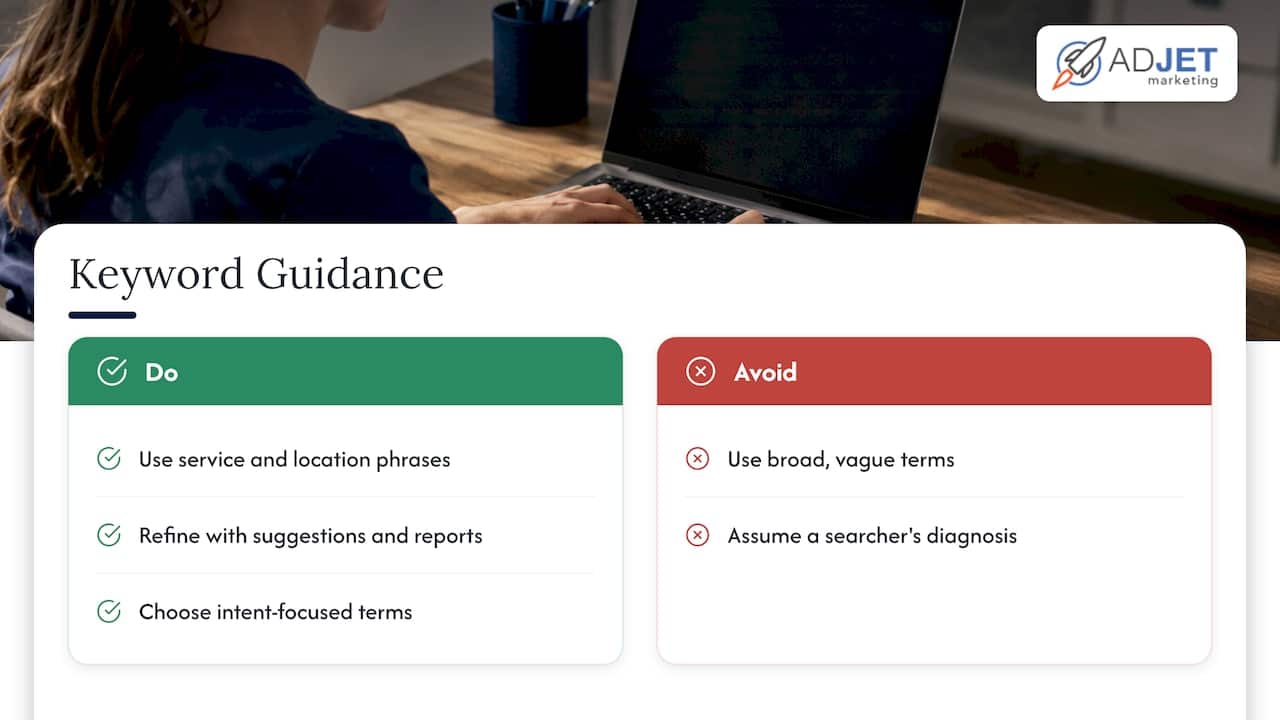
Microsoft’s editorial documentation includes a reason code stating that advertising for health care products and services must adhere to all applicable regulations. In practice, write ads that describe the service, location and next step, and avoid outcome promises, before-and-after claims you cannot support, and anything that implies you know a searcher’s condition. Microsoft’s policies are revised from time to time, so read the current healthcare policy pages in your account before launching a new service line.
Tracking and PHI
PHI (protected health information) is any information that identifies a patient and relates to their care. HIPAA’s rules apply to what your website, forms and tracking tools disclose.
Microsoft’s guidance on UET technical safeguards is direct. UET is the Universal Event Tracking tag that records conversions on your site. Microsoft says not to include PII or PHI in UET custom parameters and not to place UET tags on HIPAA-regulated pages. It offers no Business Associate Agreement for UET and does not represent it as HIPAA-compliant.
What that means in practice:
- Keep the tag off patient portals, intake forms, appointment details and any page where a visitor’s health information appears.
- Never pass names, emails, diagnoses or appointment types into custom parameters.
- Track conversions at the point where a person simply submits a general inquiry or clicks to call, and keep everything after that inside your own HIPAA-compliant systems.
- Have your compliance officer or healthcare attorney review the final tracking plan before launch.
This is where our process is built to help. Our HIPAA-compliant processes are designed so that the marketing layer, the landing page and the form that feeds your inbox, stays separate from the clinical layer.
How to set up a Microsoft Ads search campaign for a practice
Microsoft’s new-advertiser FAQs and its responsive search ads guide describe the flow. Here it is with the points where practices tend to go wrong.
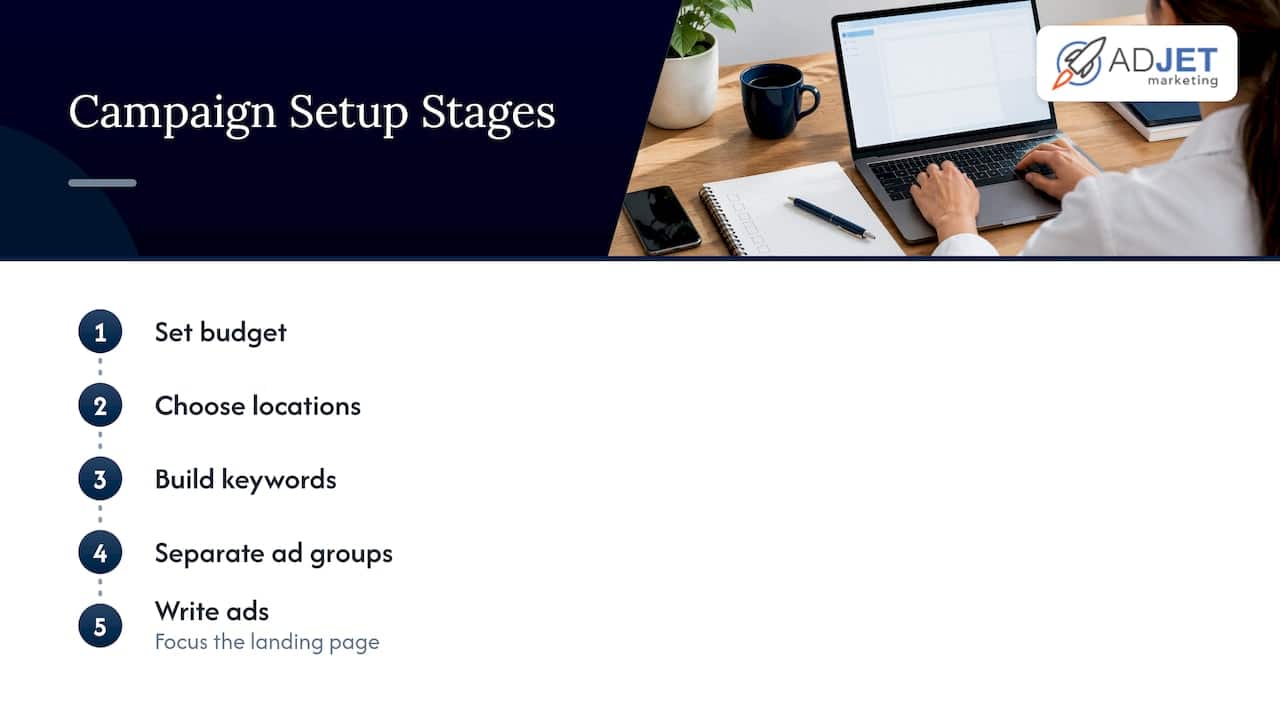
1. Create a Search campaign and set the daily budget
Start with one Search campaign per service line or per location group, not one campaign for everything. A daily budget that is too small to collect even a few dozen clicks per week will not teach you anything, so set it against what one new patient is worth to you, not against a number that feels comfortable.
2. Choose locations carefully
Microsoft lets you target or exclude countries, regions, states, cities and ZIP codes. You also choose whether to reach people physically in those places or people searching about them. For a clinic whose patients drive in, target the ZIP codes you can realistically serve. Medical travel, such as a plastic surgery practice that draws patients from other states, may justify a wider setting, but start tight and widen once you see results.
3. Build keywords from how patients describe the service
Microsoft recommends beginning with the phrases customers use for the service and location, then refining with keyword suggestions and search-term reports, and says intent-focused terms are generally more valuable than broad, vague ones. For a practice that translates to phrases like a treatment name plus your city, rather than a general condition word. You can enter a website URL or a service phrase to get suggestions, or add keywords and match types manually.
One caution for mental health, psychiatry and similar practices: choose service-oriented terms such as “therapist near me” or “anxiety counseling” for the practice, and write ads that never speak to a searcher as if you know their diagnosis.
4. Separate ad groups by service
Microsoft advises separate ad groups for distinct services or facets. A med spa should not mix injectables, laser hair removal and body contouring in one group. Each group gets its own keywords, its own ad copy and its own landing page. This keeps the ad, the keyword and the page saying the same thing, which is what earns clicks and conversions.
5. Write responsive search ads and point them to a focused page
Responsive search ads take multiple headlines and descriptions that the system combines. Write them in plain language: the service, the location, the way to book. Then enter the landing-page address as the Final URL.
This step decides whether the campaign pays back. A clinic’s home page is rarely the right destination. A page built for one service, with one clear action, is. We cover the elements that matter in our guides on medical landing page elements and the role of landing pages in healthcare marketing. Our team builds these pages on WordPress with the intent of turning visits into booked appointments.
A starting structure for a typical practice
| Practice type | Campaign split | Ad group examples | Landing page |
|---|---|---|---|
| Med spa | By treatment category | Injectables, laser, body contouring | One page per treatment |
| Plastic surgeon | By procedure | Rhinoplasty, breast procedures, facial | One page per procedure, consultation form |
| Therapist or counselor | By specialty and city | Anxiety, couples, teen counseling | One page per specialty, general inquiry form |
| Pain management | By condition area and location | Back pain clinic, injections, evaluation | Page per service with call button |
| Imaging center | By scan type | MRI, CT, ultrasound | Page per scan type with scheduling steps |
The pattern is the same in each row: one intent, one ad group, one page.
Budget, bidding and timelines
Be realistic here. Microsoft Ads typically brings less volume than Google, so the early weeks are for learning which search terms bring real inquiries. A new campaign needs time to collect data before bids and keywords can be judged, and a few weeks of clicks is rarely enough to call a verdict on a low-volume service.
A workable approach:
- Begin with manual or conservative bidding while you collect data, and move to automated bidding once a campaign has a steady number of conversions.
- Review the search-term report weekly at first. Add irrelevant terms as negatives, such as job seekers or free-service searches.
- Compare cost per inquiry and cost per booked patient, not cost per click.
- Decide in advance what a patient is worth. Our Google Ads profit calculator helps frame that math, and the same arithmetic applies to any paid search channel.
We do not promise outcomes from any ad platform. Results depend on your market, your competition, your page and how quickly your front desk answers.
Measuring what matters
Microsoft’s own advice is to measure meaningful actions, calls and form submissions, rather than clicks alone, then review which campaigns, keywords and ads produce them and shift budget to the stronger performers. Its troubleshooting logic is useful:
- Impressions but few clicks: revisit ad relevance and keyword targeting.
- Clicks but few leads: check that the landing page is fast, focused and consistent with the promise in the ad.
For a practice, add one more layer: the quality of the inquiry. Track how many form fills and calls turn into booked consultations, using your own scheduling or CRM records rather than ad-platform tags. That keeps patient details inside your systems and gives you the number that actually matters.
Most clinics come to us after a stretch of poor lead quality, lots of clicks and form fills from people who were never going to book. The fix is almost never a bigger budget. It is tighter keywords, a clearer page and a form that asks for the right information. Our conversion rate optimization work focuses on that gap between traffic and booked appointments.
Microsoft Ads and Google Ads: how they fit together
The two platforms work on the same principles, and a practice rarely needs to choose one forever. A sensible order for most clinics:
- Google first. It is where most search volume sits. Our guide to the benefits of Google Ads for medical clinics explains why we start there.
- Fix the landing pages and tracking. Every channel depends on them.
- Add Microsoft Ads once the first channel is producing inquiries at a cost you understand, using the same structure and pages.
- Build organic visibility alongside. Paid search stops when the budget stops. Medical SEO builds visibility that continues to bring in patients, and it takes months, not weeks, to show.
What we would tell a clinic owner
A second ad platform is a decision about priorities, not a shortcut. Most of the clinics we work with get more from fixing what happens after the click than from adding another source of clicks. A good page, a clean form and a tracking setup that respects PHI will improve every channel you run, now and later.
We build our work for healthcare and service businesses around that idea: Google Ads managed with a clear structure, landing pages built for one action, conversion work that finds where inquiries drop off, and reporting you can read without a glossary. We are a Google Partner agency based in Texas, and our processes are designed to be HIPAA-compliant from the first campaign.
If you are weighing Microsoft Ads, start by asking whether your current traffic is converting. If it is, adding a channel makes sense. If it is not, the next dollar belongs on the page.
Felix
Where AdJet fits
If you want the foundation in place before adding channels, our Google Ads services cover campaign structure and ongoing management for clinics and aesthetic practices. For the pages those ads send people to, our landing page plans start with a Starter Plan at $299 per month, and a Premium Plan is $1,500 per month. A single landing page is $2,000 as a one-off project. Our Growth Plan has no published price on the page. Our web design and conversion optimization services cover the rest of the path from click to booked appointment.
FAQ
What are Bing ads called now?
They are called Microsoft Advertising. Search ads can appear on Bing and partner engines, and audience ads can appear on MSN, Microsoft Start, Edge and Outlook.com. The old Bing Ads name still comes up in searches, but the platform and account are Microsoft Advertising.
Can a medical practice advertise on Microsoft Ads?
Yes, as long as the ads follow Microsoft’s editorial rules, which require that health care products and services advertising adhere to all applicable regulations. Write ads about the service, location and next step, avoid outcome promises, and review the healthcare policy pages in your account before launching.
Is Microsoft’s tracking tag HIPAA-compliant?
Microsoft does not represent UET as HIPAA-compliant and offers no Business Associate Agreement for it. It says not to put PII or PHI in custom parameters or to place the tag on HIPAA-regulated pages. Keep it off patient portals and intake pages, and have your compliance officer or healthcare attorney approve the tracking plan.
What are Doctor and Clinic Ads?
They are a Microsoft format for providers, launched in open beta in March 2023, that show on the right side of Bing results for searches on conditions, symptoms and specialists. They are generated from a feed of your specialties, locations and service type and run in their own cost-per-click auction. Check your account for current availability.
How long before Microsoft Ads brings patient inquiries?
Some inquiries can arrive within the first weeks, but a reliable read on which keywords and ads work takes longer, especially for low-volume services. Judge the campaign on booked consultations and cost per patient over a meaningful period, not on early click numbers.
Sources
- Microsoft Search ads
- What is the Microsoft Advertising Network?
- Doctors and clinics to expand reach and find new customers
- Editorial Reason Codes, Microsoft Advertising API
- UET technical safeguards for sensitive data
- Frequently Asked Questions for new Microsoft Advertisers
- About responsive search ads