









AI automation for a medical practice means software agents that handle repetitive administrative work, such as scheduling, intake, insurance checks, reminders and call answering, inside your existing systems, while anything that needs clinical judgment stays with a person. The practices that get value start with high-volume, low-risk front-office tasks, sign a business associate agreement (BAA) before any patient data moves, and expand in stages.
This guide covers what to automate, where an AI receptionist should hand a call to your staff, what the evidence says about time savings, and how to protect patient information. It also covers how automation connects to the marketing that fills your schedule in the first place.
TL;DR
- Start with administrative work: scheduling, confirmations, intake forms, eligibility checks and after-hours calls. Keep diagnosis, triage and medication questions with clinicians.
- Any AI vendor that touches protected health information (PHI) is a business associate under HIPAA. Get a signed BAA before go-live.
- The strongest evidence is for documentation and inbox time savings. Evidence for diagnostic and patient-outcome gains is still limited.
- Pilot narrowly, for example after-hours calls only, review the results, then expand over roughly 8 to 12 weeks.
- Automation handles the leads you already get. Marketing, tracking and landing pages decide how many good ones arrive, and they carry their own HIPAA risks.
Table of Contents
- What AI automation means in a clinic
- Which tasks to automate first
- What an AI receptionist can and cannot do
- What the evidence shows on benefits
- Protecting patient information
- A staged rollout that holds up
- Where marketing and automation meet
- Our perspective
- Build the demand side too
- FAQ
- Sources
What AI automation means in a clinic
It is not one tool. One 2026 guide describes it as a small system of AI agents and workflow tools that handle intake, scheduling, documentation, prior authorization and revenue cycle work, connected to the EHR and governed by defined human checkpoints. Older robotic process automation followed fixed scripts. Newer systems read the patient’s actual record, which reduces guessing.
In a small practice, that looks like an agent that watches the EHR, intake forms, fax inbox and patient portal. It handles routine items such as intake, eligibility, prior authorization drafts, refill triage and billing follow-up inside the system you already use. Anything requiring a clinician’s judgment goes to a person.
Adoption is already broad. The AMA’s 2026 survey, as reported by Yahoo News, found 81% of physicians use AI in their practices, up from 38% in 2023. The most common uses were summarizing medical research and documenting clinical care.
Which tasks to automate first
The question we hear from clinic owners is rarely “should we use AI?” It is “where does it actually save my staff time?” The answer is usually the work your front desk repeats all day.
Weave’s 2026 Pulse Survey found that 80% of practices say duplicate data entry hurts their workflow, and 63% spend an hour or more a day on manual entry. The tasks they most want to automate:
| Task | Share of practices that want it automated |
|---|---|
| Appointment scheduling and confirmations | 49% |
| Insurance verification | 46% |
| Patient intake and forms | 42% |
| Billing and payment reminders | 41% |
The same survey found that around 60% of practices are still concerned about data privacy, which is why the compliance section below matters as much as the task list.
Scheduling and reminders
Agentic scheduling tools can interpret schedule templates, provider preferences and patient needs, then propose or book appointments by agent, text or phone. They can also pre-populate intake forms from EHR data, verify contact and insurance details, and flag missing fields before the patient arrives.
Intake, referrals and documents
AI can process faxed referrals, handle digital intake, and flag incomplete documentation so staff see only the exceptions. Imaging centers and radiology groups benefit most from clean document flow. If you read studies through a remote reading partner, understanding how teleradiology works from PACS to signed report shows where automated routing and status updates fit around the clinical read.
Billing, denials and prior authorization
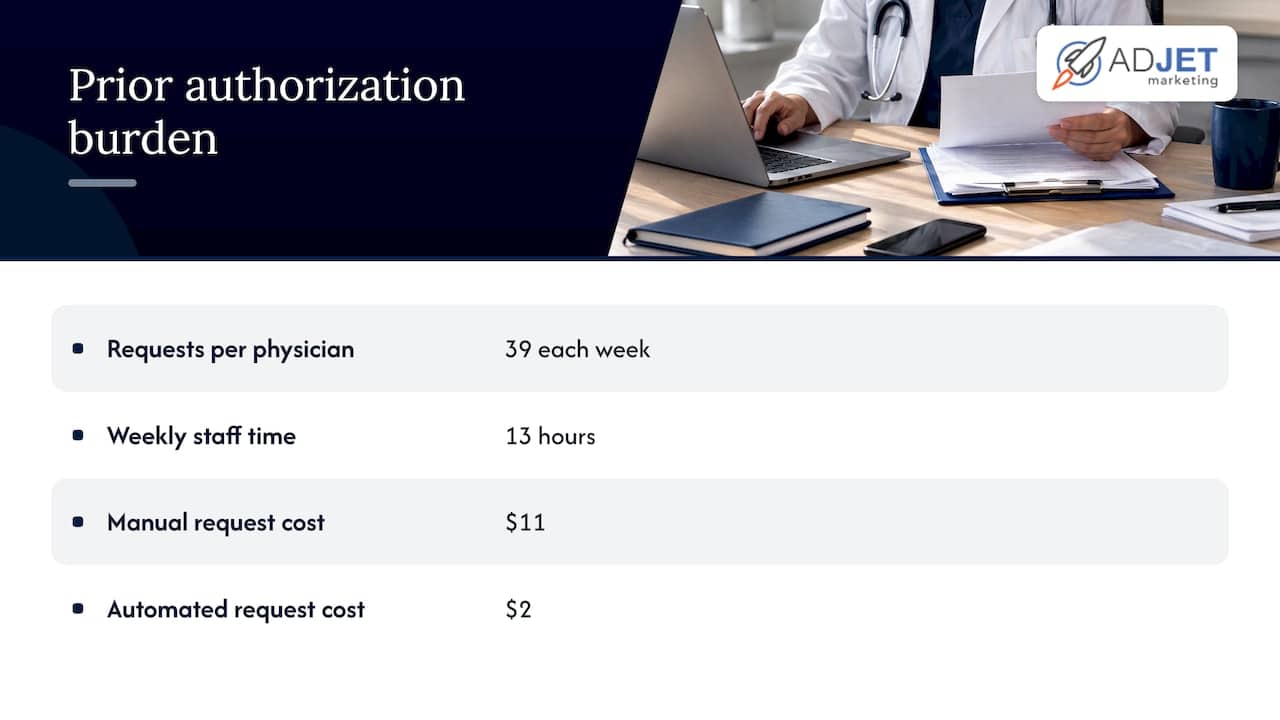
Prior authorization is a heavy administrative load. The AMA’s 2024 survey found physicians handle an average of 39 requests per week, taking 13 hours of physician and staff time, according to Commure’s summary. CAQH figures cited by RunFrame put a manual request at about $11 in staff time and an automated one closer to $2. Treat vendor-reported figures as directional and model your own volume.
Documentation
Ambient AI scribes target the charting burden. A JAMA Network Open 2024 study, cited by Commure, found physicians spend 36.2 minutes in the EHR per 30-minute visit, including 6.2 minutes of after-hours work per encounter.
What an AI receptionist can and cannot do
An AI receptionist answers the phone and works through structured, administrative requests. Typical call types include:
- Booking and confirming appointments
- After-hours intake and new-patient intake
- Insurance FAQs, directions and hours
- Prescription refill routing
- Reminder calls and post-visit follow-up scheduling
The boundary is administrative versus clinical. Researchers at Harvard Medical School, as summarized by Commure, describe scheduling and billing as lower-risk uses of voice agents, while clinical advice and triage carry different requirements.
When the call should go to a person
Build these handoffs into the configuration from day one. Common handoff triggers are:
- Detailed symptom descriptions that could amount to clinical advice
- Mental health crisis disclosures
- Medication dosage questions
- Lab result inquiries
- A patient expressing worry about their condition
- Coverage or billing disputes
- Requests to speak with a specific provider
Another source on AI phone answering adds that these systems should not diagnose, prescribe or adjust medications, or handle emergency triage without immediate human escalation. If your practice treats behavioral health, make the crisis handoff the first rule you test, and have your clinical lead sign off on the wording.
What the evidence shows on benefits
The best-supported near-term gains are in documentation and inbox management. A 2026 review in Communications Medicine finds the gains show up mainly in process measures such as time, acceptability and perceived communication quality. Evidence for diagnostic reasoning and downstream patient outcomes is more limited, and many studies are simulated.
Some concrete numbers:
- A JAMA study of 8,581 clinicians across five academic health systems, summarized here, linked AI scribe adoption to 13.4 fewer minutes of total EHR time and 16 fewer minutes of documentation time per eight hours of patient care. Estimated billing revenue rose by $167 per clinician per month.
- Tebra data shows 65% of independent practices spend more than an hour a day on documentation. Among those using AI for documentation, 64% report faster completion and 52% report less after-hours work.
- The athenahealth 2026 Physician Sentiment Survey found 42% of physicians say AI has actively reduced administrative burdens, up from 37% the year before.
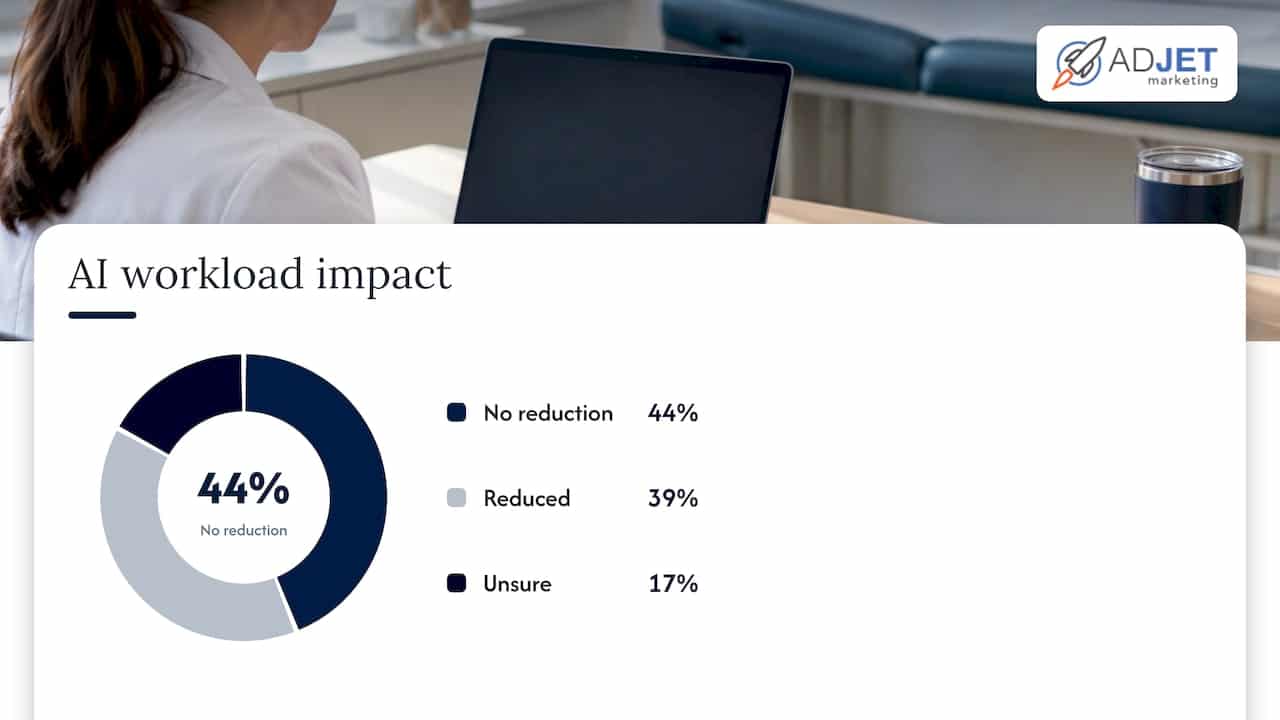
Results are not automatic. An MGMA poll from August 2025 found 44% of practice leaders said AI had not reduced staff workload, 39% said it had, and 17% were unsure. Practices using AI across a larger share of visits (26% or more) were more likely to report a positive effect. The lesson: pick a few workflows and use them thoroughly, rather than scattering small pilots.
Small practices should also know the comfort gap. The athenahealth survey found 65% of physicians at enterprise organizations are comfortable with AI, compared with 43% at small practices. Involving your team early closes that gap.
Protecting patient information
HIPAA does not ban AI. It decides who may handle patient information and under what contract.
- BAA first. HHS guidance states that when a covered entity uses a cloud service provider to create, receive, maintain or transmit ePHI, that provider is a business associate. The two parties must sign a HIPAA-compliant BAA. A subcontractor handling ePHI is also a business associate.
- Voice counts. One HIPAA guide for AI receptionists notes that even transient audio streams containing PHI trigger BAA requirements. It also recommends encryption in transit (TLS 1.2 or higher) and at rest (AES-256 or equivalent), role-based access, audit logging, documented PHI data flows and BAAs that cover subcontractors.
- Consumer tools are the trap. A PMC-published article on large language models explains that HIPAA prevents copying EMR data into an LLM outside the health system’s firewall, though a secure EMR integration can create a compliant environment.
- Govern it. The Health Federation of Philadelphia’s AI guide warns that AI tools can increase the risk of PHI exposure and recommends a governance team spanning leadership, clinical, operations and compliance or legal.
For a small practice, the governance team can be three people: the owner, the practice manager and whoever handles compliance. Ask your compliance counsel or privacy officer to review each vendor contract.
A staged rollout that holds up
The Communications Medicine review recommends prioritizing high-volume, lower-risk clerical and communication workflows, keeping clinician verification, and adding privacy, auditability and error monitoring before scaling. The AHA’s 2025 AI Action Plan report adds that organizations should vet AI projects with consistent, transparent criteria, including the link to a strategic goal and data availability, and then track approved pilots.
One vendor guide lays out a five-phase AI receptionist rollout you can adapt:
- Weeks 1 to 3: compliance and infrastructure, including the BAA and risk assessment.
- Weeks 3 to 6: configuration and EHR integration.
- Weeks 6 to 8: controlled pilot, starting with after-hours calls only.
- Weeks 8 to 12: graduated expansion.
- After that: full production, with ongoing monitoring.
Before each phase, write down one measurable target, such as missed-call rate, no-show rate or minutes of front-desk data entry per day, so you know whether it worked.
Where marketing and automation meet
Automation improves what happens after a patient reaches out. It does nothing for how they find you. Many clinics come to us with a capable front desk and a thin pipeline, or with a flood of low-quality inquiries that overwhelm the team. Both are marketing problems, and fixing them makes automation more valuable.
Three practical connections:
- Forms and intake. Web forms feed your automation. If they collect PHI, the BAA and EHR setup matter. Our HIPAA-compliant forms checklist walks through the gaps we see most.
- Tracking. Ad pixels and remarketing tags can leak PHI. Our four-step remarketing audit and our guide on Meta Pixel and HIPAA cover the checks.
- Conversion. An AI receptionist answering at 9 p.m. only helps if the page convinces someone to call. See how to increase booking rates from website visitors.
If you run a med spa, our piece on AI-powered medical spa marketing shows how the same thinking applies to demand generation.
Our perspective
We see the same pattern across clinics. Owners buy a tool to fix a symptom, a missed call or a slow intake, before they have mapped the whole patient path from the first search to the booked visit.
Our view is that the path should be designed in one piece. The Google Ads campaign, the landing page, the form, the tracking and the phone or chat experience all handle the same patient and the same PHI risk. When they are built together, you can see which source produces booked appointments and not just clicks.
We also set expectations plainly. Search engine optimization typically takes months to compound, and paid ads can produce leads sooner but depend on budget and landing page quality. Neither is a guarantee, and automation will not rescue a weak offer. What it does is make sure the leads you earn get answered quickly and consistently.
For HIPAA-regulated practices, our rule is simple: if a tool touches patient data, it needs a BAA and a documented data flow before it touches your campaigns or your site.
Felix
Build the demand side too
If your intake is ready for more volume, we can help with the part that brings it in. Our team builds and manages SEO, Google Ads, and conversion-focused websites for clinics and aesthetic practices. Our landing page plans start with a Starter Plan at $299 per month, and a Premium Plan is $1,500 per month. You can also look at our Google Ads management and SEO services to see how we scope the work.
FAQ
Can an AI receptionist replace my front desk staff?
It is better treated as extra coverage than a replacement. It can handle booking, confirmations, after-hours calls and routine questions, but billing disputes, symptom concerns, crisis disclosures and provider requests should go to staff. Most practices use it so the team can focus on patients in the office.
Do I need a BAA for an AI tool?
Yes, if the vendor creates, receives, maintains or transmits PHI for you. HHS says a cloud service provider handling ePHI is a business associate, and the same logic applies to AI vendors. Sign it before go-live, and confirm it covers any subcontractors.
Which AI automation should a small clinic start with?
Start with appointment scheduling and confirmations, intake forms and insurance verification. Those are the tasks practices most often say they want automated, and they carry lower clinical risk. Pilot one workflow, such as after-hours calls, before expanding.
How long does implementation take?
One published five-phase plan runs about 8 to 12 weeks from compliance setup to expansion, with full production afterward. Your timeline depends on your EHR integration and how many call types you automate. Allow time for the BAA and a risk assessment first.
Sources
- AI Automation for Healthcare Clinics: The Complete 2026 Guide
- 4 In 5 Doctors Now Use AI In Their Practices, AMA Survey
- How AI Automation Works for Small Medical Practices
- Weave’s 2026 Pulse Survey
- Reducing Administrative Burden in Healthcare Through AI
- AI for Medical Practices: A Practical Guide to Getting Started
- Benefits of AI in Healthcare for Group Practices
- AI for Medical Practices: 2026 Best Practices
- What Is an AI Medical Receptionist?
- Evidence, use cases, and implementation safeguards of large language models (Communications Medicine)
- JAMA: AI Scribes Cut EHR Documentation Time for Clinicians
- Webinar Recap: AI for Independent Practices
- athenahealth 2026 Physician Sentiment Survey
- MGMA: Most practices use some form of AI
- HHS: Guidance on HIPAA and Cloud Computing
- AI Receptionist for Healthcare: HIPAA Compliance Guide
- Efficient healthcare with large language models
- Health Federation of Philadelphia: AI Implementation Guide
- AHA: Building and Implementing an AI Action Plan