








Google Ads cannabis policy is straightforward once you strip away the confusion: you cannot advertise marijuana, THC products, or paraphernalia on Google Ads anywhere in the United States, regardless of state legalization. If you sell dispensary products or anything with THC, your growth plan needs to lean on SEO, cannabis ad networks, and owned channels instead.
TL;DR:
- Google Ads bans all forms of marijuana, THC products, and paraphernalia, regardless of state legalization, following federal law classifications.
- Certification for CBD ads requires LegitScript approval, proof of compliant labeling, THC content verification, and location-specific eligibility, which is limited to certain states.
- Violating policies typically results in account warnings, restrictions, or suspensions, with appeals needing matching COAs and clear explanations of product contents.
- Building a compliant digital presence involves separate domains for prohibited content, age gates, accurate batch documentation, and informational copy rather than transactional language.
- For products ineligible for Google Ads, local SEO, directory listings, and owned channels like email or SMS offer more durable and effective marketing options.
Table of Contents
- Understanding Google Ads Marijuana Policy: What’s Prohibited and What’s Allowed
- CBD Advertising Certification: LegitScript and Location Rules
- How Google Enforces Cannabis Ad Compliance and What Happens If You’re Flagged
- A Compliance Checklist Before You Touch Google Ads
- What to Do Instead of Google Ads for Cannabis Marketing
- How AdJet Approaches Cannabis Clients
- The Real Problem Isn’t the Policy, It’s the Workaround Mentality
- Get a Compliance Audit Before You Spend Another Ad Dollar
- Sources
- FAQ
Understanding Google Ads Marijuana Policy: What’s Prohibited and What’s Allowed
Google’s Recreational drugs policy draws a hard line: ads cannot promote, link to, or imply the sale of marijuana or THC products, no matter what your state license says. Federal law still classifies cannabis as a controlled substance, and Google’s advertising rules follow federal status, not state legalization. That single fact explains almost every confusing edge case advertisers run into.
“Promote or imply sale” covers more than you’d think. It’s not just a buy-now button. A landing page with product SKUs, a strain menu, delivery zip codes, or even a “shop now” link to a dispensary page all count as implying sale. Google’s automated review and human reviewers both flag these patterns, and once flagged, the whole account can get scrutiny, not just the offending ad.
Ingestible CBD, THC of any kind, and paraphernalia stay banned outright. The distinction matters:
- Prohibited always: marijuana, THC edibles, vape cartridges, flower, paraphernalia, delivery services
- Prohibited for CBD: ingestible CBD products (tinctures, capsules, gummies) marketed for consumption
- Potentially allowed: topical hemp CBD (creams, balms) under 0.3% THC, with certification
- Allowed without special certification: FDA-approved CBD pharmaceutical products
If your business model touches THC in any form, Google Ads simply isn’t in play for direct sales. That’s the part most first-time cannabis advertisers get wrong: they assume a “CBD” label on the box gives them a pass, when the policy actually hinges on THC content, product form, and how the ad copy is written.
CBD Advertising Certification: LegitScript and Location Rules
Getting a CBD ad approved on Google runs through a two-step gate. First, your product and website need LegitScript certification, a pharmacy and healthcare compliance verification service that Google recognizes as its trusted screener for CBD advertisers. Second, once LegitScript signs off, you still go through Google’s own CBD Ads review, which is separate and, by most accounts, stricter than the certification itself.
Here’s the general sequence:
- Apply for LegitScript CBD certification for your specific product line and website domain.
- Submit to Google’s CBD Ads Certification once LegitScript approves you, including proof of compliant labeling and THC content.
- Wait for location eligibility confirmation, since Google restricts CBD ad delivery to specific U.S. states even after certification.
Google has documented eligibility in a limited set of locations, including California, Colorado, and Puerto Rico, though this list shifts as policy updates roll out. Don’t assume approval in one state carries over to another; each location gets evaluated separately, and Google can add or remove regions without much advance notice.
Pro Tip: Pull your certificate of analysis (COA) for the exact batch tied to the product you’re advertising, not a generic COA from an older run. Mismatched batch data is the single most common reason CBD applications stall.
Before you apply, have these ready: a current COA from third-party lab testing, batch-specific documentation, compliant labeling that states THC content clearly, and copies of any relevant state licenses.
How Google Enforces Cannabis Ad Compliance and What Happens If You’re Flagged
Enforcement under the Dangerous products or services policy usually follows a pattern: a warning notification tied to a specific ad or landing page, then account-level restriction if the issue isn’t resolved, and in repeat or severe cases, full account suspension. Google doesn’t always give much lead time between steps, especially for ads it considers a clear violation rather than a gray area.
If you get flagged, you can appeal directly through your Google Ads account. A solid appeal usually includes:
- A clear explanation of the product and its THC content
- Current COAs matching the exact SKU or batch in question
- Your LegitScript certification ID, if applicable
- Screenshots showing the landing page has been corrected
Most appeals fail for avoidable reasons: a COA that doesn’t match the product batch, a landing page still linking to a prohibited product elsewhere on the site, or ad copy that reads as a sale pitch even after edits. Pro Tip: Before resubmitting, have someone outside your marketing team review the landing page as a first-time visitor would. If they can find their way to a THC product page in two clicks, so can a reviewer.
A Compliance Checklist Before You Touch Google Ads
Most of the risk in cannabis advertising isn’t the ad itself. It’s what the ad links to. Build your compliance foundation in this order:
- Separate your domains. Keep any prohibited-product content (THC, edibles, dispensary menus) on a different domain or subdomain than eligible hemp CBD content, so a policy flag on one doesn’t take down the other.
- Age-gate everything. Any page discussing cannabis or CBD products needs an age verification step before content loads.
- Match your documentation to your SKUs. COAs, batch numbers, and state license copies should all reference the exact product being marketed.
- Write informational, not transactional, copy. Skip commercial keywords implying sale (“buy weed near me”) in favor of brand or educational language where that’s lawful.
For account structure, keep THC and hemp CBD products in separate Google Ads accounts entirely, restrict location targeting to states where you’re certified eligible, and audit your site for stray links connecting compliant pages to prohibited ones.
- Landing pages should never mix a topical CBD product line with THC products on the same page
- Remove any breadcrumb navigation that leads from a CBD page back to a dispensary menu
- Keep labeling language consistent across the ad, landing page, and product packaging
Pro Tip: Run your own site through Google’s ad preview tool before launch. If a reviewer needed three clicks to reach a prohibited product from your compliant landing page, that’s still too close.
What to Do Instead of Google Ads for Cannabis Marketing
If Google Ads isn’t an option for your product line, the good news is you’re not without leverage. Cannabis-specific directories still drive real local intent, especially for dispensary discovery and menu browsing. They function more like a specialized Yellow Pages than a search ad platform, but for cannabis buyers already looking to purchase, that’s often exactly the intent you want to catch.
Local SEO tends to be the most durable channel available. A well-optimized Google Business Profile, consistent local citations, and local SEO tactics built specifically for cannabis businesses compound over time in a way paid ads never will, since you’re not renting visibility, you’re earning it.
Owned channels round out the mix:
- Email and SMS lists for repeat customers and loyalty programs
- Cannabis-friendly programmatic display networks for top-of-funnel awareness
- Review management on platforms that allow cannabis business listings
Federal prohibition is why platform-level bans persist despite state legalization, and that dynamic isn’t changing until federal scheduling changes.
How AdJet Approaches Cannabis Clients
When a cannabis business comes to us, the first conversation is almost always about what channels are actually available, not what we’d prefer to sell. If the product line includes THC, we recommend skipping Google Ads entirely and putting the budget into SEO and compliant digital marketing strategies for cannabis businesses instead. A typical engagement runs through a compliance audit, a compliant landing page build, local SEO and directory management, and then retention marketing. Realistically, local SEO traction takes three to six months to show up in rankings and traffic, which is a longer runway than paid ads but a more durable one.
The Real Problem Isn’t the Policy, It’s the Workaround Mentality
Most of the frustration cannabis advertisers feel with Google isn’t really about the policy being unclear. It’s that the policy is clear, and people keep looking for a way around it instead of building around it. Google’s rules follow federal law, not state legalization, and no amount of clever ad copy or landing page tricks changes that math. Attempts to disguise product pages or slip past automated review tend to backfire, often triggering the exact suspension the business was trying to avoid.
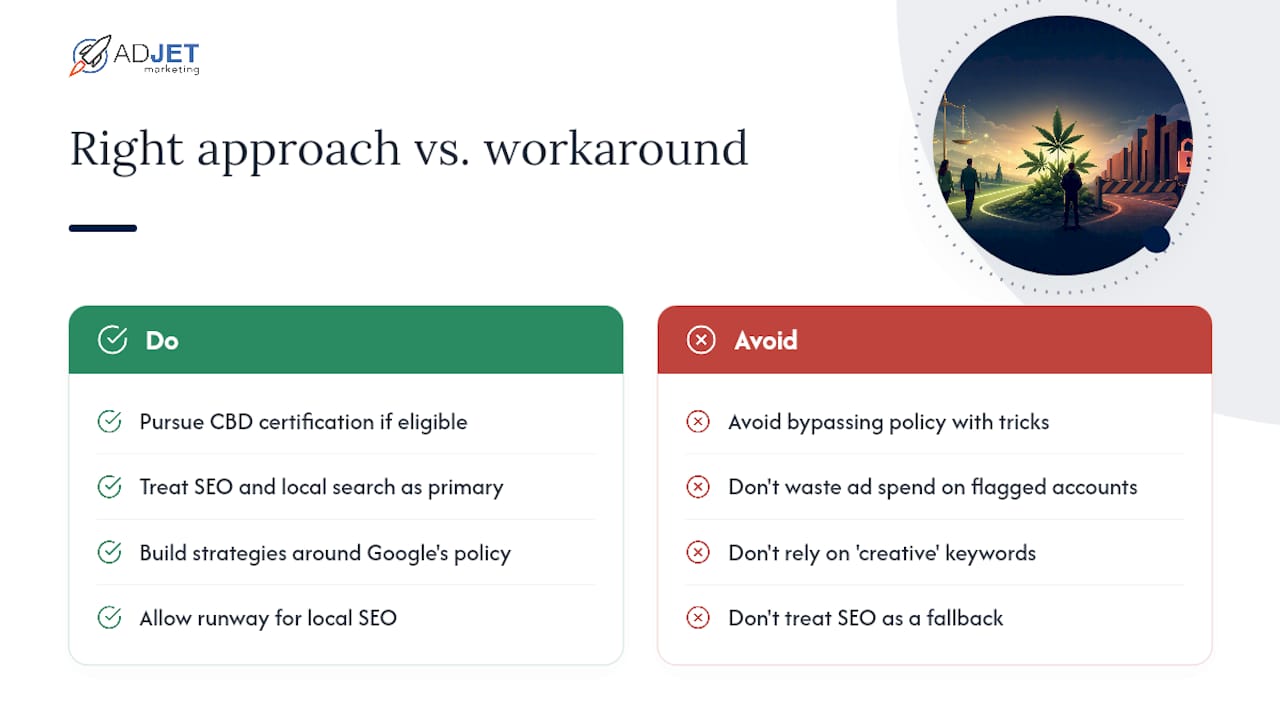
The conventional advice, “just get creative with your keywords,” is bad advice. It wastes ad spend on an account that’s likely to get flagged anyway, and it distracts from channels that actually compound. If you’re eligible for CBD certification, pursue it seriously since the documentation bar is real but achievable. If you’re not eligible, the smarter move is treating SEO and local search as your primary acquisition engine from day one, not as a fallback after Google says no.
What gets underestimated most is how much runway local SEO needs before it pays off, and how much that runway is worth compared to chasing a platform that was never going to say yes.
— Felix
Get a Compliance Audit Before You Spend Another Ad Dollar
If you’re not sure whether your product line qualifies for any Google Ads eligibility, or you already know it doesn’t and need a real acquisition plan, you can consider building a compliant, high-converting site and local SEO foundation instead of a paid campaign that’s likely to get flagged. We handle everything from compliance-aware landing page builds to search engine optimization that builds durable local visibility without depending on a platform that can suspend your account overnight. For businesses that are certified and eligible to run paid campaigns, our Google Ads management team can also audit your account structure before you launch. Request a compliance audit to find out which channels are actually open to your business right now.
This article is general information, not a substitute for advice from a qualified lawyer. Consult a qualified legal professional about your own circumstances before acting on anything here.
Sources
- Recreational drugs – Advertising Policies Help
- Google Advertising for LegitScript-certified CBD Manufacturers and Retailers
- Cannabis Regulatory Marketing Guide – Bud Authority
FAQ
What is not allowed under Google’s cannabis advertising rules?
Google prohibits ads that promote, link to, or imply the sale of marijuana, THC products of any kind, and cannabis paraphernalia, even in states where these products are legal.
Is $20 a day good for Google Ads if I’m running a compliant CBD campaign?
Budget adequacy depends far more on your industry’s cost per click and conversion rate than a flat daily number, and for a niche category like certified CBD, small daily budgets are often too thin to gather meaningful data quickly.
Can you advertise cannabis on social media platforms?
Most major social platforms follow similar restrictions to Google, banning direct promotion of marijuana and THC sales, though policies and enforcement vary by platform and change frequently.
Are prescription drug terms allowed in Google Ads?
Prescription drug advertising is allowed only through Google’s certified pharmacy program, and FDA-approved CBD pharmaceutical products fall under that separate certification path rather than the general cannabis policy.
Does Adjetmarketing help cannabis businesses that can’t use Google Ads?
Yes. Adjetmarketing builds SEO and local search strategies, along with compliant landing pages, for cannabis businesses that fall outside Google’s advertising eligibility.