









Content marketing for private schools must turn discoverability into qualified inquiries by mapping program strengths to parent search intent and converting visitors through intentional evidence pages.
The four essentials:
- Local discoverability: Appear in the Google Local 3-Pack before spending on anything else.
- Curriculum-to-query mapping: Align every program page to the exact phrases parents type.
- High-intent content: Program pages, lead magnets, and testimonials that move families toward applying.
- Nurture sequences: Automated follow-up that keeps your school top-of-mind from first click to enrollment.
Start here: Run a local visibility check today. Search your school’s category in your city and confirm you appear in the top three map results.
Table of Contents
- Why content marketing moves the enrollment needle for private schools
- How local search puts your school in front of ready families
- How to map your curriculum to the queries parents actually search
- Content types that reliably move parents through the funnel
- How to build a 12-week content calendar you can staff or outsource
- Technical SEO checklist for school websites
- From visitor to applicant: KPIs, timelines, and realistic budget ranges
- Common mistakes private schools make with content marketing
- Your 90-day launch plan: what to do first, next, and later
- How to use social media to build parent engagement and brand awareness
- Email marketing and nurture sequences for prospective families
- Community partnerships that amplify your content reach
- How storytelling highlights student success and school values
- Paid advertising strategies for private school enrollment campaigns
- Key Takeaways
- What we’ve learned from local-service and healthcare clients
- Useful sources and further reading
Why content marketing moves the enrollment needle for private schools
Content marketing reduces cost-per-inquiry and increases yield when it targets parent intent rather than broadcasting general awareness. The mechanism is straightforward: a parent searching “dyslexia-friendly middle school in Austin” is already motivated. A well-placed program page captures that intent at zero ongoing cost once it ranks.
Content marketing often returns roughly $3 for every $1 spent compared with lower ROI on paid advertising, which typically yields about $1.80 per dollar spent. That gap matters for schools with constrained marketing budgets. Organic content compounds; ads stop the moment you stop paying.
Effective private-school marketing is a coordinated system for creating qualified demand. Marketing activity must align with admissions and evidence, not run as a separate function chasing impressions.
NAIS research found that the top two goals for independent school marketing teams are growing enrollment and building brand strength. Yet the most common challenge is identifying three unique advantages competitors would struggle to match. Content strategy solves exactly that problem.
How local search puts your school in front of ready families
Local search discoverability is the mandatory foundation. If your school doesn’t appear in the Local 3-Pack, most ready families won’t consider you, regardless of how strong your program pages are.
Priority checklist:
- Claim and verify your Google Business Profile (GBP).
- Confirm NAP (name, address, phone) is identical across your website, GBP, and every directory listing.
- Set your primary GBP category to “Private School” and add relevant attributes (before/after care, special education, etc.).
- Upload at least 10 photos: campus, classrooms, events, and faculty.
- Request reviews from current families after positive touchpoints (open houses, orientation).
- Add your key programs as GBP services so they appear in local search snippets.
This is the same local SEO foundation Adjetmarketing builds for medical clinics. The principle transfers directly: local SEO for clinics and schools both depend on NAP consistency and category accuracy before any content investment pays off.
Pro Tip: Set a quarterly calendar reminder to audit your GBP for outdated hours, photos, or service descriptions. A single inconsistency in your address format across directories can suppress your local ranking.
How to map your curriculum to the queries parents actually search
The single reason most school pages fail to generate inquiries is misalignment between what you publish and what parents search for. Your “Innovative STEM Program” page won’t rank for “coding classes for middle schoolers near me” unless you’ve built it around that language.
Three-step mapping process:
- Diagnose your program strengths. List your top three to five differentiators (e.g., Montessori method, dyslexia support, AP course density, arts integration).
- Gather parent queries. Use Google’s “People Also Ask” feature, Ubersuggest, or Semrush to find the exact phrases parents type. Map each strength to two to three long-tail queries.
- Build a dedicated content hub. Create one authoritative program page per strength, then feed it with supporting blog posts, FAQs, and a downloadable parent guide.
Curriculum-to-query mapping closes the gap between a school’s program strengths and the exact search queries parents use. Build pages around specific long-tail queries rather than internal program names.
A school with a strong reading intervention program, for example, should own queries like “reading support private school [city]” and “dyslexia-friendly elementary school near me.” Each query becomes a page or a blog post. Entity-first SEO and structured proof, including faculty profiles and outcome data, strengthen your authority signals for both Google and AI-generated answers.
Pro Tip: Zero-difficulty keywords are common in school marketing because most schools aren’t doing content marketing at all. A well-optimized page targeting an uncontested long-tail query can reach page one within weeks.
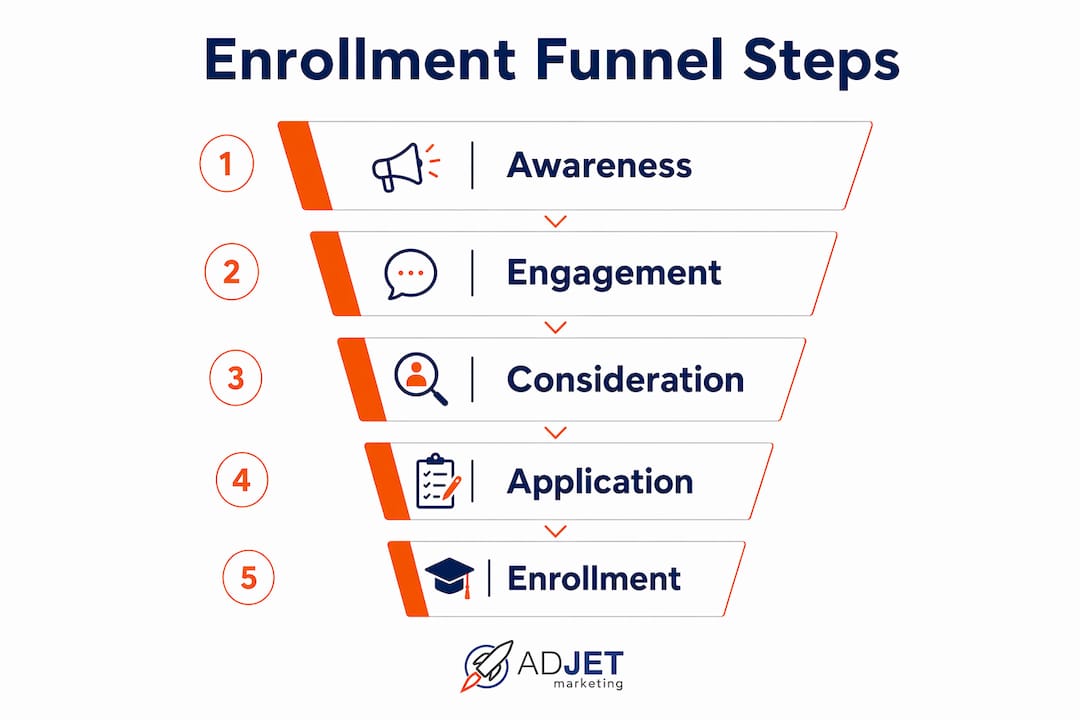
Content types that reliably move parents through the funnel
Not all content converts equally. Here’s the priority order for private school enrollment:
- Program pages (decision stage): The highest-converting asset. Each program needs its own page with parent-facing language, outcomes, and a clear inquiry CTA.
- Application landing pages (decision stage): Separate from your general admissions page. One goal, one form, no distractions.
- Lead magnets and parent guides (consideration stage): A downloadable “Questions to Ask on a School Tour” guide captures email addresses from families who aren’t ready to apply yet.
- Case studies and testimonials (consideration stage): Specific, outcome-focused stories from current families. Accreditation badges and third-party recognitions belong here too.
- Virtual tours and videos (awareness/consideration): 80% of website visitors will watch a video in its entirety when it includes captions, compared with only 20% who read written content all the way through.
- FAQ pages (awareness stage): Answer the questions parents ask before they ever contact you. These pages rank well for informational queries and reduce friction.
- Blog Q&A posts (awareness stage): Target “how to choose a private school” and similar queries. These build topical authority and feed traffic into your program pages through internal links.
Content clusters that link hub pages to supporting posts increase topical authority and speed up ranking for related queries. Refresh proven pages before publishing new ones.
How to build a 12-week content calendar you can staff or outsource
A focused 12-week plan outperforms a scattershot annual calendar. It proves the model before you scale.

| Week | Theme | Deliverable | Channel |
|---|---|---|---|
| 1–2 | Foundation | GBP audit + NAP fix | Local search |
| 3–4 | Program pages | Two high-priority program pages live | Website |
| 5–6 | Lead magnet | Parent guide (PDF) + landing page | Email/paid |
| 7–8 | Blog launch | Two blog posts targeting mapped queries | Organic search |
| 9–10 | Social proof | Two testimonial pages or video clips | Website/social |
| 12 | Email sequence | Three-email nurture sequence for new inquiries |
Roles: One person drafts, one reviews for brand/admissions alignment, one publishes and distributes. For schools with a single marketing staff member, an agency retainer covering content production and SEO management is often more cost-effective than hiring.
NAIS data shows that 54% of independent schools have annual marketing budgets above $70,000. Channel allocation guidance suggests roughly 45–55% to digital, 15–25% to events/community, 10–20% to traditional/print, and 10–15% to brand/creative.
Pro Tip: Assign content topics to the enrollment calendar, not the academic calendar. Publish awareness-stage posts in summer, inquiry-conversion content in fall, and application-stage content in winter.
Technical SEO checklist for school websites
Technical issues kill conversion and rankings. Fix the site experience before scaling content spend.
- Mobile speed: Test with Google PageSpeed Insights. Aim for a score above 75 on mobile. Compress images and defer non-critical scripts.
- Core Web Vitals: Largest Contentful Paint under 2.5 seconds, Cumulative Layout Shift under 0.1.
- Form tracking: Confirm every inquiry form fires a conversion event in Google Analytics 4 and your CRM.
- Schema markup: Add
EducationalOrganizationschema to your homepage andPersonschema to faculty profile pages. This supports entity-based authority and improves how AI tools summarize your school. - Crawlable program pages: Each program page needs a unique title tag, meta description, and H1. No duplicate content across grade-level variants.
- Accessible content: Alt text on all images, proper heading hierarchy, and readable font sizes on mobile.
The same on-page discipline Adjetmarketing applies to healthcare SEO translates directly here. If developer hours are limited, prioritize mobile speed and form tracking first.
From visitor to applicant: KPIs, timelines, and realistic budget ranges
Five key performance indicators commonly used to assess content program conversion include median cost per inquiry of around $697, median cost per enrollment of about $3,677, inquiry-to-application conversion target of 25–35%, yield rate of 50–65%, and retention rate target of 90% or higher. These benchmarks are drawn from industry analyses of private school marketing programs but may vary by context. Expect meaningful organic traffic gains within 3–6 months of consistent publishing. Enrollment impact typically shows in the cycle following your content launch, not the same cycle.
For a mid-size private school, a content program covering SEO, two blog posts per month, and basic CRM setup typically runs $2,500–$5,000 per month when outsourced to an agency.
Common mistakes private schools make with content marketing
No strategy before tactics. Most programs jump into social posts or a website redesign before clarifying messaging. Fix: define your top three differentiators and map them to queries before producing a single piece of content.
Thin program pages. A 200-word page with a photo and a phone number won’t rank or convert. Fix: each program page needs 600+ words of parent-facing content, FAQs, and a clear next step.
Wrong keywords. Publishing about internal program names no parent searches for. Fix: validate every topic with a keyword tool before writing.
No follow-up automation. Families who download a guide or fill out an inquiry form and receive no response within 24 hours often choose another school. Fix: build a three-email nurture sequence that triggers on form submission.
High traffic with a low inquiry rate is a conversion problem, not a content problem. Check your program pages for missing CTAs, slow load times, and forms that don’t work on mobile before publishing more content.
Pro Tip: Track retention by grade level. K→1, 5→6, and 8→9 are common leak points. Build targeted re-recruitment campaigns 6–12 months ahead of those transitions.
Your 90-day launch plan: what to do first, next, and later
The 90-day plan focuses on four outcomes: local visibility, evidence pages, CRM setup, and one lead magnet campaign to prove traction.
Days 1–30 (discoverability):
- Complete GBP audit and fix NAP inconsistencies.
- Publish two high-priority program pages with mapped queries.
- Install Google Analytics 4 and confirm form tracking.
Days 31–60 (evidence and capture):
- Launch one lead magnet with a dedicated landing page.
- Publish two blog posts targeting awareness-stage queries.
- Set up a three-email nurture sequence in your CRM or email platform.
Days 61–90 (amplify and measure):
- Collect and publish two testimonials or a short video.
- Review CPI and inquiry-to-application rate against benchmarks.
- Decide whether to scale in-house or move to an agency retainer.
A 90-day plan that proves traction is worth more than a 12-month plan that never launches. Start with the minimum viable program, measure it, then scale what works.
How to use social media to build parent engagement and brand awareness
Social media works best as a distribution channel for content you’ve already created, not as a standalone strategy. Facebook and Instagram remain the primary platforms for reaching parents of school-age children in the United States. LinkedIn is useful for showcasing faculty credentials and thought leadership.
Post types that generate genuine engagement: behind-the-scenes classroom moments, student project showcases, faculty spotlights, and event previews. Avoid posting only announcements and achievements. Parents engage with content that shows daily school life, not just highlight reels.
Consistency matters more than volume. Two to three posts per week with strong visuals outperform daily posts with weak content. Always include a link back to your website, whether to a program page, a blog post, or an inquiry form.
Email marketing and nurture sequences for prospective families
Email is the highest-ROI channel for converting inquiries into applications, and most schools underuse it. The key is segmentation: a family in the awareness stage needs different content than one who has already toured.
A basic three-stage sequence works well:
- Inquiry confirmation (Day 0): Confirm receipt, set expectations for next steps, and include a link to your virtual tour or most relevant program page.
- Value email (Day 3): Share a parent guide, a testimonial, or a blog post that answers a common question at the consideration stage.
- CTA email (Day 7): Invite the family to schedule a tour or attend an open house. Keep it direct and low-pressure.
Personalization tokens (first name, program of interest) increase open rates. Segment your list by grade level of interest so the content stays relevant. A family researching kindergarten options should not receive the same email as one evaluating your upper school.
Community partnerships that amplify your content reach
Local partnerships extend your content’s reach without additional ad spend. A co-authored blog post with a local pediatric occupational therapist, for example, targets parents already searching for learning support resources and positions your school as part of a trusted professional network.
Practical partnership types:
- Local nonprofits and youth organizations: Co-host an event and publish a recap post that both organizations share.
- Local pediatricians and child development specialists: Exchange guest posts or resource mentions that serve overlapping audiences.
- Local media and parenting blogs: Pitch story angles tied to your curriculum strengths. A feature in a local parenting publication generates both traffic and backlinks.
Each partnership should produce a piece of content that lives on your website and earns an inbound link from the partner’s site. That link signals local authority to Google and supports your Local 3-Pack ranking.
How storytelling highlights student success and school values
Specific stories outperform general claims every time. “Our students thrive” means nothing. “A student who struggled with reading in second grade tested two grade levels above average by fourth grade after joining our intervention program” is a story that converts.
Effective school storytelling follows a simple arc: challenge, intervention, outcome. Collect these stories through end-of-year surveys, teacher nominations, and alumni check-ins. Always obtain written consent before publishing any student-identifiable content.
Format options: a 400-word blog post, a 60-second video, a pull-quote graphic for social media, or a case study PDF used as a lead magnet. One story, four formats, four distribution channels.
Paid advertising strategies for private school enrollment campaigns
Paid advertising accelerates what organic content builds. The most effective structure for private school enrollment campaigns combines Google Search ads targeting high-intent queries with Meta ads targeting parents by age, geography, and interest.
Google Search campaigns should target bottom-funnel queries: “private school enrollment [city],” “apply to [school type] school,” and program-specific terms. Send traffic to dedicated landing pages, not your homepage. Each ad group should map to one program or one audience segment.
Meta campaigns work best for awareness and retargeting. Run awareness ads to parents within a defined radius of your campus, then retarget website visitors with testimonial content or an open house invitation. Keep ad creative simple: a strong photo, a clear headline, and one CTA.
Budget allocation: for a school spending $3,000–$6,000 per month on paid media, a 60/40 split between Google Search and Meta typically produces the best cost-per-inquiry. Adjetmarketing’s Google Ads management follows this same structure for medical clinics, and the enrollment campaign logic is nearly identical.
Key Takeaways
Content marketing for private schools converts discoverability into enrolled families by combining local SEO, curriculum-to-query mapping, and a structured 90-day launch plan.
| Point | Details |
|---|---|
| Local visibility first | Fix your Google Business Profile and NAP consistency before publishing any new content. |
| Map programs to queries | Align each program page to the exact long-tail phrases parents search, not internal program names. |
| Five KPIs to track | Monitor median cost per inquiry (~$697), cost per enrollment (~$3,677), inquiry-to-application conversion rate (target 25–35%), yield (target 50–65%), and retention (target 90%+). |
| 90-day launch sequence | Start with GBP, two program pages, and form tracking; add a lead magnet and nurture sequence by day 60. |
| Content compounds | Organic content continues generating inquiries for years; paid ads stop the moment the budget does. |
What we’ve learned from local-service and healthcare clients
The patterns we see with private schools mirror what we encounter with medical clinics almost exactly. Both categories have a high-consideration buyer, a geographically constrained market, and a trust problem that paid ads alone can’t solve.
The most common mistake we see is launching Google Ads or social campaigns before the website can convert. A school (or a clinic) spends $4,000 on ads, drives traffic to a slow, mobile-unfriendly program page with no clear CTA, and concludes that “digital marketing doesn’t work.” The problem was never the channel. It was the destination.
The second pattern: schools and clinics both underestimate the value of CRM-driven follow-up. A family who downloads a guide and hears nothing for two weeks will choose a competitor who responded within 24 hours. Automation isn’t optional at this stage; it’s the difference between a lead and an enrollment.
On timelines: expect three to six months before organic content produces measurable inquiry volume. Paid campaigns can generate inquiries within days, but the cost-per-enrollment is higher and the leads are colder. The right answer for most schools is a parallel track: fix the foundation and launch content now, run targeted paid campaigns during peak enrollment season, and let organic compound over time.
If you want agency support structured around measurable outcomes, Adjetmarketing’s SEO services are built for exactly this kind of local, conversion-focused program.
Useful sources and further reading
- NAIS: 2024–2025 State of Independent School Marketing — benchmark data on budgets, team structures, and channel effectiveness.
- Digital Marketing Strategy for Schools: Authority Guide — curriculum-to-query mapping, entity SEO, and schema implementation.
- Private School Marketing Strategies: A Complete 2026 Guide — strategy-before-tactics sequencing and mobile-first foundations.
- How to Build a Private School Marketing Plan That Drives Enrollment — KPI benchmarks, channel allocation, and retention tracking by grade.
- Adjetmarketing: Why Marketing Matters in Healthcare — the business case for performance-driven marketing, applicable to any high-consideration local service.
Recommended
- Boost Enrollment Now: 5 Proven Montessori Marketing Strategies – AdJet Digital Marketing & Google Partner Agency | SEO Development Google Ads Social
- Private School Marketing – AdJet Digital Marketing & Google Partner Agency | SEO Development Google Ads Social
- Montessori And Private School Content Marketing – AdJet Digital Marketing & Google Partner Agency | SEO Development Google Ads Social
- Convert Leads Into Enrollments: Montessori Marketing Tactics That Work – AdJet Digital Marketing & Google Partner Agency | SEO Development Google Ads Social