









Many clinic owners assume digital advertising belongs to e-commerce stores and app companies, not healthcare practices. That assumption is costing them real patients. The truth is that medical clinics that invest in structured digital advertising generate measurable, scalable patient leads at a fraction of what traditional print or TV placements cost. The challenge is not whether digital ads work for healthcare. The challenge is understanding how to track their results correctly, connect online activity to real appointments, and stay fully compliant with HIPAA throughout. This article will show you exactly how to do all three.
Table of Contents
- Why digital advertising directly addresses clinic growth challenges
- Measuring ROI: Attribution and analytics for real patient outcomes
- Beyond last-click: Advanced measurement strategies for clinics
- Privacy, compliance, and risk management in clinic advertising
- The uncomfortable truth: What most clinics miss about digital advertising ROI
- Unlock clinic growth with proven digital advertising solutions
- Frequently asked questions
Key Takeaways
| Point | Details |
|---|---|
| Track patient outcomes | Link digital ads to offline patient actions for realistic ROI attribution. |
| Use advanced measurement | Combine attribution with incrementality and marketing mix modeling for smarter clinic marketing decisions. |
| Safeguard privacy | Audit analytics and ad platforms to maintain HIPAA compliance and patient trust. |
| Invest strategically | Digital ads help clinics scale patient lead generation when paired with accurate measurement and compliance. |
Why digital advertising directly addresses clinic growth challenges
Attracting new patients has never been straightforward. You rely on referrals, word of mouth, and offline channels that are difficult to measure and nearly impossible to scale quickly. Digital advertising changes that equation entirely.
Our clinic digital marketing guide covers how search-based strategies connect clinics with patients who are already looking for care. That intent-driven targeting is something no billboard or newspaper ad can replicate. When a patient searches “pain clinic near me” or “mental health therapist accepting new patients,” your ad appears at exactly the right moment.
Attribution and analytics are essential to prove ROI because patient journeys often include offline steps like calls and walk-ins, and without offline attribution, ROI can look artificially low. This is the core challenge clinics face. A patient might click your Google ad, visit your website, call your front desk three days later, and walk in the following week. Without a system that connects all those steps, you would never know the ad drove that appointment.
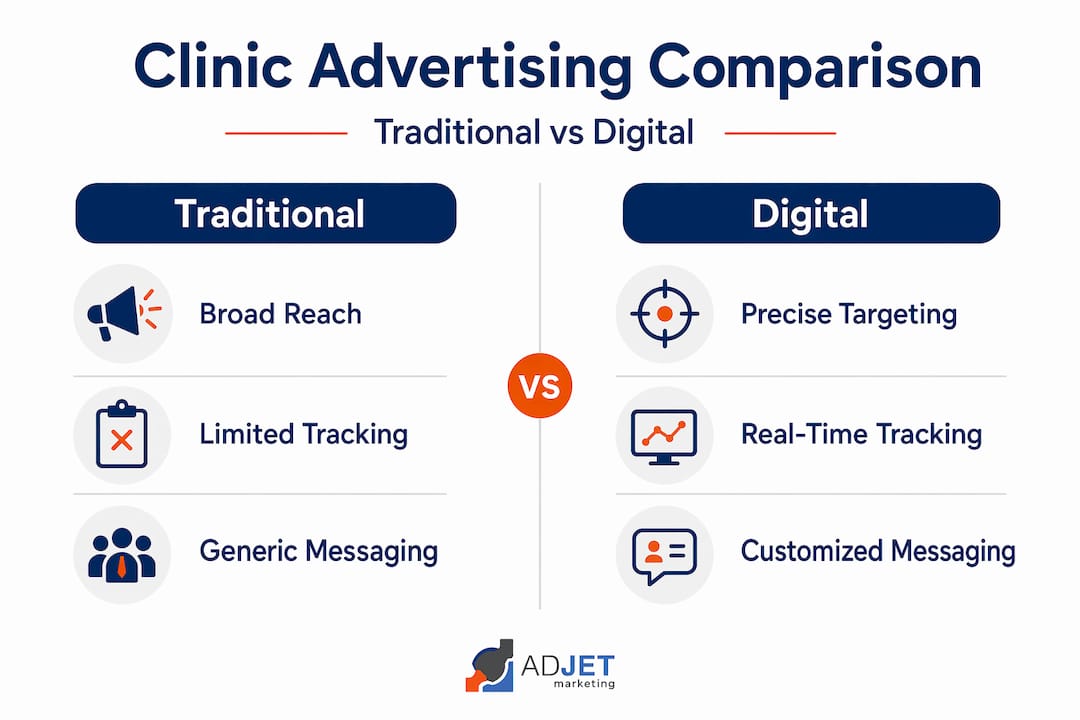
Here is how digital advertising compares to traditional methods for clinics:
| Factor | Traditional advertising | Digital advertising |
|---|---|---|
| Targeting precision | Broad demographic reach | Specific conditions, location, search intent |
| Cost control | Fixed spend, limited flexibility | Pay per click, adjustable daily budgets |
| Attribution | Nearly impossible | Call tracking, CRM matchback, GA4 |
| Speed to results | Weeks to months | Days to weeks |
| Patient lead quality | Mixed, unqualified traffic | High intent, condition-specific |
| Compliance flexibility | Standard advertising rules | HIPAA-specific setups required |
Several types of healthcare digital marketing work together to create a full patient acquisition system. These include paid search, organic SEO, display remarketing, and social media ads. Each serves a different stage of the patient decision journey. Paid search for clinics is especially powerful because it captures patients at the precise moment they are searching for your services.
Key advantages of digital advertising for medical clinics:
- Scalable lead volume: Increase or decrease budget based on capacity and seasonal demand
- Geographic precision: Target patients within a specific radius of your clinic locations
- Condition-specific targeting: Reach people actively searching for your specialty services
- Real-time optimization: Adjust messaging and bids based on actual performance data
- Measurable appointments: Connect ad spend directly to booked appointments when set up correctly
Measuring ROI: Attribution and analytics for real patient outcomes
Understanding the power of digital ads is only useful when you know how to measure their impact effectively.

A strong attribution framework connects paid media, website behavior, and CRM or offline activity. Moving beyond last-click tracking and including call tracking and CRM matchback helps link digital activity to appointments, calls, and walk-ins. That linkage is what separates clinics that see clear ROI from those that give up on digital ads after three months because “they didn’t work.”
Most clinics undervalue the full patient journey. A patient might interact with your ad five times before booking. They read a blog post, click a retargeting ad, watch a YouTube pre-roll, search your clinic name directly, then finally call. A last-click model gives 100% of the credit to that final branded search and zero credit to everything that built the trust.
Here are the steps to instrument conversions that reflect real patient outcomes:
- Set up call tracking: Use a dynamic number insertion tool that assigns unique phone numbers to each traffic source so calls from Google Ads are separated from organic or direct calls.
- Connect your CRM: Import offline conversion data from your practice management system into Google Ads so appointment bookings are recorded as conversions.
- Configure GA4 goals: Set meaningful goals in Google Analytics 4 that include contact form submissions, appointment request completions, and call clicks.
- Implement consent-aware tagging: Use Google Tag Manager with consent mode enabled to respect patient privacy while maintaining measurement accuracy.
- Build a unified reporting dashboard: Combine online metrics and offline appointment data in a single view so you can see true cost per acquisition.
- Review monthly with attribution reports: Use GA4’s attribution reports and Google Ads attribution tools to understand which channels contributed to patient conversions.
Google Ads supports data-driven attribution that uses account data to credit touchpoints based on their observed contribution to conversions, and it is positioned as the default for most conversion actions. This matters significantly for clinics because it distributes credit across the full patient journey rather than rewarding only the last touch.
Here is a breakdown of how offline and online conversion sources contribute for a typical clinic:
| Conversion type | Online source | Offline source | Measurement method |
|---|---|---|---|
| Appointment booking | Web form submission | Front desk call | CRM import + call tracking |
| New patient inquiry | Chat widget | Walk-in referral | CRM tagging |
| Consultation request | Landing page form | Phone call | Call tracking software |
| Prescription refill | Patient portal | In-person visit | CRM matchback |
Connecting your clinic growth strategies to a measurement framework like this transforms your advertising from a cost center into a patient acquisition engine with clear, defensible numbers.
“A hospital or clinic attribution framework should connect paid media, website behavior, and CRM or offline activity. Moving beyond last-click and including call tracking and CRM matchback helps link digital activity to appointments, calls, and walk-ins.” — Attribution and Analytics to Prove Hospital Marketing ROI
Beyond last-click: Advanced measurement strategies for clinics
Once ROI is trackable, clinics can refine measurement to gain actionable insight into what really moves the needle.
The problem with relying on a single measurement approach is that it creates blind spots. Last-click attribution systematically undervalues the awareness and trust-building stages of the patient journey. A patient who found you through a YouTube ad six weeks ago and then booked via Google search will never be credited back to that YouTube campaign under a last-click model. Over time, you cut the budget for what appears to be underperforming channels while those channels were actually driving patient decisions.
Integrating advanced measurement methods including attribution, incrementality testing, and marketing mix modeling helps improve ROI decisions compared to relying on single-measurement approaches. Here is what each method means in practical clinic terms:
- Attribution modeling: Distributes credit across all touchpoints in the patient journey. Data-driven attribution is the most accurate because it uses your actual account data rather than a fixed formula.
- Incrementality testing: Measures whether your advertising actually caused a patient to book or whether they would have come anyway. This is done by briefly pausing ads to a test audience and comparing booking rates.
- Marketing mix modeling (MMM): A statistical approach that analyzes all marketing inputs (Google Ads, social, SEO, direct mail) against patient outcome data to estimate the true contribution of each channel.
You can unlock patient growth faster when your budget decisions are based on incrementality and real lift rather than correlation patterns in conversion paths.
Practical measurement tactics every clinic should implement:
- Compare platform-reported conversions against actual appointments in your practice management system monthly
- Run geo-based incrementality tests by pausing Google Ads in one zip code for two weeks
- Use Google Ads’ channel metrics like cost per lead and cost per acquisition alongside incrementality insights so budget decisions reflect real lift
- Set up cross-channel reporting that includes organic search, paid search, and referral traffic together
- Benchmark your cost per acquisition against specialty-specific averages so you know if your spend is efficient
Pro Tip: When you see a gap between Google Ads reported conversions and actual bookings in your CRM, do not immediately reduce your ad budget. First, audit your conversion tracking for duplicate events, incorrectly fired tags, or missing call tracking integrations. Gaps are almost always a measurement problem, not a performance problem.
Privacy, compliance, and risk management in clinic advertising
Tracking and measurement must be paired with strong privacy safeguards to maintain patient trust and avoid legal risks.
Healthcare advertising operates under different rules than any other industry. Analytics and remarketing setups can inadvertently collect protected health information, known as PHI, depending on how your tags and data flows are configured. A standard Google Analytics or Google Tag Manager setup designed for a retail website can become a HIPAA liability when placed on a healthcare website without proper modification.
PHI includes more than patient names. It includes IP addresses when combined with health condition data, URL parameters that contain appointment types or diagnosis codes, and any form field data that reveals why someone is seeking care. GA4 and GTM may capture PHI through misconfigured tags or URL parameters, and healthcare organizations should conduct regular tracking audits, filter PHI, and implement technical safeguards to reduce compliance risk.
Top compliance risks clinics face in digital advertising:
- URL-based PHI exposure: Pages named “/appointment/depression-treatment” or “/treatment/hip-replacement” can reveal health conditions in GA4 page path reports
- Remarketing to diagnosed patients: Uploading patient lists for ad targeting may constitute using PHI for marketing without authorization
- Form data capture: GTM triggers that fire on form submission may inadvertently capture field values including condition descriptions
- Third-party pixel leakage: Meta Pixel or TikTok Pixel events can transmit health-related browsing behavior to advertising platforms
- Consent mode misconfiguration: Failing to implement consent mode correctly in GA4 can result in tracking users who have not consented, violating both HIPAA guidelines and privacy regulations
Pro Tip: Audit your Google Tag Manager container before running any paid campaigns. Specifically, check that no trigger fires on URL paths that contain condition or treatment names. Review all variables to confirm form field values are not being captured as event parameters. Work with a team experienced in protecting PHI in marketing to establish compliant workflows before scaling ad spend. For additional reading on healthcare privacy practices, the healthcare privacy blog offers useful context from the provider perspective.
The uncomfortable truth: What most clinics miss about digital advertising ROI
Here is what we see repeatedly when working with clinics that say digital advertising did not work for them. They ran ads, looked at the Google Ads dashboard after 30 days, saw fewer conversions than expected, and cut the budget. The root cause was almost never bad ads or wrong targeting. It was incomplete measurement.
Clinics that do not connect offline patient outcomes to online ad activity will almost always underestimate their ROI. Systematically, last-click reporting undervalues top-of-funnel activity like awareness and trust building, and overvalues late-touch conversions. In healthcare, trust-building is not optional. Patients choosing a surgeon, therapist, or pain specialist are not making an impulse decision. They research, compare, and think carefully. The ads and content that appear during that research phase rarely get credit under basic tracking setups, but they are doing the heaviest lifting.
The second thing most clinics miss is early-stage touchpoint value. A display ad that a potential patient saw and did not click still built brand recognition. A YouTube ad that they watched for 15 seconds introduced your clinic’s name before they searched it directly two weeks later. These interactions do not show up as conversions, but they shape behavior.
The clinics that get digital advertising right treat it as a system, not a single campaign. They connect paid media to CRM data, reconcile platform-reported conversions with actual booked appointments, and use data-driven attribution rather than last-click defaults. They also review the healthcare clinic marketing guide to ensure their full marketing strategy is aligned with how patients actually make healthcare decisions. That reconciliation process takes time to set up but produces reliable, actionable data that makes every future budget decision significantly more confident.
Our honest view is this: if you have tried digital advertising and it “did not work,” the problem almost certainly lives in your measurement setup, not in the advertising platform itself.
Unlock clinic growth with proven digital advertising solutions
You now understand how digital advertising drives patient leads, how to measure outcomes accurately, and how to keep your analytics setup compliant with HIPAA. The next step is implementation. At AdJet Marketing, we manage Google Ads solutions specifically designed for medical clinics, including full conversion tracking setup, call tracking integration, and CRM matchback reporting. We understand why marketing matters in healthcare and we build campaigns that reflect the trust-based patient decision process. We also implement secure healthcare marketing workflows to protect your clinic from PHI exposure in analytics and ad platforms. If you are ready to generate measurable patient leads without compliance risk, our team is ready to build that system with you.
Frequently asked questions
How can clinics prove ROI from digital advertising?
Clinics should connect paid media, website data, and CRM offline activity to accurately attribute patient outcomes and appointments, moving beyond last-click models to call tracking and matchback reporting.
What is data-driven attribution in Google Ads?
Data-driven attribution credits each ad interaction based on its observed contribution to patient conversions using real account data, and it is the default attribution model for most Google Ads conversion actions.
Why is healthcare ad compliance essential?
Advertising in healthcare must avoid collecting protected health information by auditing analytics setups and following HIPAA guidelines, since GA4 and GTM can expose PHI through misconfigured tags or URL parameters without proper safeguards.
What are advanced measurement methods for clinics?
Clinics should use attribution, incrementality testing, and marketing mix modeling together to improve advertising ROI decisions rather than relying on any single measurement approach.