









Content marketing for counselors is the process of creating and sharing targeted educational content that builds trust, demonstrates clinical expertise, and attracts ideal clients to your practice. Unlike paid ads that stop the moment you pause your budget, well-written content keeps working for you around the clock. 77% of patients search online before booking a mental health appointment, often using specific, personal queries. That behavior tells you exactly where your practice needs to show up. Adjetmarketing works with mental health professionals to build content strategies that meet prospective clients at that exact moment of search.
Why content marketing for counselors is the most sustainable growth strategy
Counselors face a unique challenge in marketing. Prospective clients are not just shopping for a service. They are searching for someone they can trust with their most private struggles. That search process is deeply personal, and it starts long before anyone picks up the phone.
Patients evaluate tone and approach through content before they ever book a session. A blog post about managing panic attacks at work, written in your voice, tells a prospective client more about you than any directory listing ever could. It functions as a virtual consultation, answering unspoken questions about your style, your empathy, and your clinical focus.

Content marketing, known in the broader industry as inbound marketing or organic content strategy, works by pulling high-intent clients toward your practice rather than pushing ads at a cold audience. The result is a warmer, more qualified inquiry. Clients who find you through educational content already understand your approach before they reach out.
Pro Tip: Write your first three blog posts as if you are answering the questions you hear most often in initial consultations. Those questions are exactly what prospective clients type into Google.
How does content marketing help counselors attract ideal clients?
The counseling field runs on fit. A prospective client is not just looking for any therapist. They are looking for the right one. Content marketing is the most direct way to signal that fit before a first session.
Specific, intent-driven articles outrank generic mental health blogs because they reflect lived clinical knowledge and match what people actually search for. An article titled “Is what I’m feeling postpartum anxiety or just new-parent stress?” speaks directly to a mother at 2 AM who is not sure whether she needs help. A generic post titled “Understanding Anxiety” does not.
Niche content also filters your audience. When you write specifically about grief counseling for adults who have lost a parent, you attract clients who need exactly that. You spend less time in consultations explaining your specialty and more time doing the work you trained for.
- Builds trust before first contact: Prospective clients read your content and feel familiar with your voice before they call.
- Targets high-intent searches: Specific topics match the exact language clients use when they are ready to seek help.
- Demonstrates clinical depth: Detailed, accurate articles signal professional competence without requiring credentials to be listed in every paragraph.
- Reduces client hesitation: Familiarity through content lowers the emotional barrier to reaching out.
- Supports long-term referral networks: Other professionals find your content and refer clients based on your demonstrated expertise.
The compounding effect matters here. Blog posts build domain authority over time, reducing your dependence on paid advertising. Each post you publish adds to a growing library that works continuously to bring new clients to your practice.
What types of content should counselors create?
Not all content serves the same purpose. The most effective content strategy for a counseling practice combines several formats, each doing a specific job.
1. Blog posts as your SEO foundation
Blogging is the core of any content strategy for counselors. A well-written blog post can rank for dozens of related search terms and drive consistent organic traffic for years. Publishing 2–3 high-quality posts monthly produces meaningful organic traffic growth within 3–6 months. The key word is “high-quality.” A 300-word post with no clinical specificity does almost nothing. A 1,000-word post that answers a real client question with clinical accuracy does a great deal.
Strong blog topics for counselors include:
- “How to know when anxiety needs professional support”
- “What to expect in your first therapy session”
- “CBT vs. talk therapy: which approach is right for you?”
- “How to talk to your partner about starting couples counseling”
These topics reflect real search behavior. You can find high-intent blog ideas by reviewing the questions clients ask you most often in initial calls.
2. Service pages as conversion tools
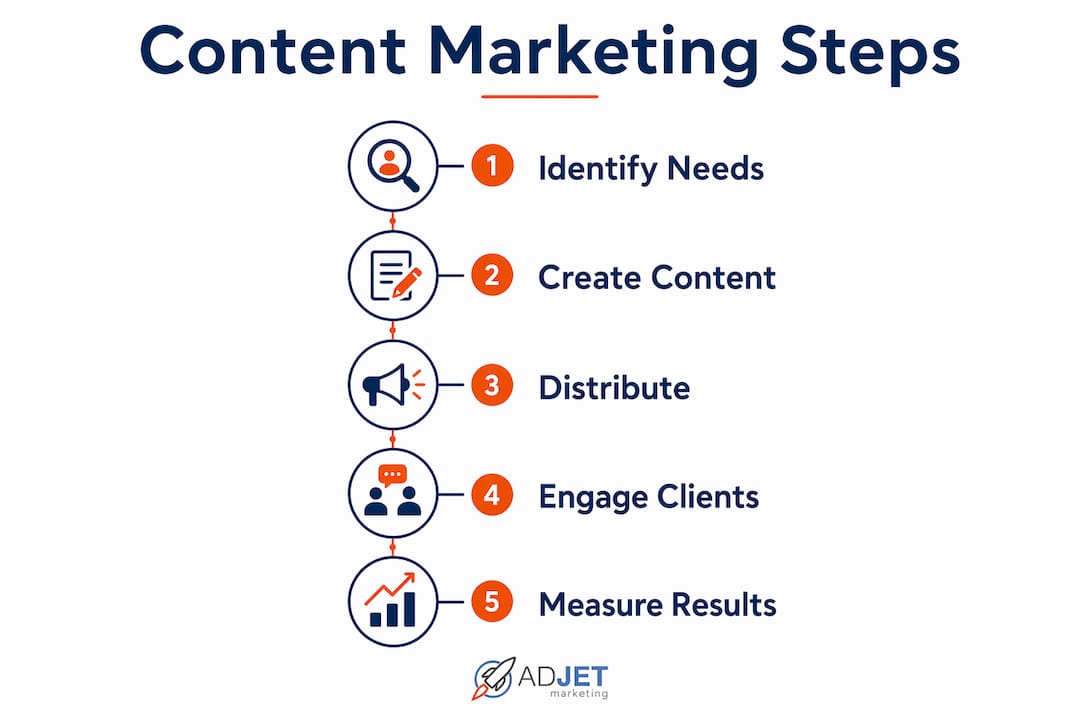
Service pages are conversion tools that complement your blog content. While blog posts attract traffic, service pages close the gap between interest and booking. Each therapy modality you offer deserves its own page: individual therapy, couples counseling, trauma-focused care, EMDR, and so on. These pages rank for specific therapy-related searches and give prospective clients a clear path to contact you.
3. Social media for personality and reach
Social media does not replace your website, but it extends your reach and reinforces your brand personality. Short posts that normalize therapy, share mental health facts, or offer brief coping tips build an audience that eventually converts to website visitors. Consistency matters more than volume on social platforms.
4. Email newsletters for client retention
A monthly email newsletter keeps former clients engaged and reminds your network that you are active. It also gives you a channel to share new blog posts, announce availability, or highlight a specific service.
Pro Tip: Pair every new blog post with a short social media post linking back to it. This drives traffic from two directions and signals to Google that your content is being shared.
For a deeper look at blogging for counseling practices, the compounding traffic benefits become clear when you map out six months of consistent publishing.
How long does it take to see results from content marketing?
Setting realistic expectations is one of the most important things you can do before starting a content program. Content marketing is a long-term investment. It is not a channel that produces results in week two.
Meaningful organic traffic growth typically appears within 3–6 months of publishing 2–3 quality posts per month. That timeline reflects how search engines build trust in a domain over time. Google does not rank new content immediately. It watches how content performs, how long visitors stay on the page, and whether other sites link to it.
| Timeline | What typically happens |
|---|---|
| Month 1–2 | Content is indexed; little to no organic traffic |
| Month 3–4 | Early rankings appear for long-tail keywords |
| Month 5–6 | Consistent traffic begins; some posts rank on page one |
| Month 7–12 | Traffic compounds; older posts gain authority |
| Year 2+ | Content library drives steady, low-cost client inquiries |
A consistent publishing rhythm outperforms sporadic content bursts every time. One well-researched post every two weeks beats five posts published in one week followed by two months of silence. Search engines reward consistency. So do prospective clients who find your blog and see that you published last week, not last year.
The practical implication for busy counselors is to plan content in batches. Write two or three posts on a Saturday morning once a month. Schedule them to publish over the following weeks. That approach keeps your calendar manageable without sacrificing momentum.
What mistakes should counselors avoid in content marketing?
Several common mistakes reduce the effectiveness of content marketing for mental health professionals, and some can actively harm your credibility.
- Writing content that is too broad: A post titled “Mental Health Tips” competes with thousands of similar articles and ranks for nothing specific. Write for a defined audience with a defined problem.
- Promising outcomes: Statements like “our therapy will help you overcome anxiety” cross ethical and legal lines. Focus on your approach and your training, not guaranteed results.
- Using client case studies without proper consent: Even anonymized case studies carry risk. Ethical, educational content that avoids client narratives protects both you and your clients.
- Using guilt-driven language: Copy that implies a prospective client is failing by not seeking help creates pressure rather than trust. Write with empathy, not urgency.
- Ignoring SEO basics: A well-written post with no attention to title tags, meta descriptions, or internal linking will underperform. Basic on-page SEO is not optional.
- Posting inconsistently: A blog with three posts from two years ago signals to prospective clients that your practice may not be active. Consistency builds credibility.
For a broader view of healthcare marketing mistakes that apply across practice types, the patterns are consistent: generic content, unrealistic claims, and inconsistent publishing are the three biggest barriers to growth.
Key Takeaways
Content marketing for counselors works because it builds trust before first contact, attracts high-intent clients through specific educational content, and compounds in value over time without ongoing ad spend.
| Point | Details |
|---|---|
| Start with specific topics | Write for a defined client problem, not a broad mental health category. |
| Publish consistently | Two to three quality posts monthly outperforms sporadic bursts of content. |
| Use service pages alongside blogs | Blog posts attract traffic; service pages convert visitors into booked clients. |
| Expect a 3–6 month runway | Organic traffic builds gradually as search engines establish trust in your content. |
| Avoid ethical pitfalls | Skip outcome promises, client case studies, and guilt-driven language in all content. |
What I have seen working with mental health practices
Working with counselors and therapists at Adjetmarketing, I have noticed a consistent pattern. The practices that grow steadily are not the ones with the biggest ad budgets. They are the ones that publish useful, specific content and do it regularly.
One thing that surprises many counselors is how much their clinical knowledge is worth in a marketing context. The nuanced way you distinguish between generalized anxiety disorder and situational stress is exactly the kind of specificity that ranks well and resonates with prospective clients. Most generic health blogs cannot replicate that. You have a real competitive advantage, and most counselors do not use it.
I also want to be direct about timelines. Content marketing takes patience. If you need clients in the next 30 days, Google Ads for therapists is a faster path. But if you want a practice that does not depend on ad spend to survive, content is the foundation. The two strategies work well together. Paid ads fill your calendar now while content builds your authority for the long term.
The counselors I have seen struggle with content marketing usually made one of two mistakes. They either wrote content that was too generic to rank for anything, or they published intensely for two months and then stopped entirely. Neither approach works. Slow, steady, and specific wins every time.
— Felix
How Adjetmarketing helps counselors build a content strategy that works
Adjetmarketing specializes in medical and mental health marketing for practices that want sustainable, measurable growth. We build content strategies grounded in real search data, clinical specificity, and ethical standards. Our team handles keyword research, content planning, on-page SEO, and publishing so you can focus on your clients. We also integrate content marketing with Google Ads and website design to create a complete growth system. If you are ready to build a practice that attracts the right clients consistently, connect with Adjetmarketing for a consultation tailored to your specialty and goals.
FAQ
What is content marketing for counselors?
Content marketing for counselors is the practice of creating educational articles, service pages, and social media posts that attract prospective clients by demonstrating clinical expertise and building trust before the first session.
How often should counselors publish blog content?
Publishing 2–3 quality blog posts monthly produces consistent organic traffic growth within 3–6 months. Consistency matters more than volume.
Can content marketing replace paid advertising for therapists?
Content marketing reduces dependence on paid ads over time but works best alongside them. Paid ads deliver fast results while content builds long-term authority and organic traffic.
What topics perform best for mental health content marketing?
Specific, intent-driven topics that answer real client questions outperform broad mental health topics. Examples include posts about specific conditions, therapy modalities, and what to expect from counseling.
How do counselors find SEO support for therapists that fits their practice?
Look for agencies or services with direct experience in mental health marketing, an understanding of HIPAA-adjacent ethical standards, and a track record of ranking therapy-related content in competitive local markets.
Recommended
- Types Of Digital Marketing For Family Counselors: 2026 Guide
- Counseling Marketing Agency: What Mental Health Practices Need
- The Power Of Blogging: Content Strategies To Grow Your Counseling Business – AdJet Digital Marketing & Google Partner Agency | SEO Development Google Ads Social
- The Role Of Content Marketing In Healthcare: 2026 Guide