









Choosing a digital marketing agency feels straightforward until you realize that a clinic running paid ads without certified expertise risks wasted budget, poor lead quality, and compliance exposure. Many medical practice owners assume any agency with a decent-looking website can manage their Google Ads effectively. That assumption is costly. There is a meaningful, verifiable difference between a certified Google Partner agency and a general marketing firm, and that difference shows up directly in your cost per lead, patient acquisition rate, and campaign compliance. This article breaks down exactly what Google Partner status means, why it matters for medical clinics, and what to look for beyond the badge.
Table of Contents
- What is a Google Partner agency?
- Core benefits of working with a Google Partner
- Google Partner vs. non-partner: What’s the real difference?
- How medical clinics benefit from Google Partner expertise
- The overlooked truth about Google Partner agencies
- Ready to amplify your clinic’s marketing?
- Frequently asked questions
Key Takeaways
| Point | Details |
|---|---|
| Certified expertise matters | Google Partner agencies are held to strict standards that directly affect campaign performance for medical clinics. |
| Exclusive resources unlock results | Partner status gives agencies early access, extra training, and advanced tools that provide real advantages in healthcare marketing. |
| Badges aren’t everything | Evaluate the agency’s actual healthcare outcomes and compliance track record—not just their Partner badge. |
| Better support and compliance | Partners offer dedicated Google support and are typically more prepared to handle sensitive compliance needs. |
| Choose for fit, not just certification | Look for a Partner agency with proven healthcare results and a collaborative approach tailored to your practice. |
What is a Google Partner agency?
Not all marketing agencies are created equal, and Google’s certification program exists precisely to separate qualified professionals from general practitioners. A Google Partner agency is a company that has met a specific set of performance and knowledge standards set by Google for its advertising platform, Google Ads.
To earn and maintain Partner status, an agency must satisfy three distinct criteria, all validated on a rolling 90-day basis:
- Optimization score: The agency’s managed accounts must maintain at least a 70% optimization score, meaning campaigns are actively managed, recommendations are implemented, and accounts are not left to run on autopilot.
- Ad spend threshold: The agency must manage a minimum of $10,000 USD in total Google Ads spend across all client accounts within a 90-day period, demonstrating that they actively run real campaigns.
- Certified strategists: At least 50% of the agency’s account managers and strategists must hold current Google Ads certifications through Skillshop, Google’s official training platform.
These requirements are not just administrative hurdles. They enforce a baseline of active account management and demonstrated knowledge that directly impacts your campaigns. An agency that cannot maintain a 70% optimization score across its portfolio is, by Google’s own standards, leaving performance on the table.
“Google Partner agencies must meet strict requirements including a 70% optimization score, $10,000 USD 90-day ad spend, and 50% certified strategists, ensuring baseline competence.” — Google Partner requirements
For medical clinics, this matters because healthcare advertising involves nuanced targeting, strict keyword rules, and sensitive audience considerations. A certified strategist understands how to structure campaigns within Google’s healthcare advertising policies, reducing the risk of disapproved ads and account suspensions.
Pro Tip: When evaluating any agency, ask them to show you their Google Partner badge and verify it by searching Google’s official Partner directory. A badge that cannot be confirmed through that directory should raise immediate questions.
Core benefits of working with a Google Partner
Understanding the qualifications is just the start. The real value lies in what those qualifications unlock, both for the agency and for your practice. Google Partner benefits include Skillshop training, customized recommendations, beta feature access, dedicated support, and directory listing, all of which enable stronger campaign management.
Here is what those benefits mean in practice for your clinic:
| Benefit | What it means for your clinic |
|---|---|
| Skillshop training | Strategists are current on Google Ads changes, including healthcare ad policy updates |
| Beta feature access | Your campaigns may test new ad formats or targeting tools before competitors |
| Dedicated Google support | Faster resolution when ads are disapproved or billing issues arise |
| Customized recommendations | Account-specific insights from Google’s algorithm improve campaign efficiency |
| Partner directory listing | Verified credibility you can check independently |
Beta feature access is worth highlighting specifically. Google regularly tests new campaign types, bidding strategies, and audience tools before releasing them broadly. Partner agencies often get early access to these features, which means your campaigns can potentially benefit from innovations like more precise local targeting or improved call tracking while competing clinics are still waiting for the general rollout.
Dedicated Google support is another underappreciated advantage. When a healthcare clinic’s ad gets flagged for a policy issue, every day the ad is down is a lost appointment. Non-partner agencies rely on standard support queues that can take days to resolve. Partner agencies have access to faster escalation paths, which translates directly to less downtime for your campaigns.
The cumulative effect on how agencies can optimize Google Ads for healthcare is substantial. Faster support, access to new features, and continuously trained staff compound over time into meaningfully better campaign performance.
Statistically, Google’s optimization score requirements mean Partner accounts are more actively maintained than average accounts. Consider that many small clinics working with uncertified freelancers report accounts that have not been touched in weeks. That kind of neglect directly inflates your cost per click and drains budget on underperforming keywords.
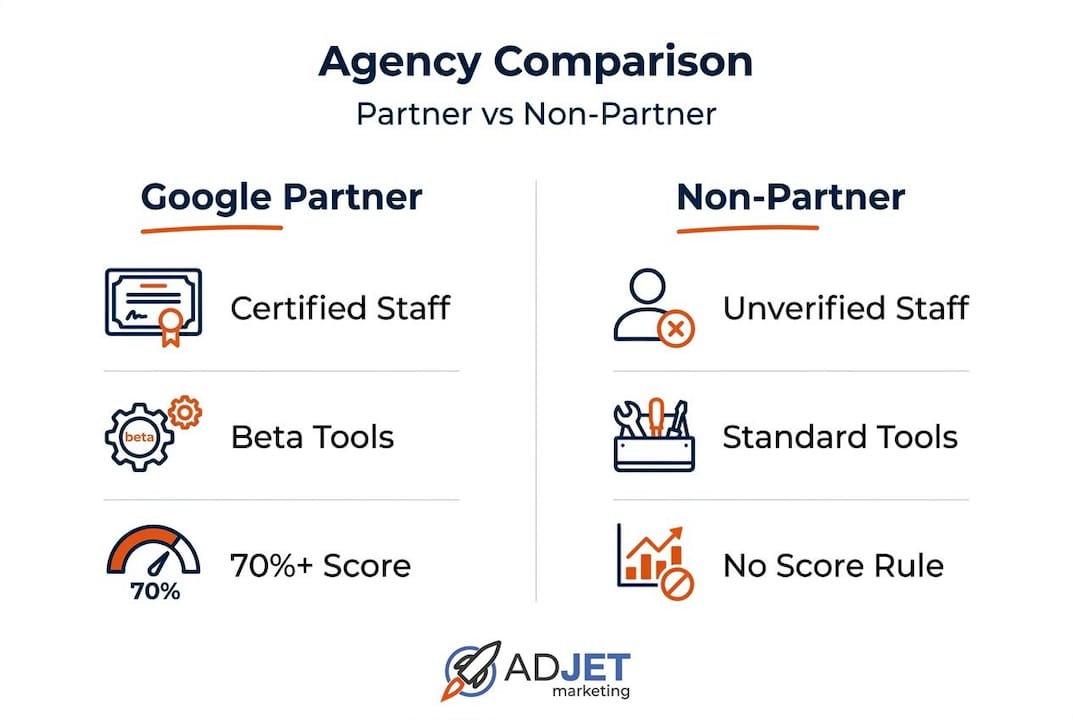
Google Partner vs. non-partner: What’s the real difference?
Armed with the list of Partner benefits, it is essential to see how they compare side-by-side with non-certified agencies, because the difference in healthcare marketing outcomes is real and measurable.
| Factor | Google Partner agency | Non-partner agency |
|---|---|---|
| Account optimization | Required 70%+ score enforced by Google | No enforced standard |
| Certified staff | Minimum 50% hold current certifications | Certifications optional or absent |
| Beta feature access | Yes, early access to new tools | No, standard public access only |
| Dedicated Google support | Yes, faster issue resolution | Standard support queue only |
| Compliance awareness | Stronger foundation through training | Varies widely by individual |
| Verified credibility | Publicly searchable in Google’s directory | No independent verification |
There is an important nuance here: not all Partner badges are equal. Basic Partner status is accessible to thousands of agencies globally, and while it guarantees a minimum standard, it does not indicate top-tier performance. Premier Partner status is a separate, higher tier awarded to agencies in the top 3% based on performance metrics, growth, and client retention. Premier Partners carry a stronger proof of results beyond baseline compliance.
For clinics evaluating whether an agency’s badge is credible, use this checklist:
- Search the agency’s name in Google’s official Partner directory to confirm status.
- Ask whether they hold basic Partner or Premier Partner status.
- Request their current optimization score across managed accounts.
- Ask how many certified Skillshop professionals are actively managing your account.
- Ask for documented examples of healthcare or medical clinic campaigns they have managed.
This matters because agency impact for medspas and other healthcare providers depends heavily on campaign quality, not just certifications. Clinics that follow these healthcare PPC tips in partnership with a qualified agency consistently outperform those using generic marketing firms.
Pro Tip: A non-partner agency is not automatically a bad choice, but you carry more of the burden of verifying their competence. With a Partner agency, Google has already done part of that verification for you.
The Google Partner requirements around a 70% optimization score and certified staff do provide an empirical edge. Account health directly correlates with lower cost per acquisition and higher ad relevance scores, both of which matter when you are competing for high-intent keywords like “pain management clinic near me” or “med spa Botox specials.”
How medical clinics benefit from Google Partner expertise
With the differences clear, the practical question is simple: what does this mean for your clinic’s patient acquisition, budget, and compliance? The answer spans three core areas.
1. Minimizing wasted ad spend
Certified agencies actively manage bidding strategies, negative keyword lists, and quality scores. The 70% optimization score requirement means accounts are regularly audited and improved, not set and forgotten. For a clinic spending $3,000 per month on Google Ads, even a 15% reduction in wasted spend translates to hundreds of dollars redirected toward converting clicks.

2. Higher lead quality through advanced targeting
Partner agencies have access to advanced audience tools and beta targeting features that allow for more precise patient targeting. Instead of broad keyword matching that attracts unqualified clicks, certified strategists build tightly structured campaigns around intent signals. A pain clinic, for example, can use audience layering to serve ads specifically to users who have been actively searching for appointment-based care rather than general health information.
3. Compliance and privacy protection
Healthcare marketing carries unique legal and ethical risks, particularly around HIPAA-compliant Google Ads practices. Certified strategists are more likely to understand restrictions on remarketing to health condition audiences, proper use of conversion tracking in ways that avoid capturing protected health information (PHI), and Google’s healthcare advertising policies. This reduces your clinic’s exposure to both ad disapprovals and compliance violations. For context on how ad strategy applies to specific service lines, Google Ads for counseling clinics demonstrates how partner-level expertise translates into real patient volume with controlled costs per lead.
Here is a quick breakdown of clinic-specific outcomes:
- Reduced cost per appointment through optimized bidding and keyword hygiene
- Fewer wasted impressions on non-converting traffic
- Lower risk of ad account suspensions due to policy violations
- Faster campaign recovery when issues arise through dedicated support
- More accurate conversion tracking to measure real patient bookings
Pro Tip: Before signing with any Partner agency, request two or three campaign performance case studies from healthcare clients. Look for metrics like cost per lead, lead-to-appointment rate, and monthly volume, not just click-through rates or impressions.
The overlooked truth about Google Partner agencies
Here is the perspective that most articles on this topic skip entirely: a Google Partner badge is a floor, not a ceiling. It confirms that an agency meets a minimum standard. It does not guarantee they understand the specific dynamics of healthcare marketing, HIPAA risk management, or the patient decision-making journey.
We have seen clinics migrate from non-partner agencies to basic Partner agencies and experience little improvement because the new agency’s experience was concentrated in e-commerce or lead generation for non-regulated industries. The badge was real. The healthcare expertise was not.
The right question is not “are they a Google Partner?” but “what have they done for clinics like mine?” Ask about recent results in your specific specialty. Ask whether they have managed campaigns for mental health providers, aesthetic clinics, or pain management centers, where targeting restrictions and conversion dynamics differ significantly from general businesses. Thinking about choosing the right marketing agency means applying a healthcare-specific lens that goes beyond certification status.
Premier Partner status carries more weight because it adds a performance filter on top of the compliance filter. But even then, a Premier Partner that specializes in retail will likely underperform a basic Partner with deep healthcare experience. Certifications matter. Industry experience matters more. The combination of both is what actually moves your appointment calendar.
There is also an important practical consideration around ongoing optimization. Partner requirements are evaluated on a rolling 90-day basis, meaning an agency must continuously maintain performance standards. That structural accountability benefits you because it creates a built-in incentive for your agency to keep improving your campaigns, not just pass an initial certification and coast.
Ready to amplify your clinic’s marketing?
If you’re ready to put the advantages of a true Google Partner agency to work for your clinic, here are the next steps. At AdJet Marketing, we are a certified Google Ads for healthcare agency that combines Partner-level technical expertise with deep experience in medical and aesthetic marketing. We understand the importance of healthcare marketing beyond just clicks and impressions. Our campaigns are built around real patient acquisition, HIPAA-aware strategy, and measurable ROI. Whether you run a med spa, pain clinic, imaging center, or IV clinic, our team brings the certified expertise, compliance knowledge, and performance focus your practice deserves. Reach out today and see what a Partner-level strategy can do for your patient volume.
Frequently asked questions
What does it mean to be a Google Partner agency?
Google Partner agencies must achieve at least a 70% optimization score, maintain a minimum $10,000 USD ad spend over 90 days, and ensure at least 50% of their strategists hold current Google Ads certifications through Skillshop.
Do Google Partner agencies cost more than regular agencies?
Partner status does not automatically mean higher pricing. It signals expertise and access to additional resources, but fees vary depending on the agency’s scope, service model, and market focus.
How do I verify if an agency is a true Google Partner?
Search Google’s official Partner directory to confirm the agency’s badge, certification status, and listed specializations before committing to a contract.
Do Premier Partners offer better results than regular Partners?
Premier Partners represent the top 3% by performance, making them a stronger signal of results-driven work. Still, always verify their specific experience in healthcare before assuming the badge guarantees the right fit.
Can Google Partner agencies help with HIPAA compliance?
Yes, many Partner agencies have experience with HIPAA-aware advertising strategies, but you should directly confirm their knowledge of healthcare data protection, remarketing restrictions, and compliant conversion tracking before onboarding.
Recommended
- Is HIPAA-Compliant Marketing Possible With Google Ads? → Yes—Here’s How To Do It Right – AdJet Digital Marketing & Google Partner Agency | SEO Development Google Ads Social
- 20 Tips To Optimize Google Ads For Healthcare
- How Do I Choose A Mental Health Marketing Agency? → 9 Non-Negotiables To Get Right – AdJet Digital Marketing & Google Partner Agency | SEO Development Google Ads Social
- Med Spa Marketing Agency | Americas Med Spa Google Partner | Adjet Marketing
- Home – Aesthetic Rank Lab