









On-page SEO in healthcare is the practice of optimizing individual webpage elements — content, metadata, structure, and technical signals — so that Google ranks your site higher and patients trust what they find. Healthcare websites are not treated like ordinary sites by Google. They fall under the YMYL classification (Your Money or Your Life), which means Google holds them to a significantly higher quality bar than a recipe blog or travel site. Thin, generic, or unattributed medical content simply will not rank, regardless of how clean your technical setup is.
The core components of on-page SEO for healthcare sites include:
- Keyword strategy: Targeting the words patients actually type, mapped to the emotional urgency behind each query
- Metadata: Title tags and meta descriptions that include location, primary keywords, and a clear call to action, without exposing any protected health information (PHI)
- Content structure: Clear headings, FAQs, and patient-friendly language that answers questions directly
- E-E-A-T signals: Credentialed author bios, “Last Medically Reviewed” dates, and source citations that demonstrate Experience, Expertise, Authoritativeness, and Trustworthiness
- Technical SEO: Schema markup, page speed, mobile responsiveness, and ADA accessibility compliance
- HIPAA compliance: Auditing every on-page element to prevent PHI exposure in metadata, URLs, and tracking scripts
The goal is straightforward: make it easy for Google and patients to understand who you are, what you treat, and why you can be trusted.
What are the key on-page SEO elements for healthcare websites?
Healthcare on-page SEO covers more ground than most industries. You are not just optimizing for clicks. You are building a case for clinical credibility on every page.
Keyword strategy
Start with three keyword tiers. Primary keywords anchor your core service pages (“knee replacement surgery Dallas”). Secondary keywords address related patient questions (“recovery time after knee replacement”). Local keywords tie both to geography (“orthopedic surgeon in Plano TX”). The gap between clinical terminology and everyday language is real. Physicians say “myocardial infarction.” Patients search “heart attack symptoms.” Effective keyword mapping bridges that gap by targeting the words patients type, not the words clinicians use.
- Place your primary keyword in the title tag, H1, first 100 words, at least one H2, image alt text, and the URL
- Use secondary and semantic keywords naturally in body content and subheadings
- Map urgent queries to condition pages, research queries to service pages, and trust queries to provider bio pages
Metadata optimization
Title tags should stay within 50–60 characters and follow this structure: [Primary Keyword] | [Location] | [Practice Name]. Meta descriptions should run 150–160 characters and combine the primary keyword with an emotional reassurance and a clear call to action. The #1 organic result captures about 28.5% of all clicks, and an optimized title is one of the clearest paths to that position.
Never include PHI in metadata. That means no patient names, conditions, appointment details, or any combination of identifiers in title tags, meta descriptions, or Open Graph tags.
Content quality and structure
Medical content needs to be accurate, comprehensive, and updated regularly. The single most impactful on-page trust signal in healthcare SEO is the “Last Medically Reviewed” date, displayed near the top of the article and linked to a credentialed physician’s bio. Most clinics skip this entirely.

Pro Tip: Format your review date as “Last Medically Reviewed: [Month Year] by [Physician Name, Credentials]” and implement the dateReviewed attribute in your Article schema. This signals freshness directly to Google’s indexing systems.
Technical SEO essentials
- Schema markup: Implement MedicalOrganization, Physician, FAQPage, and MedicalCondition schema types
- Page speed: Slow load times hurt both rankings and patient experience, particularly on mobile
- Mobile responsiveness: Most patients search on their phones, often in urgent situations
- Accessibility: ADA-compliant design, including descriptive alt text and keyboard navigation, improves both usability and SEO
- HTTPS: Secure sites rank better and protect patient data in transit
HIPAA-compliant on-page practices
Many clinics accidentally expose PHI in hidden form fields, URL parameters, and tracking scripts that Google’s crawlers can access. Restrict third-party tracking pixels to non-patient-facing pages only. For patient-facing conversion tracking, use server-side tagging or HIPAA-compliant analytics tools. Audit every on-page element, not just the visible content, for potential PHI exposure.
How does local SEO help healthcare providers attract more patients?
Local SEO is where most healthcare practices win or lose patient volume. When someone searches “urgent care near me” or “therapist in Austin,” they are ready to book. Showing up in those results is a direct line to new patients.
The foundation is location-specific keyword integration. Phrases like “[service] in [city]” or “[specialty] near [neighborhood]” belong in your title tags, H1 headings, body content, and meta descriptions. A pain clinic in Chicago should not have a generic title tag that reads “Pain Management Services.” It should read “Pain Management Clinic in Chicago | [Practice Name].” That specificity is what connects the page to local search intent.
For a deeper look at local SEO for clinics, the tactics go well beyond keyword placement.
Key local on-page tactics include:
- Local business schema: Implement LocalBusiness or MedicalOrganization schema with your full name, address, phone number (NAP), and hours. This feeds Google’s local knowledge graph directly.
- Location-specific URLs: Use URL structures like
/services/physical-therapy-dallas/rather than generic/services/physical-therapy/ - Geo-targeted meta tags: Include city and state in title tags and meta descriptions for every location-specific service page
- Local content: Create pages that address community-specific health concerns, local insurance networks, or nearby hospital affiliations
- Google Business Profile alignment: Your on-page NAP data must match your Google Business Profile exactly. Inconsistencies confuse Google and suppress local rankings.
Google Business Profile and on-page local SEO work together, not independently. Your profile drives map pack visibility. Your on-page optimization drives organic rankings. Both feed the same patient acquisition funnel, so they need to tell the same story.
How do you optimize healthcare content for patient trust and engagement?
Patients searching for healthcare information carry emotional urgency that most other search queries do not. A query like “child has high fever won’t stop crying” is not casual browsing. Content that buries the answer in three paragraphs of background context fails that patient. Healthcare content must lead with direct, high-value answers within the first 40–60 words.
The type of page you build should match the intent behind the query:
- Urgent or crisis searches (“signs of appendicitis”) belong on condition and symptom pages with immediate, reassuring information at the top
- Research-phase searches (“knee replacement vs. physical therapy”) belong on service and treatment pages with comparison content and clear next steps
- Trust-validation searches (“Dr. Smith orthopedic surgeon reviews”) belong on credentialed provider profile pages with full bios, credentials, and patient-facing information
Author bios and E-E-A-T
A credentialed author bio is one of the most powerful on-page trust signals available, and one of the most poorly executed. Every piece of medical content should link to the bio of the physician who authored or reviewed it. That bio should include the medical degree and board certifications, clinical specialty, years of experience, hospital affiliations, and a professional headshot with descriptive alt text. This creates a verifiable chain of expertise that Google’s quality raters can evaluate.
ADA compliance and accessibility
ADA-compliant design is not just a legal consideration. It directly affects SEO. Screen reader compatibility, sufficient color contrast, keyboard navigation, and descriptive alt text on every image all contribute to a better user experience score. Google factors page experience signals into rankings, and accessibility is part of that equation. Alt text also helps images appear in Google Image Search, which is an underused traffic source for medical conditions and procedure visuals.
Content formatting for engagement
- Use clear H2 and H3 subheadings so patients can scan for the answer they need
- Write in plain language. If a patient has to look up a word, you have already lost them.
- Include FAQ sections at the bottom of condition and service pages. These often capture featured snippet positions.
- Break up long sections with bullet points, numbered steps, or short tables where appropriate
How do E-E-A-T and AI-driven search shape healthcare SEO in 2026?
E-E-A-T stands for Experience, Expertise, Authoritativeness, and Trustworthiness. These are the four signals Google’s quality raters use to evaluate YMYL pages, and for healthcare websites, they must be demonstrated through on-page elements, not just backlinks.
Here is what each signal requires in practice:
- Experience: First-hand patient or clinical experience reflected in the content, such as case-based explanations or procedural walkthroughs written by practicing clinicians
- Expertise: Credentials, specializations, and medical education of content authors, displayed on every page they authored or reviewed
- Authoritativeness: Recognition by credible medical organizations, peer-reviewed publications, and authoritative health sites linking to your content
- Trustworthiness: Accurate information, cited sources, visible privacy policies, HTTPS, and HIPAA compliance signals throughout the site
Every page on your healthcare website should visibly address at least three of these four signals.
AI-driven search and structured content
AI search engines favor content that is concise, scannable, and well-attributed with clear expertise demonstration. Google AI Overviews and large language models pull from pages that are formatted for fast extraction. That means direct definition paragraphs, numbered steps, and FAQ-style question-and-answer pairs. Long, wandering prose gets skipped. Structured content gets cited.
For healthcare marketers, this is a practical shift. Optimizing for AI search visibility now means writing content that a machine can parse in seconds, not just content that reads well to a human.
The schema types that support AI recognition in healthcare include:
MedicalOrganizationfor the practice itselfPhysicianorPersonfor provider profilesFAQPagefor FAQ sectionsMedicalConditionfor condition and symptom pages
Together, these schema types improve categorization and visibility, helping both search engines and AI algorithms understand and display your page details in rich results.
Author attribution for AI citations
AI models need a clear chain of attribution to cite your content confidently. That means every article needs a named author with credentials, a “Last Medically Reviewed” date, and a link to a full physician bio. Generic “Editorial Team” bylines do not satisfy this requirement. A named, credentialed physician bio is what separates content that gets cited in AI Overviews from content that gets ignored.
Handling sensitive patient data and privacy in your SEO content
HIPAA compliance in on-page SEO goes well beyond adding a privacy policy page. It requires auditing every element of your site that a search engine crawler can access, because Google’s bots do not distinguish between public and private content. They index what they can reach.
The most common PHI exposure points on healthcare websites include:
- URL parameters: Appointment booking flows that pass condition names, patient IDs, or service types through the URL string. If Google indexes that URL, the PHI is public.
- Hidden form fields: Pre-populated fields that carry over patient data from a previous session. Crawlers read these.
- Schema markup: Incorrectly implemented schema that includes patient-specific details in structured data fields
- Tracking scripts: Third-party pixels that capture form submissions, including fields containing health conditions or appointment types
The practical fix is to audit your site with a crawl tool and review every URL pattern, form field, and schema block for potential PHI. Restrict all third-party tracking pixels to non-patient-facing pages. For patient-facing conversion tracking, use server-side tagging or a HIPAA-compliant analytics platform. Tools like Freshpaint and TrustArc are built specifically for this use case in healthcare.
Beyond technical compliance, your content itself must avoid PHI. Testimonials that include a patient’s name alongside a condition name can constitute PHI under HIPAA. Even anonymized testimonials that include enough detail to identify an individual carry risk. When in doubt, use general outcome language rather than specific patient narratives.
Privacy signals also affect patient trust directly. Visible HTTPS, a clear and accessible privacy policy, and a straightforward explanation of how patient data is used all contribute to the Trustworthiness component of E-E-A-T. Patients notice these things, even if they do not consciously evaluate them. A site that feels secure converts better, and a site that converts better sends positive engagement signals back to Google.
For a broader look at compliant healthcare marketing, the compliance and SEO considerations overlap more than most marketers expect.
Which schema markup types matter most for healthcare websites?
Schema markup is structured data added to your HTML that tells search engines and AI models exactly what your page contains. For healthcare websites, the right schema types unlock rich results, improve local visibility, and make your content eligible for AI citations. Most healthcare sites implement schema poorly or not at all, which leaves significant SERP real estate on the table.
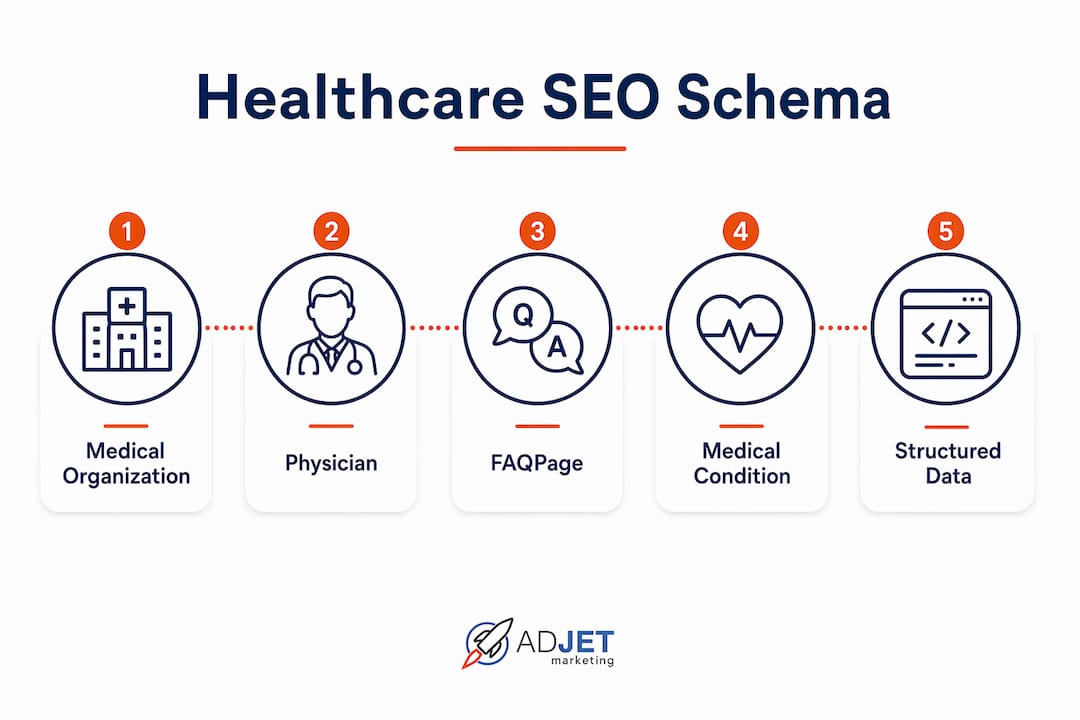
The four schema types every healthcare website should implement:
MedicalOrganization
This schema type identifies your practice to Google as a medical entity. It includes your practice name, address, phone number, hours of operation, accepted insurance, and the medical specialties you offer. When implemented correctly, this data can appear directly in Google’s knowledge panel for your practice, giving patients key information before they even click through.
Physician (or Person schema for providers)
Provider profile pages need their own schema. A Physician schema block should include the doctor’s name, medical specialty, board certifications, hospital affiliations, and a link to their professional bio. This is the on-page signal that connects a named clinician to your content, which is exactly what Google’s quality raters and AI systems look for when evaluating E-E-A-T on YMYL pages.
FAQPage
FAQ sections on condition and service pages are prime candidates for FAQPage schema. When implemented, Google can display your FAQ answers directly in the search results as expandable rich results. This increases your SERP footprint without requiring a higher ranking position. It also makes your content more likely to be pulled into AI Overviews, since the question-and-answer format is exactly what AI models prefer for fast extraction.
MedicalCondition
Condition and symptom pages should use MedicalCondition schema to identify the specific condition being discussed, associated symptoms, typical treatments, and relevant medical codes where applicable. This level of specificity helps Google categorize your content accurately and surface it for the right queries. It also signals to AI models that your page is a structured, authoritative source on that condition, not just a general health article.
A few additional schema types worth implementing:
ArticlewithdateReviewedanddateModified: Signals content freshness to Google’s indexing systemsLocalBusiness: Reinforces local SEO signals for practices with physical locationsRevieworAggregateRating: Where HIPAA-compliant patient reviews exist, this schema can display star ratings in search results
Implement all schema in JSON-LD format. It is easier for developers to maintain and easier for search engines to process than inline microdata. Validate every schema block with Google’s Rich Results Test before publishing. A schema error is worse than no schema, because it can generate a manual action or suppress your rich results entirely.
For healthcare marketers building out their on-page SEO checklist, schema implementation belongs near the top of the priority list, alongside title tags and content quality.
Key Takeaways
On-page SEO in healthcare requires YMYL-compliant content, E-E-A-T signals, HIPAA-safe metadata, and structured schema markup to rank effectively and earn patient trust in 2026.
| Point | Details |
|---|---|
| YMYL raises the quality bar | Google holds healthcare pages to stricter standards, requiring demonstrable expertise, accuracy, and trust signals on every page. |
| Title tags drive click-through | The #1 organic result captures about 28.5% of all clicks; an optimized title tag is one of the clearest paths to that position. |
| “Last Medically Reviewed” date matters | Displaying a review date linked to a credentialed physician bio is the most overlooked on-page trust signal in healthcare SEO. |
| Schema markup unlocks rich results | Implementing MedicalOrganization, Physician, FAQPage, and MedicalCondition schema improves both SERP visibility and AI citation eligibility. |
| HIPAA compliance extends to metadata | PHI can appear in URLs, hidden form fields, and tracking scripts that Google crawlers can access, requiring a full on-page audit. |
Ready to put this into practice?
At Adjetmarketing, we work with medical clinics, med spas, pain management practices, and mental health providers to build on-page SEO strategies that are both HIPAA-compliant and built to rank. We see the same patterns repeatedly: practices with strong clinical reputations that are invisible in search because their on-page fundamentals are missing. No credentialed author bios. No schema. Title tags that do not include a location. Content that buries the answer.
If your healthcare website is not generating the patient volume it should, the gap is usually on-page. Our healthcare SEO services cover everything from keyword mapping and metadata audits to schema implementation and HIPAA-compliant tracking setup. We also help practices that want to complement their SEO with patient lead generation through paid channels.
The clinics that win in search in 2026 are the ones that treat on-page SEO as an ongoing clinical commitment, not a one-time technical task.