









Ranking on Google is not reserved for large hospital networks with massive marketing budgets. If you run a private clinic, med spa, pain management center, or specialty practice, local SEO can put your name in front of patients who are actively searching for your services right now. Many clinic owners assume that search engine visibility is too technical or too expensive to pursue. That assumption costs them patients every week. This guide breaks down what local SEO actually is, why it works specifically for healthcare providers, and exactly what you can do to start improving your visibility and growing your patient base.
Table of Contents
- Defining local SEO: What it means for healthcare providers
- Why local SEO matters for clinics and practices
- Core pillars of local SEO for healthcare professionals
- Common mistakes and overlooked opportunities in healthcare local SEO
- Measuring local SEO success: Metrics that matter for clinics
- The overlooked advantage: Why small clinics can win at local SEO
- Take your clinic’s local SEO to the next level
- Frequently asked questions
Key Takeaways
| Point | Details |
|---|---|
| Local SEO defined | Local SEO helps clinics rank higher in searches for patients nearby, driving more visits and appointments. |
| Core strategies work fast | Claiming your profile and gathering reviews delivers visible improvements in a few months. |
| Avoid common errors | Unclaimed profiles and inconsistent information reduce your online visibility and cost you patients. |
| Small clinics can win | Responsive service and genuine feedback allow small practices to outrank larger competitors with smart local tactics. |
Defining local SEO: What it means for healthcare providers
Local SEO (local search engine optimization) is a set of strategies designed to help businesses show up in geographically relevant search results. For a clinic, that means appearing when someone in your city types “back pain specialist near me” or “family doctor in [your neighborhood]” into Google.
General SEO focuses on ranking for broad, national keywords. Local SEO is narrower and more targeted. It focuses on making your practice visible to patients within a specific geographic area, especially on Google Maps and the “local pack” (the map and three business listings Google shows at the top of search results for location-based queries).
As detailed in the local SEO strategies for dentists, the core principle of local SEO for healthcare is straightforward: optimize your digital presence so that patients nearby can find you easily when they need care.
Local SEO involves three primary areas:
- Google Business Profile (GBP): Your clinic’s free listing on Google, which includes your address, hours, photos, reviews, and services
- NAP consistency: Ensuring your Name, Address, and Phone number are identical across every online directory, website, and listing
- Local citations and reviews: Being listed accurately in relevant directories like Healthgrades, Zocdoc, and Yelp, with a steady stream of genuine patient reviews
“Local SEO for healthcare providers is about connecting patients with the right practice at the right moment, by ensuring that accurate, trustworthy information about your clinic appears at the top of local search results.”
The distinction from general SEO is important. A clinic does not need to compete with WebMD or the Mayo Clinic for broad health topics. You only need to outrank other local providers in your specialty and service area. That is a much more achievable goal, and it starts with the right foundation.

Why local SEO matters for clinics and practices
Now that you know what local SEO is, here’s why it can transform your clinic’s patient flow.
The data on patient search behavior is clear. Over 77% of patients use Google to search for a healthcare provider before making an appointment. That means the majority of your potential new patients are online right now, evaluating which clinic to call. If your practice does not appear prominently in those results, a competitor likely does.
Local SEO drives both online appointment bookings and direct walk-ins. When a patient finds your clinic through a Google search, they often act immediately. They click to call, request an appointment online, or navigate directly to your location using Google Maps. These are high-intent actions from patients who are ready to book.
Common visibility mistakes that clinic owners make include:
- Inconsistent NAP listings: Your address is slightly different on Google versus Yelp versus your website. Google reads these inconsistencies as signals of an untrustworthy or outdated listing.
- Few or no patient reviews: Clinics with no reviews or very low ratings get skipped, even if they provide excellent care.
- No local content: A website that does not mention your city, neighborhood, or service-specific conditions misses important ranking signals.
- Unclaimed Google Business Profile: Thousands of clinics have never even claimed their profile, leaving it with incomplete or inaccurate information.
Pro Tip: Research consistently shows that even a one-star improvement in your Google rating can significantly increase the number of patients who click on your listing. A jump from 3.8 stars to 4.2 stars is not just a reputation win, it is a measurable traffic increase.
The practical impact of strong local SEO is straightforward. More visibility leads to more clicks. More clicks lead to more calls and appointments. For a healthcare practice, that translates directly into revenue and growth. The healthcare SEO guide outlines how clinics have used local search strategies to substantially increase their new patient inquiries month over month.
Core pillars of local SEO for healthcare professionals
With the importance established, let’s break local SEO into actionable steps for your practice.
According to local SEO tips for dental practices, the most effective results come from treating local SEO as a system with interconnected components rather than a one-time task. Each pillar supports the others.
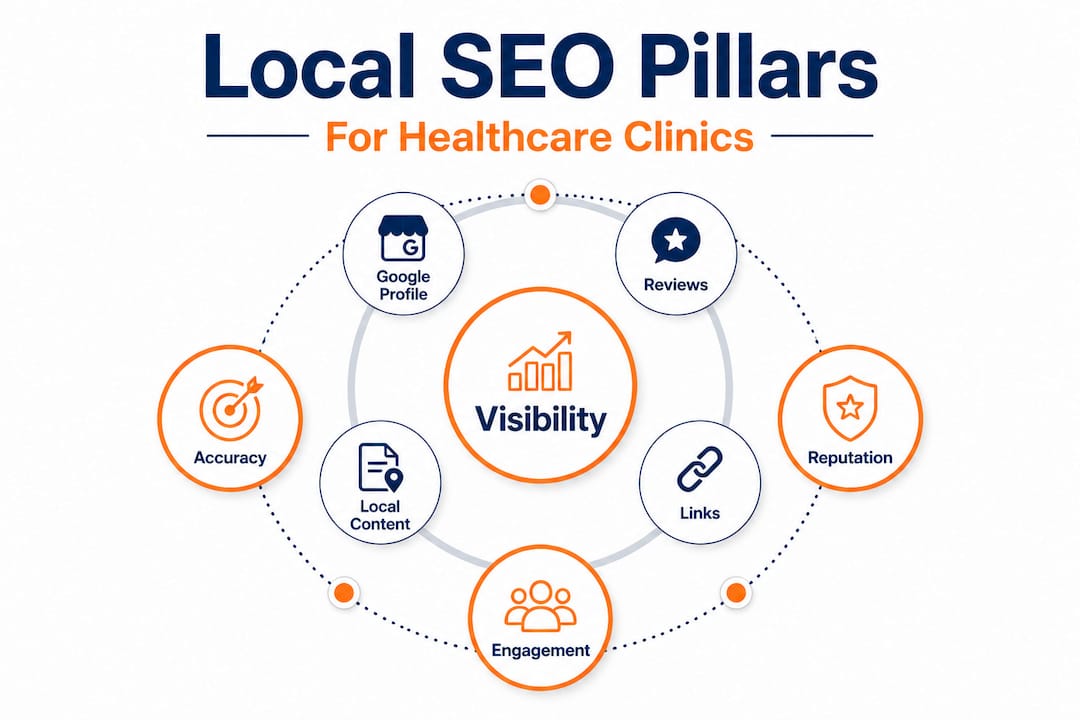
Core local SEO pillars for clinics
| Pillar | Key Action | Impact | Tip |
|---|---|---|---|
| Google Business Profile | Optimize categories, add photos, update hours | Higher map pack visibility | Add your primary specialty as your main category |
| Patient reviews | Request reviews, respond to all | Trust signals, click-through rates | Send a review link by text after positive visits |
| Local citations | List in health directories consistently | NAP consistency, domain authority | Audit listings quarterly for accuracy |
| On-site local content | Create location pages, service FAQs | Organic ranking for local queries | Include the city name and neighborhood naturally |
| Mobile optimization | Fast load times, click-to-call buttons | Reduces bounce, increases calls | Test your site on mobile monthly |
5-step action plan for local SEO basics
- Claim and fully complete your Google Business Profile. Add your correct address, phone number, hours, website URL, and at least 10 high-quality photos. Choose the most specific category available for your specialty.
- Audit your NAP consistency across all listings. Check Google, Yelp, Healthgrades, Zocdoc, and your local chamber of commerce. Fix any discrepancies immediately.
- Build a review request system. After every positive patient visit, send a short text or email with a direct link to your Google review page. Make it easy and frictionless for patients.
- Create location-specific pages on your website. If you serve multiple neighborhoods or nearby towns, give each a dedicated page with unique, relevant content about services offered there.
- Add service-specific FAQs to your website. Answer the questions your patients actually ask. This helps Google understand what you treat and improves your chances of appearing in featured snippets.
Using the step-by-step dental SEO guide as a reference, these foundations apply broadly across healthcare specialties, from mental health therapy to aesthetic medicine to pain management.
Pro Tip: Healthcare has specific regulatory considerations. If you are a mental health therapist or work with sensitive diagnoses, be thoughtful about how you describe services publicly. Your Google Business Profile and website content should reflect accurate scope of practice and align with any professional licensing board guidelines in your state.
Common mistakes and overlooked opportunities in healthcare local SEO
Even with the basics in place, avoid falling into these local SEO traps.
The most frequent local SEO errors we see in healthcare practices are surprisingly easy to fix once you know what to look for. The problem is that most clinic owners simply do not know these gaps exist.
Common errors and how to fix them
| Error | Fix |
|---|---|
| Unclaimed or incomplete Google Business Profile | Claim the profile and complete every field, including services and photos |
| Duplicate listings on Google | Request removal of duplicates through Google Business Profile support |
| Keyword stuffing in profile or website | Write naturally for patients, not algorithms; use terms patients actually search |
| No response to negative reviews | Respond professionally to every review, especially negative ones |
| Missing mobile optimization | Use Google’s free PageSpeed Insights tool to identify and fix loading issues |
| Not asking patients for reviews | Implement a post-visit text or email review request system |
Beyond avoiding mistakes, there are specific overlooked opportunities that many clinics ignore:
- Service-specific FAQ pages: Most healthcare websites list their services but do not explain them in detail. A page answering “What is a nerve block injection?” or “How long does Botox last?” captures patients in the research phase.
- Local backlinks: Getting a mention or link from your local business improvement district, hospital partner, or community health blog strengthens your local authority significantly.
- Google Q&A management: Your Google Business Profile has a public Q&A section. Most clinics leave it empty. Populate it with common patient questions and accurate answers before patients (or strangers) post inaccurate information.
- Consistent posting on your GBP: Google Business Profile allows you to post updates, offers, and news. Clinics that post regularly signal to Google that the profile is active and well-managed.
Generating positive reviews for local search is one of the most impactful actions you can take right now. A proactive review strategy, where you simply ask satisfied patients after their appointment, can transform a two-review profile into a 50-review profile within a few months.
Measuring local SEO success: Metrics that matter for clinics
Ready to take action? First, let’s see how to measure progress so you know what’s working.
Many clinic owners invest in local SEO and then wait passively to see if anything changes. That approach makes it impossible to know which actions are driving results. Evaluating local SEO for healthcare means tracking specific, clinic-relevant metrics consistently.
The four most important metrics to monitor are:
- Map views and profile impressions: How many times your Google Business Profile appeared in search results or on Maps. This tells you whether your visibility is growing.
- Website visits from Google search: Track how many visitors come to your website via organic local search using Google Search Console. Watch for growth in location-based keywords.
- Call clicks and direction requests: Your Google Business Profile Insights shows exactly how many users clicked your phone number or requested directions. These are the most direct signals of patient intent.
- Appointment bookings and new patient inquiries: The ultimate metric. Track whether the number of new patient calls or online booking form submissions increases month over month.
Connecting these data points tells a clear story. If map views increase but call clicks do not, your listing may need stronger photos, a more compelling description, or improved reviews. If call clicks increase but new bookings do not, the issue may be at the front desk or with your booking system.
Most clinics begin to see measurable improvement in map visibility and website traffic within 90 days of consistent local SEO work. Significant growth in new patient bookings typically follows at the 3 to 6 month mark. The key word is consistent. Local SEO is not a one-time setup. It requires ongoing attention to reviews, citations, content, and profile management.
The overlooked advantage: Why small clinics can win at local SEO
Beyond steps and checklists, here’s a perspective most guides skip.
We work with independent clinics that consistently outrank large hospital systems and corporate healthcare chains in local search results. This surprises people. It should not.
Large healthcare networks have advantages in budget, brand recognition, and domain authority. But local SEO rewards a different set of qualities: relevance, responsiveness, and authenticity. These are qualities that small, independent practices can deliver far more effectively than a corporate network ever could.
Consider what Google actually values in local rankings. Proximity matters, but so does how actively a business manages its profile, how recent and authentic its reviews are, and how specifically its content matches what patients search for. A solo orthopedic clinic in a specific neighborhood, with 80 genuine reviews, active Q&A responses, location-specific content, and weekly profile updates, will beat a large orthopedic group with a dormant profile and generic website copy almost every time.
The independent practice also has a relationship advantage. A patient who sees their doctor by name in a review response, or who reads a blog post written in a genuine local voice, connects differently than one reading SEO content produced by a national marketing agency for a chain location.
Using local SEO lessons for independent practices as a framework, the clinics that grow fastest through local SEO are not the ones with the biggest ad budgets. They are the ones that respond to every review, answer patient questions publicly, and create content that actually reflects the community they serve.
The uncomfortable truth is that most large healthcare systems are slow. Their marketing departments require approvals, follow brand standards, and manage dozens of locations at once. You are managing one. That agility is your competitive edge, and local SEO rewards it directly.
Take your clinic’s local SEO to the next level
If you’re ready to put these strategies into action, here’s where you can start.
At AdJet Marketing, we specialize in helping clinics and healthcare practices build local SEO systems that generate real, measurable patient leads. We understand the nuances of healthcare marketing, from HIPAA-compliant content to specialty-specific keyword strategies, and we translate that expertise into results you can see in your booking calendar. Explore our full healthcare SEO guide to go deeper on strategy, or learn more about why marketing is important for healthcare practices trying to grow in competitive local markets. If you are unsure where to start, reviewing the common healthcare marketing mistakes clinics make is an excellent first step to identifying gaps in your current approach.

Frequently asked questions
What are the first steps a clinic should take for local SEO?
Claim your Google Business Profile, verify that your NAP is accurate on every directory, and start building a simple system to collect patient reviews after positive visits, as these three actions form the foundation of local SEO for any healthcare practice.
How long does it take to see results from local SEO?
Most clinics notice improved search visibility within 90 days, with meaningful increases in patient leads and bookings typically appearing between the 3 and 6 month mark when core strategies are consistently applied.
Can local SEO help clinics with multiple locations?
Yes, each location benefits from its own optimized Google Business Profile and a dedicated location page on your website, allowing each clinic location to rank independently in nearby patient searches.
Is it necessary to hire an expert for local SEO?
Many foundational steps can be handled in-house, but working with a healthcare-focused SEO agency typically accelerates results, ensures compliance, and avoids the costly errors that slow down organic growth for most practices.
Recommended
- Leveraging Local SEO For Your Dental Practice: Tips And Tricks – AdJet Digital Marketing & Google Partner Agency | SEO Development Google Ads Social
- Guide To Effective Healthcare SEO
- The Essential Guide To Local SEO For Medspas – AdJet Digital Marketing & Google Partner Agency | SEO Development Google Ads Social
- What Are The Best Local SEO Strategies For Dentists? – AdJet Digital Marketing & Google Partner Agency | SEO Development Google Ads Social