









A good therapist website does three things: it tells a stranger quickly whether you treat what they are dealing with, it shows what the first contact and the cost look like, and it makes reaching out easy and safe. Everything else, from colors to blog topics, supports those three jobs. This guide covers the pages to build, the privacy and accessibility rules that apply in the U.S., how to handle scheduling, and how to tell whether the site is producing inquiries.
TL;DR
- Lead the homepage with who you help and what you treat, in plain words a client would use, not clinical jargon.
- Publish fees, insurance participation, session format and what happens after someone contacts you.
- If you are a HIPAA covered entity, post your Notice of Privacy Practices, and be careful with forms, trackers and testimonials.
- Build for mobile, accessibility and local search from the start, then track calls and form submissions every month.
- Expect a website to be a slow, compounding asset. Budget for ongoing improvement, not a one-time launch.
Table of Contents
- What your website has to do for a prospective client
- The pages a therapy practice website needs
- Design choices that build trust
- Privacy, HIPAA and accessibility
- Choosing a domain, platform and approach
- Scheduling and inquiry handling
- Search visibility: getting found by local clients
- Measuring whether the site works
- Our perspective
- Working with AdJet Marketing
- FAQ
- Sources
What your website has to do for a prospective client
People rarely visit a therapist website in a relaxed mood. Many are tired, anxious or unsure whether they even need help. The decision in front of them is still fairly ordinary. Psychology.com’s therapist website guide frames it as three questions: does this practice offer the kind of help I want, are the terms manageable for me, and what happens if I contact them.
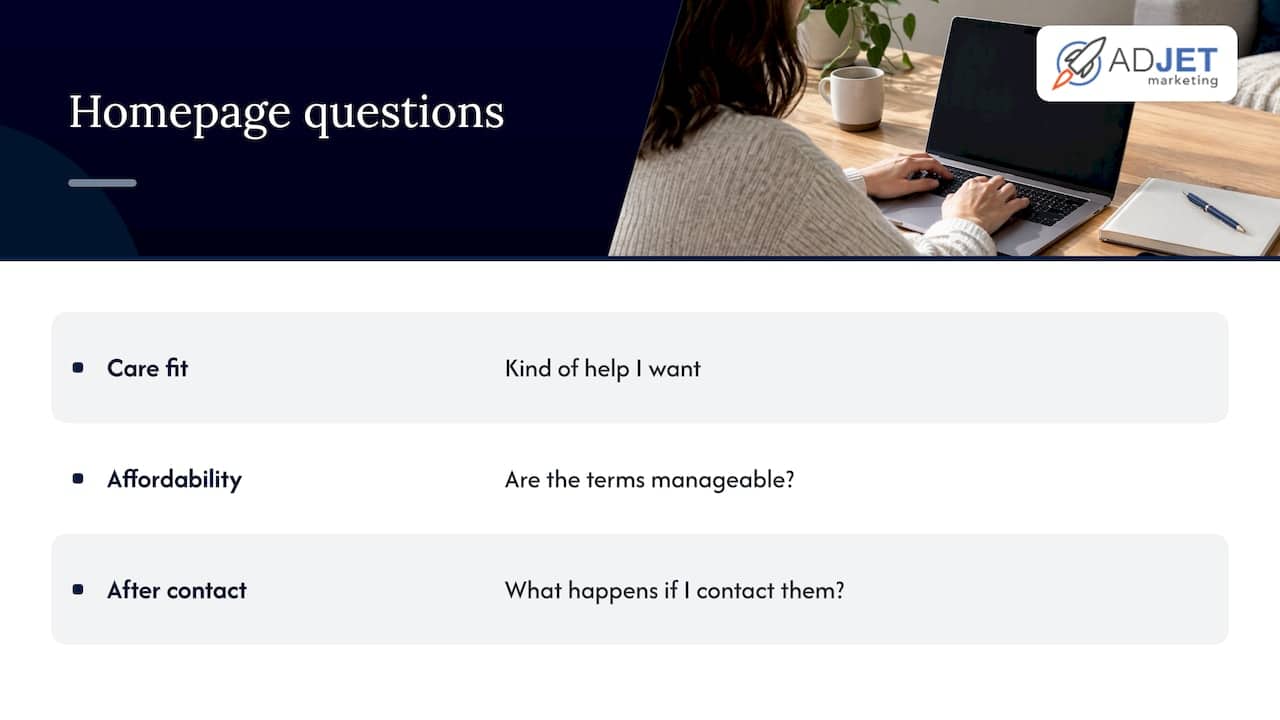
Use those three questions as your design brief. If a visitor can answer them in under a minute on a phone, the site is doing its job.
In our work with clinics, we see a pattern. Many practices come to us because the website describes the clinician (training, philosophy, credentials) but never says who the practice is for. The traffic arrives, and the visitor leaves without a clear next step. Fixing that is usually a copy and layout problem, not a redesign of everything.
Write in the visitor’s language
One therapist-focused blog argues that the first question clients ask is whether you treat what they are going through, and that the answer belongs prominently on the homepage rather than inside an About page. We agree with that placement.
A practical test: read your homepage headline aloud to someone outside the field. If it says you specialize in “relational dysregulation,” replace it with the everyday situation you help with, such as arguments that keep repeating in a marriage or constant worry that disrupts sleep. Seph Fontane Pennock, in the same Psychology.com guide, also suggests swapping broad reassurance for a concrete description of your process. A promise about how someone will feel is hard to evaluate. A description of what the first session involves gives the reader something real to ask about.
The pages a therapy practice website needs
You do not need a large site. You need the right pages, each with one clear job.
| Page | Its job | What to include |
|---|---|---|
| Home | Confirm fit in seconds | Who you help, where you practice, in-person or telehealth, one clear call to action |
| Services or specialties | Match search terms to your work | One page per main concern or modality, such as anxiety, couples counseling or trauma |
| About | Build familiarity | Credentials and license state, approach, a photo, a short human note |
| Fees and insurance | Remove cost uncertainty | Session fee and length, payment timing, which insurers you actually participate with |
| Contact or Get started | Convert interest into an inquiry | Short form, phone number, what happens next, response time |
| Privacy and policies | Meet legal expectations | Notice of Privacy Practices if applicable, telehealth consent information |
| FAQ | Answer hesitations | First session, cancellation, confidentiality, telehealth |
If you serve more than one audience, such as adults and teens, or counseling and psychiatric medication management, separate pages work better than one crowded page. Each can speak to its own reader and rank for its own searches.
Fees and insurance, stated plainly
Transparency about fees and insurance builds trust and reduces hesitation, so make it easy to find. Psychology.com recommends stating the ordinary session fee, session length, payment timing and actual insurance participation. Be precise about insurance: say whether a listed insurer means you are in network, or whether you provide documentation so a client can seek out-of-network reimbursement. Those are very different things to a person budgeting for care.
Telehealth information
If you see clients remotely, say so near the top and explain how a session works. Telehealth.org recommends highlighting telehealth prominently, giving clear instructions for access, and providing a detailed informed consent document that protects both clinician and client. State the states where you are licensed to practice so a visitor does not discover a mismatch after they have filled out a form.
Design choices that build trust
Trust on a therapy site comes from clarity more than decoration. A few choices carry most of the weight:
- Calm, readable layout. Generous white space, one or two typefaces, and body text large enough to read on a phone without zooming.
- A real photo of you. People are choosing a person. A natural, current photo helps them picture the first session.
- One primary action. Pick “Request a consultation” or “Book a call” and repeat it. Competing buttons slow people down.
- Specific language. Name the concerns you treat and the formats you offer. Vague phrases such as “holistic, client-centered care” tell a reader very little.
- Visible contact details. Put your phone number and a contact link in the header so they follow the reader down the page.
- Fast loading. Compress images and avoid heavy sliders or autoplay video, which matter most for readers on mobile data.
Design details also affect how professional the practice feels. Our own website design tips for therapists go deeper on layout and visual consistency.
It also helps to see how larger care organizations structure their pages. Treatment programs that serve young people and families often organize homepage content by who the visitor is and what level of support they need, which you can see in how treatment programs present care. A solo practice can borrow the same logic at a smaller scale: sort the page by the visitor’s situation, not by your résumé.
Testimonials and reviews
Testimonials are tempting, but ethics codes limit them. According to Jackson LLP, the APA Ethics Code does not allow psychologists to solicit testimonials from current therapy clients or others vulnerable to undue influence, and the NASW Code of Ethics says something similar for social workers. Check your own licensing board and professional code before putting any client words on the site. If you are unsure, trust-building content that does not rely on client voices, such as a clear description of your process and an honest FAQ, is the safer route.
Privacy, HIPAA and accessibility
This is the area where a good-looking site can create real risk. The details depend on whether you are a HIPAA covered entity, so confirm your status with a compliance professional or attorney.
Notice of Privacy Practices
HHS states that a covered entity that maintains a website providing information about its services must prominently post its Notice of Privacy Practices on that website, citing 45 C.F.R. § 164.520©. A footer link on every page is the common way to do it.
Forms, trackers and analytics
A contact form can collect health information the moment someone describes why they want therapy. Treat it accordingly. HHS’s Office for Civil Rights has published a bulletin on online tracking technologies describing the obligations of covered entities and business associates under the HIPAA Privacy, Security and Breach Notification Rules when they use such tools. In practice, that means:
- Keep the form short and ask only what you need to respond.
- Use a form or portal that is set up for protected health information if people may write about their condition. Some practice-management systems offer an integrated contact form that routes inquiries into your account instead of email. For example, SimplePractice documents its integrated contact form, which collects fields such as name, date of birth, email, phone and state, plus an optional free-text box.
- Review every pixel, tag and script on pages where a visitor might share health details, and ask your compliance advisor what is appropriate.
- Do not send protected health information through ordinary email or an unsecured form plugin.
Telehealth.org also recommends secure patient portals for scheduling, document sharing and messaging, with encryption treated as part of earning client trust.
Accessibility
Accessibility is part of good design and, for many clinicians, part of professional ethics. Telehealth.org recommends following WCAG standards and notes that some ethical codes view accessibility as a social-justice matter. The basics are not complicated:
- Enough contrast between text and background.
- Alt text on meaningful images.
- Forms with visible labels, not placeholder text alone.
- Full keyboard navigation.
- Headings in a logical order, so screen readers can move through the page.
- Captions or transcripts for any video.
Clients who use screen readers, have low vision, or struggle with fine motor control are also clients who may be looking for help right now. A site that works for them works better for everyone.
Choosing a domain, platform and approach
Your domain is hard to change later, so choose it with care. One platform comparison recommends a simple, easy-to-type name, ideally a .com, with your specialty or location included where it reads naturally. Something like a practice name plus city is usually easier to remember and gives search engines a useful signal.
For the build itself, you have three realistic routes:
| Route | Best for | Trade-off |
|---|---|---|
| Template site you edit yourself | New solo practices with time and a small budget | You handle copy, SEO setup, privacy settings and maintenance |
| Custom WordPress site built by an agency | Practices that want control over structure, speed and growth | Higher upfront cost, depends on choosing a team that understands healthcare compliance |
| Marketing landing page for one service | A single focused offer, such as a new group or telehealth program | Narrow by design, so it complements a main site rather than replacing it |
There is no universal winner. The right choice depends on your caseload goals, how much time you can spend on the site, and how competitive your area is. A solo therapist who is full is in a different position from a group practice trying to fill several clinicians’ calendars.
Scheduling and inquiry handling
A site that attracts visitors and then makes them wait or guess wastes the effort. Decide how your practice handles first contact, then build the page around it:
- Say what happens next. “Send a message and we reply within one business day. We then offer a brief phone consultation.” Specifics reduce the fear of the unknown.
- Offer more than one way in. Some people will call. Others will only write. A tap-to-call number on mobile and a short form cover both.
- Route inquiries into one place. A shared inbox with no process loses leads. A practice-management inquiry list or secure portal keeps follow-up consistent.
- Reply fast. Someone who has finally worked up the courage to reach out will often contact several practices. Speed and warmth matter.
- Set expectations if you have a waitlist. Say so, and say whether you can refer out. It is better than silence.
If your practice relies on online booking, our guide to online booking conversion optimization covers how to reduce drop-off in the booking flow.
Search visibility: getting found by local clients
Most therapy clients search locally. iCanotes’ SEO guide for therapists explains that Google’s local results depend on relevance, proximity and prominence. You can influence relevance through service language and content that matches what clients search for, proximity through an accurate address or service-area setup, and prominence through reviews, citations and mentions from other sites. Keep your name, address and phone number identical everywhere they appear.
For your website, this translates into a handful of steps:
- One page per main specialty, each with a clear title and a unique description of who it helps.
- Your city or region named naturally on the homepage, service pages and contact page.
- A complete Google Business Profile with the right categories. See our walkthrough on the ideal Google Business Profile setup.
- Content that answers real questions, such as what to expect in a first session or how to tell whether couples counseling is the right step.
SEO is not instant. Most practices should plan on months, not weeks, before rankings and inquiries show a clear trend. If you want a structured approach, our 3-tier local SEO blueprint for therapists and our mental health clinic SEO checklist lay out the order of work.
SEO or paid ads?
They solve different problems. SEO builds a lasting presence and tends to cost less per inquiry over time, but it is slow. Google Ads can put you in front of searchers sooner, which helps a new practice or a new service line, but the inquiries stop when the budget stops. Many practices use ads to fill early gaps while SEO matures. Either way, the website’s clarity decides how many visitors become inquiries. If you are weighing ads, our step-by-step Google Ads guide for therapists explains campaign structure, and healthcare advertising has its own privacy considerations to plan for.
Measuring whether the site works
A website that looks good but cannot be measured is guesswork. Set up two free tools, Google Analytics 4 and Google Search Console, and configure them with your privacy obligations in mind. Then track a small number of figures every month.
One growth consultancy suggests recording monthly visits, contact-page visits and total inquiries, then dividing inquiries by total visits to get an inquiry rate. Another source, Humanly’s Q&A for therapists, recommends watching conversion rate, engagement time and cost per lead, with conversion tracking on form submissions and phone-number clicks. Treat any published benchmark as a rough reference point. Your own trend over several months matters more than a number from another practice.
What to count:
- Form submissions.
- Taps on your phone number from mobile.
- Booking requests.
- Which pages those visitors viewed before reaching out.
If you need help setting this up, our conversion tracking guide for therapy websites walks through calls and forms. When tracking shows people reaching the contact page but not submitting, the form or the page copy is the usual culprit. When they never reach it, look at the homepage message and the calls to action.
Our perspective
We build websites for mental health practices, and the same issue comes up again and again: the site was designed to look professional, not to help a stressed person take a first step. Clinics often arrive after a redesign that produced nicer visuals and no more inquiries.
Our approach starts with the visitor’s decision. We map the questions a prospective client has, then structure pages, copy and calls to action around them. We build in WordPress, we plan for HIPAA-conscious handling of forms and tracking, and we report on results that matter to a practice: calls, form submissions and booked consultations.
We also set realistic expectations. A well-built site can lift conversion quickly because it removes friction. Search rankings take longer, and paid campaigns need testing before they settle. We would rather explain that timeline up front than promise a result no honest agency can guarantee. Our design, SEO and ads work are meant to support each other, so a practice does not pay for traffic that lands on a page that cannot convert it.
Felix
Working with AdJet Marketing
If you would rather not build and maintain this yourself, we design and manage websites and landing pages for mental health and other healthcare practices. Our landing page design plans include a Starter Plan at $299 per month and a Premium Plan at $1,500 per month, and a single custom landing page is $2,000 one-off. A custom branded website starts from $249 per month. For a full site, our web design service covers structure, copy direction and build, and our SEO service handles local visibility. You can also read how we approach mental health SEO.
FAQ
What pages should a therapist website have at minimum?
Start with a homepage, a services or specialties page, an About page, a fees and insurance page, and a contact page. Add your privacy notice and telehealth information if they apply. Expand with one page per major concern as your practice grows.
Do I need a HIPAA-compliant website?
If you are a HIPAA covered entity, HIPAA applies to how you handle protected health information, including through your website, and HHS requires covered entities with a website to post their Notice of Privacy Practices. Forms, scheduling tools and tracking scripts deserve particular care. Confirm your status and setup with a compliance professional or healthcare attorney.
Can I put client testimonials on my therapy website?
Check your professional code first. The APA and NASW codes both restrict soliciting testimonials from current clients or others who may be vulnerable to undue influence. Your state licensing board may add its own rules.
How long before a new therapist website brings in clients?
It depends on your market, your referral sources and whether you run ads. Clearer messaging and a better contact path can improve results from existing traffic fairly soon, while search rankings usually take several months of consistent work. Track inquiries monthly to see the trend.
Should I build the site myself or hire an agency?
A template site can work for a new solo practice with limited funds and time. An agency makes more sense when you want custom structure, local SEO, tracking and compliance-aware setup handled together. Weigh the cost against the value of a client in your practice.
Sources
- Therapist Website Guide: Pages, Costs and Launch, Psychology.com
- What Clients Want From a Therapist’s Website, Theracharts
- Websites for Therapists Part II, Telehealth.org
- Soliciting Reviews From Patients, Jackson LLP
- HHS: Notice of Privacy Practices on websites
- HHS: HIPAA guidance materials, online tracking technologies
- Managing the integrated contact form, SimplePractice
- Best Website Builder for Therapists, zynnyme
- SEO for Therapists: A 2026 Guide, iCanotes
- Website Traffic Q&A for Therapists, Humanly
- Therapy Website Metrics: 6 Numbers to Check Each Month
- Mental Health Professionals, Newport Healthcare